Knowing how to choose SEO agency for education support comes down to one question: will the agency’s work reach prospective students, parents or buyers who actually enroll or sign? A strong-looking ranking report can still leave you unsure whether anything moved in admissions.
This guide gives you the criteria to test an agency’s approach, the questions to ask before hiring, the red flags to watch for in proposals and contracts, and a realistic timeline for when progress should show.
How to Choose SEO Agency for Education: Criteria to Assess
A capable education SEO agency should fit your institution’s business model and prove it can handle technical SEO, local search, content, authority building and reporting. Use the examples below to brief an agency, not as evidence of campaign results. For a deeper look at search for universities, see our higher education SEO guide.

| Business model | Searcher and example question | Page to evaluate | Conversion trail to define |
|---|---|---|---|
| Higher education institution | Prospective student: Does this program fit my qualifications and schedule? | Program page with entry requirements, delivery format, costs and deadlines | Inquiry, application started, application submitted, confirmed enrollment |
| K-12 or private school | Parent: Is this school suitable for my child and location? | Campus or admissions page with age range, location and visit information | Parent inquiry, visit booked, application, enrollment |
| Training provider | Learner: What will this course teach, and what credential does it provide? | Course page with prerequisites, syllabus, schedule and credential details | Course inquiry, paid registration, completed purchase after refunds |
| EdTech or learning SaaS vendor | Institutional buyer: Will this platform meet our teaching and operational needs? | Use case, integration or product evaluation page | Demo request, qualified opportunity, signed contract |
| Institutional training supplier | Procurement team: Can this provider deliver our required training scope? | Enterprise training page with delivery capabilities and procurement information | RFP invitation, accepted proposal, contracted engagement |
For each business model, name three things before you talk to agencies:
- Searcher: whether the page needs to answer a learner’s, parent’s or institutional buyer’s question.
- Owner: who in admissions, marketing, academic leadership or sales is responsible for accuracy and follow-through.
- Outcome: the next meaningful action, and the record that will confirm it.
The comparison below shows what an agency should handle in each service area, and what weak delivery looks like.
| Deliverable area | What good looks like | What a weak agency does instead |
|---|---|---|
| Technical SEO | Site speed audit, crawlability fixes, schema markup (Organization, Course, FAQPage), mobile-first fixes | A one-time “SEO audit PDF” with no implementation |
| Content strategy | Program and course pages targeting real search terms, location pages, FAQ content mapped to real parent and student questions | Blog posts on generic topics unrelated to admissions intent |
| Link building and authority | Outreach to education directories, alumni and partner mentions, PR in education media | Buying low-quality backlinks or ignoring authority entirely |
| Reporting | Monthly rankings, organic traffic and, critically, inquiries and admissions attributed to organic search | Vanity metrics only, such as “traffic is up” with no link to inquiries |
Education search does not follow ecommerce patterns, because admissions run on a calendar. Queries such as “best private school near me” or “online MBA with part-time schedule” signal local comparisons and trust checks, and they peak around application and intake deadlines. An agency should plan content around your admissions cycle and know how a parent researching a preschool differs from an adult comparing MBA programs.
Specialists also understand the trust signals and rules a generalist may miss: accreditation disclosures, rankings you are allowed to cite, and the claims schools and colleges can legally make in ads and on-site content.
Local search and multi-campus visibility
Effective local SEO gives each campus a managed Google Business Profile, consistent directory listings and its own location landing page. Weak delivery relies on one generic contact page.
Branch campuses
Every branch campus adds a local layer. Strong local SEO can put each campus in its own city’s results and reduce reliance on paid traffic.
Distance learners
Local SEO matters for online programs too, because many distance learners live nearby. NCES Fast Facts reports that in fall 2021, 74 percent of the 4.4 million undergraduates taking distance education courses exclusively studied at an institution in their state of residence.
Enrollment attribution and CRM integration
Enrollment attribution should track information requests, submitted applications and confirmed enrollment as separate outcomes. A dashboard should not label every action as a conversion of equal value.

Before you report enrollment, agree on the milestone your institution records, which varies between institutions. For paid courses, decide whether purchase numbers net out cancellations and refunds. For EdTech, keep demo requests separate from qualified opportunities and signed contracts.
Write down the measurement details: event definition, source system, owner and reconciliation process. Ask how the agency will connect website activity with approved CRM records. Keep unmatched outcomes visible, and do not credit organic search by assumption. A report based on traffic alone tells you little; inquiries show whether organic performance connects to the admissions funnel.
Student data privacy and regulatory compliance
An agency does not need to be a law firm, but it should explain what data it touches, where tracking pixels fire, who can see lead and applicant information, and how it keeps sensitive data out of ad platforms.
In the US, the Family Educational Rights and Privacy Act (FERPA) protects education records, and its regulations sit in 34 CFR Part 99. Confirm the details with your compliance office, and bring your privacy or legal owner into the project before approving analytics events, CRM connections, audience activation or vendor access involving applicant data.
For every connection, ask what data it receives, why it needs it, who can access it and how long it is kept. Grant only the access each task requires, and keep student records and sensitive exports out of public reports and general-purpose AI tools. For campaigns aimed at children or parents, have counsel check the rules on data collection, consent and advertising.
Questions to Ask Before Hiring an Education SEO Agency
The most useful questions cover education results, local and program SEO, attribution, AI search visibility, link building, compliance, team experience, ownership and contract terms. Start with evidence.
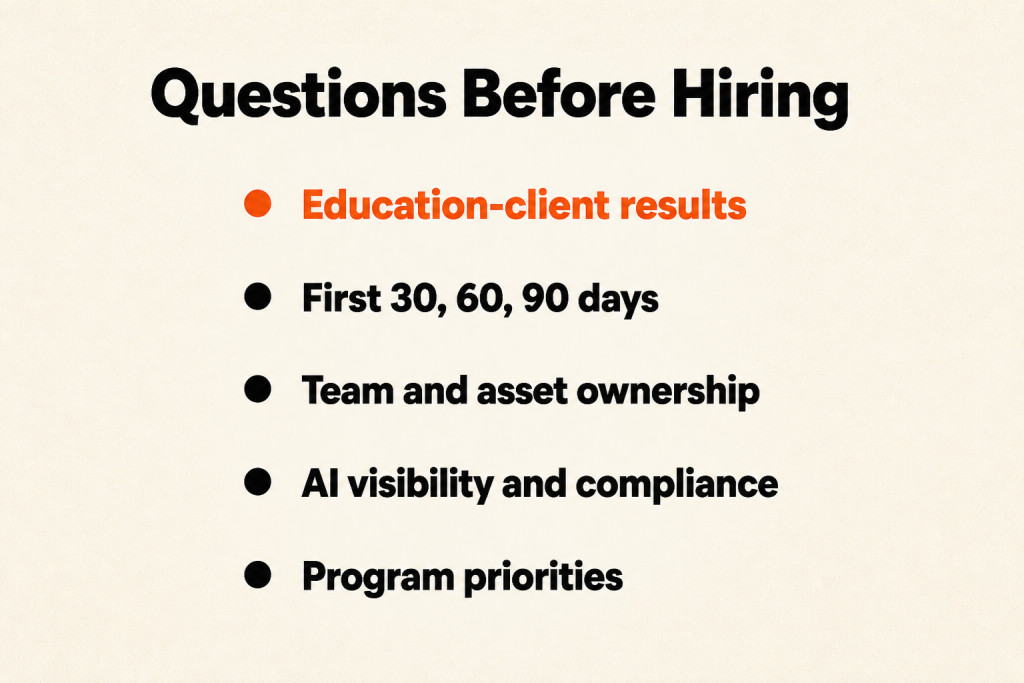
- “Show me an education client’s ranking and inquiry data before and after you started.” Ask for real case studies, not screenshots from unrelated industries.
- “How do you approach local SEO for a single campus versus multiple locations?”
- “What is your process for building program or course pages that rank?”
- “How do you connect rankings and traffic to inquiries, then to submitted applications and confirmed enrollment?”
- “Do you handle Generative Engine Optimization (GEO) and visibility in ChatGPT, Gemini and Perplexity, or only classic Google SEO?”
- “Can you show links you have earned for education clients?”
- “How do you handle our accreditation and regulatory requirements in content?”
- “Who will actually do this work, and what is their education experience?”
- What does the plan cover in the first 30, 60 and 90 days?
- Do we own our ad accounts, analytics and content?
- How do you handle student privacy and data?
- Which of our programs would you prioritize, and why?
- How do you work with our admissions team and CRM?
- What will you need from us each week?
- What will you not do for us?
- What are the contract terms and notice period?
- Can we speak with a current client?
For a broader checklist that applies to any vendor, see our list of questions to ask SEO companies.
Agency proposal red flags
The main red flags are guaranteed rankings or AI mentions, vague explanations, and unclear ownership of implementation, subcontracting or claimed education work.

- Guaranteed rankings or AI mentions: no agency controls Google or AI assistants.
- Vague explanations: an agency should explain in plain language what it is doing and why it matters. Your marketing should never feel like a black box.
- Unclear responsibility: challenge proposals that leave implementation without an owner, hide subcontracting, or show education logos without explaining the work performed.
Pricing models and contract structures
Education SEO contracts usually take one of three forms: a project for defined work, a monthly retainer for ongoing delivery, or business process outsourcing (BPO) for a wider handover of operations and results. Each brings a different scope and level of commitment.
- Project: suits work with a clear finish, such as CRM setup, a site rebuild or a content plan. It will not support ongoing recruitment.
- Monthly retainer: pays for ongoing work within an agreed scope. It works well when an internal owner sets priorities and holds the agency to its deliverables, but fees continue even when recruitment slows or site changes freeze.
- BPO: hands over the whole operation, including the service team and enrollment targets. It can suit institutions without an in-house marketing team, but it needs trust and clear rules on data and system access.
If you are weighing an outside partner, our page on SEO services outsourcing explains how that model works. For typical price ranges across agencies, see our SEO agency pricing guide. A quote far below market rates may leave out ongoing monitoring or direct strategist time, so check exactly what the scope includes.
To compare proposals fairly, ask every agency to price the same scope: discovery and strategy, content production, technical setup, measurement, ongoing maintenance, and any PR or AI search work. Check each quote for developer time, academic review, content revisions, analytics setup and post-release checks, and flag software fees, subcontractor costs and work your own team must supply.
Then link fees to enrollment with three simple calculations:
- Total cost: agency fees plus software, internal staff time and any paid media.
- Cost per enrollment: total cost divided by confirmed enrollments attributed to organic search.
- Break-even: total cost divided by the net value of one enrollment, which tells you how many enrollments the program needs to pay for itself.
Before signing, check these contract terms:
- Who owns the website content, analytics accounts and ad accounts
- Notice period and any minimum term
- What happens to work in progress and data access if you end the contract
- Which deliverables are included each month, and how changes in scope are priced
Look for month-to-month terms or a short notice period, so you are not locked in before the agency proves itself.
Expected performance timelines
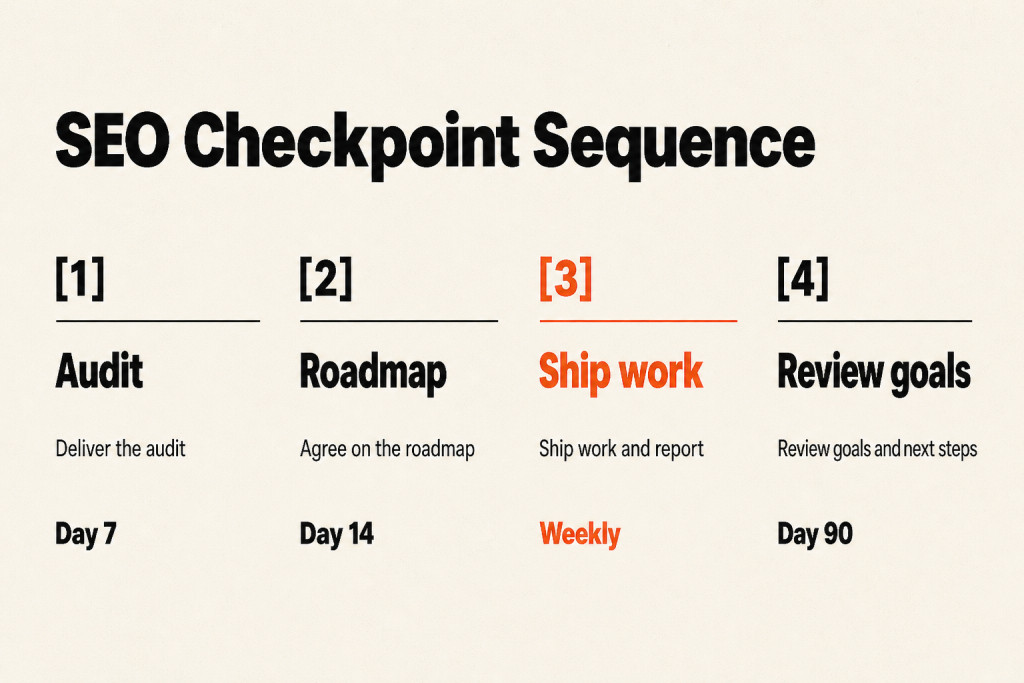
A sound agency sequence delivers an audit by Day 7, an agreed roadmap by Day 14, weekly shipped work and reporting, and a goals review at Day 90. These are checkpoints, not a substitute for your own admissions deadlines. Ranking movement usually takes several months, and inquiry growth follows after that.
| When | What should happen |
|---|---|
| Day 7 | Audit delivered |
| Day 14 | Roadmap agreed |
| Weekly | Work shipped and reported |
| Day 90 | Review against goals and plan for the next 90 days |
Before work begins, confirm when program details become official, who approves changes and which development releases must happen first. With fixed application deadlines, agency milestones should land before admission windows open; with rolling enrollment, keep optimization ongoing.
Separate work that can start now from tasks waiting on academic, commercial or technical decisions, then prioritize pages for the next intake. Keep recurring updates on dates, tuition, prerequisites, staff contacts and discontinued programs in scope, and assign an owner to each one.
Frequently Asked Questions
What does an education SEO agency actually do?
An education SEO agency improves technical SEO and local SEO, from site speed, crawlability and schema markup to Google Business Profiles, location pages and consistent NAP details. It shapes content around what parents and students search for, builds authority through education-relevant sources, and judges performance by admissions inquiries rather than traffic alone.
How long does SEO take to show results for an education brand?
Meaningful ranking movement usually takes several months, and inquiry growth follows once those pages hold their positions. Treat promises of results within a few weeks with caution.
Should an institution hire an education specialist or a generalist agency?
Both can work. Put more weight on the agency’s plan, reporting and data handling than on whether it calls itself a specialist.
Should institutions evaluate AI search visibility alongside standard SEO?
Yes. Ask how the agency checks what AI assistants such as ChatGPT say about your institution, and how it gets outdated information on tuition, deadlines and program names corrected.
Conclusion
When you work out how to choose SEO agency for education, the deciding factor is whether the agency links search demand to verified enrollment. Rankings and traffic show movement, but organic performance tied to admissions inquiries shows real progress. Ask how the agency approaches technical, local and content SEO, how it handles student data and how it corrects outdated facts in AI answers, then weigh its answers against a realistic timeline and fair contract terms. If you want a partner that reports on inquiries rather than vanity metrics, talk to our SEO team.