How to measure ROI in B2B digital marketing campaigns comes down to one question: when a deal moves through SEO, paid search, content, email and social, which spend actually helped create the revenue? Click costs and lead counts alone cannot answer it.
This guide shows how to tie campaign spend to revenue, follow leads through the CRM and the sales pipeline, compare attribution models, and judge each channel by what it returns beyond ad spend.
B2B Marketing ROI Formula
B2B Marketing ROI = (Marketing-Generated Revenue – Total Marketing Investment) / Total Marketing Investment x 100

Take a $150,000 investment in agency fees, media spend and technology over 12 months. If marketing brings in $600,000 in new revenue, the calculation is:
($600,000 – $150,000) / $150,000 x 100 = 300% ROI
Each invested dollar brought in $4 in revenue, of which $3 is net return.
For ROI across your full marketing footprint, count direct campaign costs, team compensation, technology, content production, agency partnerships and operational overhead. Add time-based costs too, such as the ramp-up period for new campaigns and the upkeep of existing ones. All of it belongs in Total Marketing Investment.
Split fixed and variable costs by channel and program so you can see both what you spend and how that spend scales. Larger organizations can also assign costs to product lines, market segments or business units and calculate marketing investment for each revenue stream.
Return on ad spend (ROAS) and true marketing ROI measure different things. ROAS leaves out agency retainers, platform fees and internal payroll, so treating the two as equal can create false confidence.
How to Measure ROI in B2B Digital Marketing Campaigns
Measure B2B campaign ROI by comparing marketing-attributed revenue with the full marketing investment over a 12-month period, after linking costs and tracking to pipeline and revenue.
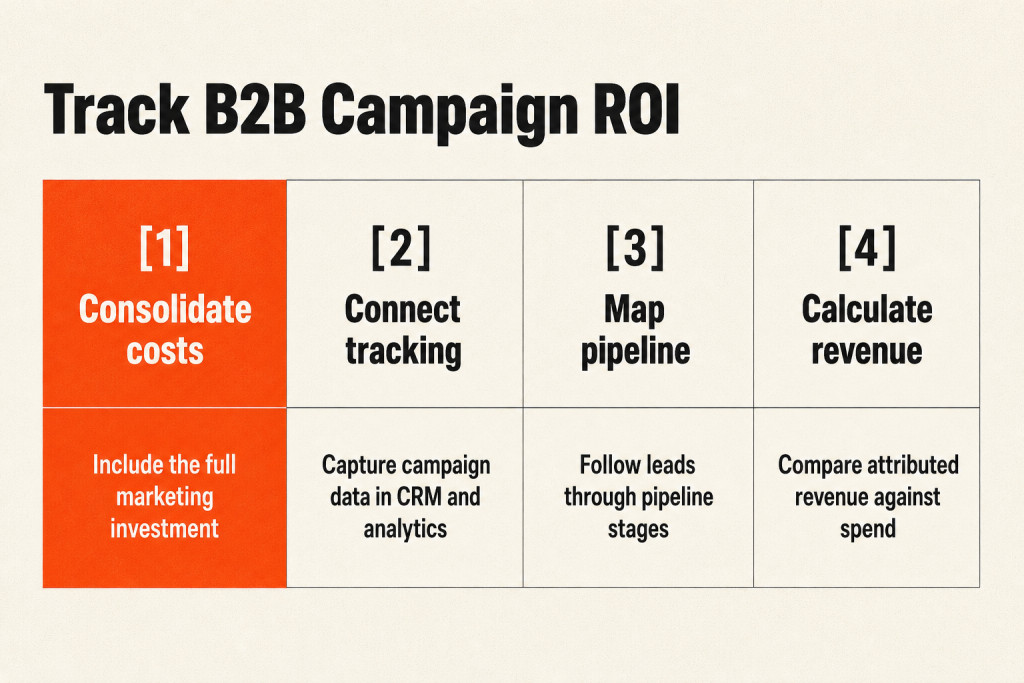
B2B buying decisions often take six months or longer. Buyers pass through many touchpoints while their needs and evaluation criteria shift, so early activity is hard to tie to revenue within a single quarter. A 12-month horizon gives a fairer picture than a quarterly one. The steps below connect costs and tracking with pipeline and revenue.
Step 1: Consolidate Total Marketing Costs
Total the full marketing investment for the period across these cost categories, including retainers and execution costs for any agency running your digital ads or SEO:
- Agency fees
- Media spend or ad budgets
- Technology costs, including CRM, analytics and marketing automation
- Internal team costs allocated to marketing
Step 2: Connect CRM and Analytics Tracking
Set up tracking so campaign information is captured whenever a lead enters your systems or moves through them.
UTM parameters on every campaign link.
Add source, medium and campaign UTM parameters to every paid ad, email link, social post and content promotion. That is the minimum you need for channel-level attribution.
Hidden form fields.
Website forms can record the original traffic source, landing page and campaign identifiers, then pass those values to your CRM automatically. Each lead stays connected to its marketing channel.
CRM pipeline tracking.
Track each lead in your CRM from first interaction until it qualifies, becomes an opportunity and closes. HubSpot, Salesforce, Pipedrive or a similar tool can tie each closed deal to its original marketing source.
Your analytics and reporting setup also needs to capture channel data consistently and keep it clean. A customer data platform or data warehouse can bring all sources together. Make sure you have:
- A consistent visitor or user ID across all platforms
- Cross-device identity resolution
- Integration between marketing automation and CRM
- Event tracking for all meaningful interactions
When your CRM syncs with marketing automation, you can follow leads from first contact to closed deal and connect marketing-sourced leads with pipeline opportunities. For paid search, our guide on how to set up conversion tracking in Google Ads covers the platform side.
Offline activity needs its own tracking. You can:
- Use dynamic phone numbers for campaign-specific call tracking.
- Create unique meeting links and registration paths for events and demos.
- Build custom CRM fields to capture offline influence on deals.
- Track visits from trade shows and field marketing activities.
Sending offline conversion data back to Google Ads and LinkedIn helps both platforms optimize toward real revenue. As third-party cookies disappear, attribution depends more on first-party data and privacy-safe measurement.
Step 3: Map Revenue to Pipeline Milestones
Connect lead volume with revenue by tracking conversion rates and contract value at each pipeline stage.
Current monthly lead volume.
Count monthly inbound inquiries, form fills, quote requests and demo requests. Keep marketing-generated leads separate from referrals, outbound and existing relationships.
Lead-to-opportunity conversion rate.
Check what share of incoming leads turns into a real sales opportunity. For example, 50 leads a month that produce 5 real conversations give a 10% conversion rate.
Opportunity-to-close rate.
Work out what share of real opportunities close. For example, 5 opportunities a month that bring 1 new client give a 20% close rate.
Average contract value.
Use a new client’s average first-year revenue to turn funnel math into revenue math.
For a clearer view, track conversion efficiency at each stage:
- Lead to marketing qualified lead
- Marketing qualified lead to sales accepted lead
- Sales accepted lead to opportunity
- Opportunity to closed revenue
Alongside these stages, watch leading indicators such as sales-ready opportunities, engagement from several people in the same account and product usage signals. Lagging indicators, including attributed revenue, customer lifetime value and net revenue retention, show results already achieved. Together they move attention away from raw lead volume and toward quality signals that forecast revenue.
Step 4: Calculate Attributed Revenue Against Spend
Take the period’s closed deals and count those where marketing started the relationship, whether through organic search, paid ads, content, email or social. Add up their first-year contract value to get marketing-generated annual revenue, then compare it with total marketing investment using the formula above.
A prospect may find you through SEO and later receive sales nurture, so mixed journeys need an attribution model. First-touch attribution credits the channel that began the relationship, while multi-touch attribution shares credit across every touchpoint.
Count direct revenue from immediate conversions, plus influenced revenue where marketing sped up an existing opportunity. Channels behave differently:
- SEO: returns build slowly, often over 6 to 12 months, then compound. Once rankings are established, organic leads arrive at a low marginal cost, so the ROI curve starts flat and rises over time. If you outsource it, our outsourcing SEO services page explains how we report on it.
- PPC and paid search: results usually come fastest, but media costs continue as long as campaigns run. Cost per qualified lead tells you more than cost per click: a $50 click that creates a $200,000 opportunity has a very different ROI from a $5 click that creates nothing.
- Content marketing: content multiplies other channels. Ranking pages need content, case studies and guides shorten sales cycles, and paid landing pages need substance. Measuring content ROI on its own understates it, because its value spreads across the whole system.
Multi-Touch Attribution Models
Multi-touch attribution models assign credit across several interactions along the buyer journey. B2B buyers touch many channels over long sales cycles, so the model you choose shapes which campaigns look profitable.

Single-Touch Models
Last-touch attribution
Last-touch attribution credits the final interaction before conversion, often a direct visit or a branded search. It ignores the awareness campaigns, educational content and nurture sequences that built interest and trust.
Teams that rely on last-touch may cut awareness channels that rarely convert directly, without seeing that those channels create the demand that conversion channels capture.
First-touch attribution
First-touch attribution credits the first discovery point, often paid search or display advertising, and ignores the later interactions that convinced the prospect to buy.
It can lead to overinvesting in top-of-funnel channels that create awareness but do not nurture prospects, while cost per lead rises and lead quality stays poor.
Position-Based Models
Linear models give equal credit to every touchpoint, on the view that each interaction moves a deal forward. They work well in shorter sales cycles, where touchpoint impact stays fairly even.
Time-decay models give more credit to touchpoints closer to conversion, because recent interactions likely had fresher influence.
Best for: organizations with shorter sales cycles, where recency matters more than first awareness.
U-shaped attribution
U-shaped attribution gives 40% of the credit to the first touch and 40% to the last touch, and spreads the remaining 20% across the middle touchpoints. Discovery and conversion get the largest share.
Best for: lead generation businesses where awareness and conversion are the key turning points.
W-shaped attribution
W-shaped attribution assigns 30% each to first touch, opportunity creation and closed-won, and spreads the remaining 10% across other touchpoints.
Best for: B2B companies with defined opportunity stages and sales handoffs.
Position-based models give marketing and sales teams an intuitive, consistent standard, although the credit split still rests on human assumptions about which milestones mattered most.
Algorithmic Attribution
Algorithmic, or data-driven, attribution uses machine learning to examine many conversion paths and credit each touchpoint by its statistical impact. It suits organizations with high conversion volume and the technical resources to build and maintain the models. In low-volume B2B environments it struggles, because the model needs a steady stream of conversions to separate real patterns from noise.
Essential Pipeline Metrics That Drive B2B ROI
Customer lifetime value (CLTV) and customer acquisition cost (CAC) show whether your marketing program is sustainable.

CLTV calculation methodology
Estimate total customer revenue from:
- Historical purchase patterns and contract values
- Retention and renewal rates
- Account expansion revenue
- Service usage and product adoption
CAC methodology
Include every acquisition cost in CAC:
- Marketing campaign investment
- Sales resources
- Technology and infrastructure
- Content and creative development
- Channel partner compensation
CLTV:CAC ratio
Many B2B businesses aim for a CLTV:CAC ratio of at least 3:1 as a sign that acquisition spend pays back.
Sales cycle length and deal volume decide which measures give the clearest signal. When a cycle spans several quarters and deals are few, pipeline velocity and stage-to-stage conversion are the most useful early signs. When contracts close quickly and in volume, acquisition cost and payback period are more direct.
B2B Return on Investment Benchmarks
Published ROI benchmarks vary widely by industry, deal size and how each study defines revenue and cost, so treat outside figures as context rather than targets. The most reliable benchmark is your own history:
- Calculate ROI for the last 12 months with the formula above and use it as your baseline.
- Compare channels on cost per qualified opportunity and revenue per channel, not on clicks or leads.
- Recalculate each quarter on a rolling 12-month window so long sales cycles do not distort the result.
- Set targets from your CLTV:CAC ratio and payback period, which reflect your own margins.
Frequently Asked Questions
What does an acceptable ROI look like for digital marketing?
It depends on your industry, business size and campaign goals, so no single benchmark fits everyone. Start from your own 12-month baseline and your CLTV:CAC ratio.
How often should I review and calculate ROI for my marketing initiatives?
Review campaign performance weekly and adjust to what the data shows, but judge ROI over 6 to 12 months to allow for long B2B sales cycles.
What are the most common KPIs to track along with ROI?
Return on ad spend (ROAS), conversion rate, cost per acquisition (CPA), cost per qualified opportunity and CLTV:CAC are the most common.
Can ROI measurement differ across marketing channels?
Yes. Channels often feed each other: paid social may raise awareness that later turns into branded-search conversions, so judging each channel alone can understate its share. Our guide on how to use Google Ads and Facebook Ads together shows how to connect the two.
Conclusion
Knowing how to measure ROI in B2B digital marketing campaigns means connecting revenue with marketing’s full cost and tracing each channel’s contribution through the buying journey. Count every cost, track leads from first touch to closed deal, pick an attribution model that fits your sales cycle, and judge results over 12 months rather than one quarter. Review performance weekly, but let pipeline and revenue, not clicks, decide where the budget goes. If you want help building that measurement into your campaigns, our digital ads team can set it up with you, and that is how to measure ROI in B2B digital marketing campaigns with confidence.