If you’re trying to understand SEO agency pricing by looking at a price list, you’re already starting on the wrong foot. That approach frames SEO as a cost to be minimized, not an investment you make to actually gain ground. A budget picked from a menu is just a number, totally disconnected from your business goals and the market you’re fighting in.
So, in the sections ahead, we’ll first break down what really drives those costs. Then you’ll learn how to evaluate different pricing models and build a smart investment plan, one that’s tied directly to your specific competitive battlefield.
Typical SEO Agency Pricing Ranges in 2026
For a small local business in a market that isn’t wildly competitive, a budget around $1,500/mo is a pretty common starting point. This is the tier for getting your footing and aiming for steady, local growth, not for trying to take over the world.
But what if you’re a B2B company or a national e-commerce store? To compete effectively on a bigger stage, you need to plan on investing in the mid-range, which is typically $3,000 to $7,500/mo. This is the price of admission to get in the ring with other serious players.
If you’re trying to become a market leader in incredibly competitive industries like finance, legal services, or SaaS, you’re looking at a whole different level of investment. You’ll need a high-end commitment of $10,000+/mo (and often, much more) just to have a fighting chance.
Business Type |
Typical SEO Budget |
Best For |
Small local business |
~$1,500/month |
Building local visibility and achieving steady growth in low-competition markets |
B2B company or national e-commerce business |
$3,000–$7,500/month |
Competing nationally, scaling organic traffic, and targeting more competitive keywords |
Enterprise or businesses in highly competitive industries (finance, legal, SaaS) |
$10,000+/month |
Dominating competitive markets, defending market share, and driving long-term organic growth |
What Drives Your Final SEO Cost?
The final cost is something that is decided based on the choices a business makes. A budget is the direct result of a few core factors: how tough the market is, what the goals are, and what assets are already in place. The more that is asked for, and the harder the fight, the more resources will be needed.
How Competitive Your Market Is
The single biggest thing that will move your price tag is how competitive your market is. It’s a simple rule: the more crowded the field, the more you’ll pay. If you’re trying to rank for valuable keywords in cutthroat industries (think legal services, home improvement, or medical care), you’re not just buying a service. You’re funding a campaign to unseat powerful incumbents who have been building their authority for years.
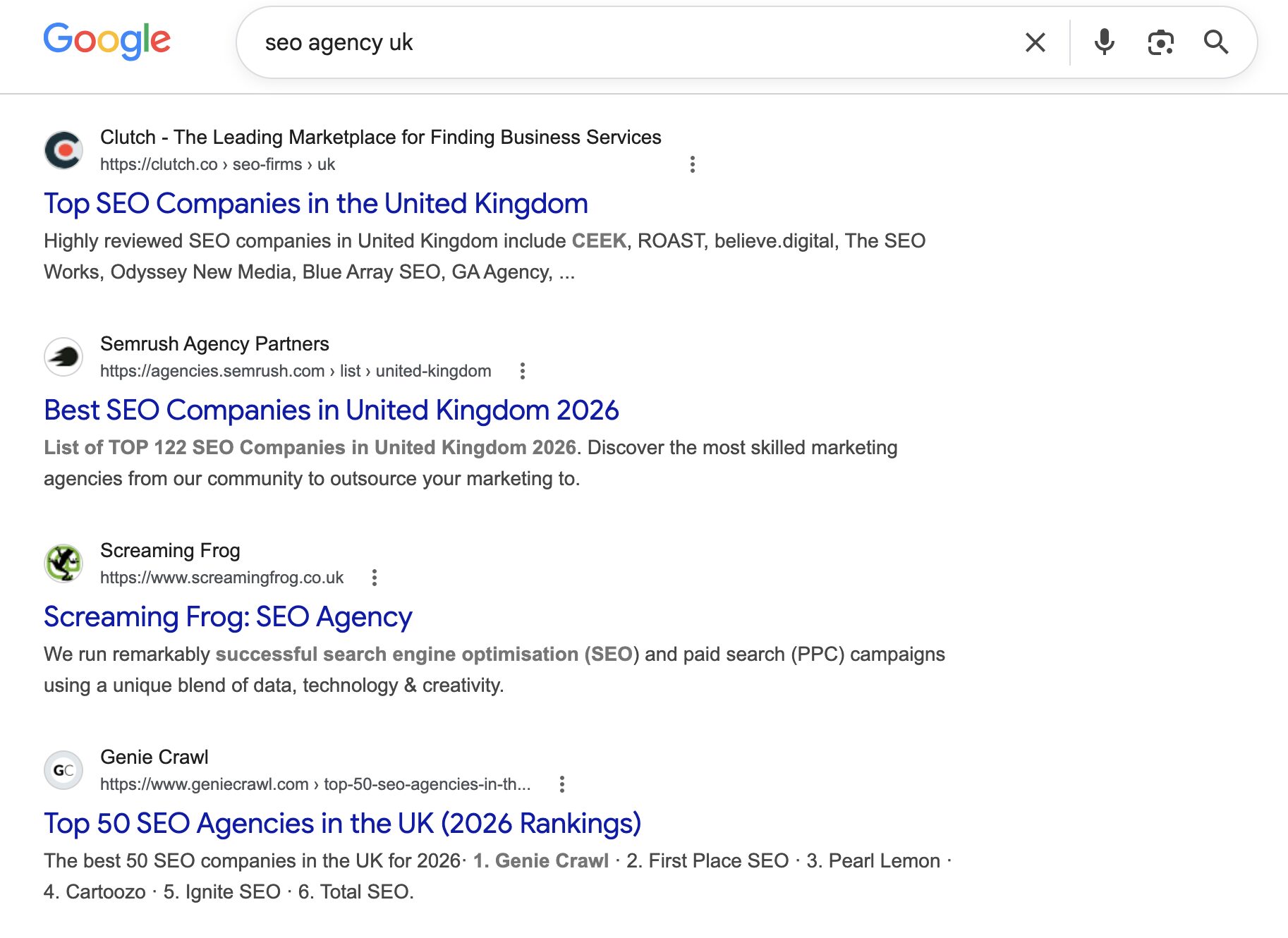
Trying to get on page one for a term like “enterprise CRM software” or “personal injury lawyer [city]” means you’re going up against massive content libraries and domains with deep authority.
You can get a feel for this yourself in about ten minutes. Before you even talk to an agency, go to Google and search for one of your main keywords. Look at the first page. Are the top spots held by huge national brands like Forbes, HubSpot, or Amazon?
Are the articles themselves incredibly in-depth guides, often running over 3,000 words? Do you see a wall of paid ads at the very top? If you’re nodding yes to these questions, you’re in for a fight.
Your Goals and How Fast You Need Results
It often takes a good 6 to 12 months to see solid, meaningful results, and for many businesses, that pace is perfectly fine. But what if you need to see a return sooner? You can, but you have to be ready for the budget to go up.
If you want to step on the gas, an SEO agency has to burn more fuel. That means running more aggressive link-building campaigns, publishing content at a faster clip, and often using paid search to grab traffic while the organic work takes root. Agencies can speed up results by using assertive link-building, quicker content deployment, and supplementary paid search.
The Specific Services You Need
A full-service SEO campaign is really a bundle of different jobs, and your cost is just the sum of the parts you pick. Your final quote will change dramatically depending on whether you need a comprehensive strategy with technical work, ongoing content, and link building, or if you just need help with one specific thing. A one-time technical audit, for instance, is a much smaller and more contained investment than a multi-year, all-in campaign.
Your Website’s Current Technical Shape
Imagine an agency has to spend the first few months just cleaning up a mess before they can even start building. If your website has a weak technical foundation, that “technical debt” will inflate your initial costs. The effect is particularly pronounced for big, complicated sites.
For instance, an extensive eCommerce website featuring 10,000 SKUs, faceted search, and pervasive duplicate content issues will demand a massive number of technical hours just to establish a healthy starting point.
That initial cleanup work, fixing slow pages, hunting down broken links, or dealing with a bad backlink profile, uses up resources that could have been spent on growing your traffic. A site migration or a major architectural rebuild is a big upfront project, and it will be priced that way.
How Much New Content You’ll Need
What is the engine of any SEO campaign? Content, and it’s one of the biggest recurring costs. You need it to rank, and the amount of content you need is directly tied to how much authority you have to build to compete. Your budget for creating articles, guides, and other resources will be a major part of your monthly retainer.

The Agency’s Own Profile and Expertise
Why pay a premium for a team with a long track record? Because you’re paying for pattern recognition. A top-tier agency brings a history of success and refined strategies that come from seeing the same problems over and over again.
While a newer or smaller firm might be cheaper, you’re taking a bigger risk on their ability to deliver. The data backs this up. According to Ahrefs, SEO professionals with 3-4 years of experience charge over twice what their peers with less than two years of experience do.
The agency’s focus matters, too. A survey from Ahrefs that looked at 439 service providers found a massive gap between firms serving different markets. Firms that work with clients all over the world typically bill for a monthly retainer of $3,473.74.
Those with a global client base have an average monthly retainer of $3,473.74, while agencies focused on local clients have a much lower average of $1,557.08. That’s a 123.1% difference, and it reflects the scale of expertise and operational costs you’re paying for.
Common SEO Agency Pricing Models and Packages
How an agency charges is a signal about how they work and what kind of partnership you’re signing up for. There are five common models out there, and they aren’t interchangeable. Your job is to match the model to how your own company operates and how much risk you’re willing to stomach.
Monthly Retainer for Ongoing Partnership
Real SEO is a long game, not a one-shot fix. This model turns an agency into a true partner that’s focused on steady improvement, which is what you need when Google is constantly changing the rules.
Your payment isn’t merely for using the agency’s tools and software. You’re not just buying a report; you’re securing a dedicated expert who builds a plan, tracking your progress and modifying your regimen monthly.
The data backs this up. A 2026 survey from Ahrefs found that 78.2% of SEO providers charge a monthly fee, and other data shows 60% of clients prefer it. Just be prepared to stick with it. You should anticipate a commitment of no less than 6 months before you start seeing any real momentum.
Project-Based for a Fixed Scope and Price
Imagine you have a very specific, one-time job, like a technical audit or a complex website migration. You agree on a fixed set of deliverables for a fixed price. For these kinds of projects, costs typically run anywhere from $2,500 to $30,000.
The catch is that a single project rarely holds its value over time. SEO needs constant attention to keep working. The majority of project-based work is most effective when succeeded by a more modest monthly retainer to protect the investment you just made.
Hourly SEO Consulting for On-Demand Expertise
Hourly consulting is like having an expert on speed dial. It is perfect if you already have an in-house team but need a specialist to help solve a specific problem or offer strategic guidance. It’s a surgical approach, with rates usually falling between $100 and $300 per hour.

It all comes down to the situation. A project is for a one-time fix, and a retainer is for long-term growth. A package is for a predictable set of needs like local SEO.
Service Packages with Pre-Defined Deliverables
Some agencies bundle a set list of services for a recurring fee, but don’t mistake them for a one-size-fits-all solution. SEOtonic’s basic package, for instance, provides 4 content pieces and one press release monthly, alongside other foundational work. These starter packages are for basic maintenance and usually cost between $250 and $3,000 a month.
Those are a world away from enterprise packages, which are built for aggressive market capture and can run from $5,000 to $25,000+ monthly. Before you pick one, be honest about your goals. A starter package is fine for keeping the lights on technically, but you’ll need an enterprise-level plan if you’re serious about a content and digital PR push.
Performance-Based Agreements for Shared Risk
Tying payment to results sounds great on paper. It feels like the agency has skin in the game. But these deals can create a huge conflict of interest, pushing agencies to chase metrics that are easy to hit but don’t actually help your business (a classic case of looking busy versus being productive).
The goal isn’t just to rank for something. The real risk here is that you end up celebrating vanity metrics, like ranking for low-value keywords, instead of focusing on what actually grows the company: generating high-quality leads and sales.
Pricing Model |
Typical Cost |
Best For |
Key Consideration |
Monthly Retainer |
Varies (ongoing monthly fee) |
Long-term SEO growth and continuous optimization |
Most common model; typically requires a 6+ month commitment |
Project-Based |
$2,500–$30,000 |
One-time projects like SEO audits, website migrations, or technical fixes |
Delivers a fixed scope but often needs ongoing SEO afterward |
Hourly Consulting |
$100–$300/hour |
Businesses with an in-house team needing expert guidance |
Flexible and cost-effective for strategic advice or troubleshooting |
Service Packages |
$250–$3,000/month (starter)$5,000–$25,000+/month (enterprise) |
Companies wanting predefined SEO deliverables |
Starter packages cover maintenance; enterprise plans support aggressive growth |
Performance-Based |
Performance-dependent |
Businesses seeking shared-risk agreements |
Can encourage vanity metrics instead of revenue-focused SEO results |
Detailed SEO Costs by Business Type and Goal
The numbers that follow show a clear pattern where your budget is tied directly to how big you want to play. We’ll break it down by a few common scenarios so you can find the one that fits your business.
Pricing for Small vs. Enterprise Businesses
Your SEO budget will scale right alongside your company’s size. It’s not complicated: bigger companies have more complex websites and face tougher competition, so they have more at stake and need to invest more. Before you even look at prices, know your headcount and your main market. That’ll help you figure out which of these tiers you fall into.

For a small business with under 50 employees, a realistic monthly budget is anywhere from $500 to a few thousand dollars. If you’re a mid-market company with 50 to 500 employees, you’re looking at a range of $3,000 to $15,000 a month. And for enterprise-level organizations with over 500 employees, the investment starts at $7,500 and can easily go past $100,000 per month.
Costs Based on Campaign Intensity
The price also depends heavily on what you’re trying to accomplish. An entry-level plan, which usually runs between $500 and $1,000 a month, is really just about getting on the board. It’s for small, local businesses that need the basics covered, including a site review, some initial keyword research, and minor on-page adjustments like meta tags, basic site architecture, and speed evaluations.
If you want to see real, tangible movement, you’ll need to step up to a Growth SEO plan. This is where you start seeing consistent content creation and serious link-building, with reporting that actually focuses on conversions, typically for $1,500 to $3,000 monthly. For truly aggressive growth (think becoming a recognized leader in your space), you’ll need an Authority SEO budget of $5,000 or more per month. If you’re in a cutthroat industry or trying to compete nationally, a realistic budget for that kind of ambition is more like $5,000 to $10,000+ every month.
Local, National, and International SEO Costs
Your geographic target has a huge impact on cost. The bigger the map, the bigger the budget, because you’re going up against a lot more competition. A Local SEO plan is the most affordable, usually costing between $500 and $2,500 per month, since you’re only fighting for visibility in one city or region; local SEO is frequently cheaper because the competition within a local area is generally less intense.
When you expand to a national audience with a Traditional SEO strategy, the price climbs to an average of $1,500 to $5,000 per month. And if you’re going global, an International SEO strategy can run anywhere from $3,000 to $20,000 a month to handle multiple languages and markets.
Costs by Geographic Location
It also matters where your SEO agency is physically located. Their cost of living and local salaries get baked right into your bill, so you’ll see a big difference in hourly rates depending on the country.

Firms in the United States of America, Canada, and Australia tend to have the highest costs, with average hourly rates of $100 – $149. You’ll find lower rates in places like Poland, which comes in around $50 – $99 an hour. The price drops again in countries like Ukraine, Spain, and Mexico, where the typical range is $25, $49 per hour. At the lowest end, you can find hourly costs under $25 in India, the United Kingdom, and the Philippines.
Average Hourly Rates for Specific Tasks
Within any given project, not all work is priced the same. When you get a proposal, you’ll notice that some tasks cost more per hour than others, and that’s because they have a bigger impact on your bottom line. Strategic work like SEO Content Creation and Local SEO often commands a rate of $100, $149 per hour. In contrast, more technical or repeatable tasks like Link Building, On-Page (On-Site) SEO, technical audits, and mobile optimization are often priced in the $25 to low double-digit hourly range.
Typical Project Costs and Timelines
What does a typical engagement look like? Looking at project data from Clutch reviews, we can see a pretty clear baseline: the average total project comes in at $37,158.66, usually spread out over 12 months. That breaks down to a mean monthly cost of $3,199.19.
So what does that year actually look like? The first couple of months are almost always focused on audits and technical fixes. You’ll likely start seeing noticeable traffic growth around the six-month mark, with consistent, high-quality leads starting to roll in closer to month ten.
Example First-Year Budget Allocation
Imagine a small local business just getting started. For them, an investment of $500 to $2,500 a month is a realistic starting point. A medium-sized company that’s trying to expand nationally should probably budget somewhere in the $3,000 to $8,000 per month range. And for a large corporation with a big, complex website, it’s not uncommon to allocate $10,000 to $50,000+ every single month.
Monthly Checklist
Once you’ve got a campaign up and running, you need a simple way to track progress and hold your agency or team accountable. Every month, you should be in your Google Search Console and Google Analytics 4 accounts, looking at traffic and conversions, plus which pages are starting to gain traction. You also need to use a tool like Semrush or Ahrefs to keep a close eye on your most important keywords, track your ranking progress, and spot new opportunities worth chasing.
How AI Search Changes SEO Strategy and Costs
With all this talk about AI, you’re probably wondering if SEO is even worth the trouble anymore. The answer is yes, but the game has changed. Your goal isn’t just to land on a list of blue links.
It’s to become the primary source for the answers that AI tools like Google’s AI Overviews, ChatGPT, and Perplexity serve up. You’re no longer just competing for clicks; you’re competing to be the authority.

There’s a new acronym for this, of course: Generative Engine Optimization, or GEO. Don’t let the jargon throw you. It’s really just an extension of good SEO, focused on getting your content discovered and used as a source by the AI models themselves. It’s not a replacement for SEO, it’s the next chapter.
This is where the strategy directly hits your budget. It forces you to get serious about the trade-off between churning out content and building up real authority. A budget that used to pay for four standard blog posts a month might now be better spent creating just two incredibly deep, 4,000-word guides.
The total cost might be the same, but you’re shifting your investment from sheer volume to provable expertise. By 2026, this is going to be the table stakes for getting seen at all.
So how do you make your content AI-friendly? It’s simpler than you think. Start by giving the machine a quick summary right at the top of your articles, a TL;DR or a concise 2-3 sentence overview is perfect.
You also need to make your facts easy for the AI to verify. This involves providing transparent source citations and implementing structured data, such as Schema markup, to label key details for machines.
How to Choose an SEO Agency and Their Proposal
If you pick your SEO agency based on who gives you the lowest price, you’re setting yourself up for a six-month contract that goes nowhere. Your real job here is to dig into their proposal and figure out if they actually get your business and have a credible plan to get things done.

The proposal tells you everything: are you just buying a list of activities, or are you investing in an asset that will grow your company? A partner who gets your strategy is always a better bet than a cheap quote.
What a Good SEO Proposal Includes
A proposal loaded with vague promises is a massive red flag. You’ll see a lot of fuzzy language that sounds productive but means nothing (think “ongoing optimization” and “SEO improvements”). This is a sign they either don’t have a real process or haven’t bothered to understand your goals.
A great proposal, on the other hand, is all about specifics. It should clearly define the scope of work, which includes listing out the exact deliverables and giving you a project timeline. It also needs to specify the metrics they’ll report on and include a RACI chart so there’s no confusion about who owns what.
A good proposal also designates who is responsible for content uploads, technical modifications, and outreach. You need to know, in writing, who is on the hook for uploading that new blog post or getting a technical fix pushed live on your site.
Key Questions to Ask Before You Hire
It’s on you to go into these conversations prepared. Don’t just listen to their pitch. Show up with at least a dozen sharp questions that force them to explain their process for things like earning backlinks and what their past experience looks like. You need to understand how they track and communicate success.
Before you sign anything, get clear on the contract details. What’s the minimum term? What are the exact conditions for ending the contract?
And who owns all the content and assets if you split up? If they’re cagey about how they get links, you’re the one taking on all the risk of a Google penalty down the road.
So what’s the clearest signal you’ve found a real partner? They’ll talk about business goals, like traffic growth and ROI. A tactician, on the other hand, will try to sell you on guarantees for a #1 ranking or a specific number of links per month. One is building your business, the other is just selling you widgets.
Setting Your Budget and Measuring Value
Alright, so you know how to tell a real partner from a widget-seller. Now for the question that trips everyone up: how do you turn that into a number you can actually put in a spreadsheet? It’s so tempting to think you can handle SEO yourself. You watch a few tutorials on YouTube, you tell yourself you’ll get the hang of it, and you dive in.

Is an SEO Agency the Right Investment?
Hiring someone in-house seems like the dedicated route, but you’re betting everything on one person’s skillset. An internal employee provides focused effort, but their work is constrained to one person’s range of abilities. What if they’re a great writer but have no idea how to do a technical audit or build a single link?
An agency, on the other hand, gives you a whole team of specialists (think a great writer, a technical SEO, a link builder etc) for what often ends up being the same price or even less once you add up a full-time salary, benefits, and all the software they’ll need. An agency offers an entire team, often for an equivalent or lower price. For most B2B companies that don’t already have a huge marketing team, an agency is just the smarter play.
It really just boils down to one question: what do you have more of, time or money? If you’ve got more time than cash and you’re genuinely excited to learn this stuff from the ground up, then sure, keeping it in-house can work. But if you have more money than time and you need to see a return sooner rather than later, an agency is a much better investment.
A Simple Framework for Setting Your Budget
Here’s the thing about SEO budgets: they need to be big enough to matter and stable enough to last. The whole point of search is that the benefits compound, but that only happens if you stick with it. You have to be in it for at least 12 to 18 months to really see those returns pile up. You also have to ask yourself how quickly you need to see progress, as this will influence your budget.
Before you ask for a dime, you need to build a simple case for the return on that investment. It helps you justify the spend to yourself and anyone else who needs to sign off.
First, get a rough idea of the potential prize: multiply your target for organic traffic by your site’s current conversion rate and the lifetime value of a new customer.
Then, figure out your total cost by adding the agency’s monthly fee to any of your own internal costs. The ROI is just your projected monthly gain, minus the monthly cost, all divided by that same cost. Even a preliminary calculation like this can be instrumental in justifying your budget.
There are some common rules of thumb that can help you get a starting number. You’ll hear marketing pros say to set aside between 7% and 10% of your revenue for marketing, and that 15% to 40% of that should go to search. Let me take a hypothetical example here.
Say your business does $2M in annual revenue. If you follow the low-end 7% guideline, that’s a $140,000 marketing budget for the year. If you then decide to put 25% of that into SEO, you land at an annual budget of $35,000, which works out to about $2,900 a month.
FAQs About SEO Agency Pricing
Does SEO cost more for new websites?
Usually, yes. New sites lack authority, historical data, and technical maturity. Early SEO spend often goes into groundwork before growth is possible. Established sites with clean foundations tend to see faster returns at similar price points.
Is cheaper SEO ever worth it?
Lower-cost SEO can make sense for basic needs like local visibility or early-stage foundations. It becomes risky when aggressive growth or competitive rankings are expected. Cheap SEO often cuts corners on strategy, content quality, or links, which can slow progress or create cleanup work later.
What pricing model is best for SEO?
Monthly retainers work for most businesses because SEO compounds over time and requires iteration. Project-based pricing suits audits or one-off fixes. Performance-based models are rare and often restrictive. The right model depends on whether you want SEO as ongoing infrastructure or a short-term solution.
How long does it take to see ROI from SEO?
Most businesses start seeing early movement within three to six months, with stronger ROI appearing over six to twelve months. Competitive industries and larger sites often take longer. Faster timelines usually require higher investment and cleaner foundations.
Can SEO replace paid advertising?
SEO does not replace paid media, but it can significantly reduce long-term dependency on it. Strong organic performance lowers customer acquisition costs over time and stabilizes demand. Many teams use SEO to rebalance spend rather than eliminate ads entirely.
So now you have a way to think beyond just comparing monthly retainers. Seeing how different SEO agency pricing models work, how to set a budget that reflects your reality, and how to think about the return becomes possible. The goal isn’t to find the cheapest option.
It’s to fund the right strategy. When you treat your budget as fuel for this kind of engine, you’re not just buying a few clicks for a month, you’re building something that will drive growth for years to come.