
Local legal searches mark the starting point for Local SEO services for law firms. Someone who needs legal help in your city may start without knowing your firm, searching Google for “car accident lawyer near me” or asking ChatGPT which attorney serves the area. Show up at that first search, and you have a real chance to win the inquiry. Competition is fierce because an injury case you sign may bring six or seven figures in fees.
Law firm SEO puts your firm in front of searchers who already want legal help, as the answer they find. Build stronger pages, keep the site technically sound, and strengthen local signals so those people can find you. Paid traffic stops when the ad budget does, while a page you publish this quarter can keep producing signed cases years later.
Why Local SEO Is Your Best Source of New Cases
One of the best sources of new cases is local SEO, because a page you publish this quarter can keep producing signed cases for years, while paid clicks stop the moment your budget does. Search is where legal clients begin, and organic placement puts your firm in front of them as the answer they already want.
What SEO does: Law firm SEO improves how your online content appears in search engine listings, through writing content and improving the technical framework. The purpose is to give potential clients relevant information, answer their needs, and create a positive experience.
Why patience matters: Search visibility rarely appears overnight. For lawyers, SEO is a long-term approach that can produce lasting results, and the investment carries more weight when 96% of people seek legal advice through search engines.
Why position affects inquiries: More than 75% of people looking for legal representation begin on Google, and over 80% click one of the first three results. When your firm does not appear among the top three for its main practice areas in its city, prospective clients may choose firms with stronger websites. Firms with better legal ability can still lose those inquiries.
How consumers research attorneys: iLawyer Marketing’s 2026 consumer research study reports that 72% of consumers would use Google to research an attorney, making Google the most-used source for finding legal help by a wide margin.
Another indication of search behavior: Martindale Avo found that 26.9% of consumers identify a search engine as the first resource they would consult when looking for an attorney.
The limitation of paid search: Legal has ranked among the costliest Google Ads categories for years. In a competitive practice area, a single high-intent click can cost more than many other industries pay to acquire a signed customer. Once the advertising budget ends, the calls can stop as well.
Why organic traffic is more qualified: Visitors who find your firm through relevant search listings are more likely to need your services than people reached through a cold email or general advertisement.
How visibility builds reputation: Publishing useful material that reflects your firm’s values through its writing style and visual identity gives people more chances to connect with the firm and remember it.
How attention becomes trust: Useful content positions your firm as an authority and gives prospective clients a reason to trust you before they decide to make contact.
What Local SEO Services for Law Firms Include
Consistent local SEO for a law firm takes sustained effort rather than a one-off fix. For example, our local SEO agency covers several core areas, helping build your firm’s visibility and authority from the ground up, then turn that base into a steady source of new cases.
Foundational Audit and Strategy
A solid SEO strategy starts with a site audit that shows what is working and what is not, so you know which pages and elements to fix first. From there, the foundational work covers a few connected pieces:
- Keyword research: Identify the exact words and phrases people use to search for legal services, then integrate them into your pages and content. Aim for the balance between search volume and search intent, targeting not only popular keywords but also the reason behind each search.
- Target audience definition: You cannot write relevant content without knowing who you are addressing. Define your audience and speak clearly to its needs, and if you serve multiple audiences, define each one separately.
- Path to conversion: Once the content matches audience needs, make sure every piece has a clear route to contacting the firm.
- Competitor analysis: Compare your firm against direct competitors and against the search competitors for each key term, since those can vary by keyword. Benchmark website structure, page structure, content quality, targeted keywords, loading speed, UX, and backlinks.
Website and Content Optimization
Build one dedicated page per practice area per location, rather than a single “Practice Areas” page listing everything or a homepage stuffed with every keyword. A criminal defense firm, for example, needs separate pages for DUI defense, drug charges, and assault cases, because one combined page rarely ranks for specific legal terms.
Legal content marketing works best when it answers the specific procedural questions clients search before they are ready to hire. These are top-of-funnel queries, but they build the trust that converts later:
- “How long does a divorce take in [state/country]?”
- “What is the average settlement for [case type] in [city]?”
- “Do I need a lawyer for [specific situation]?”
- “How much does [type of legal case] cost?”
Write these pages for the reader first: use clear headings, bullet points, and plain explanations instead of dense legal jargon.
The technical layer matters just as much. Google uses mobile-first indexing, so your site must perform well on smaller screens. Slow loading time obstructs both visitors and search engine crawlers, so surface and fix it quickly. Effective technical SEO means following Google’s guidelines, keeping the site correctly configured, mobile-friendly, and easy to navigate. Adding schema markup (structured data) hand-feeds the right information to search engines, which helps them understand your content and strengthens your E-E-A-T signals.
Local Presence and Reputation Management
Your Google Business Profile is the digital front door for your firm and the primary driver of visibility in the map pack. To rank higher, keep your name, address, and phone number (NAP) identical across every platform where the firm appears. Concretely, that means:
- Select the correct primary category (“Law Firm”) and all relevant secondary categories for your practice areas.
- Write a description that names your practice areas and city, not just “we are a law firm.”
- Upload at minimum 20 photos: office exterior, interior, and team headshots.
- Enable messaging and respond to every question.
- Post weekly updates, since Google treats fresh GBP posts as a positive signal.
- Respond to every review, positive and negative, within 48 hours.
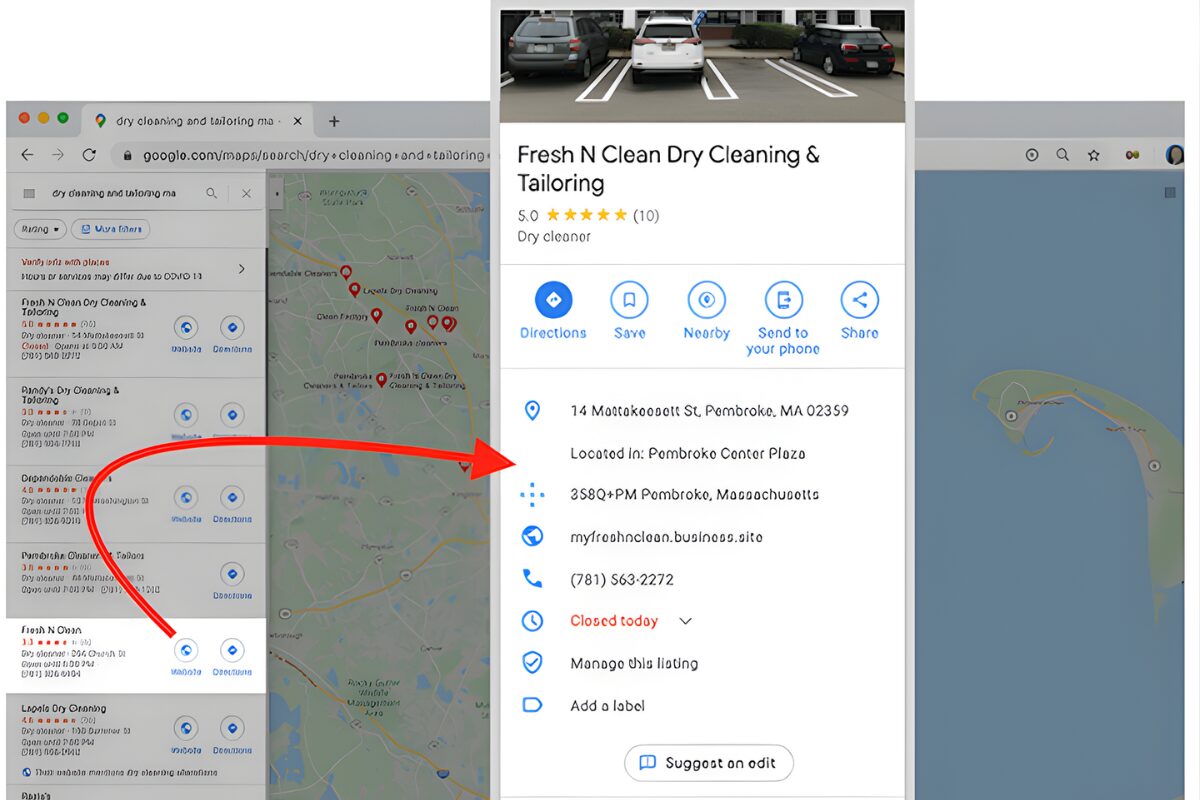
Citations reinforce this. A citation is any listing of your firm’s name, address, and phone number. Cover the general platforms (Google, Apple Maps, Bing Places, Yelp), the legal-specific directories, and local sources such as chamber of commerce listings, keeping every entry accurate.
Reviews are a powerful trust signal to both Google and prospective clients, and volume alone is not the deciding factor. A firm with thousands of mostly old reviews can be outranked by a firm with only thirty recent ones, because steady new feedback signals an active practice. Responding to every review, positive or negative, shows the firm is attentive to its community.
Authority Building and Digital PR
A few dozen links from genuinely authoritative legal and local sources do more for a firm than hundreds of junk links, and the junk now carries real risk. Prominence, in Google’s own definition, includes links from around the web, so each link from a reputable site acts as a vote of confidence in your expertise. Focus on where the links that matter come from:
- Legal directories with real authority: Avvo, Justia, FindLaw, Martindale-Hubbell, Super Lawyers, and Best Lawyers. These serve triple duty as a citation, a link, and a surface AI assistants frequently cite when recommending lawyers. Complete the profiles properly and skip the low-rent general directories that exist only to sell listings.
- Bar memberships: State, county, and city bar memberships usually include a member profile and link, as do sections, committees, and CLE speaking. These are links almost no other industry can get, and most firms already qualify.
- Local news and journalist outreach: Journalists constantly need attorneys to explain the legal angle of a story. Being the local lawyer who returns calls with a usable quote earns links from real news sites, repeatedly.
- Community involvement: Sponsorships, legal clinics, law school involvement, and community organizations. Each link is modest, but collectively they look exactly like what they are, a real firm embedded in its community.
Local links carry more weight for local SEO than generic links from national sites, because they confirm the firm is a recognized part of the local business community.
Google Local Services Ads (LSAs) Management
Local Services Ads are pay-per-lead ads offered through Google that appear at the top of search results, matching people searching for a service with relevant businesses in the same area. You only pay when a potential lead contacts you through the ad, which tends to produce higher-quality leads and cases. A consultant can set these up, or with Google’s Local Services Ads for Clio you can sign up for and manage an LSA account, run campaigns, capture leads, and measure performance within a single platform.
Law Firm SEO Costs, Timelines, and ROI
Typical monthly SEO budgets should reflect your firm’s size and level of local competition:
| Monthly budget | Best fit |
| $1,500 to $3,000 | Solo practitioners and small firms in less competitive local markets |
| $3,000 to $8,000 | Established firms in competitive metropolitan areas |
| $8,000 to $20,000+ | Highly contested practice areas, including personal injury, in major cities |
Let your firm’s size and location, along with practice-area competition, decide the spend instead of applying one rate everywhere.
You’ll usually see the earliest change in local results. Once profile details are fixed and citations and reviews are addressed, Local Pack visibility commonly starts improving within 2-4 months. Organic rankings move more slowly: competitive practice-area searches generally take 6-12 months to rank, and the toughest personal injury head terms in major metros may take longer. A larger budget can speed progress by funding more content and outreach, but there are no real shortcuts, since building genuine authority with Google takes time regardless of spend.
Judge the SEO spend against the economics of cases your firm signs. Set up reporting that ties marketing activity to firm results. Record calls and form submissions by each page, then use call tracking to make attribution easier. Track booked consultations and signed matters, then monitor Local Pack positions, Google Search Console data on impressions and clicks, how quickly reviews accumulate, and your starting visibility in AI search.
Traffic can fool you when visitors never schedule a consultation, which makes it a vanity metric. A page ranked #4 that produces two clients each month delivers meaningful value.
How to Choose Your Legal SEO Partner

A solid SEO partner deserves a careful look. Google tells firms hiring an SEO to request concrete details and references, then walk away if the provider can’t explain every planned activity and its reason.
Ask lawyers you know which agency or consultant they use, then narrow your search to people who specifically serve law firms. Call references from other firms, then inspect the provider’s portfolio and case studies to judge the actual work yourself.
Set the budget first, because meaningful Legal SEO needs a share of your firm’s marketing funds before you start comparing providers. Hourly fees for a seasoned SEO consultant may sit in roughly the same range as your legal services, so put that expense in the budget. Figure out whether you’re after ongoing monthly help or one set project, like improving keyword use across your law firm website.
Once proposals come in, hold each one to the same criteria. Use this checklist to keep the focus on the work:
- Deliverables: Does the proposal name the exact monthly work, including the number of content pieces, planned backlinks, and technical SEO tasks?
- KPIs & Reporting: Which measures define success? Give leads, calls, and cases more weight than surface-level figures such as traffic and impressions, and ask to see the provider’s monthly report.
- Legal Specialization: Does the proposal show that the agency understands your practice areas, YMYL requirements, and state bar advertising rules?
- Contract Terms: How long does the agreement run, and what happens if you need to cancel? Be cautious with lengthy contracts that lack a clear exit clause.
Key Questions to Ask a Potential Agency
Use interviews to test legal knowledge and SEO process. Ask each provider what YMYL means for legal content, how it handles state bar advertising requirements, and how it would demonstrate Expertise, Authoritativeness, and Trustworthiness (E-E-A-T) under Google’s YMYL standards. Vague answers, or none, should affect the decision.
A strong legal SEO specialist knows the legal industry and the issues that commonly hurt SEO campaigns. You should hear how content, backlinks, and technical SEO connect, followed by the approach the agency would take for your firm.
- YMYL and compliance: What does YMYL require of legal content, and how does the agency handle state bar advertising rules?
- SEO process: How does the provider handle content, backlinks, and technical SEO, and why do those activities fit your firm?
- E-E-A-T: How would the agency show Expertise, Authoritativeness, and Trustworthiness on a law firm website while meeting Google’s YMYL standards?
Clear, specific replies beat broad promises because they show whether the agency knows Legal SEO and can describe its work in plain language.
Red Flags That Signal a Bad Provider
Some answers and tactics should make a law firm think twice about moving ahead:
- Guaranteed outcomes: The provider promises results instead of recognizing the variables that affect search performance.
- Unclear process: The agency cannot explain its method, or refuses to, in terms that make the planned work clear.
- No compliance awareness: Legal copy needs a compliance review that content in many other industries does not. An agency unfamiliar with attorney advertising rules should concern you.
- No references: The provider cannot provide references from other law firms.
- Suspiciously low pricing: A few hundred dollars a month cannot fund attorney-reviewed content, genuine PR, and technical work; that price generally buys automated reports and low-quality links.
- Toxic link tactics: Bulk guest-post networks, “500 links for $99,” comment spam, and private blog networks.
- Doorway-page production: Creating dozens of nearly identical city pages by changing only the location name matches Google’s spam policies on doorway pages, creating serious risk for the firm.
- Vanity-metric reporting: Visitors from the wrong city, or people looking for another kind of lawyer, do not help the firm; qualified leads and signed cases do.
Transparency, legal awareness, and focus on business results reveal more about a provider than any impressive ranking promise does.
The Core Work We Do to Rank Your Firm
Legal SEO starts with accurate, consistent information that makes contacting your firm feel straightforward, because nearby clients must be able to verify the basics.
Winning the Map with Google Business Profile
Your Google Business Profile is central to earning a Local Pack spot. When someone searches “personal injury lawyer near me” or “divorce attorney [city],” the Local Pack sits ahead of regular organic results and displays three businesses.
Google names three local ranking factors:
- Relevance: How closely your profile information matches the search.
- Distance: How far the searcher is from your business.
- Prominence: How well known the firm appears, including reviews and links to its website.
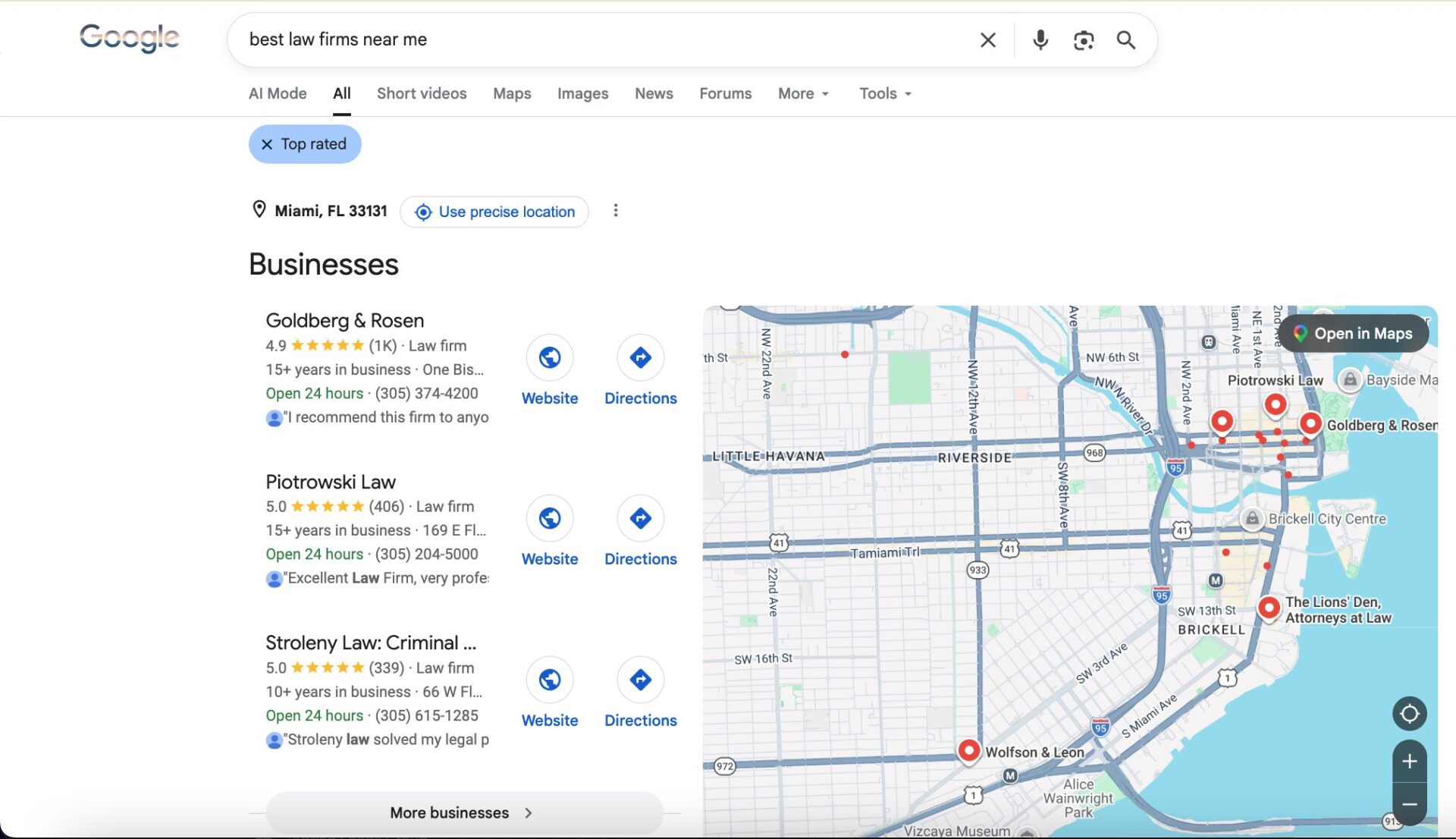
Google also makes clear that businesses cannot buy their way to a better local ranking. The profile and related signals must earn that visibility. For a law firm, focus on these practical priorities:
- Choose the precise primary category: “Personal injury attorney” matches injury searches more closely than “Law firm.” Set the primary category around the cases you want, then use secondary categories for other services.
- Fill in every available field: Add hours, services, the business description, and real photographs of the office and attorneys. Google ties relevance to complete business information, so thin profiles often lose ground to fuller profiles. Update the profile regularly with current photos, hours, and specific practice-area descriptions.
- Create one profile for each actual office: Individual practitioner profiles are acceptable. Trouble starts when a firm invents locations through virtual offices, coworking addresses, or a partner’s home presented as a branch.
- Post weekly updates: Google treats fresh GBP posts as a positive signal, so add descriptions, photos, videos, an appointment URL, and links to relevant articles.
- Keep reviews coming: Review volume, rating, and the firm’s responses all support prominence. Respond to every review, positive and negative, within 48 hours.
A complete, honest profile gives Google solid facts while giving local searchers more information to weigh.
Building a Website That Converts Searchers
A site built for search has to do more than list broad services. Visitors should quickly find and understand every service focus and legitimate location.
Practice-area URLs
Use dedicated paths:
- yourfirm.com/denver-car-accident-lawyer/
- yourfirm.com/denver-truck-accident-lawyer/
- yourfirm.com/denver-wrongful-death-lawyer/
For a separate location, build a page like yourfirm.com/boulder-car-accident-lawyer/ only if you genuinely serve Boulder.
A direct opening
Lead with the practice area and city in the headline. The opening needs to explain who the firm helps, what it does for those people, and why they should choose it over another firm. Two tight paragraphs usually beat a long introduction that delays the answer.
Early proof
Place proof near the top, such as ratings, notable results with any disclaimer your state requires, years in practice, and meaningful awards.
A clear intake explanation
Spell out what follows a call, including every intake step in order. First-time legal clients may feel anxious, and a page that clears up uncertainty can turn a visit into a call.
Transparent fee information
State whether the firm charges a contingency percentage, flat fee, or hourly range, and whether a free consultation is available. Fee questions rank among the most common searches before hiring across practice areas. Keeping that answer hidden can reduce inquiries.
Pre-hire answers
Cover the 5-8 questions clients usually raise before retaining counsel, including “How long do I have to file?”, “What is my case worth?”, and “Do I have to go to court?”. Give genuine answers, then mark them up with FAQ markup. Use clear headings and plain language instead of dense legal jargon, since crawlers read the content along with your clients.
Location-specific detail
Name the courts where the firm practices, the applicable state deadlines and statutes, and how that county’s process unfolds. A template that merely changes the city name cannot provide that information.
Attorney connections
Link each lawyer involved in these cases to a complete biography page. Those links support E-E-A-T by joining service details with professional credentials people can verify.
One primary next step
Give visitors one obvious next step, including the phone number and a short form. Six buttons competing for attention can make reaching the firm harder.
A location deserves its own page when the firm can describe serving it in specific terms. Ten strong pages beat eighty thin ones in rankings and in the picture the site gives of the firm. Google provides the free Rich Results Test for checking markup; enter a URL to see the identifiable markup Google finds, along with any errors.
Earning Trust with Expertise and Reviews
Trust grows from details readers and search systems can use to confirm who is behind the advice.
Real attorney bio pages
List bar admissions, jurisdictions, education, years practicing, representative matters, publications, speaking engagements, and community roles. Then connect each biography to independent proof, including the state bar listing, law school, and directory profiles.
Bylines and review credits on content
Google’s guidance asks for accurate authorship details, including bylines where readers expect them. Every substantive article should use either “Written by [attorney]” or “Legally reviewed by [attorney],” link to that lawyer’s biography, and identify the attorney who actually reviewed it.
Structured data
Use LegalService or Attorney markup to identify the firm, including its address and geo details. Designate lawyers as Person entities and include their credentials, so search engines can read those qualifications as structured information rather than only visible text.
A consistent identity everywhere
Keep attorney names, firm names, and factual details consistent across every platform. Your website, GBP, Avvo, Justia, the state bar directory, and LinkedIn should match because search engines and AI models compare them, and conflicts can gradually weaken confidence.
Reviews as trust signals
Review volume, rating, and recency can strongly shape Local Pack performance. A firm with 15 reviews from 2021 may lose ground to a competitor with 8 reviews from the last 6 months. That difference often reflects process, not client preference, since firms with 300 reviews generally request feedback the same way every time.
Make the request part of closing every successful matter. Send the direct review link, then have the attorney who handled the case ask the client. A brief, polite email with no pressure can work once a matter is over. You can adapt this template:
Subject: A quick favor?
Hi [Client Name],
Now that your matter is complete, I wanted to follow up. It was a pleasure working with you.
Client feedback can help people facing difficult circumstances find the legal help they need. If you have a moment, would you be willing to describe your experience with our firm on Google?
[Insert Your Direct Google Review Link Here]
Thank you for your time and the trust you placed in our firm.
Best regards, [Your Name]
Don’t offer incentives or filter requests for favorable responses. Google’s policies bar compensation or rewards for reviews, and they also prohibit selectively requesting positive reviews, known as review gating. Incentivized testimonials may also create bar-rules issues in some states. Ask everyone, and reward no one.
Protect confidentiality whenever you reply to a review. Never confirm that the writer was a client or discuss matter details, even if the criticism is wrong. A brief, professional reply asking the person to communicate offline protects the firm and reads well to everyone else.
E-E-A-T asks a practical question: can readers see that real, qualified lawyers stand behind the content and are worthy of trust? Google is checking much as a prospective client would. Detailed attorney biographies, attorney-written articles, and case results provide that evidence. Legal topics sit within YMYL, so Google looks for evidence that credible professionals support the content, and law firms already have the verifiable credentials Google wants when the site shows them clearly.
Why Legal SEO Is a Specialized Field

Legal SEO operates under tougher conditions than ordinary SEO: Google demands stronger proof, state bars govern attorney advertising, and local markets are fiercely competitive. Let any one of those pieces slip, and the campaign can lose strength quickly.
Legal information falls under Google’s “Your Money or Your Life” (YMYL) standard. Since inaccurate legal guidance can create serious consequences in the real world, Google examines law firm websites for reliability and correctness far more closely than it might examine a restaurant website.
Google classifies subjects that can affect health, finances, or safety as YMYL topics. Google’s official guidance says strong E-E-A-T, meaning experience, expertise, authoritativeness, and trust, gets “even more weight” for YMYL subjects.
Across most states, your law firm’s site and online profiles are treated as attorney advertising. State bar associations oversee that advertising, and many rules they enforce are rooted in the ABA Model Rules of Professional Conduct. Your firm has one basic rule to follow: communications about the firm or its services must not be false or misleading. That rule shapes several common claims in search-focused legal copy:
- “Specialist” and “expert” language: Many states limit these terms to attorneys holding formal certifications. Saying a lawyer “focuses on family law” is generally safe; calling that lawyer a “family law specialist” may violate local rules.
- Testimonials and prior outcomes: Several states call for disclaimers similar to “prior results do not guarantee a similar outcome,” and you should never promise that a future matter will produce a particular result.
- Guarantees: “We win or you pay nothing” explains a fee arrangement. Saying “we will win your case” promises an outcome and creates a compliance problem.
This is marketing information rather than legal advice, and applicable rules may vary by state. Before publication, submit questionable language to your own bar for review under its advertising requirements. Legal SEO copy calls for a compliance review many other industries don’t require, so approach an agency unfamiliar with these rules cautiously.
Local competition makes the job more manageable than a national comparison suggests. You’re competing with attorneys in your metro who are doing this properly, not with every law firm in America. In many markets, that local group is smaller than the paid-ad auction makes it appear. Handling seo services for law firms is specialized work, so choose a provider whose experience and approach suit your firm.
FAQ
How much should a law firm budget for SEO?
Monthly SEO costs may start at a few thousand dollars and rise to $10,000, $15,000, or more, based on the scope of work and competitive pressure. What you pay follows the firm’s online presence, the market it hopes to reach, and the campaign tasks, including keyword research, content creation, and on-site optimization. A monthly quote in the low hundreds should worry you, since it usually covers automated reports and junk links, nothing more.
How long does it take to see results from SEO?
Profile, citation, and review work may improve Local Pack visibility within 2-4 months, but reaching meaningful rankings for competitive organic terms often takes 6-12 months or more, especially in major markets. An agency may promise a first-page ranking within 30 days by picking a keyword nobody searches or using a tactic that brings trouble later. That promise is a red flag.
Is it better to hire an agency or do SEO myself?
At a small firm, one attorney can handle much of the local foundation with a few hours each week: keep the Google Business Profile up to date, gather reviews, manage citations, and publish a handful of strong practice-area pages. In a smaller market, that steady attention can put the firm ahead of many competitors.
The harder work is a steady content program, digital PR, and technical SEO, especially against firms in contested metros spending five figures a month. Usually, a lawyer’s billable schedule limits them more than their ability to understand SEO does.
Is SEO worth the investment for my practice area?
For most consumer-facing practice areas, yes. High-intent legal clicks can cost hundreds of dollars each in the ad auction, while one signed case can be worth thousands to seven figures, so a few organic cases a month can cover a market-rate budget many times over. The exception is a firm whose work comes entirely from referrals and institutional clients who never search online.
Does SEO still work with the rise of AI search like ChatGPT?
Yes, and it matters more, not less. Answer engines lean on web search signals, so firms ranking on Google’s first page are far more likely to be named. A Hoverboard AI analysis of 102,000 AI responses across ChatGPT, Google AI Overviews, Gemini, Perplexity, and Grok found #1-ranked brands get named 32% to 49% of the time, with the steepest drop-off between positions #1 and #3.
Start with the cases your firm wants, the market where those clients search, and the amount of work your team can actually sustain. Local SEO services for law firms give you a way to judge the budget, likely timing, whether work should remain in-house, and how AI search pulls from the same visible sources. Firms that benefit usually make those choices around real demand, rather than traffic alone.