Campaign performance in digital marketing B2B vs B2C hinges heavily on spotting shifting promotional mechanics.
Company buyers and individual shoppers bring different profiles to the same B2B and B2C goals: lead generation and sales. The gap between those profiles is sharp (the shared goals don’t change), so track lead generation and sales. Commercial campaigns need lasting trust, long sales processes, and proof of return on investment for professional committees. Those demands shape your message, relationship building, and wider commercial roadmap. Consumer campaigns follow impulsive, feeling-led choices tied to brand affinity and personal wants.

Core Differences in Digital Marketing B2B vs B2C
Buyer type sets the whole plan in digital marketing b2b vs b2c: B2B sells from one company to another, while B2C sells straight to individual consumers. That distinction tells you whether the money comes from an organization or one person’s pocket, and it sets the budget that follows.
Global B2B e-commerce reached $21.8 trillion in 2019, making up 82% of all online and electronic data interchange (EDI) transactions. The United States led B2B volume, while China led B2C, with both countries landing in the top 3 for each. Japan took the remaining B2B spot, and the UK took B2C. Geography shifts the mix.
Those buyer types create different operating priorities. B2B teams allocate 71% of their focus to lead generation, with content creation receiving 50% and customer retention 45%. B2C teams lead with customer experience at 58%, then social media engagement at 52%.

Target Audience and Segmentation
B2B target audiences
B2B audiences stay narrow because the buyer group needs a clear shape. Name the market you can reach, then use 3rd-party data partners for account-based targeting and custom segments, along with filters covering job title, employment, and seniority. Pair occupational segments with people reading business topics online to narrow the field further.
Add company size and industry filters. You might be speaking to a few thousand mid-size UK manufacturing businesses. Before writing the message, identify the line manager, finance director, procurement team, technical lead, and sometimes a board. Build creative for that buying group, not for one assumed owner. Each stakeholder brings different questions, and the person who first sees the campaign may never approve the deal. That group is your B2B audience.
B2C target audiences
B2C audiences may reach millions. Start with a wide pool, since even advanced targeting still covers plenty of people, then pull out those most likely to want the product. Collect age, location, income level, preferences, needs, and behavior. Break the group down by age, location, and income, then shape the offer around those details. One person usually makes the call. The consumer decides.
Buyer Psychology and Decision-Making
A bad B2C purchase is usually an inconvenience; an ineffective B2B purchase can damage the company and the buyer’s reputation.
B2C persuasion usually lands with one person making a personal choice. Emotion, price sensitivity, timing, and how closely the purchase gets examined all shape the outcome, since people often feel their way to a purchase and explain it with logic afterward. Follow the problem, search, purchase path. For quick decisions, use Instagram, reviews, social proof, and price promotions. Watch the timing and triggers, then make the next step easy. The buyer feels the result directly.
B2B buying brings several people around one company problem. One person may open the process, but approval usually draws in a line manager, finance director, procurement team, technical lead, and sometimes a board. Map the specifiers, authorizers, and daily users. A B2B offer may need 16.7 weeks or more and 6-10 decision makers before testing begins.
B2B purchases carry both financial and reputational risk, so the group has to stand behind the choice. Give every stakeholder the B2B digital marketing case studies, ROI figures, and technical proof tied to their concerns. Before committing, they conduct thorough research and compare multiple vendors, while requiring trust to be built. Present an organization people want to work with and trust to deliver. The message needs rational confidence and emotional trust. A B2C buyer can follow a feeling; a B2B buyer usually needs the paperwork as well.
B2C is dinner for yourself; B2B is a banquet where every department head has to approve the caterer. Everyone needs a seat at the table.
Sales Cycle Duration
Purchase timing draws a clean line between quick consumer choices and lengthy company reviews.
- B2C Consumer Transactions
- B2B Enterprise Agreements
| Buying Model | Typical Duration | Key Evaluation Stages | Attribution Window |
|---|---|---|---|
| B2C Consumer Transactions | Seconds to a few weeks (Nike: 1 to 7 days) | Social discovery, swift peer reviews, single-day cart checkout | Short windows measured within hours or days |
| B2B Enterprise Agreements | Weeks to 6-12 months (e.g., Salesforce deployments) | Discovery meetings, technical scoping, security compliance, procurement cost analysis, product demos, board review | Multi-touch windows spanning six months or longer |
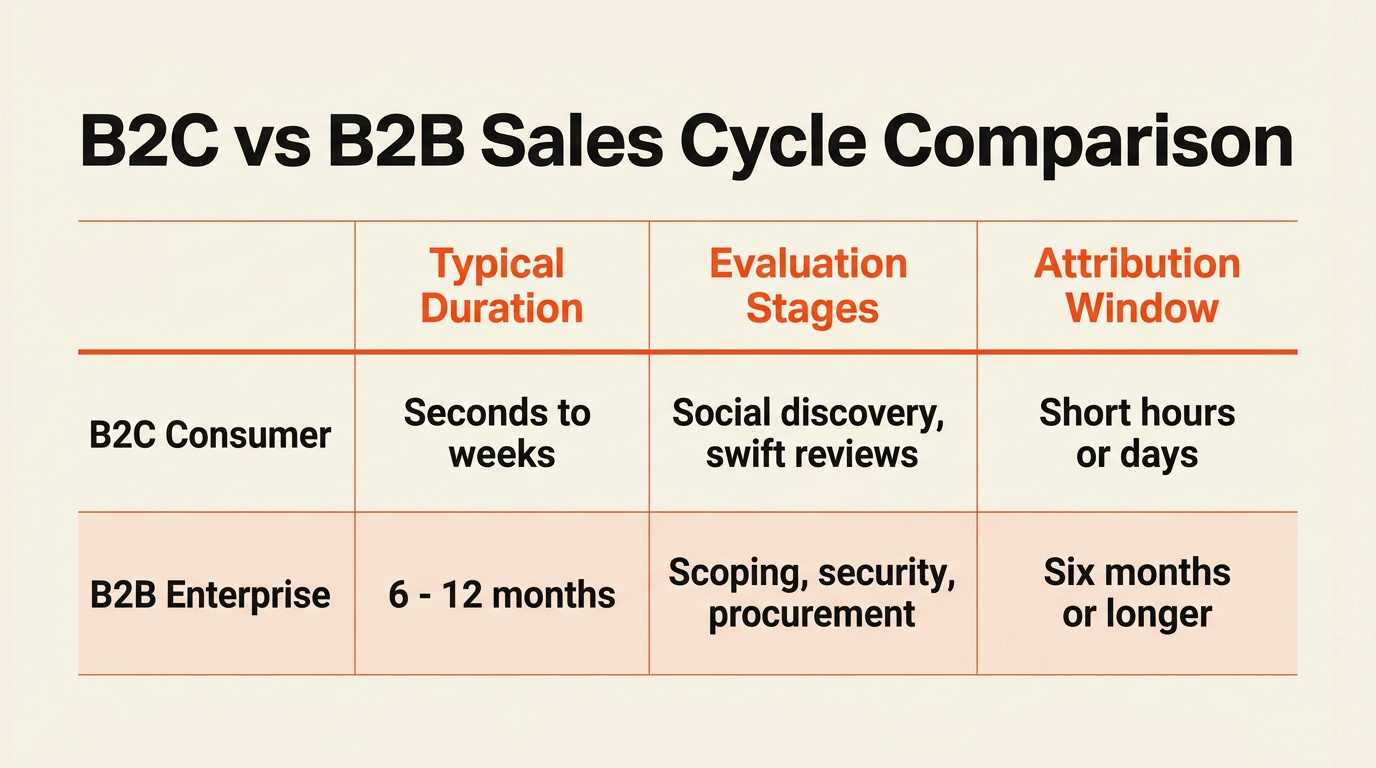
B2C consideration may last from Seconds to a few weeks, while a complex B2B sale may stretch for months or years. Nike’s usual consumer journey takes 1 to 7 days, from discovery through checkout. A shopper might spot Nike on Instagram at 9am, look into it, and place the order by lunchtime; Salesforce enterprise decisions can take 6-12 months as discovery, technical requirements, security compliance reviews, procurement, demonstrations, and board approval unfold.
Company purchases move on a slower clock than consumer orders. A simple contract can take weeks, and enterprise deals take longer, with Salesforce offering a useful reality check. IT-led discovery feeds technical requirements from operations, followed by security compliance reviews and procurement cost analysis. Then come product demonstrations, contract talks, and board approval. Plan for the complete sequence. The cycle can last 6-12 months.
A lengthy B2B cycle brings your brand back in front of prospects across content, channels, and review stages, with the first contact sometimes sitting six months before a conversation. Plan awareness, education, and consideration content. Track the ad, blog post, and final nudge. Giving credit gets harder when all three help close the deal.
Pricing Models and Value Propositions
B2B pricing often joins large deal values with tailored solutions, setup services, training, and ongoing support. The bill reflects the company problem and the work needed to solve it, so enterprise pricing rarely looks like a shelf label. Think setup, training, and support. Salesforce licenses users through Professional, Enterprise, and Unlimited editions, each with different features and support levels. Map the offer before placing the ad.
Salesforce starts at $150 per user per month in many cases, while setup costs shift with the level of complexity and customization. Annual contracts may also bundle extra products, services, and custom development. Enterprise pricing has several moving parts.
B2C prices are easier to see, with smaller individual purchases and potentially more orders. Nike shows prices clearly, runs seasonal discounts, and removes friction with free-shipping thresholds and easy returns. Most products sit between $25-$200, keeping them accessible while preserving a premium brand position. Keep the price in view.
B2B value starts with business impact: return on investment, better operations, and long-term strategic gains. Use case studies and ROI figures to speak to B2B professionals who care about outcomes rather than price alone. B2C messages focus on personal benefits, emotional satisfaction, and immediate lifestyle value, usually through broad wording and price-led creative. Let the audience decide which value comes first.
Customer Lifecycle and Funnel Architecture
Consumer funnels and company pipelines move through different milestones.
- B2C funnels are more direct: Awareness: social media and ads; Consideration: reviews and product pages; Conversion: quick checkout. Use retargeting to remind people who visited your site about the offerings that first caught their attention. Dynamic retargeting adds a personalized touch when the ad returns (a small nudge, delivered again). Customer service runs through efficient automated systems, with social media engagement supporting community building. Nike+ membership creates belonging while collecting customer data. Keep the consumer path short.
- B2B marketing requires a full-funnel approach: Awareness: blog content, SEO, thought leadership; Consideration: case studies, webinars, demos; Conversion: sales calls, proposals, contracts. Treat B2B conversion as soft and hard conversions. A soft conversion includes downloading an ebook, white paper, or case study, registering for a webinar, or requesting a demo. A hard conversion is the contractual agreement of a sale. Build the pipeline around both.
- B2B customer relationships emphasize building long-term relationships through strong connections and partnerships over time. Account-based marketing (ABM) targets high-value prospects with personalized campaigns. Regular business reviews, dedicated account managers, and customized support help maintain the relationship. Strong relationships support renewals and repeat orders.

Budget and Return on Investment Metrics
B2B budget and ROI
B2B often means higher cost per lead (CPL), fewer leads, and larger deal values, with ROI tied to long-term contracts. Track leads, MQLs, SQLs, and pipeline contribution, since those show commercial progress. Visits and impressions matter less when they fail to become those outcomes. Follow the website visit, LinkedIn ads, search campaigns, and sales touches across the account. When ten stakeholders enter the journey, one-channel attribution becomes a tidy fiction. Brand lift studies can help less tangible B2B brands see whether the target audience responds to the offer. Spend heavily to win one high-lifetime-value account, then expect dry spells. B2B revenue may take months to appear.
B2C budget and ROI
B2C generally brings a lower cost per purchase and more orders, with budgets aimed at immediate ROI and repeat buying; b2c vs b2b digital marketing budget allocation compares how consumer and business campaigns distribute capital across channels. Calculate campaign ROI over short cycles because the sales signal arrives quickly. Track conversion rates, cost per acquisition, and revenue tied directly to spend. Compare those figures with brand lift, sales lift, or a footfall attribution study to connect online activity with offline consumer actions. Consumer measurement can join those channels back together.

Channel Execution Differences
B2B and B2C digital marketing teams often work across the same channels, but buyers don’t move through them the same way. B2B uses LinkedIn, email, SEO, content, webinars, and events. B2C leans on Instagram, TikTok, Facebook, influencer campaigns, ads, and e-commerce tools, including Meta and Google. The channel list overlaps.
Google serves as a main search channel for B2B and B2C, while Facebook and Instagram can also support some B2B markets. Keeping the two approaches in separate silos misses the point. Each channel can serve a different funnel stage. Your plan still needs one spine.
Search Engine Optimization
B2B search engine optimization
B2B searches usually happen less often and use more specific wording than consumer searches. Long-tail queries can bring the right visitors when they match your business’s value proposition, even if the visit count looks small beside consumer queries. Decision-makers search for niche, solution-specific terms while they buy. Choose terms tied to products and the problems and use cases around them. You need the right visitors, not impressive numbers. SEO builds lasting visits and authority over time.
B2C search engine optimization
Both B2B and B2C need strong search visibility. B2C typically uses shorter, higher-volume keywords across standard product lines, reaching a broader consumer audience.
Paid Search
A B2C brand can launch a search ad campaign, send people to a product page, and measure purchases within hours, which is a remarkably short wait in this line of work. These ads aim for a lower cost per purchase and more transactions. Results show up quickly.
B2B Google campaigns focus on specific search needs rather than demographic profiles. They reach fewer people at a higher cost per click, while each conversion can be worth much more. B2B usually brings a higher cost per lead, with lower volume and higher-value deals.
Social Media Strategy
Social media choices and creative formats should match the buyer profiles you’re trying to reach.
- LinkedIn serves as the primary social platform for B2B, with specialized industry forums and publications alongside it. Targeting by job title, company size, seniority, and industry makes LinkedIn useful for reaching people who make or influence B2B purchasing decisions. C-suite executives often see targeted campaigns there.
- B2C digital marketing utilizes social media and paid ads, using Instagram, TikTok, and Facebook to reach broad audiences through visual content and entertainment. Instagram supports visual storytelling through images and videos, while TikTok connects brands with current trends, viral movements, and younger demographics. Influencer collaborations build brand awareness and consumer trust.
- Social media content for B2B tends to be more formal than B2C, which can make engagement harder. Share educational content that supports career development or helps people compete within a market. Meta and YouTube still have a role in B2B (especially for brand building and retargeting), including mid-market B2B brands building awareness with a broader professional audience.
Professional audiences still react to personality and clear human points of view. The belief that B2B buyers want nothing beyond dry corporate updates has aged badly. A contrarian brand can sound more human than its competitors. Personality still gets a response.
Display Advertising
Programmatic advertising techniques favored by consumer retail brands show limited relevance across most enterprise sectors.
B2B publishers can distribute native content, whitepapers, and event invitations through email. Use 3rd-party data partners for ABM targeting and custom segments, then narrow the audience by relevant professional details to match your B2B product or service. Narrow is the point here.
B2C brands can add a study measuring brand or sales lift, or footfall attribution, to a campaign and connect online activity with actions in the real world. A B2B brand with a less tangible product can use a brand lift study to check whether its target audience responds to the offering. That check helps when the product is hard to demonstrate. The study measures resonance.
Email Marketing
B2B email marketing
B2B email programs use detailed nurture sequences to move prospects through a complex sales funnel. A deeper touch plan supports the wider buying unit and account-based marketing, while each campaign addresses the buying group’s pain points. Detailed profiling is part of that work. Build for the buying group. One person rarely owns the inbox.
B2C email marketing
B2C email programs focus on promotions and new product announcements. Personalized campaigns can send exclusive perks and seasonal or promotional offers to consumer inboxes, often using different timing and messages for personal and professional inboxes. The basic email tactics for engaging people and guiding purchases remain fairly similar. The offer changes more than the mechanics.
Website User Experience
B2B website user experience
A B2B website seldom completes the sale, but it nearly always supports the evaluation. Make it show credibility, prove expertise, answer questions from evaluators and decision-makers, and give the right visitor a clear next step. The essentials are credibility and expertise, with answers to their questions.
Map the roles and sectors involved before building the customer journey. More complex B2B audiences create more complex paths. Give the conversion stage both soft and hard options. A soft conversion could be a downloadable ebook or white paper, a case study download, or a webinar registration; a demo request is another option. Keep those routes visible.
Use dedicated landing pages to make lead generation cleaner and help complex deals move ahead. You’re creating an evaluation path before anyone signs. That path needs space for the whole buying group.
B2C website user experience
For B2C, the website often works like a sales machine: add to cart, buy, done. Show prices clearly and use seasonal discounts to create urgency. Personalization and a smooth checkout improve the customer experience, while free-shipping thresholds and easy returns remove purchase friction. Keep the path short.
Digital Public Relations
B2C digital PR often centers on lifestyle and consumer coverage, including national press. Campaigns aim for broad awareness and sharing across large lifestyle publications.
During due diligence, B2B buyers read relevant trade and business media, including sector-specific outlets. A feature in the Financial Times or a leading technology publication carries more weight with those buyers than a general consumer magazine mention. They’re reading for a different reason. Earn links and placements in the places your buyers already read, and credibility can follow the commercial review.
Shared Principles in B2B and B2C Digital Marketing
When business-to-business and business-to-consumer teams use many of the same tactics, each still reaches people in its own way. Shared channels don’t erase differences in buyer thinking or in business aims and sales-cycle length.
Core Commercial Milestones
Because both models move people through a familiar buying sequence, their communication needs often overlap. B2B and B2C growth teams must map planning, branding, awareness, buyer support, persuasion, and retention, including recurring revenue and fans. The path starts with planning and moves through awareness into interaction. RACE follows it from first contact to return business.
Cross-Discipline Tactics
Both fields rely on the same main channels to track acquisition and retention alongside campaign response.
- Content Marketing: Create valuable, relevant media to attract and hold attention. Blog posts, videos, infographics, and whitepapers build trust and domain credibility.
- Search Engine Optimization (SEO): Prepare your site so prospects can find its material without friction. Organic search supports traffic and domain credibility across B2B and B2C, with Google leading both markets.
- Social Media Marketing: Engage communities directly through consistent updates and conversation. LinkedIn, Twitter, Facebook, and Instagram give enterprise and retail companies shared places to reach audiences.
- Email Marketing: Use direct messaging to nurture prospects and maintain customer relationships. Targeted emails can drive participation, promote specific goods or services, and add context for consumers and corporate accounts.
- Remarketing: Reconnect with previous website visitors through dedicated remarketing ads. Those ads bring back prospective buyers by recalling the catalog items that first caught their attention.
- Influencer Marketing: Partner with industry creators who have dedicated followings to extend brand exposure and trust. The right topical authority can support both consumer and enterprise campaigns.
- Event Marketing: Meet buyers through webinars, conferences, and trade shows. Hosting or joining these events creates direct touchpoints for product demonstrations, lead networking, and pipeline generation.
- Data-Driven Marketing: Use B2B digital marketing software to review customer preferences and user actions, then shape more precise campaigns.
Dual-Market Business Models
Consumer-facing work shapes products and services around customer needs in light of lifestyle demands and personal concerns. Commercial and retail approaches overlap because organizations still serve people; the label changes, but the human buyer stays. Some campaigns speak to consumer shoppers and enterprise clients at once. That combination is the hybrid model.
A hybrid company speaks to both groups at once. Serving them in parallel calls for separate messaging angles and acquisition funnels, with promotional plans tailored to each segment.
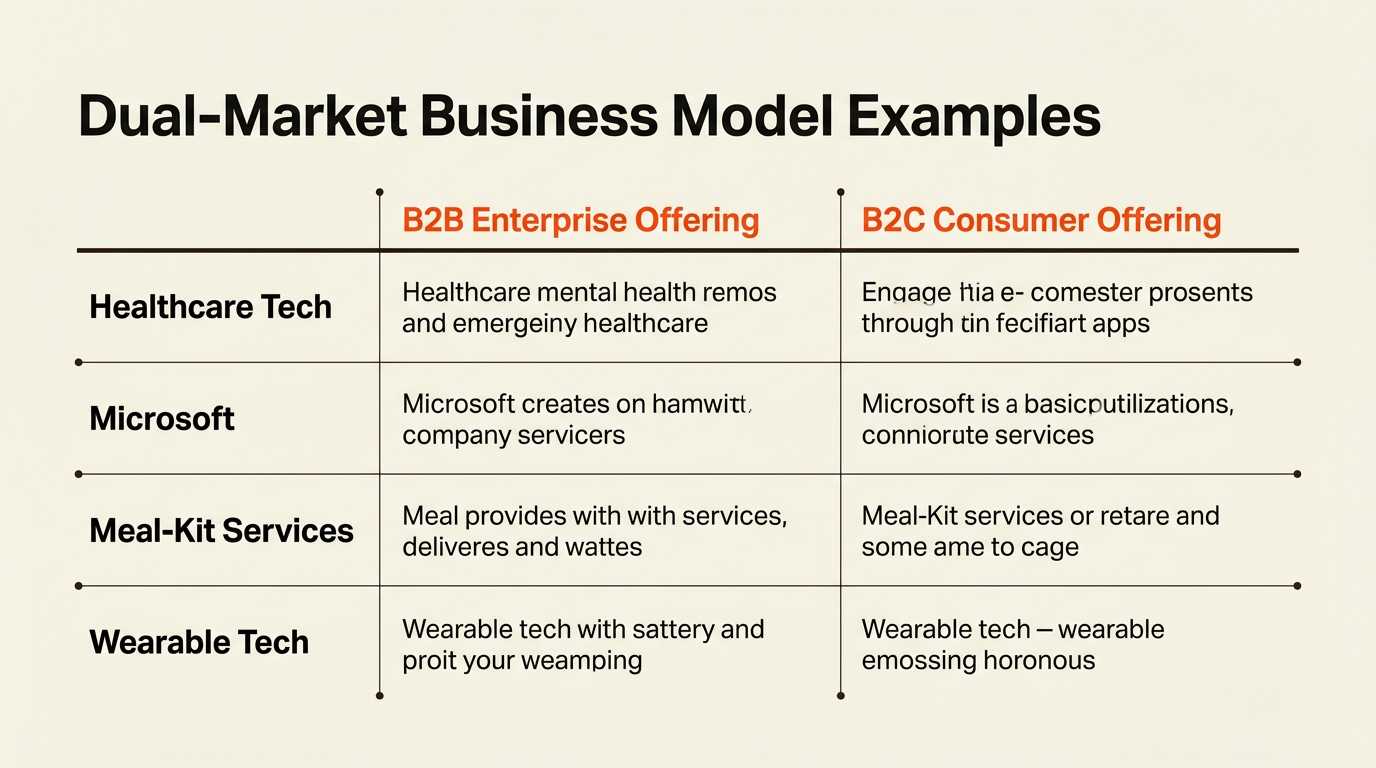
| Industry / Company | B2B Enterprise Offering | B2C Consumer Offering |
|---|---|---|
| Healthcare Technology | Powering hospitals and emergency rooms with clinical instruments | Selling personal tools like glucose monitors and blood pressure monitors |
| Microsoft | Enterprise software solutions marketed to corporate buyers | Surface tablets marketed directly to consumers |
| Meal-Kit Services | Corporate packages pitched to offices looking for catering solutions | Weekly home subscription deliveries for individual consumers |
| Wearable Tech | Collaborating with fitness centers or wellness programs for bulk purchases | Health-focused personal fitness trackers with emotional messaging |
Campaign planning has to line up. Retail tactics don’t automatically carry over to commercial buyers, since buyer journeys and audience boundaries decide which language and creative tone travel. Aim each campaign at its audience, then measure the results.
Choosing the Right B2B vs B2C Digital Marketing Strategy
Four strategic criteria shape the starting point for a B2B digital marketing strategy.
- Who is your target audience?
- How complex is the buying process?
- What is the average deal size?
- How long is your sales cycle?
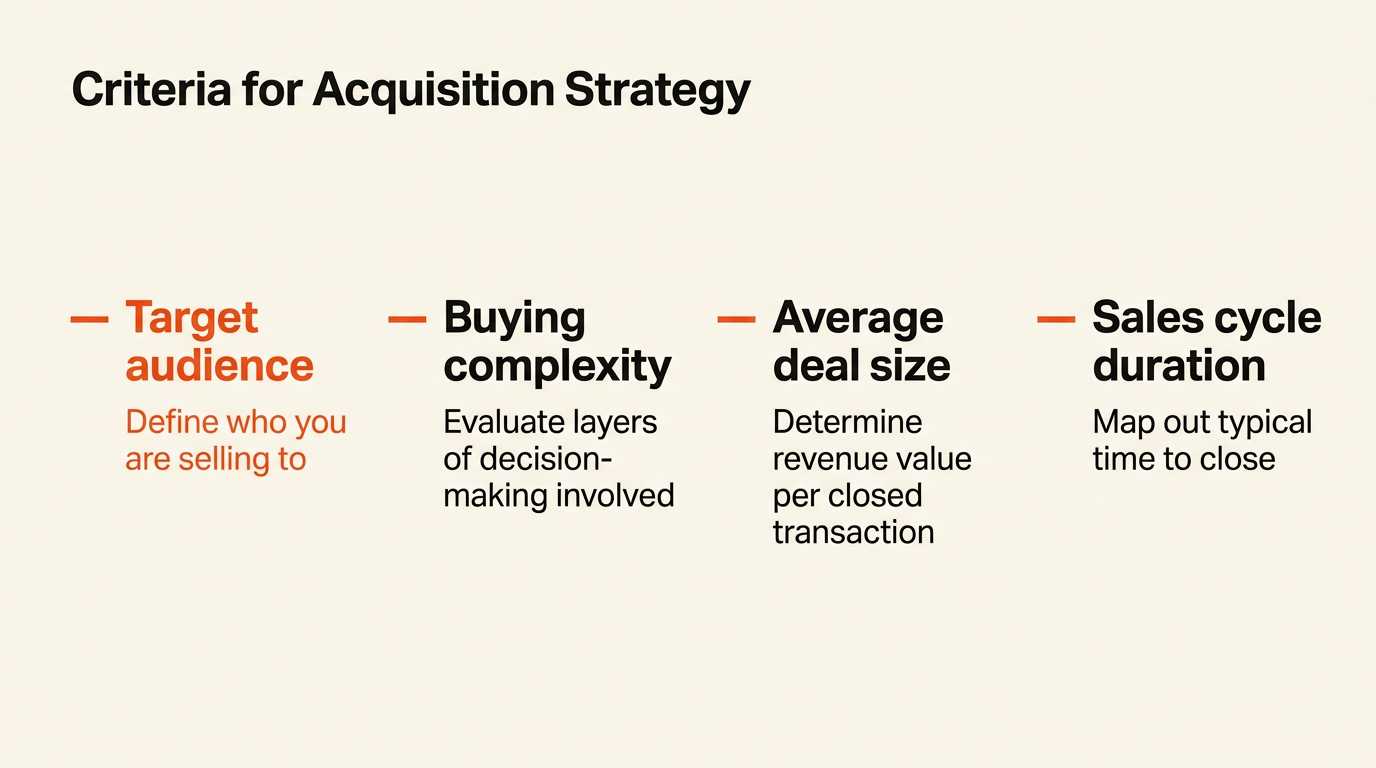
Those answers set the direction for channel choices and media spending, with content decisions following. Early-stage companies often find this call hard because budgets are tight and customer profiles shift, making quick traction essential. Selling to consumers or companies shapes the value proposition and campaign direction. It also creates a need to hire b2b digital marketing services to execute complex enterprise marketing programs when account pipelines involve several layers. Use those four criteria as your starting point.
Evaluating Audience Complexity
Target Audience Structure
Consumer purchases usually involve one decision-maker and few internal layers. Corporate buying moves through groups, with specifiers and technical operators involved alongside budget approvers. Once several people must sign off, the buying path changes.
Decision Parameters and Profiling
Your audience structure should guide customer research. Consumer teams check age and geography, while personal income also matters; enterprise teams weigh company size and industry vertical, with financial constraints shaping the profile as the buyer changes. Send personal-card purchases through a direct consumer path. When someone other than the end user approves the budget, build an account-centered journey.
Pilot Campaign Testing
With constrained resources, launch narrow pilot campaigns to test conversion performance, engagement rates, and customer acquisition costs before committing major capital.
Early testing lets teams make changes before committing further. Use a functional landing page builder to run A/B tests on campaign copy and add form builders for lead details. Adjust visual components as each audience group responds. Start with A/B tests, then refine the campaign.
Frequently Asked Questions
What separates B2B versus B2C digital marketing?
Start with the buyer: B2C reaches a person choosing products or services for personal use. B2B reaches individuals or buying teams making that call for a company or organization. Change the buyer, and the campaign needs to change with them.
Target Audience and Decision Unit
B2C usually speaks to a solo shopper seeking personal utility. Enterprise campaigns, by contrast, speak to professional groups and procurement committees buying for an organization. The decision unit might be one person, or it might be a committee.
Sales Velocity and Messaging Logic
Timing creates another clean divide. A personal need, daily convenience, or strong emotional pull can prompt a solo buyer within minutes or days. Corporate procurement may run for several months or past a year, with the pitch tied to return on investment, operational efficiency, and risk reduction. Business buying moves slowly.
Can one company use both B2B and B2C marketing strategies?
Yes, a single business can serve B2B and B2C audiences if it shapes each campaign and message around that group’s needs. A hybrid model still calls for separate strategies, messages, and funnels.
- Healthcare technology companies market enterprise instruments to power hospitals and emergency rooms while selling personal monitoring devices directly to consumers.
- Enterprise software providers offer large-scale systems to organizational buyers while marketing consumer devices and applications directly to individual users.
- Meal-kit subscription startups target individual consumers for weekly household deliveries while pitching corporate packages to offices seeking catering solutions.
- Wearable fitness technology brands market directly to health-conscious consumers while collaborating with wellness programs and fitness centers for commercial bulk sales.
Why is relationship building so important in B2B marketing?
In B2B, relationships carry more weight because longer sales cycles and higher-value deals make trust and engagement matter from first contact to conversion. A poor B2C purchase usually causes minor annoyance. A B2B mistake can touch an entire organization and damage the reputation of the person who approved it. Trust moves the deal forward.
Financial Stakes and Professional Risk
Large agreements bring substantial deal sizes and longer review periods, so trust shapes how the purchase unfolds. Build it at every touchpoint while the teams work through each agreement. A poor personal purchase may cause minor annoyance, while a failed business purchase can disrupt entire operations and harm the standing of the professional who approved it.
Customer Retention and Solution Tailoring
Strong partnerships support retention: satisfied accounts renew ongoing agreements, place follow-up orders, and recommend your services through peer networks. Good relationships keep accounts moving. Meeting unique requirements takes steady communication, which lets teams address new operational problems as the account develops. Digital campaigns across B2B and B2C approaches then support reliable revenue across every channel deployed.
The working split in digital marketing B2B vs B2C is straightforward: B2C focuses on personal utility and solo shoppers, while B2B brings buying teams, longer sales cycles, deal sizes, and risk reduction into the decision. A hybrid setup can serve both audiences when each keeps separate strategies, messages, and funnels. Relationship building then carries B2B through every touchpoint, from evaluation to conversion, supporting renewals, follow-up orders, and peer recommendations. Keep campaign paths separate, and keep the operational reality in view.