
Enterprise buyers navigate long, complicated purchase paths, making B2B social media marketing essential for organizations using channels like LinkedIn, YouTube, and X to distribute useful points of view, build credibility, and stay on buyer radar. Don’t treat these feeds like a quick direct-response hack, a volume game built on wishing, a channel reserved strictly for press releases, or an engine tracked purely through last-click metrics. Modern social distribution operates as a pre-sales trust engine.

Prospective buyers dig through these platforms long before anyone books a calendar slot with your team. Run this play properly, and the caliber of your incoming pipeline changes because prospects who weigh alternative options, read executive takes, and reach buying decisions show up already sold on your operating philosophy. First sales meetings start with serious operational substance, filtering out bargain hunters in favor of qualified accounts.
Step-by-step b2b social media marketing strategies
A disciplined B2B social media marketing strategy connects target accounts, publishing cadences, and sales pipeline outcomes into one dependable operational engine.
Wpromote revealed in their 2023 survey report that 60% of polled B2B marketers cited social platforms as their top revenue-producing channel, up from 50% in 2022.
Goal setting and revenue mapping
At a high level, treat distribution as a core pillar of your go-to-market engine rather than a routine admin chore you mindlessly check off each week without commercial purpose. Settle on your primary distribution channels, content targets, and ideal buyers before you ever ship a post. Typical operating objectives focus on growing brand presence, driving site visits, capturing referrals with gated assets, establishing authority, tracking market feedback via social listening, and protecting long-term client retention.
Sustainable revenue growth comes from tracking real business indicators instead of celebrating superficial vanity metrics. Gauge performance by looking closely at historical conversion numbers, just like the 77% of B2B marketers who lean on past performance records to justify future team budgets and resource requests. Focus on running deeper buyer conversations, because meaningful exchanges with an actual budget holder deliver vastly more pipeline impact than passive impressions.
The operational roadmap below connects milestones across Authority, Credibility, Conversation, and Pipeline straight into real revenue:
| Goal | What it looks like | KPIs to observe |
|---|---|---|
| Authority | Buyers recognize your point of view | Profile views from relevant accounts, saves, branded search trends |
| Credibility | Buyers trust your thinking | Comment quality, inbound questions |
| Conversation | Buyers initiate contact | Inbound DMs, meeting requests |
| Pipeline | Social supports revenue | Influenced opportunities, signals of improved sales efficiency |
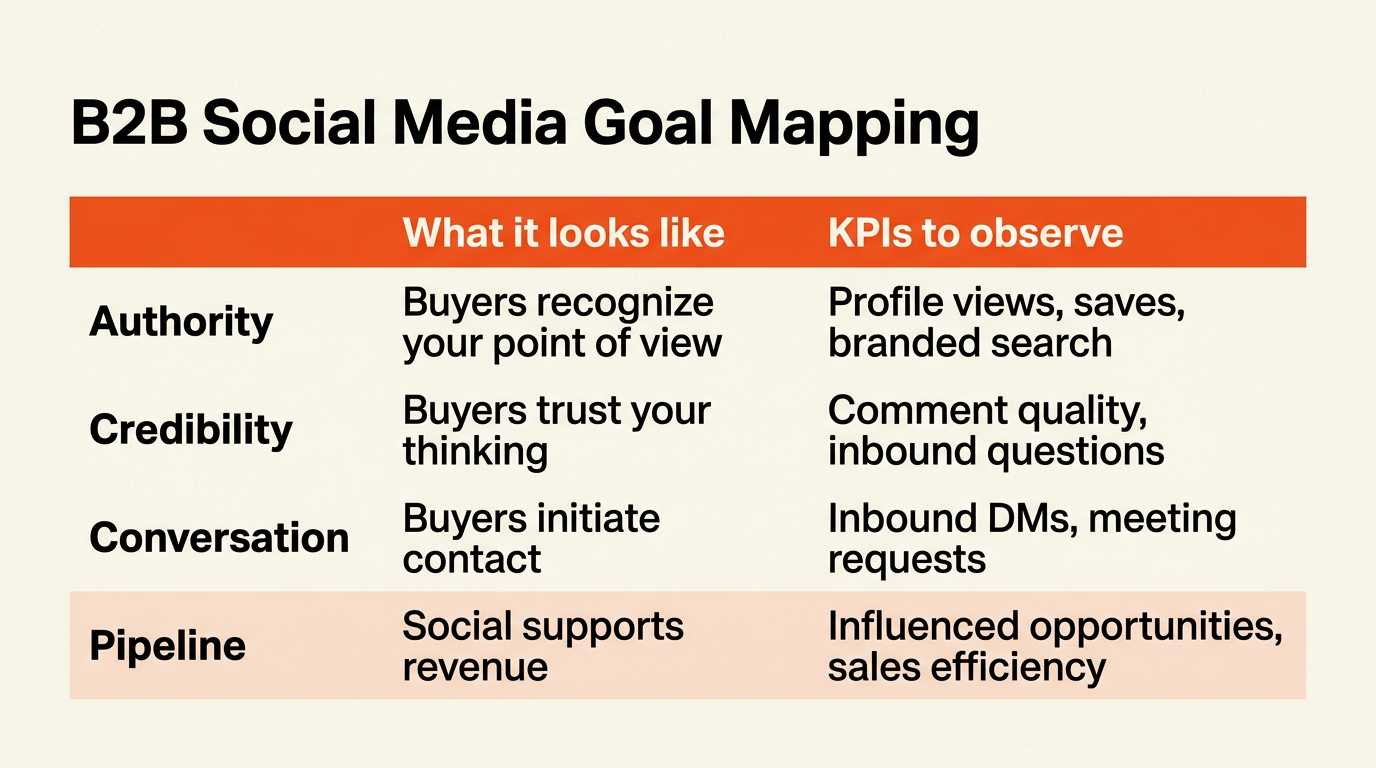
Measuring these specific indicators forces teams to evaluate every social campaign by bottom-line business value rather than pointless vanity reach.
Audience identification and buying committee mapping
Marketing teams make their single costliest mistake when they target hollow job titles instead of real committee buying dynamics.
Ideal Customer Profile Parameters Building an accurate ICP requires factoring in headcount, growth stage, day-to-day operating context, main pain points, technical friction, and distinct evaluation duties.
Buying Committee Roles Enterprise deals never close through one isolated contact because buying groups divide technical and financial diligence across several departments. Your buying committee blends an economic buyer, a functional owner, a technical screener, and an end-user lead, with each person trying to de-risk a separate organizational problem.
Decision Dynamics Dreamdata showed in a 2026 report that the average B2B sales cycle now stretches out to 272 days. Getting in front of executive decision-makers means maintaining an active presence on LinkedIn, where 98% of Fortune 500 CEOs depend on the network exclusively or as their main channel. Meanwhile, committee demographics continue shifting quickly, with Millennials now guiding 59% of these complex purchasing decisions.
Research Techniques Study rival feeds to see which tactical post structures and editorial formats consistently win meaningful engagement from target accounts. Setting up native polls on LinkedIn uncovers unvarnished prospect friction points, handing your writers validated angles for future technical breakdowns.
When you write for daily practitioners, walk through practical operational steps that cut daily software friction and speed up internal workflows. When you write for an economic buyer or finance leader, orient the conversation around risk reduction, total cost of ownership, and capital efficiency.
The 90-day content calendar
Editorial Cadence Map out a concrete 90-day content calendar before you hit publish on your first batch of material. Commit to an operational rhythm you can actually sustain instead of forcing daily drops, because network distribution engines reward dependable publishing habits over random bursts. Putting out content 3-4 times a week delivers the necessary signals to platform feeds without burning out your team or forcing you to ship low-grade filler to satisfy an arbitrary daily target.
A balanced weekly publishing cadence splits work across three distinct formats: Tuesday features an operator breakdown, while Wednesday walks through a clear framework or slide deck. Thursday presents a sharp contrarian take, saving Friday for reviewing performance data and coordinating distribution plays on the company page.
Promotional Budget Set aside real paid budget to place your material in front of fresh accounts rather than waiting on organic distribution to do all the heavy lifting. You can partner with a respected industry voice, run tightly targeted paid distribution, or plug top-performing social pieces directly into your active email workflows. Publishing assets without dedicated promotion remains a losing bet.
Internal Asset Mining Audit the publishing channels you already run and pull out existing collateral to adapt for social feeds. Internal case studies, whitepapers, interview recordings, and audio files offer immediate raw material, especially when you sit down with subject-matter experts across your company who are already solving hard technical problems.
Content engine and operational cadence
Teams quickly burn out when distribution forces them to invent brand-new concepts every single morning, but cycling through three tested asset formats keeps production moving:
- One framework post: A model, checklist, or decision guide that helps buyers think more clearly.
- One practitioner story: What worked, what failed, and what you learned from concrete operating experience.
- One opinion post: A contrarian take, a common industry myth, or an accepted practice you deliberately avoid.
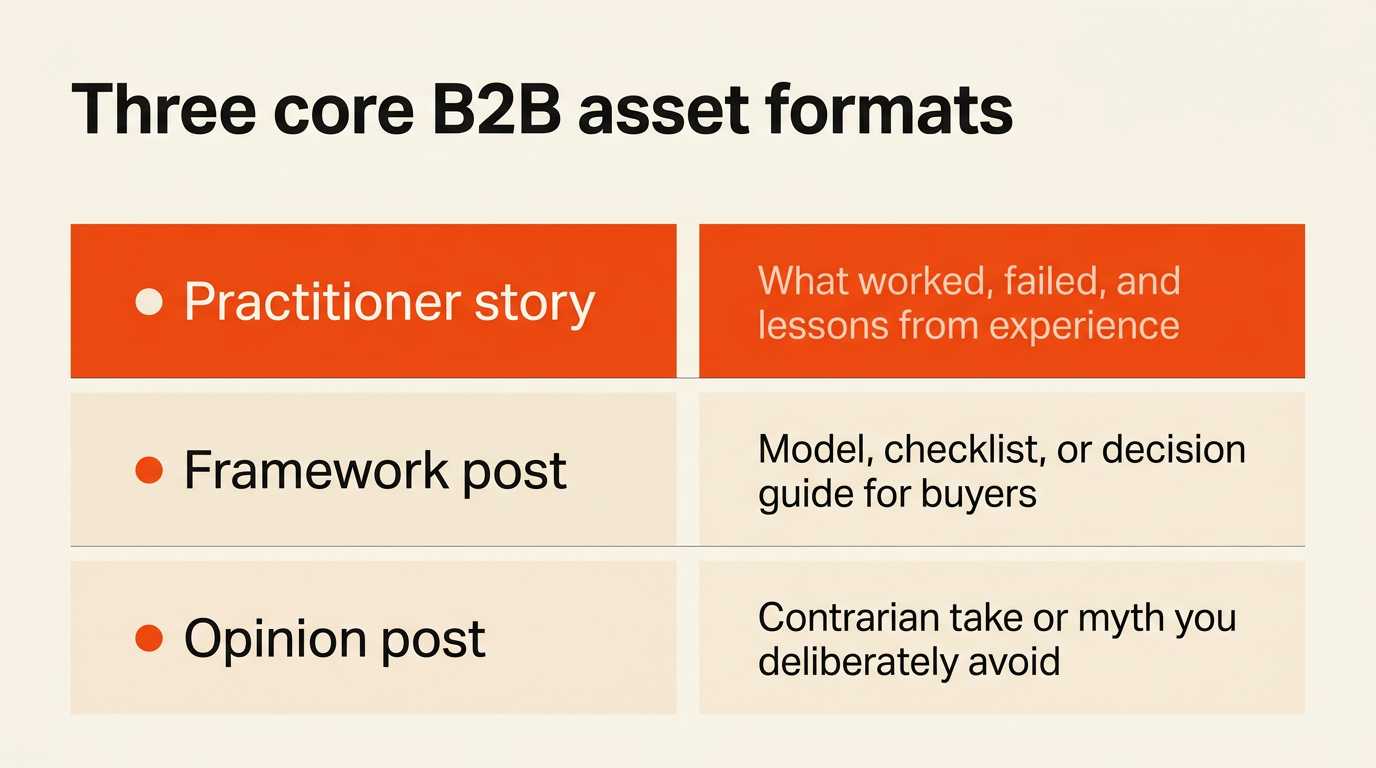
Savvy operators protect their distribution velocity by running the bulk of their publishing through personal leadership profiles. Share three weekly updates from a personal handle, repurpose the top performer for your corporate page, and carve out small windows each day to answer replies.
Organize your core publishing mix across these defined pillars:
- 40% Practitioner insights (what you’ve learned in real work)
- 30% Frameworks (models, checklists, decision guides)
- 20% Proof (case patterns, wins, failures, lessons)
- 10% Brand/product (only when it is genuinely useful)
Consistent execution beats sporadic intensity every time in B2B marketing, where you win by compounding familiarity and trust rather than chasing brief spikes in attention. Carve out a distinct point of view and keep content flowing without interruption for a minimum of 12 weeks.
Content repurposing workflow
Smart repurposing isolates the central insight of a foundational asset and translates it across multiple platform structures while protecting its original rigor and weight. Resist the urge to chop a deep teardown into tiny, disjointed fragments that offer zero practical utility.
- Anchor Asset Selection: A practical repurposing workflow starts with one deep asset, such as a detailed YouTube video, an expert webinar, or a long internal memo.
- Core Insight Extraction: From that asset, extract a small group of core insights, focusing strictly on three to five ideas that are genuinely specific and useful.
- Multi-Format Adaptation: Each insight can then be adapted into multiple formats, including a focused LinkedIn text post, a simple framework carousel, or a short video clip designed for distribution.
- Downstream Expansion: The strongest insight often deserves further expansion; in many cases, it can be developed into a long-form blog post for SEO or turned into a short sales enablement note that supports conversations later in the buying process.
Legal clearance and IP protection
Your legal team serves as an essential partner for marketing operators, especially when your editorial schedule blends light cultural references with heavy technical analysis. Jumping into viral moments can generate massive reach, but sloppy execution opens your business to costly intellectual property disputes.
Put a custom operational spin on a trending format without taking protected assets from the original creator. If you have doubts about whether a specific asset is safe to post, talk directly to legal counsel to figure out your operating parameters before pushing anything live. Many teams rebuild visual assets from scratch and establish clear legal workflows to clear approvals quickly.
Commercial brands face significant legal risks when using copyrighted music across promotional campaigns without proper licensing.
Stay cautious when using popular background audio across TikTok and Instagram, checking commercial platform terms beforehand to steer clear of copyright claims.
Where to focus your b2b marketing on social media
Mastering social media marketing for b2b means identifying the best social media platform for b2b marketing where your target buyers actually read technical breakdowns, then pouring real effort into those specific spots.
Before you try posting everywhere across the web, lock down two or three spots where your team can build genuine traction. If a network won’t let you unpack hard technical reasoning, direct operating experience, and deep domain knowledge for enterprise buyers, cut it from your primary distribution stack right away. For most B2B teams, LinkedIn and YouTube are the only two channels that reliably build commercial authority over the long haul.
A lot of teams fall into a scattergun trap, jumping on every new network without clear plans or structured campaigns. That reactive habit burns through capital and team bandwidth, and stacking up 100,000 followers means zero if none of those accounts ever sign a contract or buy your product.
Put your time into places where real buyers spend their hours by checking post-demo forms, onboarding surveys, and webinar signups, or audit inbound demo requests and referral paths inside CRM records to see where qualified pipeline starts. You can also run a 60 to 90 days test on a single channel.
With a user base topping 1.3 billion members, LinkedIn serves as the undisputed default network for modern business. Leaders across every Fortune 500 company maintain an active presence on the platform, which explains why over half of B2B professionals view it as their main hub. Survey numbers show 84% of B2B marketers pull their strongest organic returns here, and 50% of buyers treat the site as a dependable source of truth.
Winning on the platform comes down to a clear Point of View, Proof, and Consistency framework, using a practical five-step thought leadership sequence that regularly delivers for enterprise brands:
- Hook: Challenge an industry assumption or name a painful truth.
- Situation: Present a real scenario buyers recognize immediately.
- Insight: Detail your reframing, why processes fail, and what matters.
- Lesson: Provide a practical takeaway.
- Soft CTA: Invite substantive discussion without pitching a direct sale.
Setting up a dedicated LinkedIn Newsletter turns 10% to 25% of your existing page audience into direct subscribers, mainly because the platform sends automatic prompts to both current and incoming followers. Every published piece goes straight into member notifications, standard activity feeds, and primary email inboxes.
Marketers are producing far more video on the platform, driving a 12% year over year jump in adoption while LinkedIn tests a dedicated vertical feed. That shift lets teams reach buyers through high-end placements like Connected TV inventory and First Impressions ads filtered by seniority and company size.
YouTube
LinkedIn handles quick industry commentary, but YouTube works as a permanent home for thorough technical teardowns. Long-form video gives your team room to walk through difficult architectural trade-offs, answering the exact technical questions evaluation committees ask before picking an enterprise software partner.
Winning B2B channels build their video libraries around four reliable formats:
- Educational deep dives (10-20 min): Explain a problem category thoroughly, evaluate competing architectures, and outline concrete decision criteria.
- Product walkthroughs (5-12 min): Walk through specific use-case workflows showing the before-and-after operational impact.
- Webinar replays: Convert live presentations into evergreen reference material by attaching a concise introduction explaining intended technical audiences.
- Podcast or interview episodes: Document practitioner perspectives to build domain credibility, then extract short segments for LinkedIn distribution.

Publishing detailed technical video on YouTube systematically builds trust throughout multi-quarter enterprise procurement cycles.
X and niche professional communities
Maintaining an active account on X or niche discussion spaces is optional, but these hubs offer real value when engineers and peers gather there to:
- Share short insights
- Test ideas quickly
- Participate in industry threads
Use these fast-moving discussions to reinforce your industry standing rather than relying on them to generate primary pipeline.
Jumping into conversations on Reddit delivers raw market feedback, but the platform brings serious cultural hurdles because moderators crack down on overt brand promotion while upvoting blunt practitioner takes. It gives you solid field intelligence, but it won’t produce dependable enterprise customer acquisition.
Gated setups like Discord and Slack do an outstanding job hosting client groups and deepening account relationships, but private servers offer zero search footprint and zero organic discovery.
Video-first networks
Around 78% of B2B marketing teams create video today, and 56% plan to increase their production spending over the next twelve months. Running short vertical creative is smart right now, especially with Millennials holding direct sway over 59% of modern enterprise purchasing calls.
Short-Form Video ROI Industry data shows short clips drive the strongest commercial returns across video types, outperforming traditional narrative stories, standard customer case studies, and product walkthroughs. Content Marketing Institute data reveals 19% of B2B marketing organizations now run active TikTok accounts, more than doubling their adoption pace from last year.
Lo-Fi Authenticity Findings from LinkedIn’s 2025 B2B Marketing Benchmark show that raw authenticity easily beats glossy commercial production. Unfiltered discussions deliver a 2.5x lift in audience response over studio footage, while quick handheld smartphone clips generate 2-3X more views and interactions across business feeds than polished agency assets.
Compliance Constraints Short vertical assets still have to satisfy strict corporate legal standards, so write your own concepts from the ground up and stay completely away from unlicensed trending tracks to keep your firm clear of fast copyright claims.
Supporting social networks
Consumer apps like Facebook and Instagram offer occasional value, serving purely as secondary distribution channels for technical B2B commercial teams.
Facebook Facebook works best as a private home for customer portals, alumni hubs, or user groups, with 29% of B2B marketers seeing organic returns there. It won’t help you discover new buyers organically, but its paid toolset lets you tap into Lookalike Audiences, behavioral segments, and targeted retargeting for accounts that already know your firm.
Instagram Instagram supports recruiting and visual disciplines where upfront field research shows dedicated buyer communities, such as practicing architects reviewing project portfolios each morning. The format won’t let you unpack complex infrastructure architectures or operational trade-offs, making it useless for persuading multi-stakeholder enterprise committees evaluating high-stakes contracts.
High-performing content formats for B2B
Interactive polls
Interactive Polling Channels When you run interactive polls across LinkedIn, Facebook, or X, you tackle two clear jobs at once: capturing actual audience sentiment to sharpen your messaging and pushing your brand into new professional feeds.
Market Research and Feedback Surveying your target buyers on Facebook, X, or LinkedIn hands your marketing team fresh market sentiment in just a few hours. You can pinpoint real customer friction from the results, write sharp posts around those verified problems, and plug firsthand field intelligence straight into your ongoing campaign planning.
Algorithmic Visibility Each vote submitted on a native poll prompts the network algorithm to broadcast that interaction to secondary networks instantly. Because connections of a voting user encounter the post without a prior brand follow, that immediate engagement pushes your question into second-degree professional feeds and creates massive compounding reach.
Keep your core editorial angle dead simple whenever you fight for attention in crowded feeds. Isolate one clear friction point, hit the specific pain directly in your opening line, and walk through your tactical solution before the reader moves past your post.
Practical utility consistently wins in B2B feeds, where a direct, unpolished video pulls a 2.5x engagement lift over glossy studio production. Today, 78% of B2B marketers rely on video assets as a standard piece of their regular distribution mix.
Enterprise buyers study your feed content to reduce exposure on expensive contract decisions, verifying whether your team understands their daily operational hurdles, brings genuine hands-on experience, and carries the technical chops to solve them.
Lo-fi vertical video
Plain phone video shot without studio gloss pulls much better engagement on LinkedIn than five-figure agency shoots ever will. Business buyers pay attention to candid operator perspectives over scripted corporate pitches, and LinkedIn is already rolling out dedicated vertical feeds that mirror consumer video apps.
Capturing clean, high-performing vertical video only requires a tight set of basic production rules. Film using the back lens of your mobile device at 1080p or 4K at 30fps, clip a small lapel mic 6 inches under your collar, and set up facing natural daylight or an open ring light with 9:16 vertical framing.
Short vertical video yields the highest commercial return among every format you can test, outperforming brand stories, polished client testimonials, and standard software tours. Currently, 78% of B2B marketers distribute video clips, while 56% intend to expand their budgets for the format over the coming year.
Clear benchmark data from the LinkedIn B2B Marketing Benchmark, the Salesforce Internal Social Team, and the LYFE Marketing Case Campaign for Sherman the CPA proves this performance gap:
| Benchmark Source | Video Production Method | Documented Engagement Lift |
|---|---|---|
| LinkedIn B2B Marketing Benchmark | Authentic video vs. polished studio video | 2.5x boost in engagement |
| Salesforce Internal Social Team | Lo-fi smartphone video vs. hi-fi production | 2-3X more engagements and video views |
| LYFE Marketing Case Campaign | Sherman the CPA simple phone-filmed reels | 3-5 times more engagement and views |
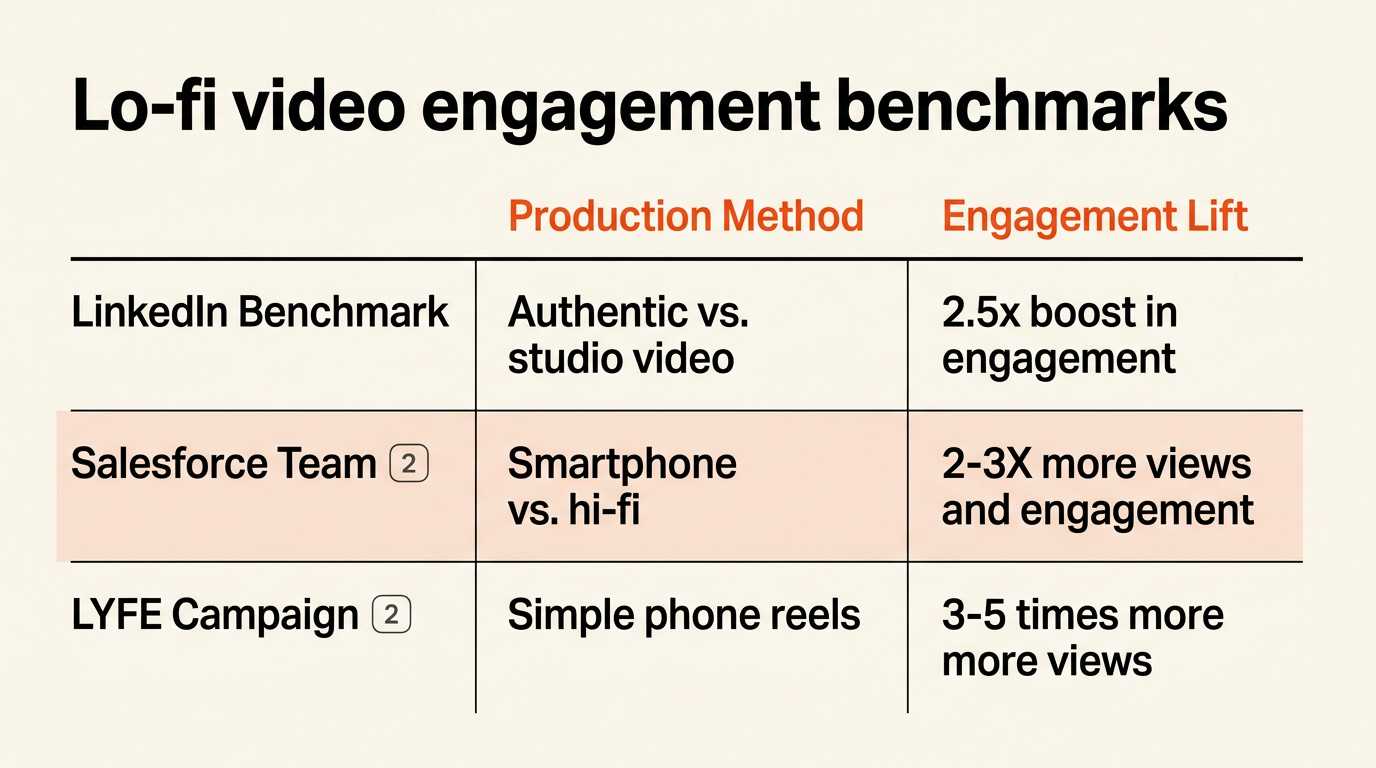
Because raw footage consistently outperforms slick corporate reels across these studies, hold your product walkthroughs under 30 seconds and rely on simple GIFs whenever you spotlight individual product features.
Targeted memes
Targeted memes explain complex operational ideas quickly, helping your organization feel approachable, direct, and trustworthy to prospective accounts.
Satirical industry commentary gives software brands an immediate way to cut through corporate noise, showing buyers there are pragmatic operators behind the product. While organic reach explodes when a joke lands, trending formats burn out quickly and require immediate distribution before their cultural relevance disappears. Always rebuild borrowed visual concepts from the ground up and get your internal legal team to sign off on each draft. Running commercial campaigns with copyrighted audio tracks or unlicensed background music exposes your business to instant legal exposure.
Newsletters
Native in-app newsletters provide your team with a dependable vehicle to turn casual social readers into direct brand subscribers across multiple platform touchpoints.
Conversion Efficiency A well-run LinkedIn Newsletter reliably turns existing company followers into committed subscribers at conversion rates landing between 10% and 25%.
Omnichannel Delivery Surfaces Publishing a native edition instantly triggers subscriber invites to your current audience, while new page visitors get a prompt right when they click follow. Published editions distribute simultaneously to app notifications, main feed updates, and the registered email inbox of every subscriber.
Subscriber Velocity Benchmarks Audience velocity stacks up rapidly when you commit to a predictable publishing schedule. For instance, Salesforce hit 1 million subscribers within three months of starting Ask More of AI, proving that detailed technical breakdowns build serious commercial authority.
User-generated content and customer proof
User-generated proof covers candid written reviews, casual screen recordings, and operational breakdowns published directly by working professionals rather than your internal marketing department.
Commercial ROI Ranking Unfiltered customer feedback gives your product immediate market credibility, since technical buying committees trust peer war-stories far more than branded positioning. According to a 2026 HubSpot report, 24% of marketing leaders rank user-generated evidence among their absolute highest-ROI assets for closing deals.
Content Mix Allocation Reserve 20% of your publishing calendar for concrete customer proof, focusing on specific workflow wins, gritty implementation details, and candid project post-mortems.
Risk Mitigation for Committees Detailed customer case studies, unedited quotes, and authentic practitioner reviews give buying committees hard evidence that peer organizations rely on your product every single day. Enterprise committees will always default to the path with the least career risk, leaning on verified peer adoption to protect their reputations before approving an enterprise agreement. Corporate purchasers are almost twice as likely to accept higher pricing when they place their confidence in a supplier.
Community Advocacy Loops Actively nurturing your power users after onboarding triggers consistent word-of-mouth recommendations, spinning up an ongoing engine of public references, referral pipelines, and institutional trust.
Podcast sponsorships
Podcasts give B2B brands a high-trust commercial route to reach targeted executive decision-makers directly, allowing you to renew winning programs and replace underperforming inventory.
- Less than a third (29%) of U.S. adults had listened to a podcast in 2012, whereas 73% of people listen to podcasts in 2026.
- In a Harris Poll survey, 68% of listeners reported trusting recommendations from podcast hosts, and 35% described podcast sponsorships as more trustworthy than standard advertising channels.
- Listener engagement translates into action: 49% of listeners acted after hearing an episode sponsorship, with 23% visiting the website, 20% purchasing a product, and 16% recommending vendors to professional peers.
- Effective campaigns depend on disciplined placement: test an initial cohort of five to 10 shows across a one-month flight, then either renew inventory or rotate into fresh programs based on verified conversions.

Educational carousels and infographics
Dense operational frameworks translate surprisingly well into bite-sized visual slides, matching how busy executives scan their feeds between meetings.
Framework Share of Voice Dedicate 30% of your editorial schedule to clear decision models, tactical blueprints, and practical audit checklists that help prospective accounts evaluate internal operational headaches.
Structural Slide Formats Visual carousels lay out technical trade-offs across easily digestible slides, pairing step-by-step rollout plans, clear comparison charts, and tactical teardowns that explain why conventional approaches fail.
Anchor Asset Repurposing Pull three to five core insights out of every long-form technical webinar or video session, then repackage those lessons into visual slide decks built for wide distribution across professional social feeds.
Measurement, attribution, and reporting
When aligning social media and B2B digital marketing strategy, teams need dedicated tracking software to link distribution directly to revenue, because built-in network dashboards cannot solve multi-touch attribution on their own.
Enterprise sales involve around a dozen stakeholders and take most of twelve months to close. For example, Dreamdata’s 2026 benchmark found that an average commercial deal requires 272 days from first touch to signature. If your account begins on a LinkedIn update, moves past a company follow, joins a webinar, and reaches pipeline review, standalone dashboards assign social zero value.
Wpromote’s 2023 survey noted that 60% of B2B marketers ranked social channels as their primary revenue driver, up from 50% in 2022. Among respondents, exactly half used social to secure top-of-funnel discovery, while 46% reported that it generated their strongest bottom-of-funnel pipeline volume.
Dedicated attribution engines supply web monitoring alongside auto-tagging and custom reporting parameters. That underlying data feeds enterprise analytics setups like Tableau or Looker Studio, where 77% of B2B marketing teams rely on historical pipeline performance to defend their upcoming budget allocations.
Measuring real pipeline impact demands separating shallow vanity metrics from actual commercial velocity.
- Vanity volume versus revenue disconnect: Accumulating 100,000 followers yields nothing if none of those accounts subscribe or buy from you, just as maintaining a quality website fails if nobody visits it. Looking only at follower expansion, likes, or impressions hides genuine business results.
- Qualified pipeline progression: Measure social outcomes through influenced pipeline opportunities, signals of improved sales efficiency, and the revenue derived from social channels compared directly against ad spend.
- Direct conversational intent: Serious buyer interest displays itself through direct signals: inbound DMs, inbound prospect questions, meeting requests, and comment quality.
- Account-level evaluation signals: True audience alignment shows up in account-level behaviors, including profile views from target companies, content saves, branded search trends, and click-through rates (CTR).
- Commercial purchase intent: Interpreted alongside direct intent signals, audience growth reflects buying motivation; research indicates that 70% of people follow brands because they intend to purchase from them.
How modern B2B buyers navigate social media
Before any direct outreach happens, commercial evaluation is already underway. Treat your social presence as an essential pre-sales foundation so target accounts put you on their day-one shortlist early. When an executive drops a screenshot of your operating model into a private Slack group, that dark social activity drives internal alignment without ever pinging your analytics platform.
Tell your marketing team to add a simple discovery text box to high-intent signup forms, then check those self-reported answers against active deal stages to expose unmeasured touchpoints. Most of this analytical alignment builds invisibly across direct messages and shared threads, meaning accounts arrive pre-sold on your logic and initial sales discussions start from a much stronger position.
That ground game is necessary when the typical B2B purchase cycle now spans 272 days of independent vetting before anyone contacts sales.
Across every deal, multi-stakeholder groups evaluate distinct institutional risks before signing off. Economic buyers focus on budget constraints and finance sign-off, team leads evaluate day-to-day operational fit, and technical leads inspect security architecture rules to protect their respective units. Steering these groups requires connecting across age demographics, using LinkedIn to reach senior leaders while showing up on emerging networks where younger evaluators steer team software decisions.
To track behavior across these fragmented channels, marketers can distribute UTM parameters across core assets and use social listening tools to follow wider industry discussions.
Frequently asked questions
What are the best strategies for B2B marketing on Facebook?
Marketers secure their strongest conversion lift on Facebook by putting paid behavioral segments and Lookalike Audiences to work through platform targeting tools.
Every dependable B2B program on Facebook comes down to four fundamental tactics:
- Paid behavioral targeting: Run targeted ad campaigns against custom data inputs, lookalike audiences, and demographic profiles to reach your specific buyer personas.
- Mid-to-late funnel retargeting: Retargeting ads and community groups advance mid-to-late funnel engagement, deploying tracking pixels to serve relevant assets directly to active researching buyers.
- Private community nurturing: Facebook works best for customer groups, private groups, or alumni communities when you already possess an audience, though the platform remains notably weak for discovery and public authority-building.
- Educational organic assets: Publish client success stories, educational content, and event promotions on your organic calendar to maintain steady baseline visibility.
Numbers from a Content Marketing Institute survey reveal that 29% of B2B marketers rank Facebook as their top-performing organic channel.
Can a b2b social media marketing agency help?
Yes, leveraging specialized b2b social media marketing services from an outside Social Media Marketing Agency expands pipeline by injecting focused reporting models, production chops, and executive guidance.
Buyer-aligned strategy formulation
Experienced partners anchor your distribution directly to complex buying committees, protracted deal cycles, and core pipeline targets.
Authority-led content production
Good agencies guide your team to showcase practical problem-solving on LinkedIn and YouTube across video and thought leadership formats.
Attribution and measurement infrastructure
Your internal staff might already track high-level conversions. Even so, an outside partner sets up objective reporting mechanisms that isolate real commercial revenue, cutting past vanity metrics.
Paid targeting and intent data activation
Skilled partners layer intent signals and tested buyer profiles onto your active campaigns, filtering targeting criteria to pull qualified accounts into sales meetings.
What is the 5 5 5 rule for social media?
Under the 5 5 5 rule, every fifteen published entries break down into five company updates, five industry breakdowns, and five audience discussions.
This steady publishing cadence divides cleanly into three specific post categories:
- Five brand-focused posts: Assets highlighting customer case studies, product walkthroughs, company awards, and internal culture updates.
- Five curated industry posts: Updates distributing external practitioner news, category analyses, and relevant third-party perspectives across your domain.
- Five engagement-focused posts: Interactive updates like LinkedIn polls and targeted discussion questions structured to spark direct, two-way dialogue across your market.
Holding to this split prevents your feed from degenerating into a self-absorbed bullhorn. Instead, it positions your company profile as an analytical resource for evaluators, ditching shallow viral impressions to feed active pipeline and sales conversations.
Running sustainable B2B social media marketing engine requires deliberate rigor rather than theatrical vanity. Teams now hold practical guidelines to calibrate Facebook ad spend, assess external agency teams, and execute the 5 5 5 publishing framework without falling into standard corporate broadcasting. Treat each day’s output as an analytical briefing built to equip internal deal champions with defensible logic. Once you commit to surfacing objective proof in every post, decision-makers bring your reasoning straight into procurement conversations.