
Scaling content marketing financial services firms can stand behind is not just a matter of publishing more: each piece has to support business results while staying within compliance review.
You’ll have a clearer basis for deciding what deserves investment and how to keep it useful, compliant, and tied to business results. A webinar can carry on beyond a single event, but its value still depends on tracking the results.
Measuring Content ROI in Financial Services
Measure content marketing ROI by subtracting the content investment from the revenue it generates, dividing the result by the investment, and multiplying by 100. Alongside page views and impressions, a strong content program tracks outcomes to see who saw the work and whether it brought in new leads. Email sign-ups and lead magnet downloads can show if content moves potential clients closer to working with you; booked consultations indicate that some have progressed further (views capture exposure, not the next step). Views show reach; conversions show lead activity.
When a webinar series can be tied to new client consultations, content has a clearer case as a revenue driver instead of a cost centre.
With a tight budget, ROI puts content spending in context, and content marketing ROI uses a calculation much like the one for digital marketing ROI.
ROI = [(Revenue − Content Investment) / Content Investment] x 100
Say your wealth management firm puts $10,000 into a digital ad campaign and earns $60,000 in revenue from new clients. The calculation looks like this:

[($60,000 – $10,000) / $10,000] x 100 = 500%
Here, the $10,000 content marketing investment would have produced a 500% return. That’s often seen as a “good” marketing ROI, with a 5:1 ratio, or $5 back for every $1 spent.
No single ROI figure counts as good across every financial services content activity.
Website content clusters may deliver excellent ROI for a financial planner, while curated pieces sent to an email list may do less well. Results can vary by strategy.
When you request budget, connect the ask to investment and ROI, then weigh possible returns across the full content flywheel. A webinar produced professionally for US$5,000 (use content marketing pricing to benchmark external production costs) could realistically become 10+ assets, with a potential to generate 25 MQLs; using a 10% average rate of converting MQLs into clients and an average client lifetime value of US$25,000, that spend could directly influence US$62,500 in new business.
Building a Compliance Workflow That Scales
Financial-services compliance earns trust when it guides the work, rather than serving as a box to check.
Build compliance into the content process from day one, and it can lower risk while getting content to market sooner. Don’t leave it until the final approval stage. Start compliance checks at the beginning.
By 2026, an AI compliance wrapper is becoming an increasingly more common part of the workflow, pre-screening generative content against FINRA Rule 2210 and SEC guidance. It combines automated archiving with human-in-the-loop review of product specifics, including performance claims and testimonials.
Multi-Tiered Review Workflows
Route each piece through clear, ordered reviews, with every team’s role set before Compliance & Legal Review.

Implementation Steps:
- Marketing & Brand Review: The internal team checks whether the piece is on-brand, whether its message is clear, and whether it is optimised for the target audience. That gets the team’s own house in order before anyone else sees the content.
- Subject Matter Expert (SME) Review: An internal expert, such as an analyst, advisor, or portfolio manager, fact-checks the material and validates every claim, number, and piece of technical jargon.
- Compliance & Legal Review: The content goes to the compliance team, which can focus on regulatory alignment (including disclosures) and substantiating claims because quality and accuracy have already been checked.
Once teams know their part, compliance doesn’t have to spend its time copy-editing, a common source of friction. Revision cycles shrink. Review times can fall by up to 40%.
Pre-Approved Templates
Give the team pre-approved templates for common formats, so each piece has a compliant starting point instead of being built from scratch. Standardised disclosure materials, including disclaimers, and approved wording leave creators free to focus on useful insights, not regulatory fine print. Each template is ready for the team to use.
The library should include these main assets:
- Webinar Decks: Pre-approved intro and closing slides include the necessary disclaimers.
- Blog Posts: Built-in sections provide standard disclosures about investment risks.
- Video Scripts: Placeholders allow for required on-screen text or spoken disclaimers.
- Email Newsletters: Compliant footers and data privacy information are already included.
Pre-Flight Checklists
Before publication, run a standard checklist over every piece so it gets a final review and the whole team shares responsibility for compliance. Treat those checks as the last safety net.
Your Essential Pre-Publication Checklist:
- Fact-Checked? Have all statistics, dates, and market figures been checked against a reliable source?
- Claims Substantiated? Is there hard evidence for every claim, such as “market-leading” or “proven results”?
- Is it Balanced? Does the content present potential upsides as well as risks, without language that sounds like a guarantee?
- Terminology Correct? Are industry terms used precisely as regulators define them?
- Disclosures Present? Are all required disclaimers and warnings included and easy to understand?
- No Advice Given? Is it clear that the content is for informational purposes only and is not financial advice?
Digital Record Archiving
Keep a record of every published piece, especially when you update or repurpose older content. Monitor and audit content regularly to make sure it still meets compliance standards.
Organize records with consistent labels and keep each piece’s version history and approval status so teams can retrieve the approved copy quickly. When content is updated or repurposed, retain earlier versions and their approval records, and schedule regular audits to check that records are complete and content still meets compliance standards.
Which Content Formats Work for Financial Firms
The right content format depends on who you’re trying to reach and where they are in the buyer journey. A webinar asks for a real time commitment, which can be a lot from someone who’s just met your brand, even when the subject matters to them. Infographics take less time to absorb. Webinars tend to suit prospects further along, while infographics can reach people who are just learning about your organization or product. Format affects who stays with you.

With a budget in the nine figures, operating 2 podcasts alongside a video channel, a blog, and a magazine is more manageable. If you’re starting out, pick ONE channel you believe can bring the best result, then put more behind it once it gains traction. Every content type has potential, but spreading your effort too thin can leave you stretched. Start with one channel.
Long-Form Blogs
Show your expertise
A blog gives you a reliable way to show your expertise online. Long-form posts of 1,000 words or more leave room to explain complex subjects in language your niche understands, and search engines respond well to that depth. According to recent research, 39% of content marketers who publish articles of 2,000+ words say their content efforts deliver strong results.
Make articles discoverable
Use clear H2 and H3 headings to give readers an easy route through an article. Answer common search questions, including People Also Ask topics, so readers can get to the details they came for.
For each post, check these details before publishing:
- Keep the H1 title tag under 60 characters. Aim for 56-58 characters to keep the headline tight and avoid truncation.
- Write a meta description under 155 characters, and include the exact target keyword somewhere in the copy for clarity and relevance.
- Edit the URL slug to use the exact keyword. Most CMSs generate one from the full title, which is rarely ideal; keep it clean, short, and keyword-only. Content teams still need this reminder surprisingly often.
- Add ALT tags to every image. They support accessibility by helping screen readers describe visual elements to users with impaired vision.
- Save the thumbnail image as a JPG and name the file with the exact target keyword to boost the chance of appearing in Google Image Search. Use descriptive filenames rather than random strings for every uploaded image, too; file naming plays a bigger role in image search than many people realize.
Financial services content has a few extra practices to follow:
- Explain financial concepts without burying readers in jargon. Clear language helps readers stay longer, since clarity is rare in this space.
- Data-backed pages can give analysts material to cite, and authoritative citations may support search visibility, though neither outcome is guaranteed.
High-Converting Lead Magnets
For financial advisors, lead magnets can answer questions high-income and high-net-worth clients already have. Useful gated resources include:
- Estate planning checklists
- Stock-compensation guides
- Private-equity tax flowcharts
- Worksheets for planning around significant liquidity events
Give each resource a landing page that says what it is, who it’s for, and offers a short form. A tidy page with one clear message tends to convert better than a long explanation.
Email Newsletters
Stay connected
Regular email newsletters keep you in touch with warm leads and current clients. They share useful updates and show readers you’re paying attention to the issues that matter to them, giving those relationships a steady point of contact.
Choose a format
A newsletter can offer timely commentary on market events or niche updates, or provide an educational roundup of recent blog posts or videos. Either format can be tailored to readers’ interests with relevant subject lines. Test small adjustments and track open and click-through rates; results will vary.
Social Media
Social media informs investment decisions among both age groups, but how people use it varies considerably.
- 60% of investors aged 18 to 34 use social media to inform investment decisions.
- Just 9% of investors 55 and older do so.
The FINRA Investor Education Foundation reported that social media informs investment decisions for 60% of investors aged 18 to 34. Just 9% of investors 55 and older do the same, a gap that shows where financial brands need to appear.
Interactive Calculators
Calculators give prospects something useful right away and can prompt high-intent consultation requests. They need regular compliance checks and technical upkeep because tax codes and lending criteria change. Quizzes and calculators can support a content cluster, with each piece adding to the last and giving prospective clients a fuller view of the subject. A retirement planning quiz, for example, can invite people to schedule a chat about their results.

Distributing Content Where Investors Look
Executive Social Selling
Carry quiz and calculator answers onto executives’ professional profiles: break articles into smaller snippets and share them on social media. For financial services content, LinkedIn can be a useful channel; executives may share posts from personal accounts as well as company pages, depending on the audience and goals. See content marketing on social media for channel-level tactics.
Content Gating
Some content types are better candidates for gating.
When to Gate Your Content:
- Full webinar recordings and on-demand replays
- In-depth research reports and white papers
- Proprietary data analysis and trend forecasts
- Practical templates, checklists, and toolkits
Keep these formats open to readers.
When to Keep Content Open:
- Blog posts and articles
- Short educational video clips
- Infographics and data visualisations
- Speaker quotes and social media graphics
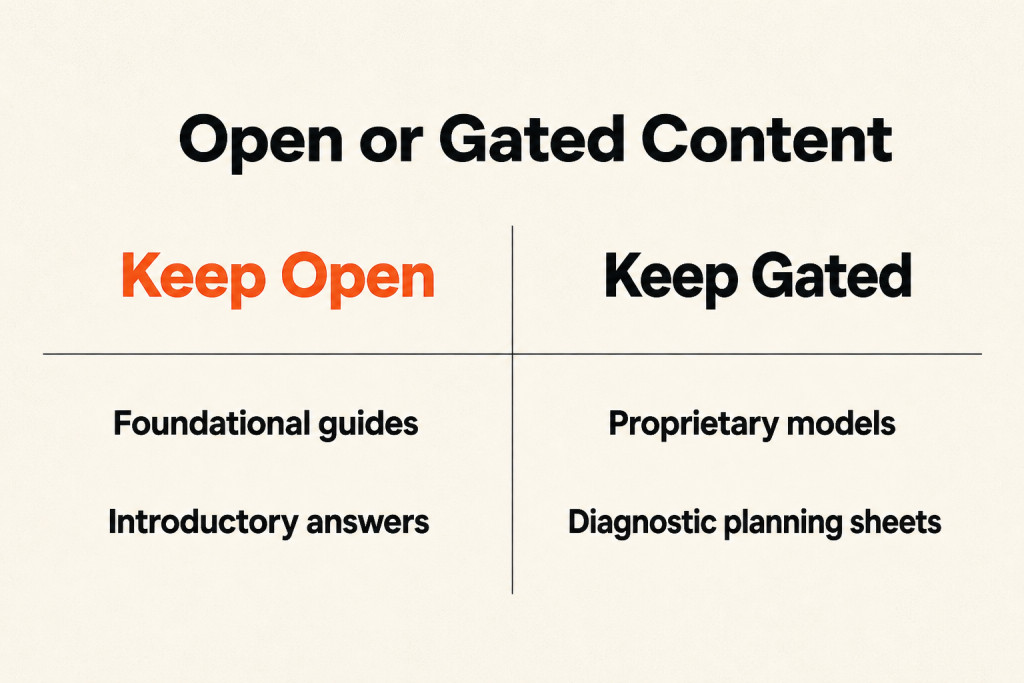
Keep proprietary benchmarking models and diagnostic planning sheets gated, while foundational explanatory guides and introductory answers stay open; forced signup forms can send prospects to ungated rivals. Gate everything and brand awareness suffers; gate nothing and the sales pipeline runs dry.
Strategic Co-Marketing
Co-host a webinar with a firm that does not compete with you, such as a legal or consultancy practice. The partnership can extend your reach to a new, relevant audience and give your insights third-party credibility.
Frequently Asked Questions
Why Invest in Content Marketing for Financial Services?
Digital customer acquisition gets a lift from content that helps buyers learn, compare options, and feel confident before choosing a product or service. It gives them the knowledge to make informed decisions while they look into choices on their own.
What is the biggest mistake financial services make with content?
Spreading effort across every content format before tying it to revenue can leave financial services firms stretched thin. Begin with topics prospects already search when they’re close to a decision, then scale.
How should financial services measure content marketing?
For B2B financial services firms, showing content’s return on investment is how the team makes the case for keeping its budget. Leaders don’t care much about page views; they want a direct connection between the team’s work and business results. Leadership teams are not interested in page views as vanity metrics. Our B2B content marketing strategy guide covers the wider framework, and fintech content marketing looks closer at product-led firms.
What type of content works best for financial services?
Bottom-of-funnel (BOFU) pages are the best place to start, answering commercially focused searches such as “small business line of credit requirements.” Establish the BOFU foundation before expanding. After that base is in place, add educational mid- and top-funnel content to build trust over time.
How Does Content Marketing in Financial Services Compare to Other Sectors?
Financial firms must keep their content within regulations and compliance guidelines as they create and distribute it, a process that adds review and editing. Since the public may know little about finance topics, content should explain concepts, offer guidance, and answer audience questions.
How do financial firms secure budget for content marketing?
Present the budget ask as a proposal for a predictable lead-generation engine, rather than asking leadership to approve a marketing budget.
How can a small team manage compliance?
A small team can keep compliance moving with a repeatable, streamlined workflow, so reviews don’t become a bottleneck that brings everything to a halt.
Should financial firms outsource content production or keep it in-house?
Financial firms can outsource production when they need skilled writing support and regulatory fluency, while keeping subject-matter experts involved and the firm’s voice at the center; this gives the team more time for clients. A skilled writer can shape your ideas into clear, organized articles, making a steady publishing schedule easier to keep. A Content Marketing Agency with regulatory fluency can provide that support while your voice stays at the center. Ask how it manages compliance review, involves subject-matter experts, and supports distribution and performance measurement. Your voice stays at the center, and you get more time to focus on clients.
Key Takeaways
When a firm publishes on a steady schedule, quality has to come before volume if its content is to earn trust and turn prospects into clients.
- Prioritize content quality over quantity to build trust and convert prospects to clients.
- Make your content recognizable: customers should identify you as the source whether they read a 100-character social media post (or a 10-page report).