
Industrial content marketing agencies should help B2B buyers make sense of a supplier’s quality, safety, security, and sustainability standards (buyers may weigh these before they even review product specifications).
Technical topics need clear explanations, not institutional research papers penned by a professor who’s been teaching continuously since Radiohead released “Creep” in 1992. That professor’s still teaching in the same classroom, year after year.
Start by checking what to look for in a partner, then assess the content they can produce.
What to Check Before You Hire an Agency
Polished agency visuals may look impressive, but they say little about its grasp of an industrial field; terminology mistakes can alienate plant managers and procurement engineers, and clean design won’t correct them.
Supplier selection can put procurement professionals and engineers under real pressure. Procurement professionals and engineers need to know whether a supplier can meet demanding standards for quality, safety, security, and sustainability; the product or service alone won’t answer that question. Buyers may consider some certifications non-negotiable, whether a buyer needs a CMMC-certified semiconductor manufacturer or a private-label food-flavoring supplier with SQF certification.
Request a clear set of editorial resources, including the Content Governance Guide, from the agency to keep industrial content accurate and current:

- Editorial Calendar: Records content types and formats, publishing dates, themes and topics, target audience, primary and secondary keywords, editorial guidelines, reference sources, and more.
- Writing Style Guide: Sets out how to use the manufacturer’s name, product names, acronyms, and abbreviations; style and tone guidelines; words to use and avoid; spelling and capitalization; when to deviate from AP style; citations and references; and the brand promise, values, pillars, line, and statements.
- Content Governance Guide: Recommends which team members should update content so the website, social media, and e-newsletter remain fresh and current.
The agency’s content should follow a deliberate keyword plan. The Keyword Lexicon should sort keywords and phrases across products and services, brand ideals, and areas such as thought leadership, innovation, and intellectual capital. The required categories should include products and services keywords, brand positioning keywords, reputation keywords, decisioning keywords, and location keywords. Together, those categories make five categories.
Across the decision funnel, buyers use reputation keywords during awareness, category keywords during consideration, and branded keywords during preference/purchase stages.
Capabilities an Industrial Agency Needs
Industrial content must reach people and search engine bots while persuading buyers and specifiers enough to earn a place on Google page one; a brand people can’t find can’t be bought.

The Content Marketing Institute reports that 86% of manufacturing marketers use content marketing. To serve its purpose, content must connect industrial know-how with the needs of people evaluating potential suppliers. This is central to content marketing for manufacturing companies.
Subject Matter Expertise and Technical Storytelling
Buyers
Buyers want a supplier that can tackle a specific problem and has handled similar problems for other customers. Instead of trying to serve everyone, a supplier can distinguish itself with Problem+Application+Industry expertise.
Your team of content creators, editors and designers
Content creators, editors, and designers need a curious eye to uncover brand evidence and proof, along with an imaginative streak that turns brand appeal into persuasive content.
Customer stories should trace the character’s path, from the obstacles they faced and how they got past them to the way they ultimately changed.
When assessing an agency, ask how it prepares for and conducts interviews with your subject-matter experts, and how it checks technical details before publication. Look for a clear process for turning expert input into stories buyers can understand, with your team able to review and correct the content.
High-Value Technical Asset Production
Industrial companies rely on different formats to explain their solutions in depth and show what those solutions can do. Their asset mix can span several formats:
- High-octane case studies that present customers as heroic problem solvers
- Webinars by subject matter experts
- Videos of product demonstrations
- Infographics
- Whitepapers
- Comparison sheets and Buyer’s Guides
- News & Events information that reveals business vibrancy
- Blog posts showing products as solutions to customers’ problems in various industries
Detailed case studies show how a product or service addressed specific problems for industrial clients, giving visitors a story they can see themselves in. For real-world technical case studies and asset formats, see successful b2b content campaigns. Whitepapers tackle a topic or problem shared by many in the target audience, then explore it in depth, drawing on research to provide useful insights. Case studies can also show how the featured situation was ultimately transformed.
Businesses often require an email address to grant access to content they consider high-value. Request forms usually sort users into groups to gauge lead quality.
Video gives companies a way to show equipment and solutions in action. 91% of businesses use video as a promotional tool, while 87% of marketers say it significantly boosts website traffic. A U.S. company uses videos to bring viewers inside precision machines, including CNC machining equipment imported from the foremost manufacturers worldwide.
AR and VR can make product presentations and virtual walkthroughs of manufacturing facilities feel immediate. Companies can take potential clients through production lines anywhere in the world with immersive VR experiences. Those tours can draw customers in and help them picture products in real-world settings, significantly increasing the chances of purchase.
Account-Based Marketing and Journey Mapping
Account-based marketing focuses content on target accounts, while journey mapping supports buyers with relevant content at the discovery, consideration, and decision stages. Industrial content can give an internal champion material to share with procurement and safety reviewers, then pass along to executive reviewers, rather than leaving it with one person as reading material.
Account-Based Marketing (ABM)
Account-Based Marketing (ABM) centers on key accounts, with campaigns shaped around each account’s challenges and needs. Personalized content and targeted ads can engage decision-makers within those accounts, while direct sales outreach keeps the audience deliberately focused. By directing promotional and sales efforts toward high-value targets, industrial firms can improve their odds of closing deals and build lasting relationships while keeping up with industrial marketing trends.
The results speak for themselves:
- ABM improves sales and marketing alignment for 67% of organizations, leading to a 36% increase in client retention rates.
- Businesses attribute 77% of their revenue growth to ABM, pointing to its role in enhancing sales conversion rates in line with current industrial marketing trends.
- Successful ABM strategies can streamline engagement and build deeper connections with clients, resulting in larger deal sizes and better upselling opportunities.
Industrial prospects
In the Discovery Stage, industrial prospects cast a wide net while working out what problem they have. Information that frames an issue from several perspectives can help build a connection with your company.
Once prospects have named the problem, they enter the Consideration Stage and weigh possible solutions. With many potential vendors offering a lot of different options, content should go past the basics and make your unique value proposition clear, helping prospects tell you apart from competitors.
At the Decision Stage, prospects start weighing the details of a possible purchase or contract. When they understand the choices and details that set your business apart, they can compare your offerings more easily with those of industry competitors.
Based on the number of distribution partners, a typical manufacturer may serve one or more of these groups:
- Buyers, distributors, wholesalers, retailers, agents, and customers, including the design engineer, plant manager, procurement manager, or even the president
- Influencers, engineering, production, operation, supply chain, and quality control teams
Dedicated Agency or Fractional Leadership?
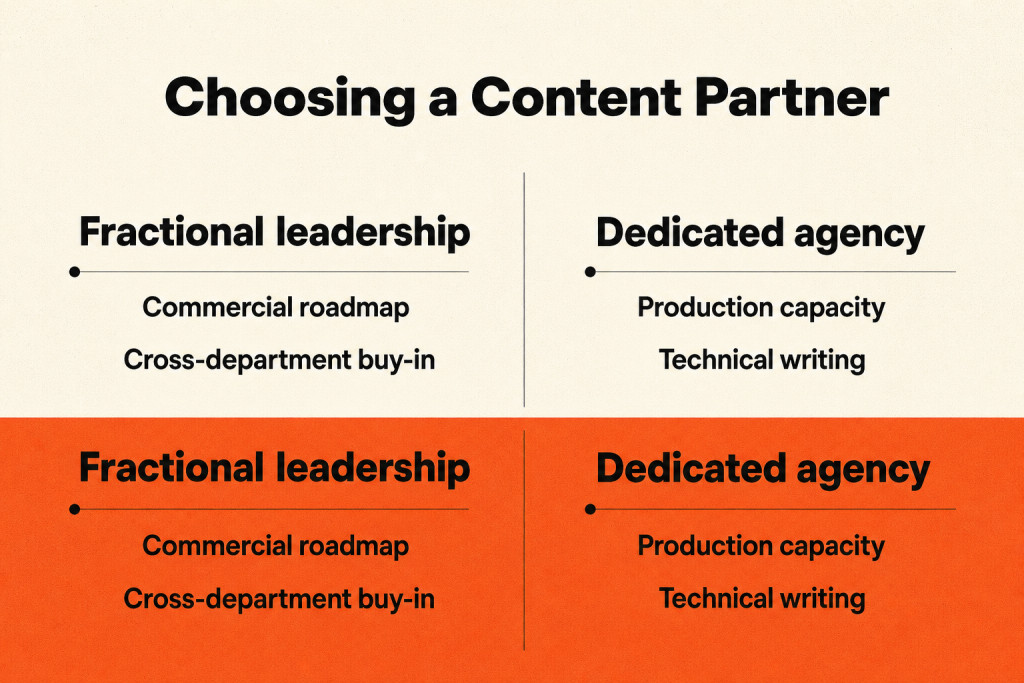
When choosing, start with the gap: fractional leadership fits when you need a commercial roadmap and cross-department buy-in; a dedicated agency fits when strategy is set but production capacity and technical writing are missing. Let the gap shape the brief.
One arrangement you may encounter in industrial B2B is a combined “Sales & Marketing” role, often filled by someone with a strong sales background. That can look like a sensible fit, but the two disciplines aren’t interchangeable; a Content Marketing Agency can provide specialized content production capacity. For the wider framework, read our B2B content marketing strategy guide; the latest B2B content marketing trends show where buyer expectations are heading.
Manufacturers that succeed connect communication to broader strategic revenue and reputation goals. They build a community of friends and allies who engage with their offerings and expertise through insightful, practical, and valuable content.
Connecting Agency Work to Sales and CRM
Agency deliverables should connect to CRM and sales workflows, with each deliverable mapped to the buyer question it answers and the sales handoff it supports. A manufacturing portfolio company may have great potential, strong products, and a loyal customer base, yet growth can still be harder than it should be without that alignment. Operating partners and advisors in private equity have likely seen this firsthand.
A legacy CRM is a common culprit (even if it once served its purpose): it may not fit how teams need to work today. Without that fit, it may not support the sales and marketing collaboration teams need to drive revenue.

Personalization
Personalization in industrial promotion means meeting the needs of individual clients and specific segments. Use Data analytics to reveal client preferences and behaviors and create targeted strategies; track interactions in CRM systems to send personalized emails and tailored product recommendations.
AI-driven tools
AI-driven tools make lead scoring more accurate, helping sales teams prioritize high-potential prospects and improve outreach efforts.
The benefits
Personalized promotions can increase engagement rates by up to 20%.
Promotional decision-makers
With 89% of promotional decision-makers viewing personalization as vital to success, integrating personalized approaches will likely become a cornerstone of effective industrial marketing trends.
Metrics That Prove an Engagement Works
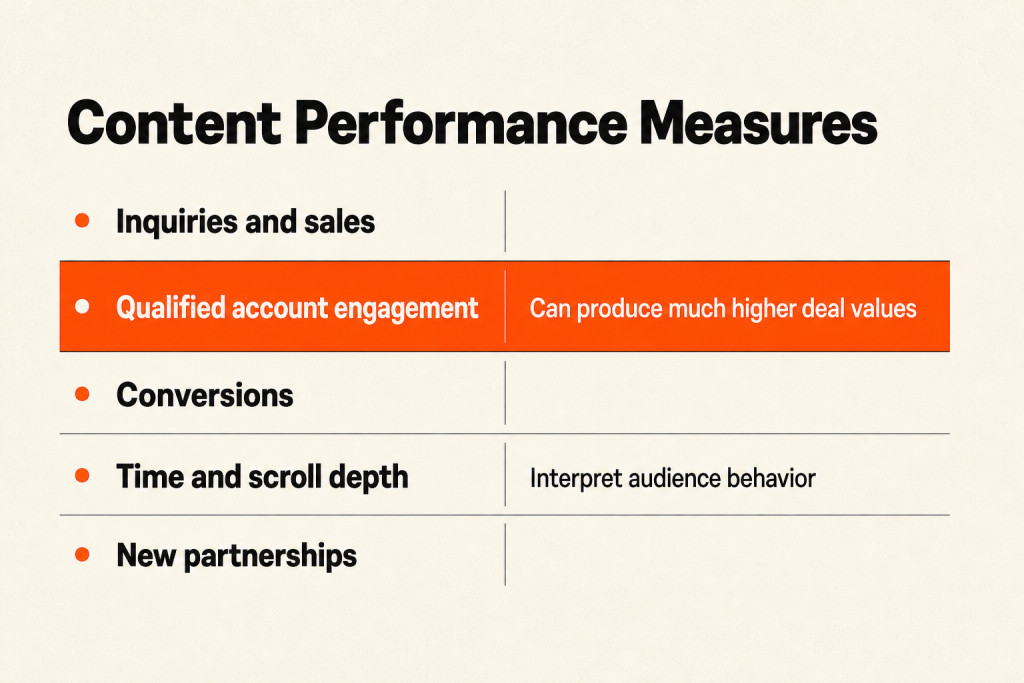
Track inquiries and sales, qualified account engagement, conversions, and audience behavior such as time spent or scroll depth to assess industrial content performance. Qualified account engagement can produce much higher deal values, even with much lower overall traffic volume than broad consumer-style publishing; larger deals can come from less traffic.
- Impact on inquiries and sales
- Views and popularity
- Bounce rate or time spent on a content asset
- Number of shares
- Google page one rankings
- Number of new partnerships formed
Dashboards and KPIs help measure content marketing ROI. Use Google Analytics to track traffic, engagement, and conversions (including conversion rate), then use that data to improve the content strategy over time.
Track these three metrics to assess site behavior and conversion activity:
- Scroll Depth
- Pages Per Session
- Conversions (and conversion rate)
For one manufacturing client, organic traffic grew by a factor of 3X, and organic leads rose 25%. HubSpot research found that industrial companies with blogs generate 67% more leads than companies without blogs.
Conclusion
Choosing an industrial content agency means matching its technical depth and delivery model to the commercial bottleneck your content needs to solve. A portfolio can show what an agency has made, but performance should be judged by inquiries, sales, conversions, partnerships, and engagement from target accounts or RFQs. Time on page and scroll depth help explain how people use content; traffic and rankings offer context, not the outcome. The measures should fit the job you hired your industrial content marketing partner to do. Before you choose, ask each agency to connect one priority content need to the buyer question, sales action, and outcome it would support.