
Converting pipeline opportunities into actual revenue remains the biggest operational hurdle for modern commercial teams, making B2B marketing automation an essential capability.
For accounts involving complex buying groups, reliable automation keeps messy purchasing paths moving forward smoothly. We’ll look at core infrastructure, lifecycle stages, and dominant platforms (the actual machinery). From there, a structured rollout plan shows you how to turn raw prospects into verified revenue growth.

Bringing in fresh contacts is standard marketing routine, but turning those relationships into net revenue is what actually keeps a business alive. In 2026, most B2B teams struggle far less with finding initial prospects than with keeping engagement alive across drawn-out, intricate purchase journeys that lead to closed deals. Stop leaning on manual outreach whenever lead volume spikes. That’s how qualified deals slip away completely unnoticed. Smart automated workflows fix this gap by capturing, scoring, and nurturing entire prospect pools systematically at scale.
B2B marketing automation fundamentals
Across enterprise sales, companies run dedicated automation platforms to manage routine marketing work. These systems guide prospects along multi-month paths and align target accounts without someone stepping in at every single turn.

Large corporate deals take months instead of settling in an afternoon. Between 6 and 10 separate decision-makers review products on their own schedules. Connect smart tools to your automation system so the software pairs resources with buyers based on their job titles, core interests, and current stage. That steady setup keeps conversations organized across every account interaction until the contract closes.
Asking a small marketing group to guide hundreds of deals by hand through a 6-month sales cycle just falls apart mathematically. I once believed sheer effort could fix the problem, but tailoring messages for every contact breaks small teams. Automation handles those repetitive daily tasks. That lets your people spend their hours on actual strategy and creative messaging.
Core definition
In business sales, marketing automation means software that coordinates, schedules, and tracks routine promotional tasks. Teams run their campaigns through these tools to work faster. They cut out manual effort across outbound email sends, social posts, and paid ad distribution.
Three core jobs define how the software operates every day. First, it tracks lead activity across web visits, email opens, content downloads, and online event attendance. Next, the system scores and groups buyers by company traits and actual habits. Then it kicks off tailored message sequences matched to where each person sits in the buying journey, removing everyday guesswork.
System results depend on clear rules shared between sales and marketing, which should be built into your broader B2B digital marketing strategy. When someone downloads a technical guide, the platform acts right away. It places the contact into an automated sequence, updates their qualification score, and flags the right sales rep. System alerts assigned commercial sales representative immediately upon these triggers. Every follow-up touchpoint gets logged so your pipeline shows real buyer interest. Work that once ate up team hours wraps up instantly and reliably.
Modern B2B digital marketing software connects automation engines directly to CRM, analytics tools, ad channels, and resource libraries. They do far more than send emails. They steer the whole buyer journey from the very first visit to the signed contract without losing track of important details.
Distinctions from B2C models
While consumer tools and corporate platforms look similar on screen, they handle very different business realities. Clear operational divides separate the two approaches across process setup, core metrics, and sequence structure:
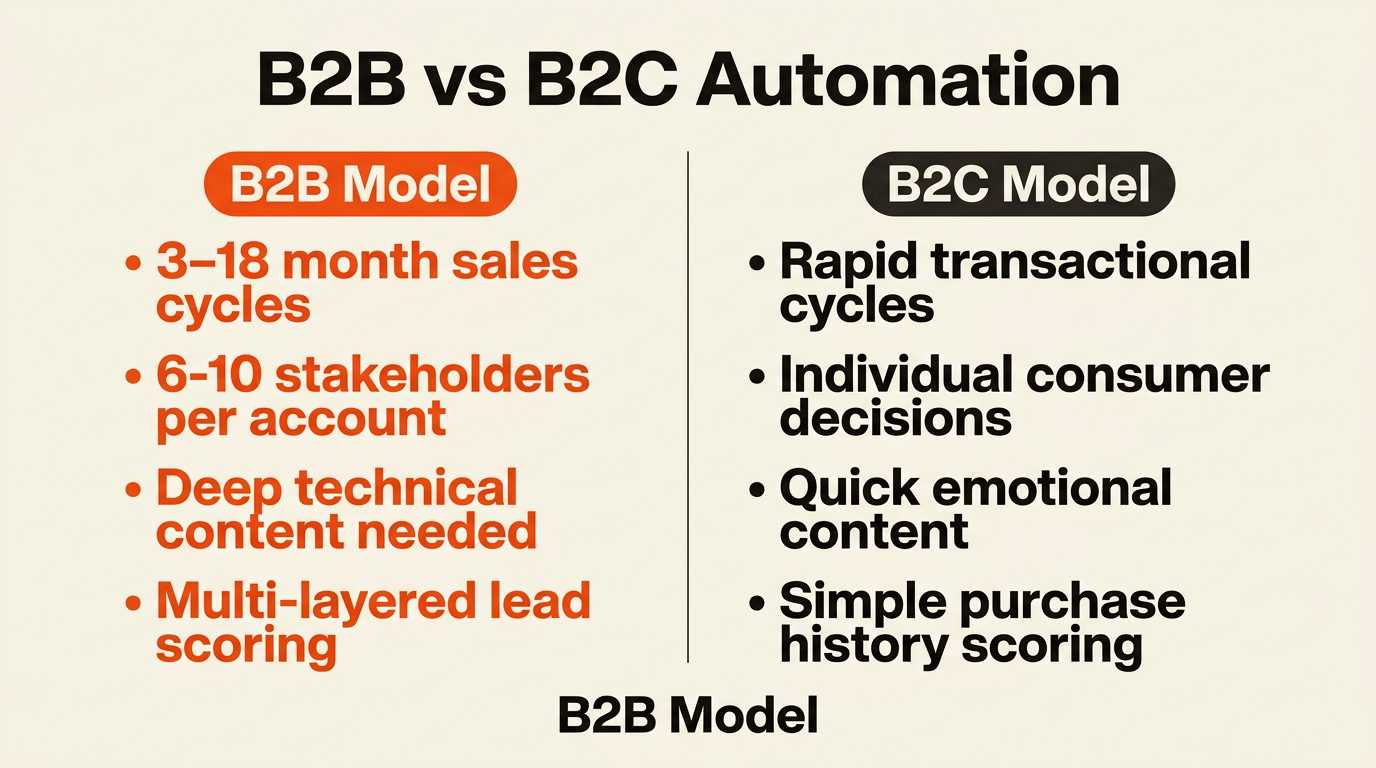
- Sales cycle length and complexity, B2B cycles run 3-18 months with multiple touchpoints. Your automation must nurture leads through extended evaluation periods, maintain engagement
- Multiple decision-makers vs. individual buyers, B2B deals involve 6-10 stakeholders per account. Your marketing automation software tracks individuals, but scores and routes at the account level.
- Content depth and personalization requirements, B2B prospects consume case studies, technical documentation, ROI calculators, and industry-specific content before engaging sales. Your marketing
- Lead scoring complexity, B2B scoring models weigh firmographic data (company size, industry, revenue), behavioral data (content consumed, pages visited), and account-level
- Integration requirements, enterprise automation software must sync with CRM systems, sales enablement platforms, account-based marketing tools, and attribution software.
Sales cycle length and complexity
Typical enterprise deals span 3-18 months with dozens of checkpoints along the road. Your software must stay active across long review cycles, hold attention during quiet stretches, and wake up conversations whenever new buyer signals appear. Consumer platforms manage retail sales that wrap up within days using rapid sequences and fast impulse triggers.
Multiple decision-makers vs. individual buyers
Most corporate deals pull in 6-10 stakeholders per account. Your software tracks specific people, but scores and routes the entire company together. You need sequences that send tailored materials to CFOs, technical reviewers, and end users at the exact same time, while consumer systems only speak to solo shoppers.
Content depth and personalization requirements
Business buyers read customer stories, technical teardowns, ROI calculators, and sector research before they ever talk to a salesperson. Your automation system has to serve the right piece based on job title, company size, and evaluation stage. Consumer content stays quick, emotional, and far, far less technical.
Lead scoring complexity
Enterprise scoring balances company firmographics like revenue and team size with buyer actions like page visits and asset downloads. One contact grabbing a single PDF does not make a qualified lead. Consumer scoring looks much simpler, where order history, cart value, and basic demographic data tell you everything you need.
Integration requirements
Corporate automation platforms have to sync cleanly with CRM records, sales enablement software, account tools, and attribution models. Sales reps need instant access to qualified opportunities without digging through separate screens. Consumer tools link mainly to digital storefronts and ad networks through much simpler data connections.
Automated programs guide most of the early buying journey today. Even with all that technology running, closing the deal usually still requires sitting down face to face.
Primary benefits
Adopting automated systems delivers clear, measurable improvements across pipeline growth, team productivity, and prospect engagement:
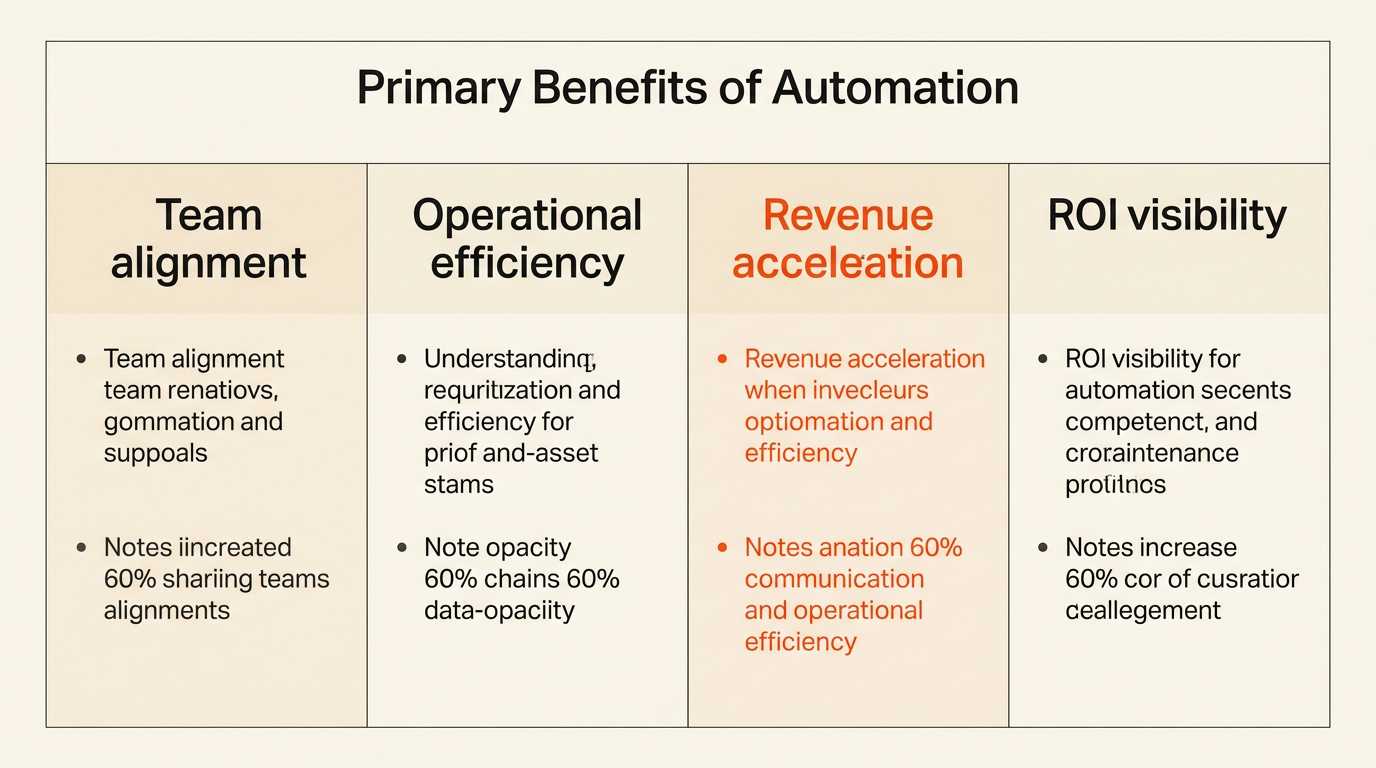
- Revenue acceleration through faster lead conversion, Automated nurture sequences move prospects through the sales funnel 20-30% faster than manual follow-up. Your sales team engages leads when they’re
- Sales and marketing alignment on lead quality, Shared lead scoring criteria and automated handoff workflows eliminate the “these leads are garbage” problem. Sales knows exactly why a lead is
- Operational efficiency that scales without headcount, One marketer with automation does what used to require three people doing manual tasks. Your team handles 10x more leads, runs more campaigns, and
- Attribution and ROI visibility become measurable, Manual processes can’t track which campaigns influence $500K deals over 9-month cycles. Automation connects first touch to closed revenue, shows
Revenue acceleration through faster lead conversion
Targeted nurture workflows advance prospective clients across sales stages 20-30% faster than unautomated rep outreach. Sales reps step into the conversation when buyers are genuinely prepared to purchase, rather than chasing cold dates or dropped reminders.
Sales and marketing alignment on lead quality
Shared qualification criteria and automatic handoffs settle old disputes between sales and marketing teams. Reps see the exact events that earned a lead, while marketers track which prospects become paying customers and refine their criteria using real sales data.
Operational efficiency that scales without headcount
One specialist backed by automation can replace the manual output of three team members across routine campaigns. That leverage lets you process 10x more leads without hiring more staff.
Attribution and ROI visibility become measurable
Manual spreadsheets cannot show how marketing touches influence $500K contracts across an extended 9-month cycle. Automation ties early visits straight to closed revenue, highlights which guides generate pipeline, and verifies marketing impact on business growth.
Investment readiness
Enterprise automation setups bring real software costs and operational friction. Breaking even takes at least six months of steady use, usually becoming justified once you produce more than 15 leads per month. Rushing into these platforms will not pay off for every business profile.
Deciding if your business is genuinely ready for automation means taking an honest look at specific operational baselines, Industry context, and Previous marketing & sales processes:
- Do you generate more than 15 leads per month?
- Individual components of your sales process can be digitised?
- You want to address your prospects/customers in a targeted and personalised way?
- Do you prefer to work with one central system rather than dozens of different ones?
- Are you planning to scale your business processes?
Knowing whether adopting the system makes sense depends on evaluating several clear organizational factors:
- Customer structure
- Previous marketing & sales processes
- Industry
- Budget
- Product range & services offered
Once your company meets one or more of these operational conditions, investing in marketing automation becomes a sound practical move.
If sales reps spend hours manually emailing early-stage leads who never write back, bringing in an automation system makes complete sense. But hold off on software if your reps know every prospect by name. Generating real buyer demand has to come first when your pipeline numbers are still that small.
A growing enterprise should adopt marketing automation when lead volume climbs, sales paths grow complicated, and manual outreach cannot keep up. Keeping up with B2B digital marketing trends also means recognizing when automation has become necessary to support increasingly complex buyer journeys.
Installing automated systems delivers the best results once your basic demand programs and core messaging already run smoothly. Take the time to build those foundations first.
The automation lifecycle
If you want to see how enterprise automation builds real pipeline, break the machinery into connected stages.
Prospect capture
Fresh prospects enter your pipeline through web forms, landing pages, gated downloads, industry events, and site visits. Automation tools safely gather these leads across forms, email campaigns, social channels, and content efforts. Put every record into your central CRM right away. From there, the database tracks browsing patterns and email history.
Lead qualification
Scoring models use point values to rank new contacts by how much they engage. Your team filters out noise by combining demographic traits like job titles and organization size with digital behavior. Some accounts look very, very ready. Commercial teams separate hot opportunities from bad fits, leaning on predictive algorithms trained on broad datasets to sharpen the calls. Using fixed-point rules, automated tools weigh complete profiles against campaign responses so reps can spot their strongest prospects fast.
In practice, qualification works as a two-way screen: account profile criteria confirm sufficient purchase budget, at least on paper. Then behavioral trends show whether they plan to buy right now.
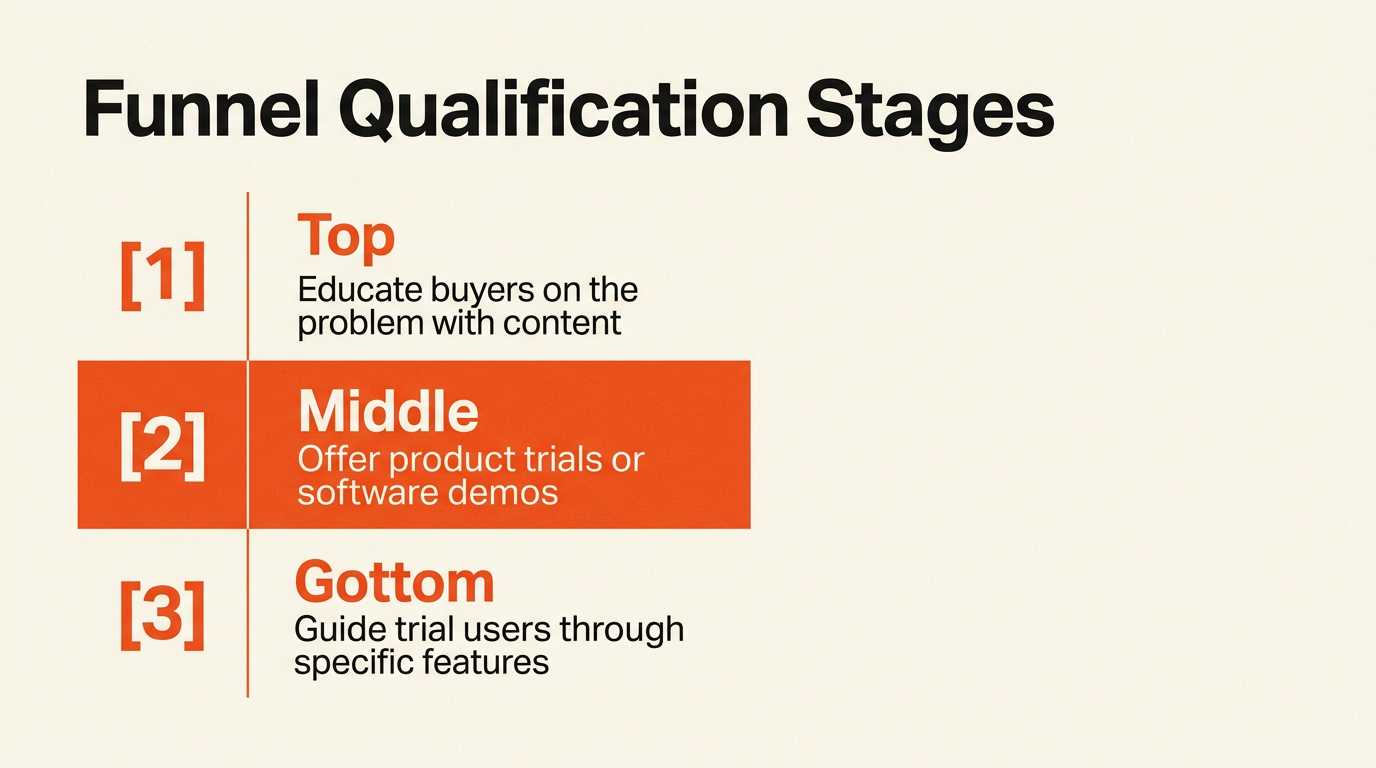
Enterprise qualification follows a step-by-step path across your pipeline stages:
- Top of the funnel: You create blog posts, infographics, and webinars to educate potential customers about the importance of the problem your services solve.
- Middle of the funnel: Once potential customers begin showing interest, you send targeted emails or newsletters, offering a free trial or a software demo.
- Bottom of the funnel: Once they start using your trial, you send follow-up emails to guide them through specific software features and answer questions.
Automated nurturing
Throughout automated nurturing, buyers get educational content through focused email tracks and tailored experiences. That drip builds trust, answers straightforward questions, and readies people for a real sales conversation.
These email workflows trigger directly on user activity. When someone clicks or registers, the software moves. In an example scenario, the system sends a welcome email series explaining features immediately after user sign-up.
At a B2B SaaS company, your sales funnel looks very much like this:
Sales hand-off
Once a prospect clears agreed qualification benchmarks, software marks the record as a sales qualified lead. Pass those accounts straight to commercial reps to cut friction between teams. Score behavioral and firmographic signals automatically. The platform then distributes top deals across territories and industry specialties without any human intervention.
Setting up native Salesforce integrations stops data delays between marketing and sales teams. Both groups see identical details, giving account executives a complete activity history.
Implementation best practices
Enterprise integrations demand substantial capital and genuine patience, so organizations should anticipate at least six months before these workflow adjustments yield measurable returns. Expect 6-12 month deployments for enterprise platforms.
Funnel journey mapping
When mapping out your sales funnel, think through everything from the bottom up. Start with your primary online target, whether that means a qualified lead or a closed deal, and work backward step by step until you arrive at first contact.
Map out your sales funnel early so you identify the exact touchpoints where automation actually adds value. That usually means lead scoring, nurturing prospects over time, and handling follow-up messages. Spell out your existing status quo clearly. Both outside consultants and your internal IT group will need to examine operations really, really hard. External specialists must understand your company structure in detail before software runs smoothly.
Strategic roadmapping
Early benchmarks and clear targets protect your schedule from unexpected delays later in the rollout. Map out a timed schedule that defines responsibilities, accountabilities, and every task that arises along the way. Take your time with this planning stage. Careful preparation always pays off many times over the course of the project.
Leading adopters combine automated systems with solid data foundations, firm governance rules, and tight coordination between marketing and IT teams. Set up direct communication channels between sales and marketing using regular meetings and joint strategy sessions. Shared discussions keep daily activities aligned with overarching business goals.
Key performance indicators
Important key figures are:

Establish clear goals and milestones from project initiation to keep teams focused on measurable success. Use your marketing automation platform to create shared dashboards and reports, giving both teams live visibility into lead stages and campaign results. That transparency builds clear accountability and keeps everyone focused on driving conversions together. Senior executives get to watch pipeline attribution and return on investment unfold in real time as deals progress.
Privacy compliance
Compliance with GDPR mandates remains essential if you want a legally sound setup. You must pay special attention to data tracking and automated email marketing. In both cases, securing explicit consent directly from the customer is an absolute requirement before you do anything.
Digitisation and data go hand in hand, and enterprise B2B software stacks produce piles of sensitive company and customer information. You must protect that data from unauthorised access and misuse across every connected system. Paying for sound expert advice before launching campaigns is simply smart business. Data protection violations cost serious money on one side and destroy buyer trust on the other.
System maintenance
B2B marketing automation projects are constantly changing and evolving over time. If you want your system to hold up, adapt continuously to legal, technical, and operational shifts. Update your software on schedule, keep your records clean, and push for steady improvements during everyday operations.
Use the built-in analytics inside your automation platform to track key performance metrics and pinpoint specific problem areas. Adjusting active workflows based on regular reviews of performance data keeps your entire engine sharp. Building that culture of continuous improvement makes sure your sales and marketing efforts stay aligned and effective.
Iterative optimization
Most automation tools offer powerful options for detailed performance tracking, but numbers alone fix nothing. Evaluate your defined metrics on a regular schedule to see which workflows succeed, which have room for improvement, and which are completely ineffective. Optimizing your marketing step by step takes really, really consistent work. That steady habit will noticeably improve your results.
Implementation challenges
A rollout across an enterprise takes 6 to 12 months of heavy management. Make sure certified administrators get specialized training on behavior-driven platforms. Without engineering resources for data integration, messy data won’t let the system tailor user experiences or make back any ROI.
Internal adoption stalls whenever reps ignore automated alerts because marketing qualifies accounts without agreeing on what a ready buyer looks like. I once let sales reps complain that the leads were garbage, but you need shared data and consistent definitions. Lock down shared lead scoring criteria with automated handoff workflows. That simple discipline keeps both sides working on the highest-value opportunities.
Frequently asked questions
What is B2B marketing automation?
Think of this technology as software and workflows designed to capture, score, and nurture leads through long buying cycles. Instead of running disconnected campaigns, teams use the technology to combine account records with performance metrics. That coordination ties your data and scheduling together so prospective accounts keep moving forward. You end up guiding people from initial curiosity to sales readiness at scale.
When should a company invest in marketing automation?
Start investing once your incoming lead volume climbs and sales cycles turn complicated. Manual outreach falls apart the moment the pool of active and prospective buyers expands across your whole business. Core demand-generation foundations must already be operational before rollout, and messaging clarity must be established prior to automated distribution. The whole process pays off only after those pieces are in place.
How do sales and marketing align through automation?
Automation establishes uniform lead definitions and centralizes shared lead data across both departments so both groups look at identical customer records. Automated handoffs keep attention focused on high-value opportunities, but your teams still need regular collaborative planning meetings together. Shared dashboards and reports inside the platform give instant visibility into lead progress and campaign performance. That common picture keeps everyone accountable across the entire pipeline.
What are the common implementation mistakes?
Launching software without an underlying operational strategy suppresses meaningful ROI, and populating automation engines with inaccurate or dirty data degrades workflow outputs. Improper process configuration creates operational breakdowns across daily activities. Organizations also struggle when killing personal touch with over-automation. Post-hoc remediation expenses escalate significantly higher than the upfront cost of hiring qualified implementation specialists. Hire experienced professionals to handle the entire rollout from the start.
Treat marketing automation as a living operating model to produce steady revenue as buyer needs, internal data assets, and company goals shift over time. Early on, I handled setups as isolated, one-off projects, but you must continually tune your system rules. Disciplined teams never stop refining their core platforms.
Ditching random email blasts remains the most direct way to defend your pipeline. You now possess the structure to guide buying committees across extended cycles without exhausting your reps. Before launch, respect GDPR rules by securing explicit consent and building compliant tracking. Then give the architecture at least six months to settle into everyday sales routines. When your B2B marketing automation matches how accounts evaluate purchases, the underlying engine holds up. That daily rigor turns genuine interest into dependable revenue.