If you’re a beginner searching “what are Meta Ads” to decide whether they fit your business, the real question is what you need them to do and what your budget can test.
You’ll come away better able to judge whether Meta Ads suit your business and which choices shape your budget, from a simple Boost Post to a full campaign. This guide explains what are Meta Ads, where they appear, how the auction works, and what they typically cost. One detail worth watching: the highest bid doesn’t always win.
What Are Meta Ads and Their Ecosystem
Meta Ads are paid ads that run across Facebook, Instagram, Messenger, WhatsApp, and the Audience Network, all managed in one tool, Meta Ads Manager.

Across that system, Meta reaches more than 3 billion monthly active users and accounts for roughly a quarter of worldwide digital advertising spend. The table compares each property’s audience and typical use case.
| Property | Monthly active users | Typical use case |
|---|---|---|
| ~3 billion | Broad reach, lead generation, local business targeting | |
| ~2 billion | Visual storytelling, younger audiences, Reels and Stories | |
| Messenger | ~1 billion | Click-to-Message ads, customer service, re-engagement |
| ~2.5 billion | Click-to-WhatsApp ads (emerging) | |
| Audience Network | n/a | Placements on third-party apps and websites |
A few more figures show the scale:
- 3.2B daily active users across Meta’s platforms
- 10M+ active advertisers globally
- $131B in Meta’s annual ad revenue (2023)
Those audiences serve different business needs, so match each property to how your business finds customers.
How Meta Ads Help Small Business
Meta Ads help small businesses build awareness, generate leads, and reach potential customers who aren’t actively searching. That is the key difference from Google Ads, which catches people who are already searching.
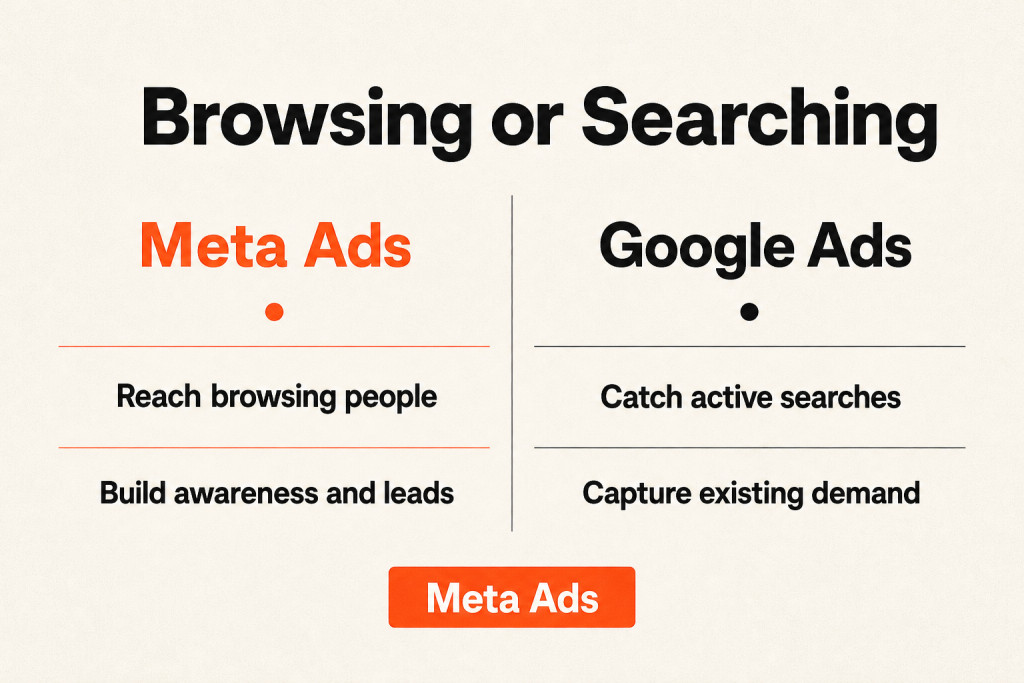
Meta Ads create demand. Interest targeting puts your offer in front of people who don’t yet know they need it, like a shop window catching someone’s eye as they walk by. Interests, behaviors, demographics, life events, and purchase intent signals all help shape the audience.
Google Ads capture demand. Search ads answer people who are already asking, much like giving directions to someone who asks. If you are weighing the two, see are Google Ads worth it. Many businesses use both: Meta to create interest, search to capture it.
Meta Ads suit a range of business types and goals:
- Service businesses (coaches, consultants, agencies, clinics, law firms): lead generation campaigns work well for collecting client inquiries.
- E-commerce businesses: catalog ads and retargeting recover abandoned carts and can deliver strong ROAS.
- Local businesses (restaurants, salons, gyms): target people within a specific radius of your location.
- Online course creators and coaches: build audiences, then sell programs to a highly targeted group.
- B2B businesses targeting SMEs: small business owners are active on Facebook, where professional targeting can reach them.
Meta Ads may not be the best fit if:
- You sell high-ticket enterprise B2B software; LinkedIn Ads may work better.
- Your audience mainly searches Google before buying; Google Search Ads are more effective.
- You have no budget for awareness and need immediate revenue-generating clicks.
You can start with as little as $1 a day, though a useful test needs more (see the budget section below).
How Do Meta Ads Work in the Auction?
When someone opens Facebook or Instagram, Meta runs a real-time auction to decide which ad they see. Thousands of advertisers compete for the same slots, but the advertiser offering the most money doesn’t always win.

For each auction, Meta weighs three factors:
- Bid amount: how much you’re prepared to pay for a result, such as a click, lead, or purchase.
- Estimated action rate: how likely Meta predicts that specific person is to take the action you want, based on their behavior history.
- Ad quality and relevance: how good and relevant your ad is to the audience, based on engagement, feedback, and hide rates.
The winning ad has the strongest combined score, not necessarily the biggest bid. That is why compelling creative at a $5 CPM will often beat generic copy at $20 CPM: creative quality can matter more than budget.
Once launched, each new campaign or ad set goes through a learning phase, which typically lasts until it records about 50 optimization events, such as clicks, leads, or purchases.
- Delivery is noisy and inconsistent while the algorithm tests audience segments.
- Avoid major changes during this window.
- Wait for enough optimization events before judging an ad set’s performance.
Large budget shifts, major audience edits, and creative overhauls can reset the learning phase and make results unstable.
The Three-Tier Campaign Structure
Meta Ads use three levels: the campaign sets the business goal, the ad set defines who sees the ad and how the budget is spent, and the ad is the creative people see. A typical small account runs 2-5 active campaigns, 3-10 ad sets per campaign, and 3-5 ads per ad set; more sprawl than that spreads data too thin for the algorithm. For a practical walkthrough, see how to run Meta ads.
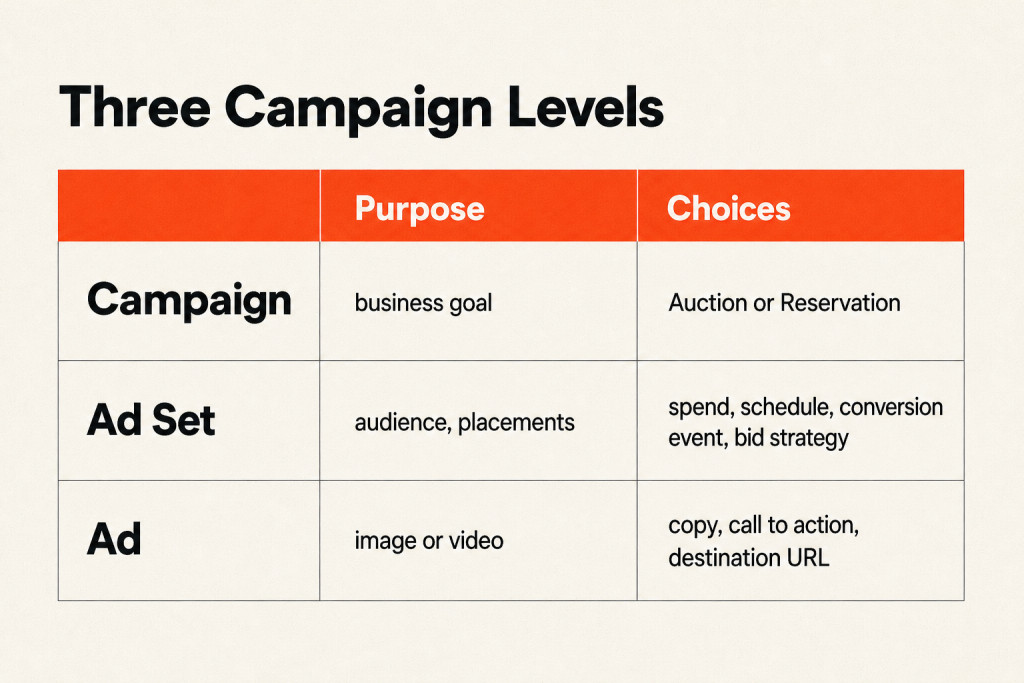
Campaign Level
The campaign sets the objective, which tells Meta’s algorithm which outcome to pursue:
- Awareness: reaches as many people as possible.
- Traffic: sends people to your website or landing page.
- Engagement: gets likes, comments, shares, and page follows.
- Leads: collects names, emails, and phone numbers; best for service businesses.
- App Promotion: drives app installs and in-app actions.
- Sales: drives purchases on your website or in your app.
Choose your objective carefully. Meta shows your ad to the people most likely to take the action you picked. If you choose Traffic when leads are the real goal, expect plenty of visits and very few enquiries.
At this level you also choose a buying type and whether to use campaign budget optimization:
- Auction: flexible, low minimum spend, variable performance; best for most advertisers.
- Reservation: locks in impressions in advance at predictable CPMs; best for large brand campaigns.
- Campaign budget optimization: lets Meta spread one budget across your ad sets.
Ad Set Level
The ad set sits in the middle: it decides who sees the ad, where, when, and for how much.
- Audience: who you want to reach, by age, location, interests, or custom audiences.
- Placements: where your ad appears, including Feed, Stories, Reels, and more.
- Budget: how much you spend per day or over the campaign lifetime.
- Schedule: when your ads run, all day or during specific hours.
- Bid strategy: how Meta bids in auctions on your behalf.
For most conversion campaigns, set the conversion location to “Website,” choose “Maximize number of conversions” as the performance goal, and pick the conversion event Meta should optimize for. Make sure that event is set up correctly and firing. Then choose a bid strategy:
- Highest volume (default): Meta gets as many results as possible within your budget; best for beginners.
- Cost per result goal: you set a target cost, and Meta tries to stay at or below it while maximizing volume.
- Minimum ROAS: for e-commerce, you set a minimum return on ad spend, and delivery runs only when Meta expects to meet it.
Ad Level
The ad is what people actually see:
- The image or video
- The primary text (main copy)
- The headline
- The call-to-action button, such as Learn More, Sign Up, or Shop Now
- The destination URL
Formats include single image, video, carousel, collection, and Instant Experience. To start simply, launch two ads, one video and one static image, so Meta has options across placements. Add up to five primary text and five headline options to test pain points, solutions, personas, or angles.
For aspect ratios, use square or 4:5 creative in feeds, 9:16 in Stories and Reels, and 1:1 in right-column and search placements.
Audience Targeting Options
Meta Ads offer three audience types, each drawing on different data:
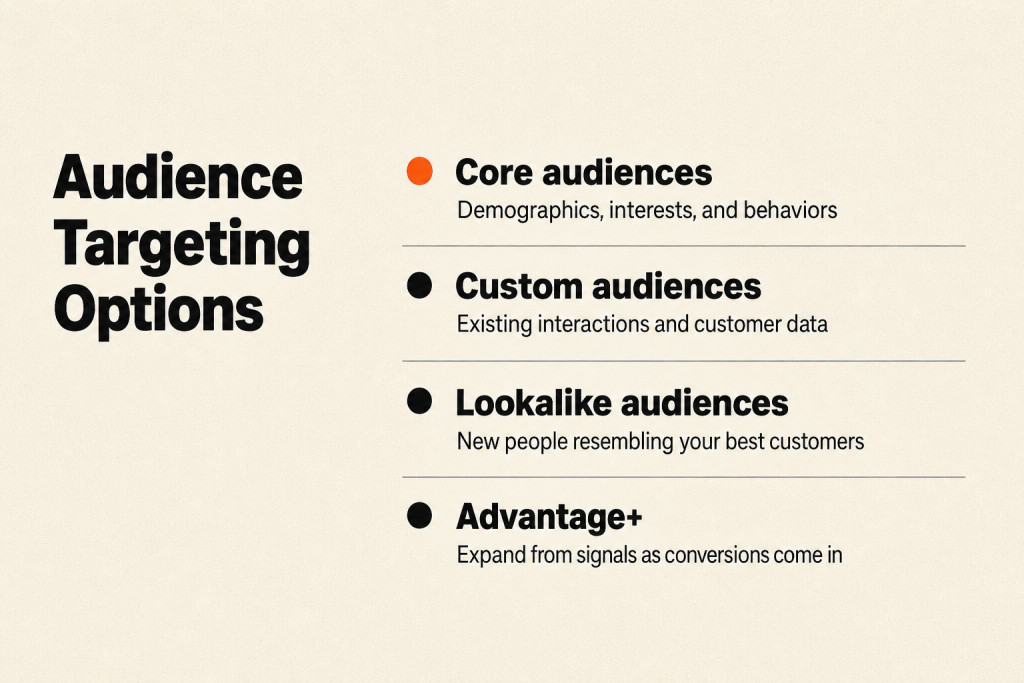
- Core audiences: target people by demographics, interests, and behaviors, narrowed by age, gender, and location.
- Custom audiences: built from website visitors tracked by the Pixel or Conversions API, app users, video viewers, engaged users, and customer lists.
- Lookalike audiences: reach new people who resemble your best customers.
A 1% lookalike of your customer list is a useful first cold-audience test, though results depend on your data and campaign goal.
Meta’s AI-driven targeting (Advantage+ audience) lets you add optional signals, such as age range and interests. As it learns who actually converts, the algorithm can expand beyond them.
Where Are Meta Ads Shown Across Placements
Meta ads appear in Facebook and Instagram feeds, Stories and Reels, Facebook Marketplace, the Audience Network, Messenger, and Facebook search results. Start with automatic placements unless clear data shows one underperforming, because Meta moves budget to wherever results are best. Removing placements on a hunch usually means fewer impressions and higher costs.

- Facebook Feed: the main news feed on desktop and mobile, with the highest reach across age groups.
- Instagram Feed: best for visual, high-quality creative aimed at 18-40 age groups.
- Facebook and Instagram Stories: full-screen vertical ads; vertical video works best.
- Facebook and Instagram Reels: short-form video placements that feel organic when done well.
- Facebook Marketplace: good for local and product-based businesses.
- Audience Network: partner apps and websites that extend reach at a lower CPM.
- Messenger: ads in the Messenger inbox that work well for direct response.
Typical Costs and Budgeting
A small business can start Meta Ads with $5-10 a day. Across industries, average CPC is around $1.14 and average CPM is approximately $14.19, and most small businesses test with $300-500 a month before scaling what works.

Prices come from the auction, so they shift with your audience, industry, country, time of year, and how crowded your niche is. As a rule of thumb, wait until a new campaign has spent $500-1,000 and run for 7-14 days before drawing conclusions.
For a quick benchmark range, compare your numbers with these averages, and see what is a good CPM for Meta ads for more context:
- Average CPM: $10-15 (cost per 1,000 impressions)
- Average CPC: $0.80-1.50 (cost per click)
Conversion rates and lead costs vary widely by industry:
| Industry | Conversion rate | Cost per lead |
|---|---|---|
| Restaurants & Food | 18.25% | $3.16 |
| Attorneys & Legal | 10.53% | $18.17 |
| Real Estate | 9.53% | $16.61 |
| Education | 10.08% | $28.22 |
| Financial Services | ~9.09% | ~$58.70 |
| Dentists | 6.38% | $76.71 |
| Home & Home Improvement | 5.22% | $41.26 |
| Cross-industry average | 7.72% | $27.66 |
With a modest budget, keep the setup simple. Every extra campaign and ad set divides the budget more thinly, and the algorithm may not gather enough conversion data to stabilize.
Frequently Asked Questions
Are Meta Ads and Facebook Ads the same?
Yes. Facebook Ads became Meta Ads after the parent company renamed itself Meta in October 2021. Ads Manager, targeting options, and billing work the same way; only the brand changed, and the platform now covers Instagram, Messenger, and WhatsApp as well as Facebook.
How much do Meta Ads cost?
You can set a budget as low as $1 per day, but the algorithm needs enough events to optimize. Typically, $30-50 per day for 7-14 days gives it time to clear the learning phase. The average cost per lead across industries is about $27.66. For more detail, see how much do Meta ads cost.
Do I need a website to run Meta Ads?
No. You can collect leads with Instant Forms, send people to your Facebook Page or Instagram profile, or direct them to WhatsApp. A website with the Meta Pixel installed does improve performance and enables retargeting.
What is the Meta Conversions API and do I need it?
The Conversions API (CAPI) sends conversion events from your server directly to Meta. Because iOS privacy changes and browser tracking prevention make the Pixel less reliable, serious advertisers should treat CAPI as essential; without it, the algorithm learns from only a fraction of your conversions and cost per lead climbs.
Conclusion
Meta Ads is the current name for Facebook Ads, a single system for reaching people across Facebook, Instagram, Messenger, and WhatsApp before they start searching. Pick the objective that matches your real goal, keep the account structure simple, give the algorithm enough budget and time to learn, and pair the Pixel with CAPI so it learns from reliable data. Now that you know what are Meta Ads and how they work, start with a small test budget and scale what brings results.