Wondering why your company is losing organic clicks? It is likely because search behavior has changed faster than most SEO strategies. With AI tools, users are getting answers without ever clicking through to websites. Recent data stated about 60% of searches now end without a click in some verticals.
That’s where generative engine optimization – GEO agencies in Singapore come in, helping brands stay visible when AI becomes the interface.
This guide breaks down what GEO actually means, why traditional SEO is falling short, and how to evaluate agencies that claim they can help you adapt. If you’re deciding where to invest next, this will save you time and, realistically, a lot of wasted budget.
How We Ranked Singapore’s Top GEO Agencies
To rank the top generative engine optimization agencies in Singapore, we looked at documented case studies, agency websites, published content, and third-party signals like client reviews and industry reputation.
We prioritized factors that reflect real GEO capability:
- AI technology integration (35%)
Ability to optimize for generative engines using proprietary tools or clear AI-focused methods - Proven GEO results (25%)
Evidence of improved AI visibility, citations, and measurable outcomes - Authority and credibility (15%)
Client feedback, reputation, and presence in the digital marketing space - Leadership expertise (15%)
Team experience across both SEO and AI-driven search strategies - Specialized GEO services (10%)
Offerings like AI-focused content, reputation building, and technical readiness for LLMs
(If you’re evaluating agencies, this is where having a clear digital marketing strategy makes a big difference.)
Read more: Top Google Ads Agencies in Singapore (2026)
Top 10 GEO Agencies in Singapore: 2026 List
1. Golden Owl Digital

Golden Owl Digital (GODI) is a performance-driven agency that has pioneered the Answer-First content methodology in Singapore. We specialize in bridging the gap between technical SEO and conversational AI, ensuring brands aren’t just indexed, but cited as primary sources by LLMs like Gemini, ChatGPT, and Perplexity.
What separates GODI in practice is how tightly strategy and execution are connected. Most teams either focus on content or technical SEO, but GEO requires both to work together. Our approach starts with diagnosing how a brand currently appears inside AI answers, then restructuring content, entities, and distribution so AI systems can actually use it.
In one recent B2B project, we helped DISC Personalities increase AI citation visibility by over 560% within three months. This came from implementing AI-optimized content strategies, strengthening entity signals, and building a tighter content-to-distribution loop.
Top services:
- Conversational Intent Mapping: Aligning content with how users actually talk to AI.
- Citation Engineering: Strategies to win Source links in AI Overviews (AIO).
- B2B Content Knowledge Graphing: Structuring data for better AI extraction.
- Entity-Based Optimization: Building brand authority as a verified entity in the eyes of search engines.
- Integrated SEO Campaign: Combining SEO and GEO to provide a comprehensive growth path and maximize B2B performance.
Pricing: Custom packages starting from $1,500 – $5,000/month (highly competitive for the specialized GEO niche).
Best for: SMEs and B2B SaaS companies looking for agile, high-ROI strategies that future-proof their organic traffic against zero-click searches.
Find out: SEO Agency Pricing in 2026: Average Costs and Package Guide
2. First Page Digital

As one of Singapore’s largest agencies, First Page Digital uses its massive data scale to provide Platform-Specific GEO. They treat optimization for Google Gemini differently than ChatGPT, providing a granular approach to AI visibility.
Top services:
- Multi-Platform LLM Footprint Analysis.
- AI-Powered Keyword & Sentiment Research.
- Technical Schema & RDFa implementation for AI crawlers.
Pricing: Project-based starts at $5,000+; Retainers typically range from $2,500 – $10,000+/month.
Best for: Large Enterprises and MNCs requiring high-volume data analysis and a global reach.
3. OOm Singapore

A premier Google Partner with nearly two decades of experience, OOm has integrated GEO into its Holistic Search framework. They focus on maintaining traditional rankings while simultaneously capturing Answer Engine real estate.
Top services:
- AEO (Answer Engine Optimization) for Featured Snippets and AI boxes.
- Content auditing for Experience & Expertise (E-E-A-T) signals.
- Integrated SEO & SEM for immediate and long-term visibility.
Pricing: Packages typically start around $1,588/month.
Best for: Medium-sized businesses that want a stable, reputable partner with a proven track record across 100+ industries.
4. Impossible Marketing

A homegrown Singaporean success story, Impossible Marketing focuses on Local GEO. They are the experts at ensuring your business is the recommended local entity when users ask AI for services near me.
Top services:
- Local Entity Building & Citation Management.
- Google Business Profile (GBP) Optimization for AI search.
- Conversion-focused GEO Content Landing Pages.
Pricing: SME-friendly packages starting from $1,200 – $3,500/month.
Best for: Singapore-based local service providers (clinics, law firms, F&B) and regional SMEs.
5. Hashmeta

Hashmeta is a tech-heavy agency that leverages its own AI proprietary platforms to automate research. They are particularly strong at using Social GEO—optimizing how AI models perceive brand sentiment from social signals.
Top services:
- AI-Native Content Clusters.
- Social-to-GEO Authority Building.
- HubSpot CRM & Marketing Automation Integration.
Pricing: Mid-tier focus with retainers typically between $3,000 – $6,000/month.
Best for: Brands that want a mix of social media influence and cutting-edge AI search visibility.
6. Synscribe

Synscribe is an engineering-led boutique firm. They are the developers’ SEO agency, focusing heavily on the technical architecture that allows Large Language Models (LLMs) to ingest site data without errors or hallucinations.
Top services:
- RAG (Retrieval-Augmented Generation) friendly site architecture.
- Technical GEO Audits & API-driven content.
- Dynamic Schema & Metadata Engineering.
Pricing: Custom technical quotes, often starting at $3,000/month.
Best for: Tech startups, SaaS companies, and high-complexity e-commerce sites.
7. MediaPlus Digital

MediaPlus focuses on the intersection of Web Design and AI Visibility. They ensure that once a user finds you via an AI answer, the landing page is psychologically optimized to convert that information seeker into a buyer.
Top services:
- Conversion Rate Optimization (CRO) for GEO traffic.
- AI-Powered E-commerce SEO/GEO.
- User Experience (UX) audits for Answer Engine traffic.
Pricing: Combined Web + SEO/GEO packages starting from $2,000+/month.
Best for: Retail and E-commerce brands where the Look and Feel of the site is as important as the ranking.
8. iProspect Singapore (Dentsu)

Part of a global network, iProspect treats GEO as a programmatic media category. They use Cultural Intelligence and machine learning to predict search trends before they hit the mainstream.
Top services:
- Machine Learning-driven Trend Prediction.
- Global LLM Narrative Management.
- Cross-Platform Discovery (TikTok, Pinterest, and AI Search).
Pricing: Premium Enterprise pricing; typically $10,000+/month.
Best for: Global consumer brands (FMCG, Luxury) needing 24/7 brand protection in AI training sets.
9. Digitrio
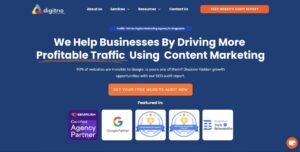
Digitrio positions itself as a growth partner for SMEs. They focus on the high-intent keywords that AI models prioritize when users are in the buying phase of their journey.
Top services:
- High-Intent Keyword Mapping for AI Answers.
- Quality Backlink Building for Authority.
- Performance-based SEO/GEO reporting.
Pricing: Transparent SME pricing starting at $1,000/month.
Best for: Growing companies that need a transparent, straightforward agency that delivers weekly results.
10. Neetclick
Neetclick is a specialized boutique that excels in Question-Led Content. They are the masters of the long-tail, conversational query, ensuring your brand answers the specific How-to questions that dominate AI search.
Top services:
- Long-tail Conversational Query Optimization.
- Deep-dive Technical Guides for LLM Training.
- Competitor AI Visibility Benchmarking.
Pricing: Custom boutique pricing, generally $1,500 – $4,000/month.
Best for: Education providers, consulting firms, and information-heavy businesses.
What is GEO vs AEO vs SEO?
SEO vs AEO vs GEO represent an evolving, complementary search strategy: SEO (Search Engine Optimization) focuses on ranking in traditional blue links, AEO (Answer Engine Optimization) structures content for direct answers in AI/voice assistants, and GEO (Generative Engine Optimization) makes content trustworthy to be cited by LLMs like ChatGPT or Google SGE.
Here’s a simple breakdown that reflects how we actually see it play out in real campaigns:
| Approach | What it focuses on | Where it shows up | Core goal |
| SEO (Search Engine Optimization) | Rankings on Google | SERPs (blue links) | Drive clicks |
| AEO (Answer Engine Optimization) | Featured snippets, voice answers | Google snippets, voice assistants | Get direct answers |
| GEO (Generative Engine Optimization) | AI-generated responses | ChatGPT, Gemini, Perplexity | Get cited in AI answers |
One thing we often tell clients is this: If your content is not being used by AI systems, your visibility is already shrinking, even if your rankings say otherwise.
Dig deeper: AEO vs SEO: How Does AEO Differ from Traditional SEO?
Why SEO is No Longer Enough in 2026
The way users find information has changed forever in 2026. Instead of browsing ten links, they are asking one question and trusting one synthesized answer. According to Bain & Company, 80% of search users now rely on AI-written summaries for at least 40% of their searches.
The Era of Zero-Click Searches
With the rise of Google AI Overviews (AIO) and platforms like Perplexity, users no longer need to click through a list of blue links, creating a surge of zero-click searches. AI models now crawl, synthesize, and provide the final answer directly on the search results page.
The Harsh Reality: If your brand isn’t featured within that AI-generated summary, you are effectively invisible to a massive portion of your target audience who never scroll past the AI’s response.
The Rise of Answer Engines
Search has evolved from fragmented keywords (e.g., SEO agency Singapore) to complex, conversational queries (e.g., Which SEO agency in Singapore is best for scaling a B2B SaaS startup via AI search?). Traditional SEO, built on keyword density, simply cannot address these nuanced, intent-heavy dialogues.
The Strategic Benefits of GEO (Generative Engine Optimization)
When done right, GEO changes how your brand shows up in AI-driven environments.
- Winning AI Citations: GEO ensures your website becomes a trusted data source that Large Language Models (LLMs) like ChatGPT and Gemini prioritize. When an AI states, based on data from [Your Brand]…, your perceived authority increases.
- Building Entity Authority: Beyond keywords, GEO helps search engines understand who your business is and what you are an expert in. This ensures your brand is recommended during AI-driven comparisons or best-of queries.
- Capturing High-Intent Conversions: Users interacting with AI search often have a specific problem to solve. Appearing in an AI response places your brand at the very bottom of the sales funnel, right when the user is ready to act.
- Optimizing for Conversational Search: GEO structures your content to be natural and readable for voice assistants and AI chat, which is the primary search method for mobile users in 2026.
- Protecting Brand Accuracy: By providing structured data and clear answer-first content, GEO prevents AI hallucinations (misinformation) about your services, pricing, or reputation.
In our past audits, companies investing early in GEO saw content lifespan increase significantly. Instead of content peaking and fading, it keeps resurfacing in AI answers over time.
To save you time and also a fair amount of budget, this is usually where we recommend starting with a focused SEO audit before expanding into GEO. Most teams skip this step and end up scaling broken foundations.
Find out more: Can GEO Replace Traditional SEO? A Complete Guide for 2026
What a GEO Agency Actually Does
A lot of agencies are rebranding SEO as GEO. In reality, a real GEO engagement looks different once you get into execution.
1. Content structured for AI retrieval
This goes beyond keywords. Structure now determines whether your content gets picked up or ignored by AI systems. A strong GEO agency builds content around entities, clear answer blocks, and semantic relationships. This is where most traditional blog content quietly underperforms.
2. AI citation optimization
Publishing content is not enough to show up in AI answers. The content has to be usable, quotable, and contextually relevant for how AI models retrieve information. This usually involves building topical authority, creating reference-worthy sections, and aligning with how tools like ChatGPT synthesize responses. We see many teams miss this, even with solid content.
3. Multi-platform visibility tracking
Rank tracking alone doesn’t tell you much anymore. You need to know where and how your brand appears inside AI-generated responses. A GEO agency should track citations, mentions, and share of voice across conversational queries. It’s still an evolving space, but ignoring it creates blind spots.
4. Content and distribution loop
Publishing is only half the work. Without distribution and reinforcement, even strong content struggles to gain traction. Good agencies connect content with PR, social signals, and authority building, then continuously refine based on how AI platforms respond. This loop is where long-term visibility actually compounds.
Many of our clients discover that their content performs differently in AI environments compared to search. That feedback loop is where real gains happen.
(If you’re already investing in content marketing or SEO, this is usually the layer we integrate without rebuilding everything from scratch.)
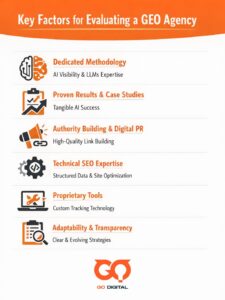
Key Factors for Evaluating a GEO Agency
- Dedicated Methodology: Ensure they have specific processes for AI visibility, not just traditional SEO repackaged. They should understand Large Language Models (LLMs), semantic search, and Retrieval-Augmented Generation (RAG).
- Proven Results & Case Studies: Look for tangible evidence of improved AI visibility, such as increased mentions or citations in AI tools.
- Authority Building & Digital PR: Effective GEO relies on authoritative content and trust signals. Look for agencies experienced in digital PR and high-quality link building.
- Technical SEO Expertise: The agency must handle structured data, knowledge graph integration, and site architecture, which helps AI engines understand your content.
- Proprietary Tools: Top agencies often use custom technology for tracking brand mentions and simulating crawler behavior.
- Adaptability & Transparency: Since AI is evolving, select a partner that tests, documents results, and provides clear, non-jargon explanations of their strategy.
Choosing the right GEO or SEO agency in general is crucial. It can make or break your business growth in the long run. If you want how to do this effectively, check out our detailed guide on how to choose the right SEO agency.
Questions to Ask a GEO Agency Before Hiring
If you want to avoid wasting budget on a partner that doesn’t fit, ask better questions upfront.
Below is the exact set we use internally when evaluating generative engine optimization agencies in Singapore, especially when the stakes are high and timelines are tight.
1. Strategy & AI Capabilities
What to ask:
- What is your strategy for optimizing content for AI overviews and answers?
- How do you shift from keyword-driven to entity-driven optimization?
- How do you approach zero-click searches and AI-generated summaries?
What good answers should include:
- Building topical authority
- Using structured data (schema) to improve machine understanding
- Creating content that directly answers user queries in extractable formats
- Positioning your brand as a source for AI-generated answers
If they can’t explain how content gets picked up by tools like ChatGPT, you’re not looking at a GEO partner yet.
2. Content & Authority Building
Content is still the engine, but how it’s built has changed.
What to ask:
- How do you create content around search intent?
- What is your approach to E-E-A-T (Experience, Expertise, Authoritativeness, Trustworthiness)?
- How do you handle link building, and how do you keep it safe?
What to look for:
- Content mapped to real decision-stage queries
- Clear plans to build author credibility and brand trust signals
- Link-building focused on relevance and authority
We’ve seen sites with fewer backlinks outperform competitors simply because their content was structured better and trusted more.
3. Experience & Technical Expertise
What to ask:
- Can you show results in similar industries?
- How do you ensure compliance with search engine guidelines?
- What’s your approach to technical SEO in an AI context?
- What tools do you use?
What strong answers include:
- Real examples, not generic case studies
- Understanding of crawlability, site speed, and indexing
- Familiarity with tools like Ahrefs and Semrush, plus entity or semantic analysis tools
- Clear explanation of how technical structure supports AI visibility
4. Reporting & Communication
What to ask:
- What does your reporting include?
- How do you measure success in GEO, not just SEO?
- How do you respond to algorithm or AI changes?
- Who will actually manage the account?
What you want to see:
- Reporting that includes AI visibility, mentions, and citations
- Clear KPIs beyond rankings, such as engagement quality and brand presence
- A process for testing and adapting, not just reacting
- Direct access to the people doing the work
5. Contract & Working Relationship
What to ask:
- What is included in the pricing and deliverables?
- Who owns the content and strategy if we stop working together?
- What do you need from our team to succeed?
What to clarify early:
- Ownership of all assets, content, and data
- Realistic timelines and expectations
- Internal responsibilities, approvals, inputs
Read more: 15 Questions to Ask SEO Companies Before Hiring Them
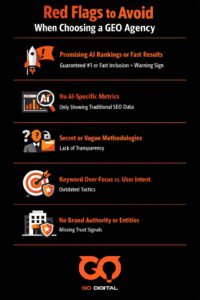
Red Flags to Avoid When Choosing a GEO Agency
1. Promising AI rankings or fast results
If an agency guarantees #1 on ChatGPT or inclusion in AI Overviews within weeks, take that as a warning. AI systems don’t work in fixed rankings and change constantly across users and contexts. A credible partner will frame GEO as a long-term build of trust signals.
2. No AI-specific metrics
If reports only show keyword rankings, traffic, and backlinks, you’re looking at traditional SEO with a new label. That data doesn’t tell you whether your brand appears in AI-generated answers. Strong agencies track AI visibility, citation frequency, and how often your brand is mentioned across AI tools.
3. Secret or vague methodologies
Be cautious when agencies avoid explaining how they work or hide behind proprietary systems. GEO relies on clear elements like structured data, entity building, and content design, none of which are secret. A good agency will explain their approach in simple terms and show how it connects to results.
4. Over-focus on keywords instead of intent
If the conversation revolves around keyword density and meta tags, the strategy is outdated. AI engines prioritize clear, structured answers that directly address user intent. Agencies that understand this will focus on answer-first content and high information clarity.
5. No focus on brand authority or entities
If the strategy only touches your website, it’s incomplete. AI systems validate credibility across multiple sources. Strong agencies build brand presence through digital PR, mentions, and trusted third-party signals so AI has something to trust.
Conclusion
Choosing the right generative engine optimization agencies in Singapore comes down to clarity. You’re not just investing in content or rankings anymore, you’re investing in how your brand shows up inside AI-driven decisions.
From what we’ve seen working with B2B teams, the biggest wins come from structuring what already exists, building real authority, and making sure AI systems can actually use your content.
If you’re not sure where to start, that’s usually where we step in at Golden Owl Digital (GODI). Our role is to help teams see how they currently show up in AI search, identify what’s holding them back, and build a system that compounds over time.
Frequently Asked Questions (FAQ)
What is a generative engine optimization agency?
A generative engine optimization agency focuses on helping your brand appear in AI-generated answers from tools like ChatGPT or Google AI Overviews. Instead of only improving rankings, they optimize content so it can be cited, summarized, and trusted by AI systems.
How is GEO different from traditional SEO?
SEO focuses on ranking pages and driving clicks. GEO focuses on getting your content included directly in AI-generated responses, where users often make decisions without visiting multiple websites.
Do I still need SEO if I invest in GEO?
Yes, but the role of SEO changes. Technical SEO and content foundations still matter, they just need to support AI visibility as well. Most effective strategies today combine both.
How long does it take to see results from GEO?
Most teams start seeing early signals within 2–3 months, such as initial mentions or citations. Meaningful impact usually takes 4–6 months as authority and content coverage build over time.
Is GEO only relevant for large companies?
Not at all. In fact, SMEs often benefit faster because they can move quicker and build focused authority in specific niches. The key is having a clear strategy and consistent execution.
What’s the first step to getting started with GEO?
Start by understanding where your brand currently appears in AI-generated answers. From there, you can identify gaps in content, authority, and structure before investing further.