
Manufacturing content calls for a careful balance.
Technical buyers need detailed answers, and manufacturers need a clear way to show what their products can do—a tricky balance for content marketing for manufacturing companies as the discipline grows in importance. Many manufacturing marketers still don’t have a solid content strategy.
The article covers formats that explain complex products, help buyers compare solutions, and give manufacturers a way to build and measure a manufacturing content program. It also examines the gap between content’s growing importance and the lack of a solid strategy among manufacturing marketers.
Why Content Marketing for Manufacturing Companies Needs a Specialized Strategy
Growing importance
Content marketing had become more important to manufacturers: 72% of respondents in a recent Content Marketing Institute survey said it mattered more to marketers than it had the year before. See B2B vs B2C content marketing for a closer comparison of the two approaches.
A strategy gap
Even so, only 32% of manufacturing marketers said a solid content marketing strategy was in place.
A specialized approach
Content marketing for manufacturing companies calls for an approach grounded in the industry and the technical details of its products. The field is mostly B2B (business-to-business), unlike B2C (business-to-consumer), and the products still need technical detail. Content also has to reach decision-makers, including engineers, procurement managers, and other technical buyers.

Detailed, solution-oriented content
For these buyers, content should be detailed and data-driven, with a clear focus on solutions, showing how a product tackles business challenges, improves efficiency, or cuts costs. Use thorough explanations and case studies, supported by technical material, to make the value of complex products or services clear. Then spell out that value.
Experienced professionals at a specialized Content Marketing Agency can help manufacturers get the best return on their investment.
4 Content Formats That Help Technical Buyers Decide
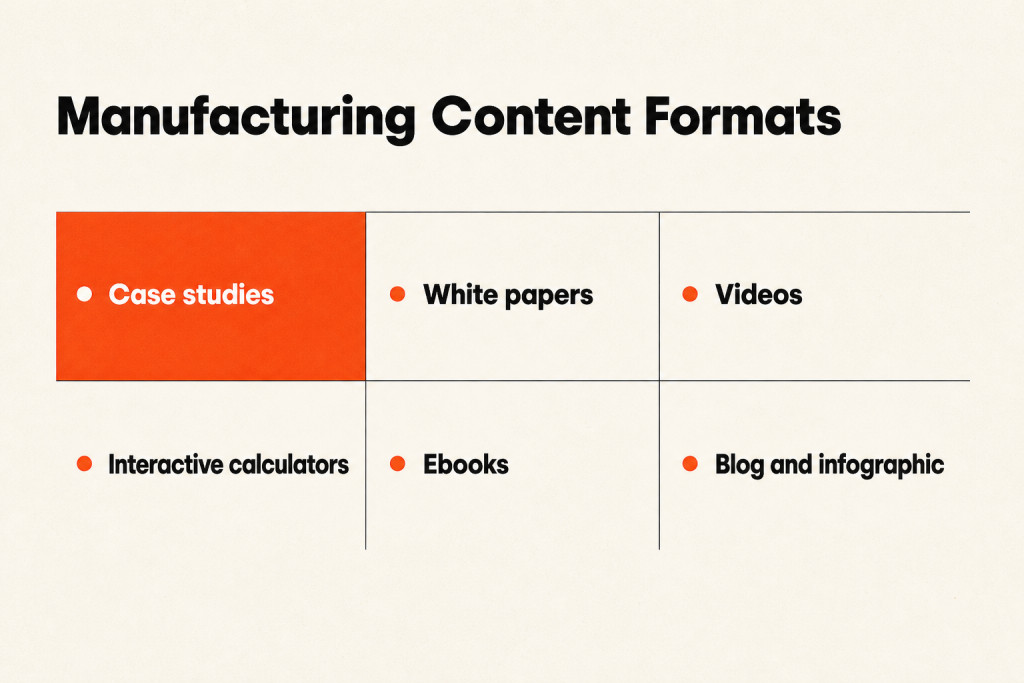
Manufacturing content marketing formats include case studies and white papers, which help technical buyers evaluate options through evidence and clear technical details. Manufacturers can use B2C formats when they inform and teach, while B2B marketing in manufacturing usually puts greater weight on evidence. Buyers are weighing more than whether a solution works; they want the best possible fit. Complex products and services can be hard to grasp, especially when details matter, so clear, thorough information helps potential customers compare their options. For content marketing for industrial companies, formats such as case studies and white papers make technical details easier to evaluate.
Technical Case Studies
For buyers, a case study offers evidence that product copy or a testimonial can’t: it lays out the problem, explains the solution the product offered, describes the implementation, and reports the results. That trail shows problem-solving ability and can earn credibility and trust with potential clients. The proof is specific.
Four stages can shape a case study:
- Outline the problem.
- Show the solution offered by the product.
- Describe the implementation.
- Track the results.
A company can put case studies on its company website, blog, social media platforms, and in email marketing campaigns.
White Papers
White papers and ebooks provide in-depth reports grounded in research and technical solutions. Industrial companies can attract high-quality leads by offering content in exchange for contact details that addresses audience problems and establishes industry authority. For example, a manufacturer could release a white paper explaining how robotics can improve manufacturing efficiency. To assess lead quality, businesses commonly request an email address through forms that sort respondents.
- In-depth analysis: A white paper can provide research and insights on a specific topic or problem common to the target audience.
- Lead qualification: Businesses often ask for an email address before granting access to high-value content. Request forms usually ask questions to segment users and qualify lead quality.
- Evidence for claims: Facts and figures can back up claims made in a white paper.
- A robotics example: A manufacturing company might publish a white paper on how robotics can improve manufacturing efficiency. The paper could explore cutting-edge robotic technologies, show the business’s leadership in manufacturing innovation, and attract potential partners interested in advanced automation solutions.
Product Demo Videos
Explaining products visually
Videos let manufacturers present complex products, clarifying their functions and benefits. Seeing the product can make technical ideas easier for buyers to grasp, as long as it comes through clearly on screen. Video also gives industrial companies a more engaging, interactive way to explain what their products or services can do. Buyers can see the product for themselves.
Sharing and demonstrating
Manufacturers can post videos across online platforms, including social media and YouTube, then use them for virtual factory tours or to show products in action.
Instructional and educational content
A manufacturing company might make instructional or educational videos about manufacturing techniques or product demonstrations. Making complex processes easier to understand can build customer understanding and interest.
Interactive Calculators
Self-service tools let prospects assess their needs as they progress through buying and consider a product’s value. Examples include product configurators and financial tools for estimating ROI or costs. Our roundup of content marketing tools lists options for building them.
Develop interactive tools like product configurators, ROI calculators, or cost estimators to help potential customers evaluate their needs or calculate potential savings.
This approach works reliably only with product lines that have standardized tolerances and sizing rules; self-serve estimates can mislead on heavily custom engineering projects.
Mapping Content to the Industrial Buyer Journey
Discovery Stage
At the Discovery Stage, industrial prospects look across a broad range of information as they pin down the problem they need to solve. Seeing the issue from several angles helps create a connection with your company.
Consideration Stage
Once they’ve identified the problem, prospects move into the Consideration Stage and weigh possible solutions. They may be comparing several potential vendors, each with different solutions, so your content needs to go beyond basic facts and spell out your unique value proposition to set your business apart from competitors.

At this point, technical buyers read content much as they would an engineering submittal. Persuasive claims matter less than verification data showing that a component can hold up under real operating conditions.
Decision Stage
As prospects approach the Decision Stage, they start weighing the details of a possible purchase or contract agreement. Once they understand the details and options that distinguish your business, they can compare your offerings with those of industry competitors more easily.
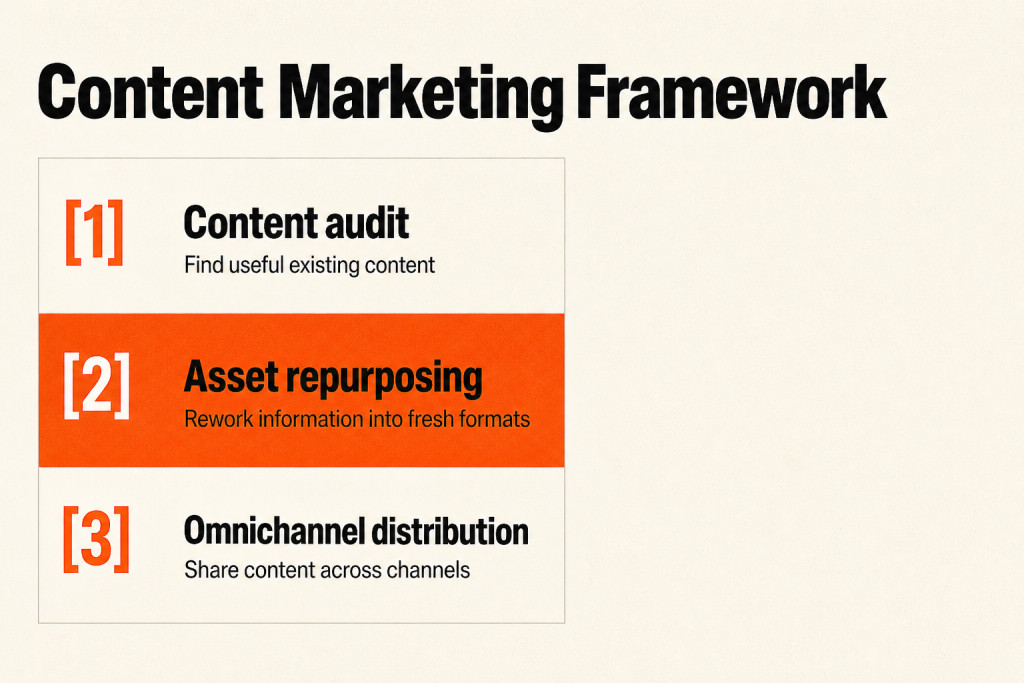
A Three-Step Framework for Implementing Manufacturing Content Marketing
Step 1: Audit Existing Content
A content audit helps prevent repeated work and can support a structured b2b content marketing strategy for technical content creation. Content that’s drawing little attention may need just a few small fixes to become a significant draw to your website, bringing quick wins, so start with those pages. Underperforming content may need only a few minor improvements. Existing installation guides, field service reports, and internal CAD notes can be reshaped into useful resources for customers.
Step 2: Repurpose Assets
Examples of Different Mediums to Present Content:
Reworking the same information into other formats gives you fresh content and saves time on research. An ebook or checklist can be offered as a download, while video, blog, infographic, or social series provide ways to see which format presents the information best.
Step 3: Distribute Across Channels
Omnichannel distribution means sharing content on social media, emailing subscribers, using paid promotion periodically, and building links. Content built for search covers only part of the job, since it suits people who already have a sense of the answer they need. Together, these channels can reach a wider industrial audience. Our guide to content marketing on social media explains how to choose platforms.
Before people start downloading your content, set up workflow content for email nurturing. That gives you a chance to promote more of your content to people who’ve already shown interest.
How to Measure Content Performance in Manufacturing
Judge manufacturing content performance using measures that fit the content type, goal, campaign, and audience—not raw visit counts alone. When a page draws just a handful of plant managers who go on to request a quote, it can matter more than thousands of casual visits; raw visit counts alone misrepresent technical content’s value. Stay current with B2B content marketing trends as buyer expectations change.
In complex manufacturing purchases, several people may be involved and timelines can be long, which makes it hard to measure content’s direct effect on sales and revenue.

Email sign-ups, content downloads, and social shares give you intermediate measures of whether content builds interest and moves leads through the funnel.
A short Time On Page is hard to interpret on its own; check what your visitor does next during the site visit, since that gives the number context.
Which measures make sense depends on the content type, goal, campaign, and audience; use them to assess performance:
- Bounce Rate
- Time On Page
- Scroll Depth
- Pages Per Session
- Conversions (and conversion rate)
Frequently asked questions
What is content marketing for manufacturing?
For manufacturers, content marketing helps teach potential customers, hold their interest, and turn them into buyers in a crowded market, often a technical one. It gives manufacturers a way to share information that fits the industry’s technical needs.
How can industrial companies measure the effectiveness of their content marketing efforts?
Industrial companies can judge how their content is doing by checking results and measuring ROI. Google Analytics measures content-driven visits, audience engagement, and conversions; companies can draw on those metrics to refine their approach and boost performance over time.
What is the difference between a persona and a customer?
A buyer persona is a fictional character used as a planning tool. It captures traits shared by an ideal target audience, rather than describing one actual customer.
Should everything just go on our website?
Manufacturers should distribute content beyond their websites. A strong website anchors manufacturers’ content efforts, and the company’s site should be on point. Also, share your content across multiple platforms, including industry blogs, forums, and social media.
Content marketing for manufacturing companies works best when each piece gives industrial buyers proof that answers the questions they need resolved. The fit between proof and question matters more than the format. Buyer personas help teams represent an ideal audience, and Google Analytics provides data on visits, audience interaction, and conversions. The website remains central, with industry blogs, forums, and social media also in the mix. Keep the evidence tied to what buyers need to evaluate solutions and move procurement forward.