
On LinkedIn, a post can kick off the business conversation you want even when public likes are lower, which makes LinkedIn content marketing harder to judge by likes alone. That gap can leave you unsure what deserves a place in your feed or whether your posts are helping the business grow.
You’ll get a practical way to shape a point of view, choose formats that fit your message, and read engagement for signs of buyer intent. The tricky part is that the post that matters may not be the one with the most visible likes.
How to Build a LinkedIn Content Marketing Framework
Step 1: Define Positioning
Define your positioning by choosing a focused lane for a specific audience and the transformation you help them achieve. A clear lane helps strong creators stand out: one is known as a storyteller, another as a teacher, and another as an entertainer. Each has built a name around that strength, and you can see the focus in their content.

When you try to speak to every possible buyer, your message can get so broad that it stops connecting with anyone.
Try this positioning line to pin down your point: I help (audience) achieve (transformation) through (unique angle/method).
Use these questions to pinpoint the topics you can speak about with focus:
- What do I know?
- What problems do I naturally solve?
- What have I learned the hard way?
- What topics could I talk about?
Step 2: Build Content Architecture
These four content types each build a different part of your audience’s trust.
Narrative Content
Use stories to shape your point of view and the beliefs behind it. They show what you stand for, which ideas you push back on, and how you see the world.
System Content
A useful system can set LinkedIn creators apart over time; many have built success by sharing a process shaped around 4-8 questions.
- Think about the insight you want to share:
- problems your audience faces
- process and system you have built
- An important concept in your industry
- List the 4-8 questions you will answer with your framework
- Create steps, checklists, or pillars
- And, finally, give it a name.
Proof content
Let your posts show how you solve problems, not just talk about them. Proof can come from before-and-after results, client wins, experiments, or personal milestones.
Demand Content
Your edge comes from the insights only you can offer. Hooks, posting frequency, and polish matter less than how you read a situation, spot patterns, and turn experience into a point of view.
The 4-1-1 rule keeps the mix in check: for every 6 pieces you post, share 4 relevant pieces from others, add 1 soft promotional post, and include 1 hard promotional post. Bring your own perspective to each one, and connect these LinkedIn efforts to your broader social media content marketing strategy.
Step 3: Select Format Mix
What split across formats emerged from Maja Voje’s review of 400+ viral LinkedIn posts?
- Single image (62.7%)
- Document (20.2%)
- Video (10.6%)
- Text (4.6%)
LinkedIn video viewership rose 36% year-over-year, and video creation grew 2x faster than creation for all other post types.
A few habits tend to make pre-recorded video work better:
- A hook in the first 2 seconds, the first frame and first sentence
- Short clips between 30-120 seconds that teach, explain, or react
- Direct framing, clear thinking over polished production
LinkedIn’s own benchmarks put LinkedIn Live at 7 times (7x) the reactions and 24 times the comments of pre-recorded native video.
Native documents tend to earn higher impression rates than other post types. Carousels remain an underused, high-return LinkedIn format; the algorithm counts swipes as dwell-time signals, and every slide someone views can extend distribution.
Text posts usually have the lowest average reach of any format. A clear, specific point of view can still give them the highest comment-to-impression ratio.
Step 4: Set an Engagement Routine
Set aside 15-60 minutes per day for comments, on 3-5 days per week.
Before and after each post
Ahead of publishing your LinkedIn post, leave comments on 5-6 others; afterward, comment on 5-6 more. LinkedIn rewards activity with more impressions.
Reply while engagement is highest
Make room for 15 to 20 minutes after publishing to answer comments while engagement is highest. That can lift visibility and help you build stronger ties with your audience.
Keeping track of who you want to engage with can get overwhelming, and doing it by hand can take hours. Group the activity into two focused blocks (one before publishing and one after), then maintain a shortlist of 20-30 priority people with whom you want to stay visible. Work through the list regularly; aimless scrolling gives you less structure.
Step 5: Repurpose Core Assets
Start with one central idea, and the 4R Content System can turn it into a range of posts:
| Framework | What it means | Result |
|---|---|---|
| Reframe | Change the lens | Why doubling your revenue has nothing to do with ads (and everything to do with positioning). |
| Re-angle | Change the audience or the pain point | For freelancers: “How I doubled my freelance revenue in 90 days, without touching ads.” For founders: “The revenue playbook I used to grow my business without paid acquisition.” For coaches: “How I filled my coaching pipeline without a $$$ on ads.” |
| Repackage | Change format, not message | Carousel: “5 organic levers that doubled my revenue.” Text post: “The exact steps I followed to double my revenue with $0 ad spend.” Video: “Walk with me, I’ll show you the organic system that doubled my revenue.” |
| Resurface | Bring it back with updates, timing, or new proof | Updated: “I doubled my revenue last year without ads, here’s what changed when I repeated the strategy this year.” Timed: “Why organic growth is outperforming ads in 2026 (and how it doubled my revenue).” With new proof: “6 months later, here’s the data behind how I doubled my revenue organically.” |
With these approaches, you can reshape one idea for different formats and audiences as part of a flexible LinkedIn content marketing strategy. A webinar can supply several LinkedIn posts; one podcast episode can yield short video clips, quote graphics, carousels, and blog articles for broader social media content marketing. A customer interview can also become a case study, a founder story, and a run of social posts.
Step 6: Track Conversion Metrics
Track high-retention formats, DM-triggering posts, and non-follower reach to see whether your content holds attention, prompts private business conversations, and brings new people into view. Three signals can give you an early read on growth.
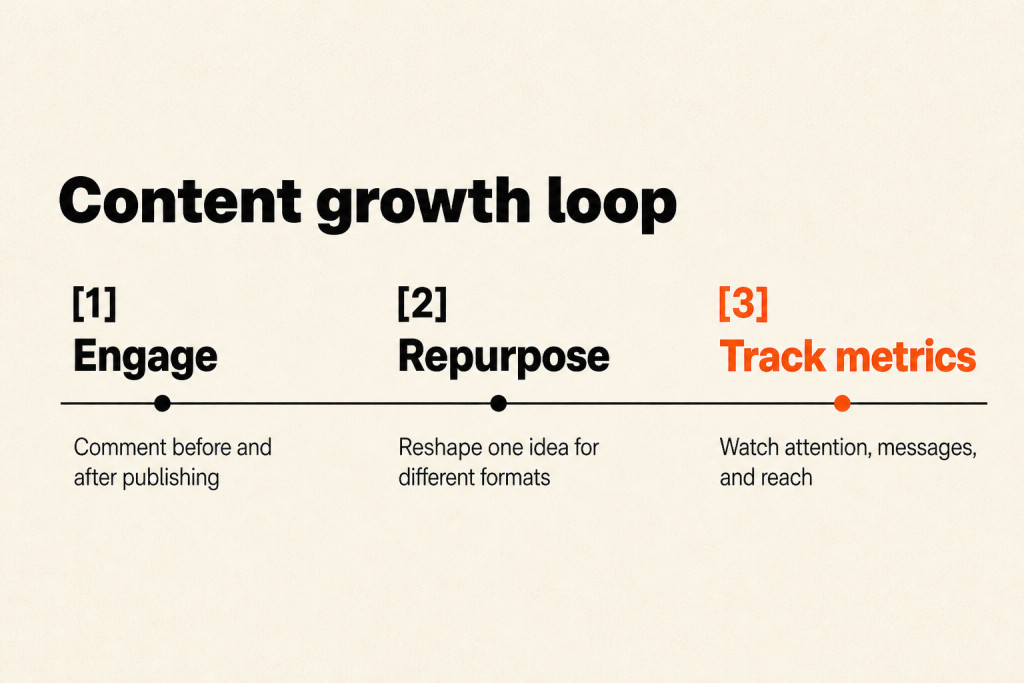
High-retention formats, Check which formats people read, watch, or swipe through to the end. Finishing a post points to value more reliably than reaction counts, so build your scalable content system around the formats that hold attention.
DM-triggering posts, A private message after someone sees a post points to trust and a problem they still need to solve. These posts reveal which topics, angles, and tones make you seem like the right person to contact, even when public engagement stays low. Keep track of them separately.
Non-follower reach, When a post reaches a large share of people beyond your network, it can bring new people into view of your content. These posts show which topics and formats help strangers find you. Spot the angles that work, then make more content around them.
These other measures show how people respond and whether that response connects to business outcomes:
- Engagement
- Profile visits
- Comments
- Saves
- Follower growth
- Inbound leads
To see performance in more detail, keep an eye on these measures too:
- Engagement rate: How actively your audience interacts with your content.
- Follower growth rate: How quickly your audience is expanding.
- Click-through rate: How often people click your links or CTAs.
- Lead gen form completions: How many leads your campaigns capture.
- Cost per lead: How efficiently your paid spend converts.
- Share of voice: How visible your brand is compared to competitors.
Posts that spark direct business conversations can draw far fewer public likes than broad motivational posts. They trade viral visibility for a real commercial pipeline.
Best Practices for Creating LinkedIn Content That Gets Read
Lead with value:
A LinkedIn post should quickly show readers what they’ll get from it; as noted above, public likes aren’t the whole story. LinkedIn is a core channel in any B2B content marketing plan.
Use line breaks:
Short paragraphs and clear line breaks give people easy points to scan rather than a dense block of copy to wade through.
Ask questions:
Sincere questions can get people talking.
Tell stories:
Personal stories make lessons from lived experience stick better than generic advice.
Short is powerful:
When you share a link, keep your caption brief and let the headline carry the message.
Two to three relevant hashtags should be enough.

A good starting point for Company Pages is posting 2-5 times per week; consistency matters more than frequency. Individual executives and employees can publish 1-3 times weekly to establish thought leadership.
On LinkedIn, businesses tend to find the best posting windows on Tuesdays at 11 a.m. and 5 p.m.; Wednesdays at 11 a.m. and 4 p.m.; and Thursdays from 1-5 p.m.
Keep your writing simple: use short paragraphs, everyday language, and one clear point. Read each sentence aloud and revise any wording that sounds unnatural. Collaborating with a Content Marketing Agency can help refine messaging and production.
A practical approach is to spend more time building familiarity on LinkedIn than asking for a sale.
How the LinkedIn Algorithm Ranks Your Posts
LinkedIn uses signals such as originality and expertise, a human perspective, and conversation and distribution to assess posts and decide how widely to show them. LinkedIn’s ranking signals show what the platform checks in a post and how it responds to each one.
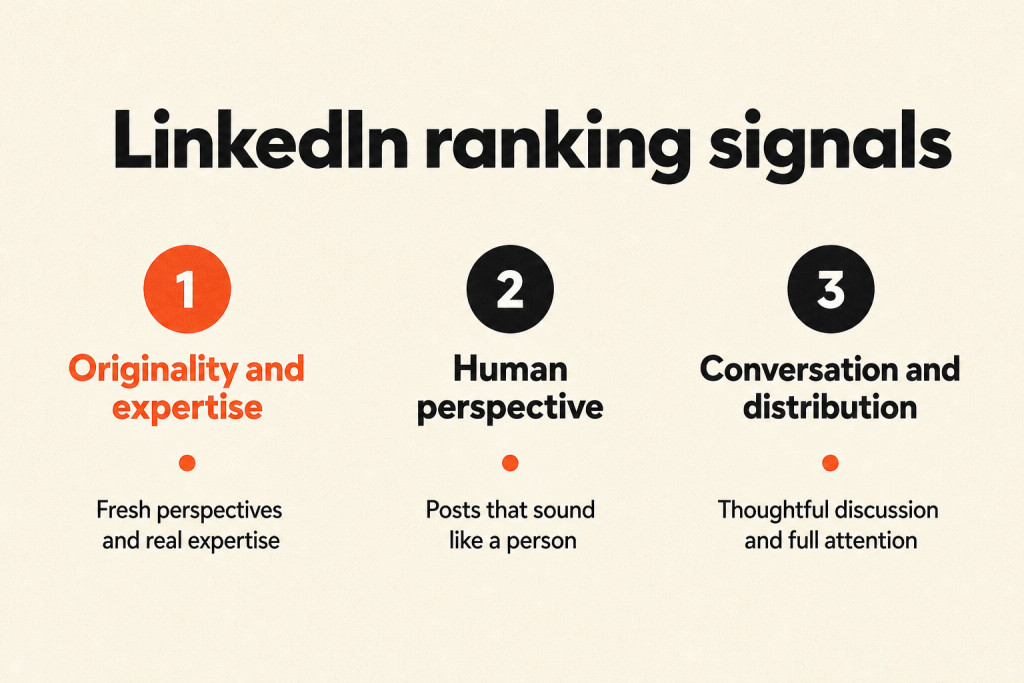
| Signal Category | Algorithm Factor | Platform Treatment |
|---|---|---|
| Originality and expertise | Fresh perspectives and unique points of view. Real expertise. Content that demonstrates genuine knowledge. | The more you tap into real stories, data, and expertise, the better your content will perform. |
| Human perspective | Posts that sound like a person, not a template. | AI-generic posts: Low-effort posts that read like they were generated in seconds with no point of view. Duplicate or plagiarized content: Anything flagged as copied or unoriginal. |
| Conversation and distribution | Posts that spark thoughtful, back-and-forth discussion. People who read your full post or watch your whole video help push your content further. | When you publish, LinkedIn tests your post with a small initial audience. If it earns meaningful engagement, it gets shown to a broader feed. Engagement bait: Posts chasing quick reactions rather than real discussion. |
LinkedIn weighs a post’s relevance to other members alongside its creator’s credibility on that subject and content type. It favors posts that keep readers around and spark thoughtful peer discussion over AI-generic posts that send people offsite right away.
Employee Advocacy: Turning Your Team Into Distribution
Personal accounts
Whether you’re an employee, a solo business owner, or at the C-level, personal accounts carry even more value on LinkedIn, a platform built around business, and can extend business accounts for promotion. For other platforms, see our guide to content marketing on social media.
Personal touch
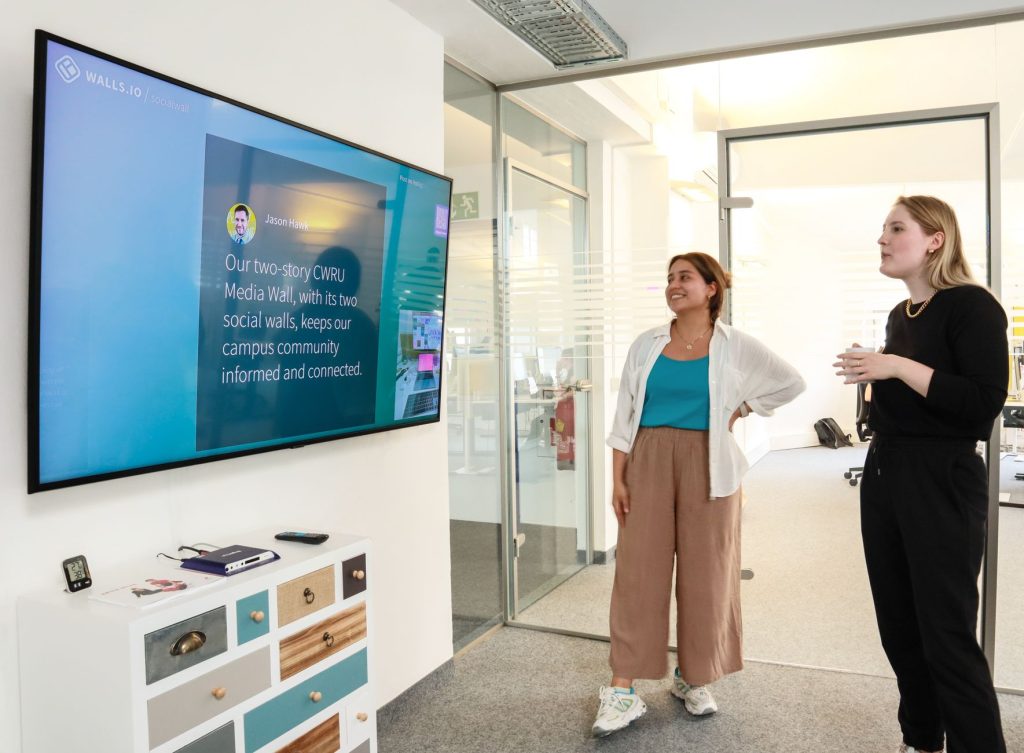
Put your brand’s content in employees’ hands to reach exponentially more people through sharing. They can also make the posts and captions their own with a personal touch.
Hiring and recruiting
Employee posts on LinkedIn can also help with hiring and recruiting.
Pre-approved message ideas
Include pre-approved message ideas so your team stays on-brand.
Advocacy programs fail when rigid corporate scripts are required; people quickly tune out robotic brand messaging in personal feeds.
Frequently asked questions
What types of content work best on LinkedIn?
In 2026, short-form video has the highest engagement among content types on LinkedIn. Carousels and document posts also work well (polls prompt quick engagement), while text-only posts can spark conversation. LinkedIn newsletters can build a subscribed audience, and long-form LinkedIn articles support thought leadership.
How often should I post on LinkedIn?
Start with 3 to 5 posts per week; that’s frequent enough to stay visible without sacrificing quality. Three thoughtful posts every week beat posting every day just because you feel you have to.
What is the 3-2-1 rule on LinkedIn?
The 3-2-1 rule is an engagement strategy for staying visible without overwhelming your audience. For every one piece of content you post, engage with three other posts and leave thoughtful comments on two of them.
Does every LinkedIn post need to promote my business?
Most of your LinkedIn content shouldn’t feel like an ad; promotions work much better when the surrounding content educates, entertains, or starts conversations.
Conclusion: Build the Habit First
A focused point of view and useful participation help build trust; pre-approved message ideas can help your team stay on-brand without relying on rigid scripts. On LinkedIn, short-form video, carousels, documents, text posts, newsletters, articles, and polls each offer a different way to engage. A steady cadence of 3 to 5 posts per week leaves room for thoughtful posts and community engagement, making LinkedIn content marketing more sustainable. Promotions fit better when the surrounding content gives people something useful to discuss. For your next post, choose one useful point of view and use it to start a conversation with your audience.