
Biotech content marketing has to help researchers judge scientific claims and give buyers guidance they can use during self-directed, long-cycle evaluations. The harder planning question is that SEO traction, AI citations, and pipeline impact run on separate timelines.
This guide gives you a practical way to map content to audience roles, choose formats that carry scientific detail, and make decisions about review, distribution, and performance. Use it to build guidance buyers can trust across a long evaluation—not simply publish more.
How to Segment Audiences for Biotech Content Marketing
To segment biotech content, map the key decision makers in each audience and tailor content to their differing needs. Across life science audiences, content has to account for business leaders, investors, researchers, healthcare professionals, patients, and others, because their needs, priorities, and content preferences don’t line up. Typically, 2-3 individuals take part in a purchasing process. Build content that resonates with all of them. This approach supports broader b2b content marketing strategies for complex, multi-stakeholder buying committees. For the wider playbook, see our guide to B2B content marketing.
Business audiences may prioritize market analysis, financial projections, regulatory pathways, and commercialization strategies, though the balance with scientific detail varies by audience and buying context. They weigh market opportunities and competitive landscapes, while also considering potential returns on investment. High level thought leadership content can attract these readers and provide useful information while delighting them.

For scientific readers, offer existing customers detailed case study reports alongside highly technical white papers and peer-reviewed publications that present your latest scientific results, together with the methodologies and data behind them. They need to grasp the core science, including methods and data, and judge the rigor behind claims. Purchasing decisions commonly bring together an end-user who needs to complete tasks efficiently and a director-level employee assessing vendors for scalability and security while also reviewing quality compliance. Procurement checks that pricing and legal stipulations are followed. Each role checks a different part of the purchase.
Give each buyer evidence tied to the decision: bench scientists need protocol reproducibility and methodology details, while executive buyers need operational throughput and development risk reduction.
Which Technical Formats Earn Scientists’ Trust?
Buyer-ready technical formats give each buyer evidence they can use: bench scientists need protocol specifics and raw validation data, while Scientific buyers assess a commercial claim against peer-reviewed evidence, protocol application notes, and validation studies. (Busy technical researchers can find brief summaries too thin.) For scientific buyers, depth, precision, and transparency are useful content considerations; 9 content types can foster engagement and help generate pipeline.
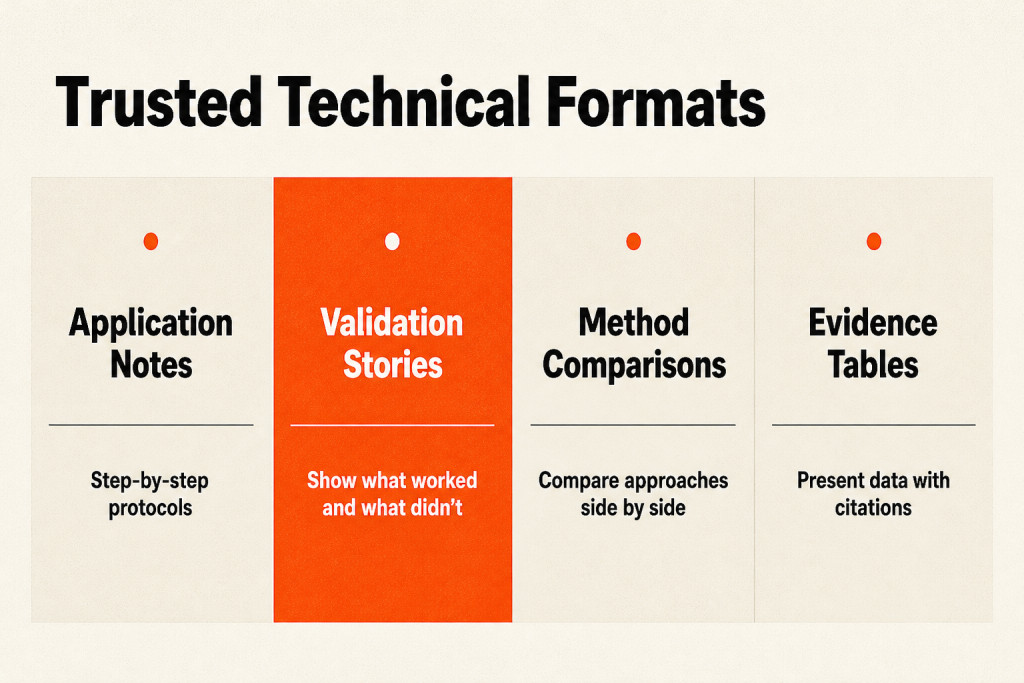
- Application Notes, Step-by-step protocols grounded in real-world use cases
- Validation Stories, Explain how a method was tested, including what worked and what didn’t
- Method Comparisons, Compare competing approaches side by side
- Protocols and Checklists, Share SOPs for download or by email
- Teardown Guides, Examine how a technology or process works in depth
- Decision Matrices, Map buyer needs to solutions with visual tools
- Evidence Tables, Present structured data with citations
- ROI and Risk Content, Address business cases for executives
- Anonymized Case Studies, Show real outcomes without revealing client names
Solid research findings lend scientific narratives depth and authenticity; Case studies, whitepapers, and research articles can give them a sound foundation.
Add these five elements to make your material more useful:
- A clear statement of the problem or challenge
- The methodological approach or solution
- Supporting data and evidence
- Practical applications
- Future implications or next steps
Building Compliance Workflows That Don’t Slow Publishing
A content compliance workflow should track regulatory changes, involve legal early, keep claims clear and scientifically accurate, protect data privacy, and review content regularly. When regulatory review waits until final approval, contamination found then can mean tossing the whole batch.
For life sciences companies, ethical and legal operations depend on meeting regulatory requirements from the start. These regulatory and medical review standards are shared across broader healthcare content marketing. The Food and Drug Administration (FDA), the European Medicines Agency (EMA), and the Medicines and Healthcare products Regulatory Agency (MHRA) set strict rules for promotional content, and those rules often call for approval before anything is shared with an audience. Put review ahead of release.
Data protection and privacy laws govern how companies collect, store, and use customer data for marketing. That includes requirements under the General Data Protection Regulation (GDPR) and the Health Insurance Portability and Accountability Act (HIPAA). Privacy rules apply to customer data.
Because regulations and review needs shift, these five practices can help teams keep content accurate and compliant:

- Stay Informed: Keep up with relevant industry regulations by attending workshops and subscribing to regulatory updates. Consider hiring a compliance officer if needed.
- Involve Legal Early: Bring your legal team into content creation early to support compliance from the start. This can save time and resources while preventing potential legal issues.
- Clear and Accurate Information: Keep content clear, balanced, and scientifically accurate. Avoid unsubstantiated claims and support claims with appropriate references.
- Data Privacy: Explain how you collect and use data, and obtain proper consent before using personal data in marketing initiatives.
- Monitor and Review: Regulations change and evolve, so review content regularly to maintain ongoing compliance.
Teams can back these practices with three tools: an approved claims library holding language vetted in advance, a review workflow that sends all content through MLR, legal, and compliance, and an audit trail covering every published asset. Cite sources for every stat and claim in your content, and never imply FDA endorsement.
Reaching Researchers Across Channels
Content distribution takes as much effort as creating the material in life sciences; both reaching the right audience and using the right channels are the other half. Our guide to content marketing on social media covers platform tactics in more depth.
Digital Platforms
Digital platforms give life sciences teams places to share content with their audiences:
- Research Gate
- Industry-specific forums and communities
- Scientific journals’ online platforms
- Company websites and blogs
Traditional Channels
Offline channels give biomedical teams another route to reach their audience:
- Scientific conferences and symposia
- Industry publications
- Professional associations
- Academic institutions
- Trade shows

Alongside those routes, distribution can support search visibility, keep a presence during buying cycles, and draw media attention.
1. SEO + AI Overviews
To gain visibility in Google search results and AI-generated summaries, apply structured data, internal linking, and answer-block formatting.
2. Programmatic and Account-Based Targeting
Display and programmatic ads can help keep your content in view throughout long buying cycles.
4. Digital PR Syndication
Syndicate material via industry publications, press release distribution, and earned media placements so your content can pick up backlinks and media mentions. These placements build domain authority and make AI citations more likely.
Structuring a Biotech Content Team and Workflow
This content model works best when dedicated Scientific writers pair with internal Subject matter experts and a specialized external Content Marketing Agency supports the team. Bringing colleagues’ different perspectives and expertise into the work produces richer materials. Pooling the team’s resources, knowledge, and creativity helps create content that resonates with its audience and gets the message across. Working together supports quality and gives team members ownership and commitment.
Bring your team together around these roles to develop and support its content:

- Core Team:
- Scientific writer(s)
- Subject matter experts
- Content strategist
- Compliance reviewer
- Technical editor
- Supporting Roles:
- Graphic designers
- Video producers
- SEO specialists
- Digital marketers
- Analytics experts
A central repository lets everyone in the company check accurate information in one shared place.
Strong content can reach further through new formats, extending the value of your best pieces: a popular blog post can be adapted into a video, while a webinar could become an ebook chapter.
Tracking Pipeline, Not Just Traffic
Pipeline attribution clarifies commercial accountability; top-of-funnel volume alone can’t. Monthly traffic may look modest beside consumer-facing numbers, so assess results through conversion and pipeline measures. Keep an eye on B2B content marketing trends as buyer behavior shifts.
Conversion Metrics
These measures show how audiences respond to the content:
- Technical inquiry rates
- Research collaboration requests
- Sample/demo requests
- Newsletter subscriptions
- Sales qualified leads (SQLs)
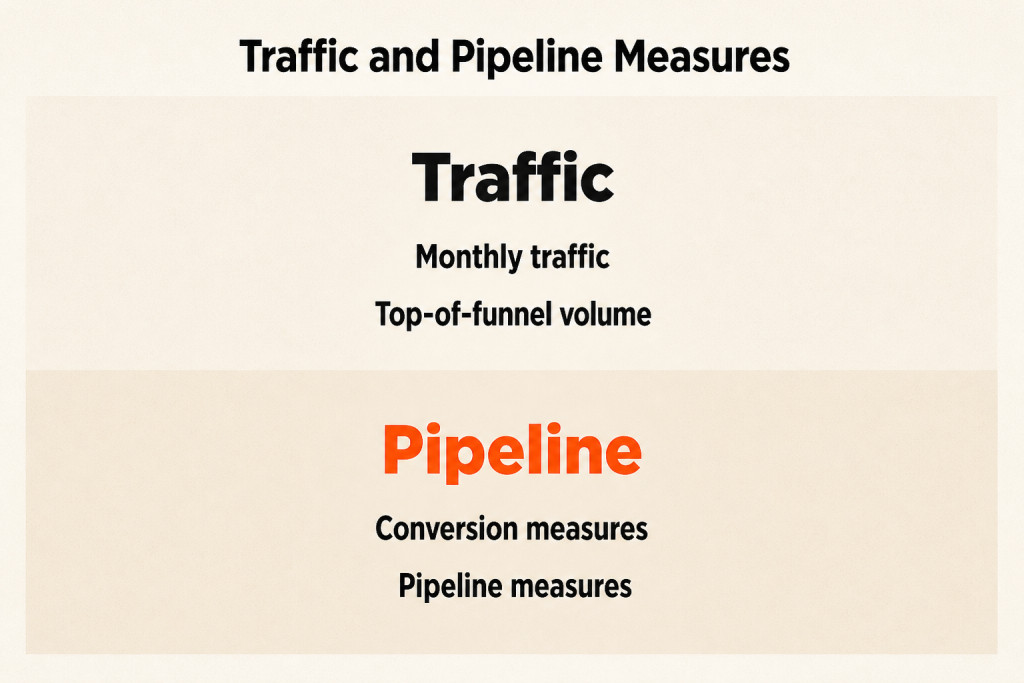
Keep tabs on SQL rate, meeting volume, RFP velocity, and cycle time, and measure content’s contribution to revenue.
Track the number of new leads, where they come from, and how they move through the sales funnel. Then use those details to shape content for lead generation.
Conversion rate counts how many content consumers take the desired action, rather than simply how many people view the content.
When Biotech Content Marketing Becomes a Priority
Strategic triggers for biotech content marketing include seeking additional VC funding, approaching clinical trials, or entering the pre-launch phase. Clear technical differentiation in published data gives an assay, instrument, or platform the basis for a viable pipeline; content marketing cannot create that foundation on its own.
Some buyers may reach sales conversations after searching online, comparing products, and checking facts for themselves rather than waiting for a company to explain their options.

For a life science content marketing strategy, timing matters too: Leadership buy-in and budget allocation are needed to get content out effectively across diverse channels. Those conditions can signal when to focus content marketing.
- Post-launch phase
- Siloed marketing efforts
- Lack of content marketing expertise
- Increasing need for customer outreach
- Your competitors have built comprehensive Resource and Educational Centers
Frequently Asked Questions
How long does life science content take to generate pipeline?
Typical timelines vary by outcome: SEO traction may take 60-90 days, AI citations 90-120 days, and measurable pipeline impact 120-180 days.
What formats do researchers trust most?
Researchers tend to trust the formats outlined above.
How does content marketing stay compliant with regulatory standards?
Biotech content is subject to industry rules, especially when addressing progress in medicine, drug development, or clinical trials. Ensure materials comply with FDA, EMA, or other relevant guidelines, make no exaggerated claims, and undergo review by legal and regulatory teams before publication.
A biotech content marketing strategy should account for separate timelines for SEO traction, AI citations, and pipeline impact, while favoring evidence-rich formats researchers trust and including regulatory review in the process. Scientific findings, methodologies, and data can inform role-specific guidance for buyers undertaking self-directed evaluations with long sales cycles. Keep FDA, EMA, or other relevant guidelines in view as materials move toward publication.