
Create one revenue model to support B2B sales and marketing alignment.
With one revenue model, sales and marketing can plan pipeline together, agree on who their buyers are, and keep their efforts connected. Treated as one revenue engine, go-to-market teams lose fewer leads, speed deals along, and give buyers a consistent experience throughout the customer lifecycle.
How to Build B2B Sales and Marketing Alignment
Start by having sales and marketing agree on the market, demand signals, account movement, ownership, and performance measures; those agreements create one shared go-to-market operating model.
The teams don’t have to perform the same tasks: marketing creates demand and shapes the buyer experience, while sales builds relationships, uncovers needs, manages opportunities, and closes business inside one connected system.
Shared Revenue and Pipeline Modeling
Build a shared B2B digital marketing strategy around a model linking the revenue target with pipeline, conversion, and account coverage.
When sales and marketing pursue shared revenue goals, objectives, and KPIs, some familiar barriers start to come down.
Trace the path back from the business outcome, then have sales, marketing, finance, and revenue operations agree on how activity turns into revenue.
The model should define:
- Revenue targets: Net-new, expansion, segment, region, and product goals.
- Pipeline requirements: The qualified pipeline needed to support those goals.
- Conversion assumptions: Expected movement between qualified account, opportunity, and closed-won stages.
- Velocity assumptions: The expected time accounts spend in each stage.
- Capacity constraints: The number of accounts sales and marketing can engage effectively by segment and motion.
- Shared leading indicators: Account engagement, buying-group coverage, sales action, and stage progression.

Give both teams one pipeline model instead of separate lead-volume and revenue targets, so they can follow the link between targeting, engagement, conversion, and revenue.
The finished model should name owners, record assumptions, use one dashboard, and follow a scheduled review cadence for shared revenue and pipeline.
Gartner reports that sales teams with interdepartmental KPIs are nearly 3x as likely to surpass customer acquisition targets.
Count pipeline value, opportunity conversion rates, and revenue attribution among those KPIs.
The cited research says 85% of businesses view aligned goals and shared marketing and sales KPIs as a powerful alignment enabler (1).
Set one unifying goal, with sales, marketing, implementation, and customer success working together as a single revenue team.
Once that meeting ends, keep putting the North Star metric forward and test each new idea or initiative against it.
The North Star metric may center on revenue, or it may track product usage; bring it into every company meeting so it becomes an ingrained company value and keeps messaging consistent.
Move ownership one level deeper in the funnel: marketing can own marketing-qualified leads (MQL) and how many become SQLs (sales-qualified leads).
Salespeople can own funnel prospects and track how many become opportunities once the implementation team has qualified them.
Without incentives tied to the one-level deeper metric, assigning ownership won’t change behavior.
Ideal Customer Profile and Buying Group Definition
Define the ideal customer profile at the company level using firmographic, technographic, operational, and strategic traits, then distinguish fit from readiness.
Have the two groups pursue the same market and identify the same people taking part in each purchase.
A target account system needs to cover:
- Fit criteria: Industry, company size, geography, technology environment, use case, and business characteristics.
- Exclusion criteria: Conditions that make an account unserviceable, unprofitable, or unlikely to succeed.
- Account tiers: The level of investment and personalization each account warrants.
- Readiness signals: Intent, engagement, timing, opportunity context, and relevant business changes.
- Buying-group roles: Champions, decision-makers, technical evaluators, financial approvers, users, procurement, and potential blockers.
- Coverage requirements: The roles that must be known or engaged before the account advances.
Fit shows whether an account belongs in the market; intent, engagement, and opportunity context show whether it deserves action now.
The finished system should include a governed target account list, tiering model, buying-group map, and clear rules for adding, removing, and reprioritizing accounts.
When sales and marketing build it together, they see more of the ICP, including the target audience’s pain points, preferences, and buying behaviors.

Account Journey Mapping and Stage Gate Criteria
Give sales and marketing shared language for an account’s position, next action, and owner.
A consistent customer experience starts with agreement on the buyer’s stages, touchpoints, and areas of friction.
Use observable criteria that describe the account or buying group, rather than vague labels tied to the team that owns it.
A practical account journey can cover:
- Target: The account meets ICP and prioritization criteria.
- Aware: The account has received or encountered relevant brand and category messaging.
- Engaged: One or more people at the account show meaningful first-party or third-party activity.
- Qualified account: Fit, readiness, buying-group evidence, and agreed engagement criteria justify coordinated action.
- Opportunity: Sales has confirmed a business problem, active evaluation, and a credible path to a purchase decision.
- Customer: The account has purchased and entered adoption, value realization, and retention motions.
- Expansion: New needs, stakeholders, products, or business units create an additional revenue opportunity.
At every stage, record entrance and exit criteria, required data, accountable owner, expected actions, and the time threshold.
Keep the definitions consistent across the CRM, marketing automation platform, dashboards, and operating reviews.
The finished document should fit on one page and define every stage, along with the evidence needed for progression, recycling, or disqualification.
Sales and marketing can bring their views of the buyer’s journey together through connected activities:
- Collaborate on a buyer persona covering key characteristics, challenges, and preferences of the target audience.
- Map the buyer’s journey across awareness, consideration, decision, and post-purchase stages.
- Identify touchpoints and B2B marketing channels such as the website, social media, email, and sales conversations.
- Develop targeted content, messaging, and sales strategies for each journey stage.
The average modern B2B journey lasts 4.6 months.
Buyers use 10 or more channels, yet 86% of purchases come to a halt during the buying process.
“91% of B2B buyers anticipate at least some degree of personalization throughout the purchasing process.”
Lead Qualification Standards
Good handoffs start with shared lead qualification rules; without them, qualified leads pass between teams while opportunities slip away.
Gartner found that 49% of Chief Sales Officers say the meaning their organization assigns to a marketing qualified lead differs significantly from marketing’s.
To expose the gap, place sales and marketing leaders in separate rooms and ask each person to define MQL, SQL, and pipeline.
Lay the answers side by side and check for differences in qualification criteria, handoff points, and metrics.

Pair demographic fit with behavioral signals drawn from engagement with marketing campaigns and content.
Clear handoff steps help qualified leads get attention at the right time.
HubSpot data indicates that 79% of leads generated by marketing never convert, primarily because of poor nurturing.
Sales reps never contact 73% of marketing leads at all.
Service Level Agreements
A sales and marketing service-level agreement should govern the full account journey, not just the instant when marketing passes something to sales.
Each SLA must specify:
- Trigger: The event or combination of events that requires action.
- Qualification: The fit, readiness, buying-group, and data requirements that must be present.
- Owner: The person or team responsible for the next action.
- Response time: The maximum time allowed before the action begins.
- Required action: The outreach, campaign, research, routing, or account update that must occur.
- Feedback: The status and reason code the owner must return.
- Recycling rule: What happens when the account is not ready, the signal is weak, or the contact is wrong.
Review a high-intent target account and take the agreed action during that same business day.
Within one business day, accept, reject, or return a qualified account for more context.
When an account is rejected or recycled, its owner should enter a standardized reason within two business days.
Bring each stalled opportunity to the weekly account standup with its buying group, recent engagement, objections, and next-best play.
The finished SLA matrix belongs inside the workflow system, with automated routing, reminders, status tracking, and reason codes.
Companies with an active SLA are 34% more likely to see greater year-over-year ROI.
Firm response rules create accountability, but overly rigid rules can lead to shallow outreach logged only to clear a task.
Content Coordination and Sales Enablement
Match content to the deal stage: early assets create awareness, mid-stage material handles objections and buyer concerns, and late-stage collateral supplies social proof.
Sales teams leave 60% to 70% of B2B marketing content unused, while 65% of sales reps can’t find marketing content to send prospects.
Marketing often overestimates its grasp of sales needs: 59% of marketing managers say they know what content sales needs, compared with only 35% of salespeople.
When content follows buyer journey stages, aligned teams report a 30% reduction in sales cycles and 73% higher conversion rates.
For every priority use case and buying-group role, build a shared message map containing:

- Business problem: The operational or strategic issue the buyer needs to solve.
- Value hypothesis: The outcome the account can reasonably expect.
- Role-specific relevance: Why the issue matters to each buying-group member.
- Proof: Customer evidence, product capability, implementation detail, and risk reduction.
- Objections: The questions or concerns likely to delay the decision.
- Next action: The most useful step for the buyer at that moment.
Schedule regular content reviews with sales reps or key sales leaders, giving marketing time to preview blog topics, white papers, case studies, and email sequences.
Sales can explain whether the content will help them sell and point out what it lacks.
Give sales a shared document or tracker where they can request an updated slide deck, new case study, or FAQ cheat sheet.
Once content is in use, ask sales whether the brochure helped, how prospects responded to the latest email template, and what should change.
If prospects regularly compare the sales team with a new product, marketing can prepare battle cards for those conversations.
Technology Stack Integration
Technology can pull the teams apart or bring them together; alignment calls for integrated tools and one source of truth.
A CRM can raise customer retention and increase sales by 15-30%.
At a minimum, connect the CRM with the B2B marketing automation platform so both teams see lead and account data in real time.
A complete alignment stack usually includes:
- Customer relationship management: Account ownership, opportunities, activities, stages, and forecast data.
- Marketing automation: Campaign execution, nurture, forms, email engagement, and lifecycle workflows.
- Account and buying-group intelligence: Fit, identity, contact roles, account research, and prioritization.
- Intent and engagement data: Evidence that accounts and buyers are researching, interacting, or becoming more active.
- Orchestration and workflow automation: Routing, alerts, next-best actions, coordinated plays, and task completion.
- Analytics and reporting: Shared measurement of engagement, conversion, pipeline, velocity, and revenue.
- Content and sales enablement: Governed messaging, buyer-ready assets, playbooks, and usage feedback.
- Data management and integrations: Account matching, enrichment, deduplication, governance, and synchronization across the stack.
Revenue operations should control field definitions, the system of record, data quality rules, account matching, and synchronization requirements.
Sales and marketing should control how that information gets used.
Closed-loop reporting should give real-time feedback on lead quality and campaign performance, while customer data should be analyzed for trends.
Communication Cadences and Feedback Loops
Use one visible day-to-day communication channel, plus shared calendars for overlapping planning and content-review time.
Three connected cadences create the operating rhythm:
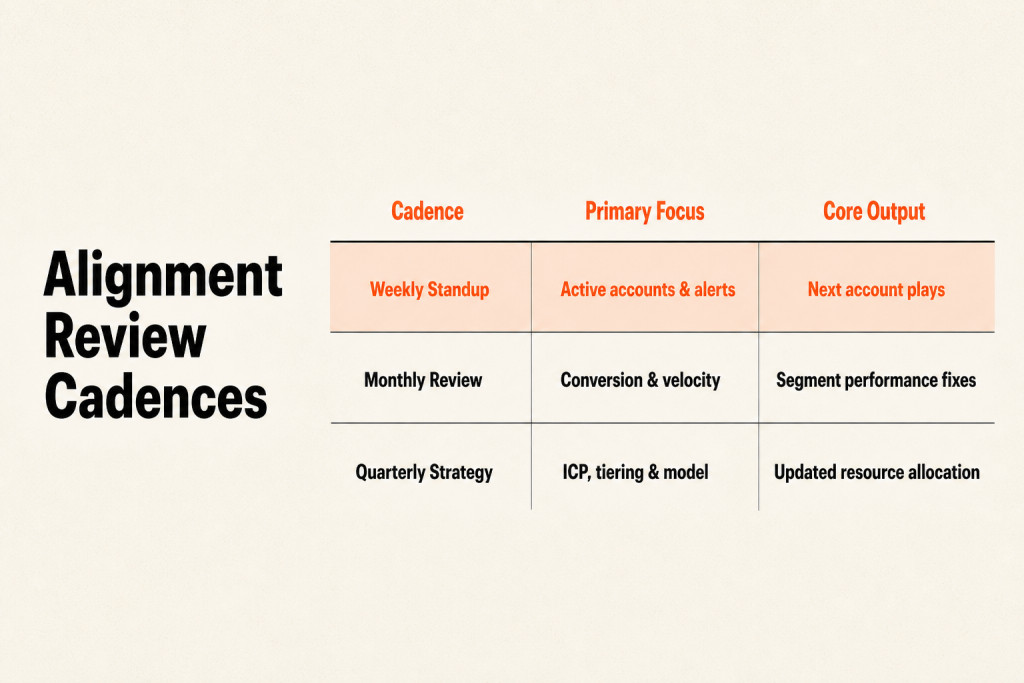
- Weekly account action standup: Review newly active accounts, buying-group gaps, unaccepted alerts, stalled opportunities, SLA exceptions, and the next plays to run.
- Monthly performance review: Review conversion, sales action, response time, pipeline velocity, account coverage, win-loss patterns, and play performance by segment.
- Quarterly strategy review: Revisit the ICP, B2B market segmentation, target account capacity, tiering, pipeline assumptions, buying-group model, messaging, channel mix, and resource allocation.
Send the status data before every meeting.
Reserve live meeting time for decisions, exceptions, and commitments; give every decision an owner and due date, then review it at the next cadence.
Drop recurring meetings that only repeat dashboard activity.
An alignment meeting should end with a changed priority, coordinated account action, resolved process issue, or documented decision.
The finished system should connect a shared calendar, standard agenda, decision log, and action tracker to the revenue workflow.
Companies with regular sales-marketing communication are 67% more effective at closing deals and accelerating pipeline.
Handle issues as shared problems to solve, not ammunition for one team to use against the other.
“Courageous conversations” give team members room to question assumptions.
The point isn’t to make everyone think alike; their differences should stay productive instead of turning destructive.
Operational Execution and Implementation
Useful disagreement lasts only when B2B sales and marketing alignment shifts with the market, buyer behavior, and team growth instead of sitting unchanged for two or three quarters.
Keep the connection active with regular communication, candid feedback, and steady improvement; a set-and-forget arrangement fades quickly.
An executive sponsor may get alignment moving, but competing priorities eventually push teams back into separate silos.
Revenue Operations brings the commercial organization into one revenue function and fixes coordination gaps that behavior-focused efforts often leave open.
By 2022, RevOps existed at 48% of companies, following a 300% increase in the VP of Revenue Operations role over 18 months.
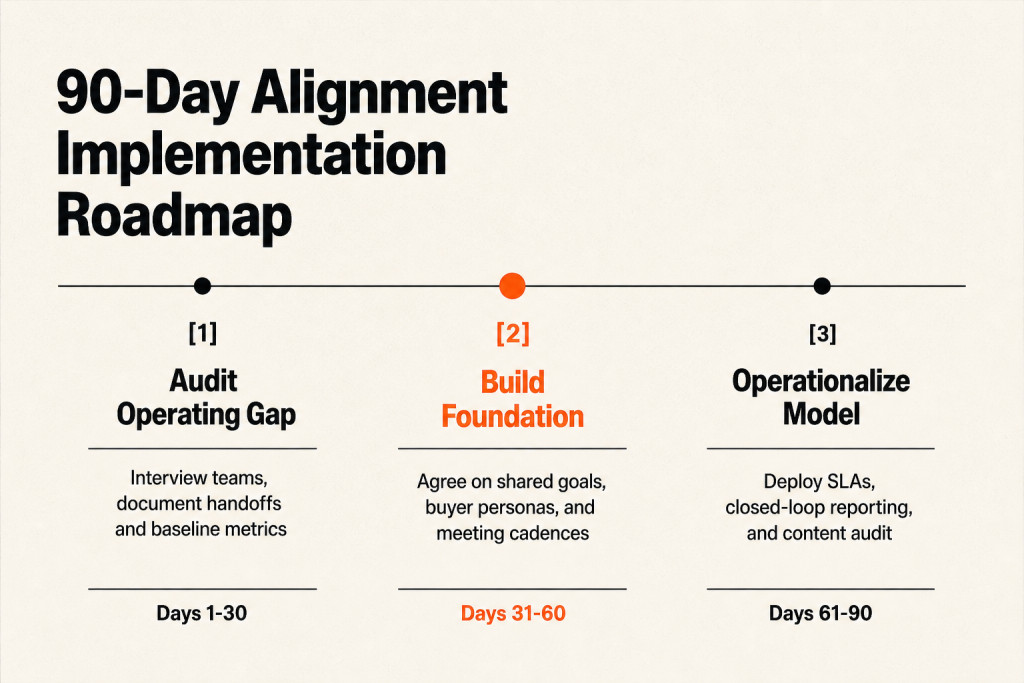
Ninety-Day Alignment Roadmap
Spend the first 30 days auditing carefully: speak with sales reps and marketing team members separately, then document lead definitions, marketing handoff processes, and team metrics.
- The first 30 days should focus on a careful audit of the
- Days 31 through 60 are for building the foundation. During
- Days 61 through 90 should operationalize the model.
Use days 31 through 60 to build the base by agreeing on shared revenue goals, buyer personas, meeting cadences, and communication frameworks.
During days 61 through 90, put the model into practice with SLAs, closed-loop reporting, and a content audit aimed at gaps affecting active deals.
Alignment Audit Checklist
Run the checklist on a regular schedule, checking whether systems, planning, handoffs, messaging, data, accountability, and rewards still aim the same way.
- Shared Revenue Goals: Set common targets for quarterly pipeline $ and revenue, then discuss the same KPIs in meetings; marketing should not report MQLs alone, and sales should not focus only on closed deals.
- Unified Planning: Build go-to-market strategies, campaign calendars, and product launch plans jointly, with sales and marketing contributing to each plan.
- Clear Lead Handoff Process: Define when marketing passes a lead using agreed criteria, and require sales to follow up within the timeframe set by the SLA.
- Consistent Messaging: Check content and sales pitches against the same product descriptions, language, and key benefits before prospects hear them.
- Shared Tools & Data Visibility: Give both teams access to trusted lead statuses, pipeline figures, and campaign attribution, so a salesperson can quickly see how a lead engaged with marketing.
- Mutual Accountability and No Blame Games: Replace “Marketing’s leads are weak” and “Sales is lazy” with joint acknowledgment of the challenges both teams face.
- Cross-Department KPIs and Rewards: Measure team outcomes alongside department output; marketing reviews should include sales pipeline impact, while sales can be evaluated on its use of marketing resources, including content and leads.
If teams say, “we can’t see what they’re doing,” take that complaint as proof the systems aren’t working together.
Connect the technology stack closely enough to cut down siloed information, a major source of misalignment.
Key Metrics for Measuring Alignment
Measure alignment by whether sales and marketing target the right accounts, answer demand, advance buying groups, and produce revenue as one system.
Break out your B2B marketing metrics by account tier, market, use case, source, and play.
Follow marketing-generated leads from their first touch to the closed deal, so the full-funnel view includes the entire customer lifecycle. That stops marketing from taking lead credit while sales calls those same leads unqualified.
Revenue and Pipeline Health
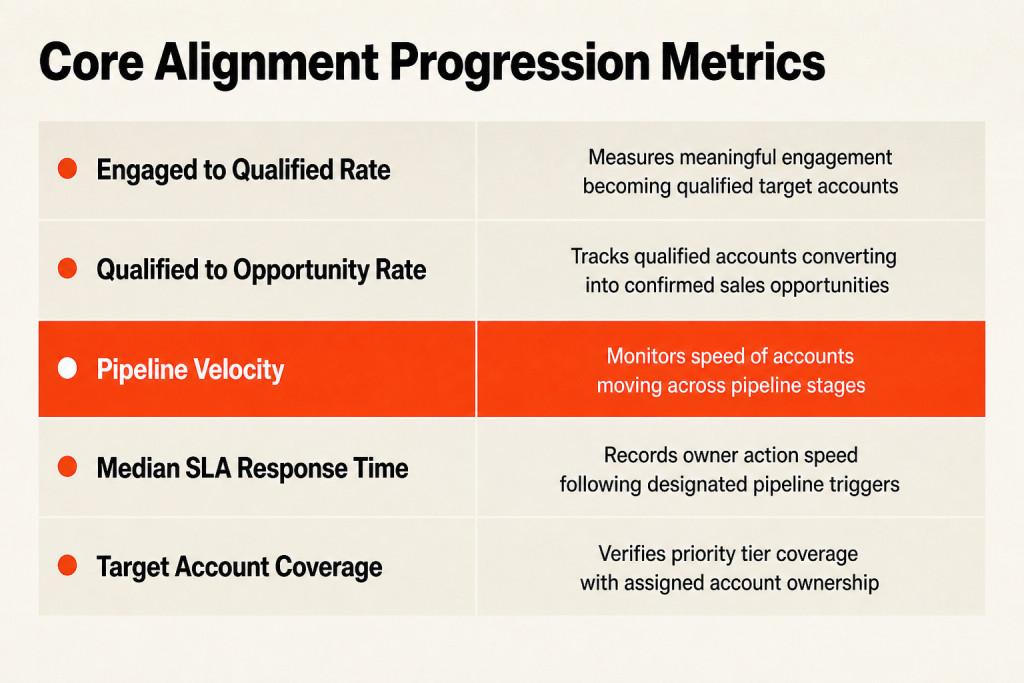
Use pipeline health metrics to see movement through the revenue funnel and spot bottlenecks. Read pipeline value, opportunity conversion, sales velocity, and revenue attribution together.
Pipeline Velocity shows how fast leads travel through the sales funnel, giving sales and marketing a shared signal for coordination.
Aberdeen Group’s research showed 32% revenue growth year over year for highly aligned organizations, while competitors posted a 7% decline.
SiriusDecisions found strongly aligned B2B companies grew revenue 24% faster over a three-year period.
HubSpot’s 2025 State of Sales report says reps at companies with sales and marketing alignment are 103% more likely to beat their targets.
One study reported a 38% increase in sales win rate among teams with alignment.
Aligned teams grew revenue 19-20% faster on average, while poorly aligned organizations could see revenue fall year over year.
Target-account coverage checks whether priority accounts have clear ownership, proper fit, the right tier, and complete account data.
Conversion and Funnel Progression
These measures trace accounts from engagement through coordinated action and into sales opportunities:
- Engaged-to-qualified account conversion: meaningful engagement becoming a qualified account for coordinated action.
- Qualified-account-to-opportunity conversion: qualified accounts becoming confirmed sales opportunities.
- Stage conversion: where accounts advance, stall, recycle, or leave the journey.
- Median response time: how long the assigned owner takes to act after an agreed trigger.
- Sales action rate: qualified accounts or high-value alerts receiving the required sales action.
Track marketing-qualified-to-sales-qualified conversion, lead-to-opportunity conversion, channel-level lead volume, and the time each lead takes to receive a response.
Operational Efficiency and Asset Utilization
According to HubSpot data, 79% of leads generated by marketing never convert, primarily because nurturing is inadequate; sales reps never contact 73% of marketing leads.
Misalignment Warning Signs and Causes
Our research shows that companies’ view of their sales and marketing alignment often differs from the way those teams actually operate.
Only a small 8% of companies show strong alignment between sales and marketing.
Conflicting Goals and Metrics
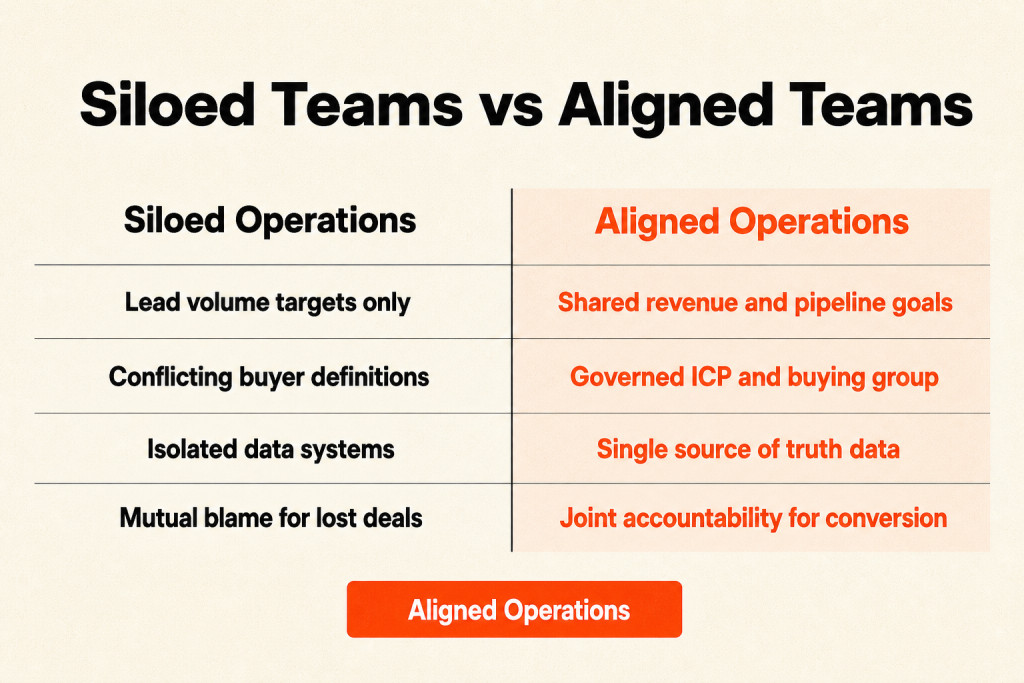
When goals, priorities, and workflows stay separate, sales and marketing retreat into silos, individual wins get rewarded, collaboration suffers, and company impact shrinks.
A department may choose whatever best serves its own interests. However, that choice stops the teams from creating a sizeable impact across the company.
Sales chases immediate revenue, while marketing invests in long-term brand awareness and lead nurturing. Their timelines, incentives, and professional identities don’t match, so friction follows.
Sales keeps pursuing large deals because they bring huge revenue and stronger incentives, while marketing works on low-hanging fruits that feed its lead-generation engine.
If marketing gets judged by lead count and sales by closed revenue, the kitchen gets rewarded for sending plates while the dining room empties because the food isn’t ready.
The Lead Quality Disconnect
The disconnect then moves through the pipeline. Marketing sends leads sales sees as unqualified, so salespeople set them aside and prospect on their own. Marketing treats lead volume as proof of success, while sales treats weak conversion as failure. Prospects outside the ideal customer profile fill the pipeline, and both teams end up blaming the other.
Sales and marketing often lack the same definition of a “sales-ready” lead. Their qualification rules, handoff points, and metrics don’t line up with each other.
Communication Breakdowns and Data Silos
When platforms and data systems stay separate, teams hit barriers to alignment and miss parts of the pipeline.
Data silos keep teams from seeing how marketing activity and sales activity connect with closed deals.
With immediate access to marketing intelligence, salespeople can see which content prospects consumed, which emails drew engagement, and which pain points they researched. Without shared sales and marketing data, each team fills those gaps with its own assumptions instead of facts.
Feedback about lead quality may arrive at marketing too late from sales, while sales reps may not receive campaign goals clearly enough to adjust their own approach.
Pipeline and revenue reports can split when teams use different attribution rules or stage definitions.
The result is two teams reading separate versions of the very same pipeline.
Business Value of Aligned Revenue Teams
When teams align, revenue and profitability advance faster: Forrester found 2.4x greater revenue growth and 2x greater profitability growth.
Aberdeen Group recorded a 39-percentage-point year-over-year revenue gap, with highly aligned organizations ahead of laggards. That spread reaches into business performance, not just department coordination.
Pipeline Acceleration and Revenue Growth
Reported results indicate that aligned organizations generate 208% more marketing revenue than organizations with poor alignment.
LinkedIn reported higher business growth among 87% of sales and marketing leaders whose departments maintained robust alignment.
Sales cycles fall by 40% among companies using Account-Based Marketing (ABM).
In a survey of 821 respondents, Peterson, Gordon, and Palghat linked alignment to eight performance dimensions, from qualified leads generation and lead conversion rates to new account acquisition and revenue targets.

Taken together, these results tie sales and marketing alignment to the measures that show whether commercial activity becomes growth.
Buyer Experience and Customer Retention
Revenue-team coordination matters more when several people shape a purchase: Forrester’s 2024 research says 13 people belong to the average B2B buying group.
During the customer journey, vendors directly engage buyers for just 17% of their time, so much of the process occurs beyond direct vendor interaction.
Before purchase decisions are final, internal agreement can fracture: Gartner’s research found that 74% of buying teams experience internal conflict.
Salesforce reported that 76% of customers want companies to recognize their needs and expectations, raising the standard for aligned communication.
Over the customer lifecycle, aligned organizations record 36% higher customer retention and 20% higher customer lifetime value.
A connected experience shapes the purchase and the period after an account becomes a customer.
Frequently Asked Questions
What is sales and marketing alignment?
Sales and marketing alignment joins the two teams around one customer experience. They coordinate their processes and activities, pursue the same goals, keep their message consistent, and share a clear view of how the customer moves from interest to purchase.
Why is sales and marketing alignment important?
You’ll usually see better lead quality and stronger conversion rates when sales and marketing stay aligned. Research found that organizations whose sales and marketing operations worked closely together achieved 24% faster revenue growth over a three-year period and 27% faster profit growth over a three-year period.
What is a sales and marketing SLA?
A sales and marketing SLA records what happens when an account reaches a defined buyer event. Write down the trigger, qualification standard, owner, response time, required action, feedback path, and recycling rule. Then set the number of qualified leads marketing sends each period, the follow-up speed sales reps must meet, and the way both teams report progress.
How does account-based marketing improve sales and marketing alignment?
Account-Based Marketing brings sales and marketing together to choose high-value accounts and pursue them as a shared focus. A 40% reduction in the sales cycle has been reported by companies using Account-Based Marketing.
What tools help align sales and marketing?
Sales and marketing alignment tools give the sales and marketing functions the same context, run agreed workflows, and track how accounts move forward. Choose tools that display the same account and buying group, show why an account ranks highly, turn a signal into an owned action, and reveal whether that action changed the pipeline.
How often should sales and marketing meet?
Keep the rhythm practical: review pipeline and lead quality every week, hold feedback sessions each month, plan jointly each quarter, and refresh buyer personas each year. Alignment lasts when sales and marketing use the same account context, buying-group view, operating rules, and measures of success.
A shared revenue model, target-account system, and account journey gives sales and marketing the same place to start. Book a meeting to see how the platform can help your sales and marketing teams prioritize the right accounts, coordinate buyer engagement, and turn shared pipeline goals into action.
You’ve now connected buyer definitions, handoffs, shared goals, and feedback loops with a shared revenue model. The working terms are sales and marketing alignment, the sales and marketing SLA, ABM, sales and marketing alignment tools, and meeting cadence. Together, they make B2B sales and marketing alignment practical, linking the customer lifecycle to 36% higher customer retention and 20% higher customer lifetime value.