Win institutional healthcare accounts through targeted B2B healthcare digital marketing by clearing strict clinical and compliance standards across sprawling, multi-stakeholder buying committees. Actual success hinges on convincing insurance providers, private practices, outpatient clinics, and hospital networks to adopt products that directly improve patient outcomes or sharpen daily operational efficiency.
Selling to healthcare institutions forces teams to cut through layers of organizational bureaucracy, unlike consumer campaigns that nudge patients toward immediate symptom relief with quick emotional hooks. Here, marketers must win over panels of technical specialists who demand clear risk reduction along with dependable financial returns. Landing these contracts means building documented, logically sound cases that satisfy clinical directors and hospital administrators alike.
Strategic B2B Healthcare Digital Marketing
Securing major institutional deals in healthcare requires teams to clear demanding clinical and regulatory bars set by broad evaluation committees. Outreach efforts must convince health plans, independent clinics, regional networks, and hospital systems that a product will tangibly elevate patient care while driving real administrative efficiency.

Navigating enterprise healthcare demands grinding through stubborn administrative red tape, which couldn’t be further from direct-to-consumer ads that spark quick symptom relief with emotional urgency. Vendor teams pitch cross-functional committees of domain experts who prioritize proven risk control and durable financial yields. Closing these deals requires presenting methodical, data-backed evidence that holds up under scrutiny from hospital executives and clinical leaders.
High-Impact B2B Healthcare Digital Marketing
Arm your clinical champions with assets that persuade analytical procurement committees instead of relying on top-of-funnel marketing fluff. Build case studies around baseline friction, onboarding overhead, EHR interoperability, and total cost of ownership if you want to survive institutional scrutiny from a Value Analysis Committee. Showing exactly how an intervention resolves baseline operational strain alongside heavy training demands hands champions the concrete proof they require to defend purchasing decisions before hospital leadership, especially when measuring hard clinical outcomes.
Ground your collateral in strict regulatory candor and consistently present hard data over hype to defeat clinical skepticism early. Removing promotional claims and unverified absolutes heads off institutional pushback while protecting your account from regulatory watchdogs.
Compress ancillary formats into secondary, supportive diagnostic collateral where practical compliance playbooks, leadership interviews, and technical readiness assessments can validate an organization’s credibility. This boundary prevents distracting buyers from primary, committee-ready clinical evidence.
Organic Search Strategy for Healthcare Inbound Demand
Clinical buyers start their evaluations of prospective software vendors by turning to a search engine. Medical administrators search for precise, technical fixes that can clear specific hospital bottlenecks. Capturing high-intent organic rankings for those operational terms carries far more weight than chasing broad consumer traffic. When you optimize digital content around practical workflow problems, you directly pull in institutional buyers who are actively preparing to make large procurement decisions.
Search algorithms evaluate medical material against strict standards for firsthand experience, domain expertise, authoritativeness, and trustworthiness, forcing marketing teams to hit clear quality benchmarks. You won’t win durable rankings unless you prove continuously that credentialed clinical professionals write every asset and support each claim with verifiable data.
Whether managed internally or guided by a specialized b2b healthcare digital marketing agency, budgets are shifting fast across pharma brands and healthcare vendors alike. Industry projections show teams spending more on social networks than linear TV for the first time, while search still commands roughly 55% of digital spend. You’ve also got to prepare for zero-click AI search, especially as Reddit expands as an organic channel with around 48% year-over-year growth.

Commercial Intent Keyword Research
High-Intent Operational Search Queries
Turn your site into an authoritative resource hub by building dedicated landing pages and thorough buyer guides around the exact phrases your purchasers use, including hospital workforce management software. Pull your target queries directly from Google Keyword Planner or SEMrush, isolating terms that match your solutions while maintaining healthy monthly search volume.
Demand capture works reliably in consumer health marketing where patients search to address immediate personal problems. But evaluating enterprise pipeline strictly through last-click attribution starves the peer network activity and clinical documentation that created the initial relationship. That measurement mistake directly leads marketing teams to over-invest in bottom-funnel channels.
Technical Search Architecture and Website Speed
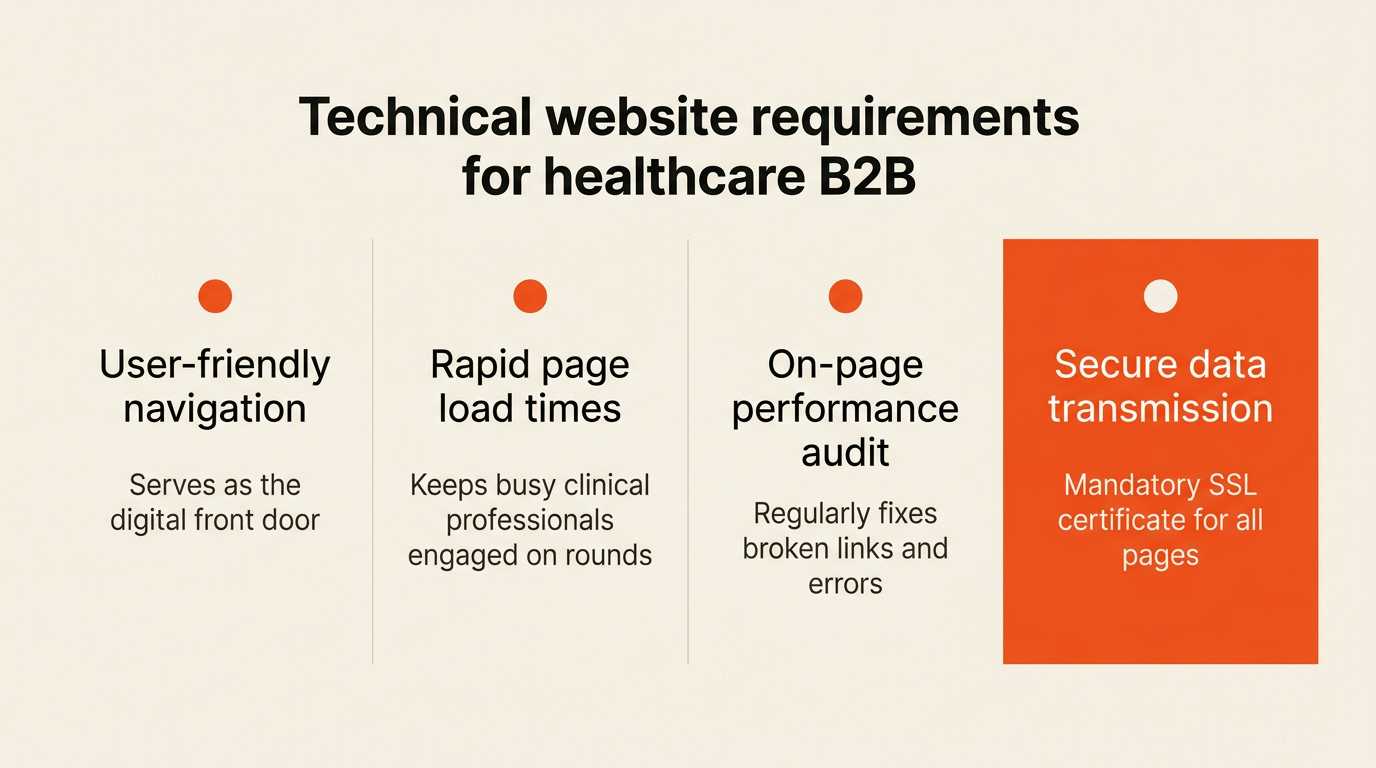
Every healthcare B2B vendor requires a solid technical web foundation to keep institutional visitors engaged and sustain search visibility across modern clinical environments:
- Serving as the digital front door, a professional website gives healthcare B2B companies an essential platform to share complete information about their services through user-friendly navigation, mobile optimization, and clear calls to action.
- Maintaining rapid load times keeps busy professionals engaged, and responsive layouts allow doctors to access pages on mobile devices during hospital rounds. Conversely, slow loading and poor design suggest technical incompetence, quickly causing buyers to question whether the vendor can manage sensitive medical data safely.
- Enhancing on-page technical performance requires fixing broken links, using correct header tags, speeding up page rendering, performing regular site audits via tools like Google PageSpeed Insights, and addressing technical errors quickly while applying SEO best practices.
- Securing data transmission on healthcare sites that handle sensitive information makes an SSL certificate mandatory, which organizations must purchase and deploy across login screens, forms, and every page where user data is collected.
Authority Backlink Acquisition via Clinical Publications
Reputable Clinical Inbound Links
Secure authoritative inbound links from reputable healthcare publications, industry associations, or websites by pitching targeted guest posts, appearing on podcasts or interviews to share clinical expertise, and producing link-worthy research assets.
Industry Association Ecosystems
Trade outlets like Becker’s and HealthIT News, along with communities like HIMSS and specialized specialty associations, provide strong environments for PR, sponsored content, and relationship development. One of the best ways to open direct networking channels and partnership opportunities is to join relevant professional associations across the healthcare field. A healthcare IT company, for example, can join a medical informatics association to meet prospective collaborators.
Specialized Geographic Optimization
Local search signals and regional buyer profiles help commercial suppliers connect directly with nearby healthcare networks:
- Optimize for local queries, including phrases like healthcare solutions in [location], whenever your organization maintains a physical facility.
- Set up a Google My Business profile, publish accurate contact details such as your phone number and address, and ask customers to submit reviews.
- Adapt your messaging to regional audiences by localizing your content where relevant.
- Review historical customer accounts for common characteristics, including organization size, specialty, technology stack, accreditation, or region. Discovering that mid-sized regional hospitals operating on a specific EMR produce the highest conversion rates tells your team exactly where to focus.
Paid Search and B2B Healthcare Media Management
Digital Advertising Scale
Clinical search captures roughly 55% of all digital spend focused on healthcare leaders across commercial channels. Across U.S. healthcare and pharma, total digital ad expenditure grows from roughly $25 billion in 2025 to about $26 billion in 2026.

Efficiency Benchmarks and Down-Funnel Returns
Tracking campaign efficiency over time takes active measurement rather than comfortable assumptions. Benchmark data from First Page Sage shows that healthcare and medical leads cost roughly $126 on average, while qualified pipeline climbs several times higher across individual accounts. Turning an MQL into an SQL happens at around 13% in healthcare. That conversion rate sits near the bottom of all industries, reflecting market structure rather than a systemic breakdown.
Intent-Driven Keyword Bidding
Bid directly on search terms tied to what you sell, such as medical software solutions or healthcare technology providers, while tracking form completions through Google Ads. Thorough keyword research across exact match, phrase match, and broad match lets you isolate top performers and capture a wide variety of search queries.
Conversion-Centric Institutional Landing Pages
Display physical clinic or office addresses using location extensions. Tailored landing pages and tight ad structures route paid traffic toward specific product milestones:
- Build dedicated landing pages tailored to your PPC campaigns that present detailed information covering your enterprise offerings and b2b healthcare digital marketing services.
- Connect ad content directly to relevant landing page copy, incorporate forms to collect leads, and include a clear, compelling call-to-action to support conversions.
- Direct searchers to specific locations across your site by applying site link extensions that offer extra detail.
- Present product features via structured snippet extensions, point out primary advantages through callout extensions, and display physical offices using location extensions.
- Track campaign outcomes, such as product purchases or submitted lead forms, by configuring conversion tracking tools, including Google Ads conversion tracking or third-party analytics platforms, to evaluate and direct media performance.
Granular Professional Demographic Targeting
Sharpen your campaigns by layering demographic targeting, location targeting, and device targeting pegged to confirmed hospital size and clinical job titles. Testing multiple targeting parameters against each other helps you figure out the most productive media mix for your live budget.

Retargeting Strategies for Institutional Prospects
Set up remarketing lists and create tailored ads for users who have interacted with specific pages on your website.
Because an institutional buying cycle frequently stretches well past a full year, keeping prospects interested depends entirely on steady, dependable follow-up. Consistent pacing maintains vendor presence without applying high-pressure sales tactics. Using automated workflows to deliver relevant assets at scheduled intervals keeps your team visible without putting excessive pressure on the buyer.
Negative Keyword Governance
Search query reports reveal the unqualified search terms triggering your ads. Adding those irrelevant queries to your negative keyword lists sharpens audience delivery while driving up your overall campaign efficiency.
Social Media for B2B Healthcare Professional Digital Marketing
Research from PWC shows that more than 80% of buyers look at social posts, articles, and user feedback before buying anything. When clinical buyers evaluate your team, your LinkedIn company page functions just like an Amazon product listing. Hospital administrators and senior physicians carry their consumer habits straight into the workplace, evaluating commercial suppliers against the same standards they use at home. A buyer who scrutinizes a $20 Amazon purchase will dig deeply into your credentials before putting a $150,000 device in front of a hospital purchasing committee.
Cold email outreach still delivers steady returns, but pairing those messages with targeted touches on LinkedIn expands your footprint across target health systems. Healthcare organizations tap into LinkedIn to connect directly with department heads and clinical peers who ignore regular sales messages. If you post practical operational updates, share relevant clinical data, answer questions in comment threads, and highlight user stories, you pull qualified interest directly into your pipeline.
Professional Social Thought Leadership
Peer Network Discovery Clinicians discover almost every new medical device through peer channels like academic journals, specialty conferences, and technical discussions on LinkedIn where surgeons review operative cases. Real hospital adoption only occurs after a respected specialist proves that the hardware delivers clinical results. Today, LinkedIn operates as an open venue for clinical validation, where key opinion leaders post case studies and department chiefs evaluate real surgical outcomes long before taking a call with your sales reps. Ignore vanity follower counts and focus entirely on being visible to the around 200 KOLs who actually steer your clinical discipline. Showing up consistently in front of that small group is what turns a casual colleague introduction into a formal evaluation meeting with the hospital committee.
Corporate Brand Authority Posting practical analysis directly from your corporate profile builds authority while drawing engagement from department chairs, IT directors, and executive teams. For instance, an equipment manufacturer can publish short breakdowns of emerging diagnostic workflows, detailing their operational trade-offs and showing how they fix common hospital bottlenecks. That ongoing commentary demonstrates that your company understands daily clinical realities.
Clinical Video Walkthroughs and Explanations
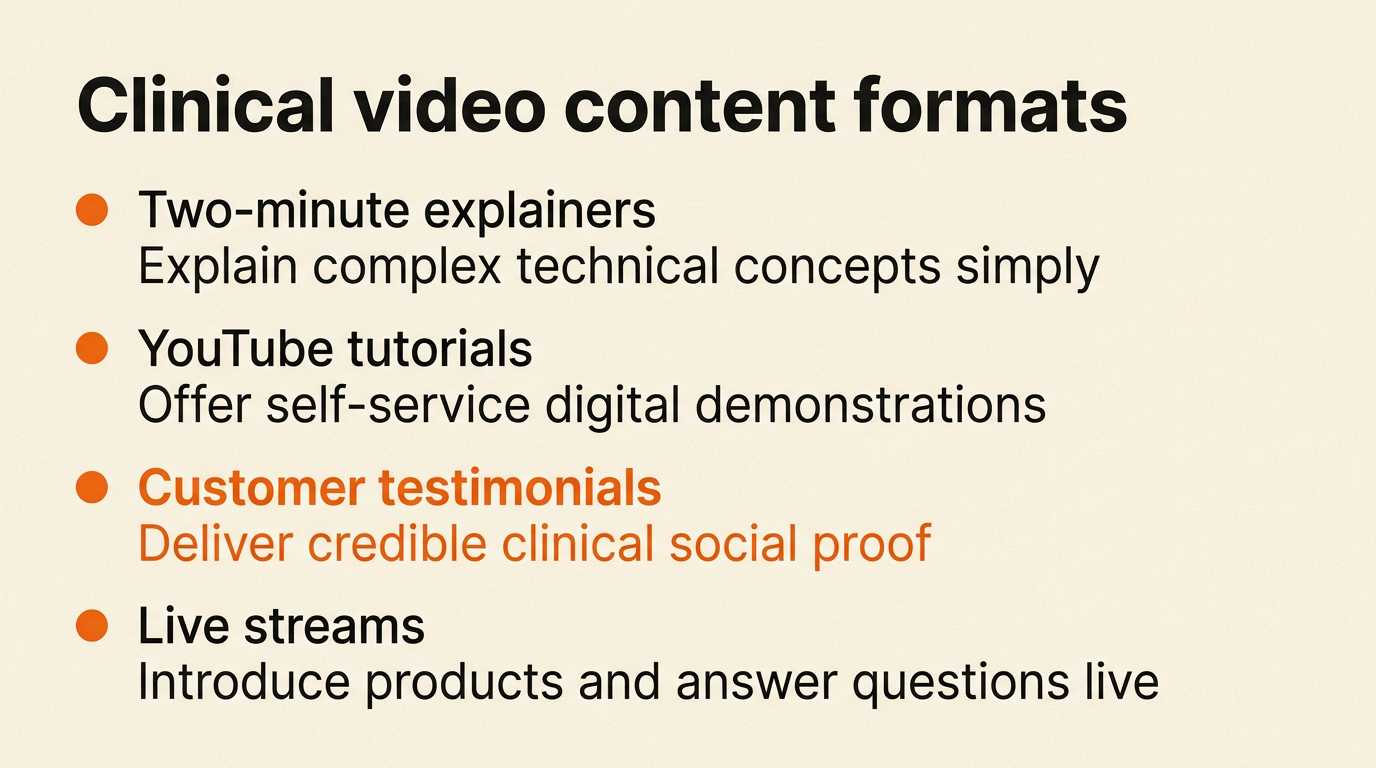
Hospital personnel upload guided software tours to YouTube and stream Facebook Live sessions to show sophisticated equipment across buying stages:
- Two-minute explainer videos unpack complicated technical concepts through motion graphics and live-action sequences that illustrate physical ergonomics and exact functional performance.
- YouTube tutorials explain intricate healthcare systems or highlight medical device functionality, while digital demos allow prospective clients to evaluate how a product works without booking a formal sales meeting.
- Producing videos that summarize services concisely, share customer testimonials, or showcase practical product operation keeps viewers engaged and communicates messages dynamically.
- Video recordings of customer testimonials offer credible social proof that helps dismantle the natural skepticism found throughout medical purchasing committees.
- Unveiling new innovations, such as a new medical imaging technology, via Facebook Live allows teams to introduce product features, answer live questions, and interact directly with attendees.
Specialized Industry Discussions and Social Polling
Suppliers monitor user discussions amid roughly 48% yearly growth on Reddit, alongside running Twitter polls and participating in professional exchanges:
- Marketers must prepare for zero-click AI search as Reddit records around 48% year-over-year growth to become one of healthcare’s fastest-growing organic channels, creating space for community participation where unvarnished peer conversations happen.
- Starting and participating in specialized LinkedIn groups centered on healthcare topics, like value-based care approaches, gives professionals an environment to address industry challenges and builds community engagement.
- Joining or organizing Twitter chats about prevailing healthcare developments, such as a discussion on electronic health record interoperability standards, lets teams address questions, communicate with specialists, and share perspectives.
- Running Twitter polls gives organizations a way to collect real-time opinions from their audience, such as surveying clinical professionals on their preferences regarding clinical trial participation.
Targeted Professional Social Advertising
Demographic Role Filtering Set up your paid LinkedIn campaigns to filter for exact institutional titles like Medical Director or Hospital Administrator. Pair those granular audience filters with direct messages and educational posts published from your company page. Write specific creative tailored to the real workflow bottlenecks that frustrate clinical leaders, procurement officers, and technical staff during a purchasing cycle.
Compliance and Ethical Governance in Healthcare Marketing
Anchor commercial trust with enterprise hospital accounts through strict technical privacy governance. Strip out patient-level data completely from your B2B campaigns, focusing your personalization purely on the facility, clinical specialty, job title, and stated operational headache. Inspect your web telemetry directly by pulling up browser developer tools on demo forms, whitepaper downloads, contact pages, and pricing sheets. Make sure third-party advertising tags collect zero parameters, and wipe tracking pixels off URLs that mention clinical conditions or patient portal links. Shift your setup to server-side tag management with strict data-scrubbing rules that purge user IP addresses and query strings before any payload leaves.
Treat regulatory compliance as a major credibility asset rather than an operational tax. Clinical buyers pick apart marketing claims with intense skepticism, so cut absolute promises like cure or guarantee and focus strictly on operational gains supported by verified data. You win over cautious committees by running a tight ship: route all clinical messaging through formal medical or legal review, enforce a clear do’s-and-don’ts language guide, establish audit trails, and document your internal sign-off process for endorsements.
Statutory mandates require that same discipline across all outbound messaging. Give recipients obvious unsubscribe options, provide clear email preference centers, maintain detailed suppression files, and scrub out every reference to sensitive health data. If you market across international borders, rely on opt-in inbound programs; in regions with strict privacy enforcement, run outreach through direct phone calls and LinkedIn instead of cold email.
Frequently Asked Questions
What Are the Primary Marketing Objectives of Hospitals and Health Systems?
When hospitals build their marketing campaigns, they focus on two foundational targets: expanding patient volume and securing sustained clinical credibility.
Service Line Growth and Clinical Trust Regional health systems focus their resources on growing main service lines and raising regional awareness across their target markets. Consistent outreach establishes these facilities as world-class care providers, while clinical leaders direct their day-to-day energy toward improving measurable quality scores.
Physician Referrals and Collaborative Networks Health systems increase referrals from community physicians and healthcare professionals by organizing structured collaborative sessions alongside regular clinical educational symposiums.
Community Outreach and Patient Experience The overall patient experience remains another foundational operational goal for regional hospital networks. Marketing teams pull this off by delivering clear communication and straightforward service access, while expanding community outreach programs that encourage preventive health measures across local populations.
Commercial Revenue Targets and Operational Budgets Data from McKinsey & Company shows that acquiring new clients must account for more than 10% of annual revenue growth across top-performing enterprise operators. Healthcare organizations track marketing allocations every quarter against these clear benchmarks. Established practices generally commit 2-5% of revenue to sustain these programs, while newer practices invest 5-10% during their first year to build regional recognition.
Why Do Healthcare Conversions Still Rely on Telephone Interactions?
In high-stakes healthcare procurement, heavy regulations force institutional buyers to talk directly with real staff before committing enterprise budgets, even after doing all their product discovery online. Findings published by Invoca demonstrate that the majority of enterprise healthcare deals finalize over a phone call. That reliance leaves an attribution blind spot for marketing teams who track nothing beyond digital form fills and website clicks.
How Do Organizations Balance Personalization with Regulatory Privacy?
The ongoing balance between personalization and privacy represents the hardest friction point in healthcare marketing, solved only by tailoring messages to organizational firmographics while keeping individual patient records completely out.
Personalize on professional and firmographic signals, not patient data.
Enterprise outreach cannot touch protected health information (PHI) under any circumstances, relying solely on explicit consent frameworks and anonymized organizational data. Segmentation builds around operational pain points and facility classifications rather than mentioning any specific medical condition.
Campaign architects cannot build retargeting workflows around data points suggesting an individual user manages a specific illness or searches for particular clinical treatments.
Using sensitive patient data for digital ads without clear, written consent directly violates federal statutory mandates and triggers massive regulatory penalties. That strict boundary eliminates standard browser retargeting and forces organizations to maintain secure, compliant infrastructure. A disciplined privacy posture protects institutional standing, and maintaining 1,000 thoroughly profiled, opted-in professional contacts generates far more commercial value than chasing 10,000 unverified records.
What Inbound Marketing Strategies Deliver the Highest Return in Healthcare?
High-impact inbound programs consistently pair hard clinical evidence directly with established educational distribution channels:
- Deliver multi-channel, evidence-led campaigns built on precise account segmentation, LinkedIn outreach, and email nurture sequences paired with authoritative educational assets.
- Publish clinical case studies that objectively prove real-world outcomes, such as documenting how a peer hospital reduced emergency room wait times by 30%, giving buying committees verifiable peer proof.
- Mobilize clinical peer networks by equipping respected key opinion leaders on LinkedIn to share operational techniques and procedure reviews, turning warm introductions into credible departmental procurement meetings.
- Optimize organic search visibility for high-intent operational software queries and workflow bottlenecks like hospital workforce management software rather than generic consumer wellness definitions.
- Host interactive educational webinars on pressing technical topics like data security best practices to establish domain authority and generate a pre-qualified institutional sales pipeline.
Key Takeaways
Still, winning enterprise health accounts demands verified clinical validation and disciplined execution alongside steady alignment with hospital buying committees across six fundamental rules that govern high-performing B2B healthcare marketing programs:
- Divergent Strategic Playbooks: Across the commercial landscape, healthcare marketing divides into two irreconcilable models. Consumer health drives volume for individual patients, while B2B medtech requires you to build clinical adoption networks, influence IDN procurement, and develop credible clinical champions inside hospital systems.
- Enterprise Committee Governance: Multi-stakeholder committees govern procurement decisions under tight regulatory oversight and protracted review timelines. Align your team across 8 to 12 participants in finance, IT, and clinical positions across contracting horizons that run from several months to well over a year.
- Down-Funnel Conversion Economics: Healthcare generates approximately 13% as an MQL-to-SQL conversion rate, placing it near the bottom of all surveyed sectors. Track pipeline contribution, clinical champion density, and opportunity velocity on your internal dashboard instead of relying on vanity impressions or general website traffic.
- Compliance as an Institutional Trust Asset: Meeting strict regulatory standards such as HIPAA, GDPR, FDA requirements, and CAN-SPAM remains non-negotiable for commercial teams. When executed well, systematic adherence functions as a trust signal that accelerates evaluation and eliminates key hurdles in enterprise contracting.
- Pre-Launch Demand Engineering: Relying on formal commercial launch dates would make sense if hospital purchasing was simple. But in complex health systems, winning teams construct their clinical evidence base, industry narrative, and key opinion leader consensus well before facing hospital value analysis committees.
- Omnichannel Media Modernization: Digital advertising spend across U.S. healthcare and pharma moves toward roughly $26 billion in 2026 as systems modernize communication. Social media investments are surpassing linear TV budgets, and organizations deploying digital sales models generate five times the revenue growth of their peers.
Executing an effective healthcare b2b digital marketing strategy gives your team a clear operational roadmap to close complex institutional accounts. Teams build actual momentum by equipping internal clinical champions with the exact data needed to convince medical and financial committee gatekeepers alongside technical gatekeepers. When you lock down regulatory compliance from day one, prepare clinical validation before formal reviews, and track opportunity velocity instead of vanity traffic figures, prolonged hospital procurement cycles shift into predictable expansion. Put these six operating principles on your team calendar tomorrow morning, and measure every outreach campaign against verified pipeline conversion.