
Knowing how to choose a b2b digital marketing agency requires treating your search as an operational audit rather than a casual chemistry check.
Any team can assemble a polished pitch deck, but the real hazard in your early meetings is never knowing what happens when a live campaign stalls. Teams should pin down their exact failure protocol before signing a contract. If you skip that operational review, you typically uncover their response only after burning ninety days on an unprofitable retainer.

Standard sales calls almost never expose the disconnect between a slick sales presentation and actual business outcomes, which is where most agency engagements fall apart. That reality only becomes obvious during your first quarterly review, when nobody on the agency roster can tie your cash out the door to closed pipeline.
An internal evaluation system has to be far more rigorous than their deck is slick. Research from the ANA and 4As highlights just how costly and resource-intensive running an agency pitch process can become, costing an average of $400,000.
How to Choose a B2B Digital Marketing Agency: Key Selection Criteria
Traditional b2b digital marketing agency selection criteria routinely focus on the wrong priorities while pricing comparisons overshadow operational fit. Teams spend hours reviewing creative portfolios while completely ignoring weekly collaboration workflows, which means nobody looks into reporting mechanics until the first invoices hit accounting.
Headcount numbers, industry trophy cases, and glowing reviews for top b2b digital marketing agencies dominate the ranking charts published by mainstream market research firms. Day-to-day partnership success actually hinges on tactical operating habits that show almost zero correlation with those three vanity signals.
Inspect four operational pillars before you ever look at past client work. Polished case studies regularly mask slow turnaround times and tangled communication channels. Treat turnaround speed as your fifth mandatory filter. In bloated agencies, simple campaign tweaks get buried under three layers of management approvals when you really need account specialists who hold full authority to make immediate pivots.

Minor operational friction across a twelve-month contract quickly snowballs into massive revenue drag. When internal agency bureaucracy stalls an edit that should take an afternoon, you end up letting an underperforming campaign burn cash for two weeks without correction.
Industry Sector and Buyer Persona Experience
True marketing performance is heavily dictated by three distinct areas of expertise:
- Industry experience. Have they worked with companies in your sector? B2B SaaS is not B2B fintech, and B2B contech is not B2B healthtech.
- Channel experience. Have they actually run the channels they recommend? When evaluating the range of b2b digital marketing services, asking “how many ABM programmes have you delivered” is more useful than asking “do you offer ABM.”
- Target customer experience. Have they marketed to your buyer before? Marketing to a CTO is different to marketing to a CFO and different again to marketing to a Head of Procurement.
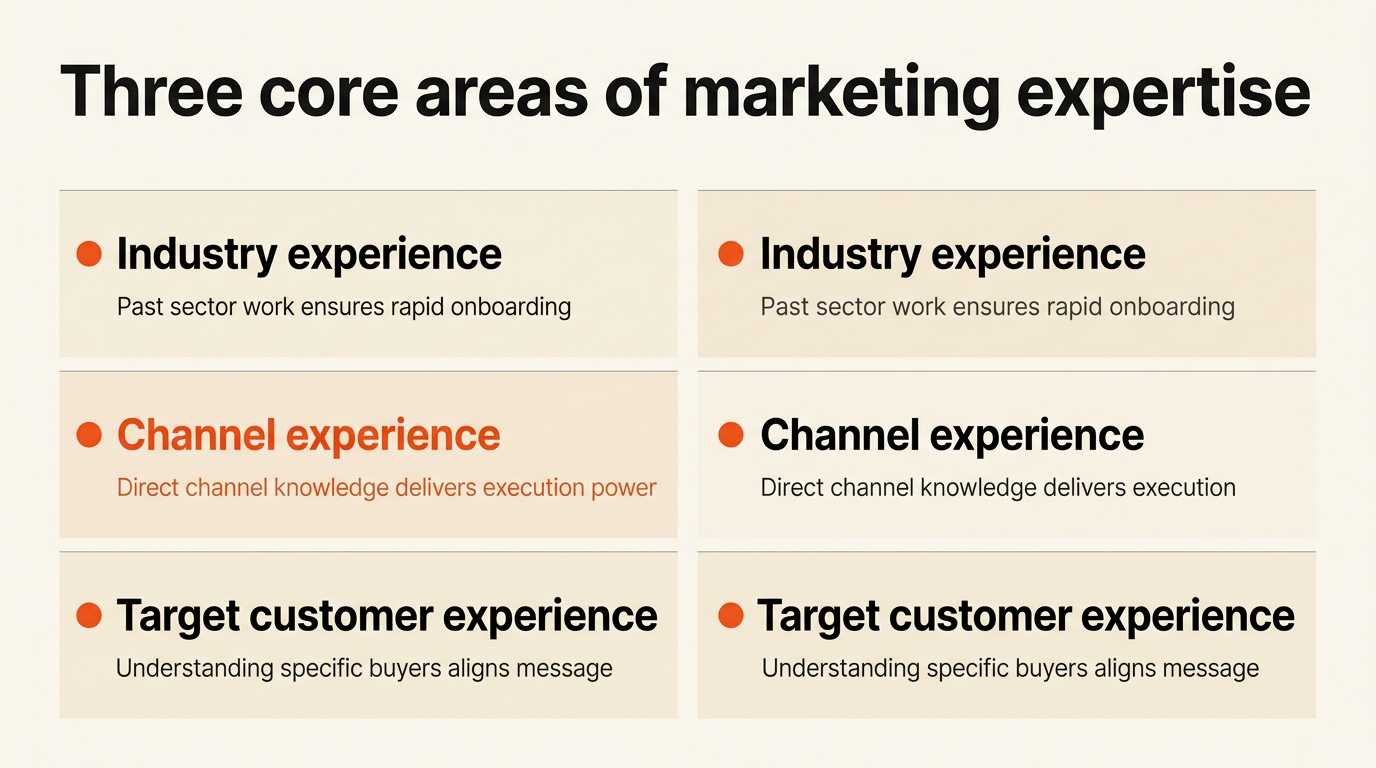
Execution moves fast when an agency brings all three capabilities together, but onboarding drags out whenever a team only possesses one or two.
Complex B2B industries demand years of hands-on exposure. Heavy manufacturing brings rigid compliance rules, construction deals with prolonged purchasing cycles, and enterprise SaaS requires managing intricate multi-stakeholder buying committees. Generalist agencies spend early engagement months learning basic procurement terminology and will struggle to address a Head of Procurement. An agency grounded in those operational dynamics will not waste your first three months trying to decode an RFP.
Verify direct experience with channel reporting rules whenever your go-to-market engine relies on vendor partner programs or Market Development Funds (MDF). Generalist agencies that do not understand strict MDF compliance documentation will leave your reimbursable co-op dollars uncollected and permanently lost.
Team Composition and Day-to-Day Staffing
Account managers placed between your team and hands-on execution specialists introduce structural friction that ruins otherwise promising partnerships. Critical strategic feedback gets relayed, delayed, and watered down at every handoff instead of moving straight to the people doing the work.
Every client relationship needs different personnel, so ask three questions before signing any contract:
- Who runs the account day to day, including names, titles, and individual years of experience
- How many other accounts those same people work on simultaneously
- What happens operationally if performance drops in month two
Agencies love staffing pitch meetings with seasoned directors who disappear the moment you sign the contract. Leveraged junior associates typically take over daily execution because that is how agency service margins get built. But when campaign performance slips, an entry-level coordinator who merely schedules social posts cannot replace senior strategic leadership rooted in real B2B buyer psychology.
Smart agency models balance their rosters by assigning senior operators to high-stakes tasks where nuanced judgment matters, while letting junior talent run routine execution to build skill. Early-career practitioners bring high energy, yet they burn out under isolation, making deliberate support systems far more valuable than pitch-room concealment.
Reporting Transparency and Direct Dashboard Access
Live Dashboard Infrastructure Insist on clear visibility into daily campaign numbers during contract negotiations. When an agency resists live transparency, they are almost always concealing flawed attribution models rather than protecting proprietary methodology. Before paying initial retainers, inspect the analytics workspace yourself and demand real-time data access across active channels instead of settling for a curated monthly PDF summary. Pin down their exact communication cadence, clarify every tracked metric, and verify whether performance numbers populate automatically or require manual assembly.
Core Commercial Performance Questions Every month, a dependable reporting cadence must resolve three questions: what specific actions were taken, what measurable commercial results followed, and what tactical adjustments your team will execute next.
Connected System Reporting Winning enterprise revenue means managing a six-month buying committee across multiple internal stakeholders, which operates on fundamentally different commercial mechanics than consumer marketing built around quick checkouts. Demand direct pipeline attribution across every touchpoint using automated integrations that feed live campaign performance directly into your CRM instead of exporting spreadsheets by hand.

Questions on How to Choose a B2B Digital Marketing Agency
Targeted interview questions filter out unqualified finalists before your company commits to a costly hiring mistake.
Distinguishing a true revenue partner from a task-oriented vendor hinges on 10 explicit questions directed at agency executives. We shaped this diagnostic framework through years of partnering directly with industrial, construction, SaaS, and logistics brands while reviewing failed engagements.
Revenue Metric and Pipeline Definition
An unbroken operational link must connect every deliverable straight to Marketing Qualified Leads (MQLs), Sales Qualified Leads (SQLs), and your target Customer Acquisition Cost (CAC). Attribution also has to account for pipeline velocity, which gauges how fast qualified opportunities travel through your commercial funnel. Data from HubSpot confirms that world-class B2B teams tie agency activity to closed contracts rather than task volume.
Agencies run to impressions, reach, and follower counts whenever they need to distract you from stagnant quarterly pipeline numbers. Staring at vanity metrics on monthly slide decks gives you comforting charts without proving that a single dollar ever reached your bank account. The best B2B marketing agency focuses on conversion rates, Customer Acquisition Cost (CAC), and verified pipeline value instead of empty channel traffic. Before you sign any contract, make them show you a verified case study where their marketing metrics led directly to a closed B2B contract.
Sales Cycle Dynamics and Stakeholder Management
Buying Committee Complexity How fragmented has B2B deal-making really become? Data from Forrester’s State of Business Buying, 2026, reveals that a typical enterprise purchase involves 13 internal stakeholders and 9 external influencers, with groups growing even larger during technical reviews. Engineering, procurement, finance, operations, and legal rarely share the same priorities. On top of that, research from Gartner shows buyers spend only 17% of their total purchase window meeting with potential suppliers, a tiny slice of time divvied up across every competing vendor chasing your deal.
Prolonged Buying Timelines and Role-Specific Content Tailoring Across sectors like construction, enterprise SaaS, and industrial manufacturing, commercial sales cycles regularly span 6 to 18 months before closing. Make your agency build role-specific assets for every stage, such as sending a whitepaper to an operations VP while delivering technical spec sheets to engineering. These deals bear zero resemblance to impulsive consumer purchases where one shopper buys unassisted in minutes. A standard sale in these fields stretches across 6 to 18 months, requiring 6+ months of active nurturing, 60+ touchpoints, and roughly 7 stakeholders.
Account Team Workload and Dedicated Personnel
In B2B digital marketing strategy, an experienced media buyer or senior SEO strategist can effectively run 4 to 6 enterprise accounts before execution slips. You should expect shallow, template-driven work whenever specialist workloads climb past 8 accounts.
Before signing any agreement, insist on seeing the names and backgrounds of the specific people managing your account day-to-day, including your SEO analyst, PPC manager, and content strategist. If leadership hesitates to let you interview those individual practitioners, treat that friction as your cue to walk away.
To evaluate team structure, review these core operational responsibilities:
- Who owns account strategy on a day-to-day basis
- Who handles direct channel execution
- Who is responsible for reporting and performance visibility, since ambiguous ownership leads directly to inconsistent performance
Diagnostic Onboarding Methodology
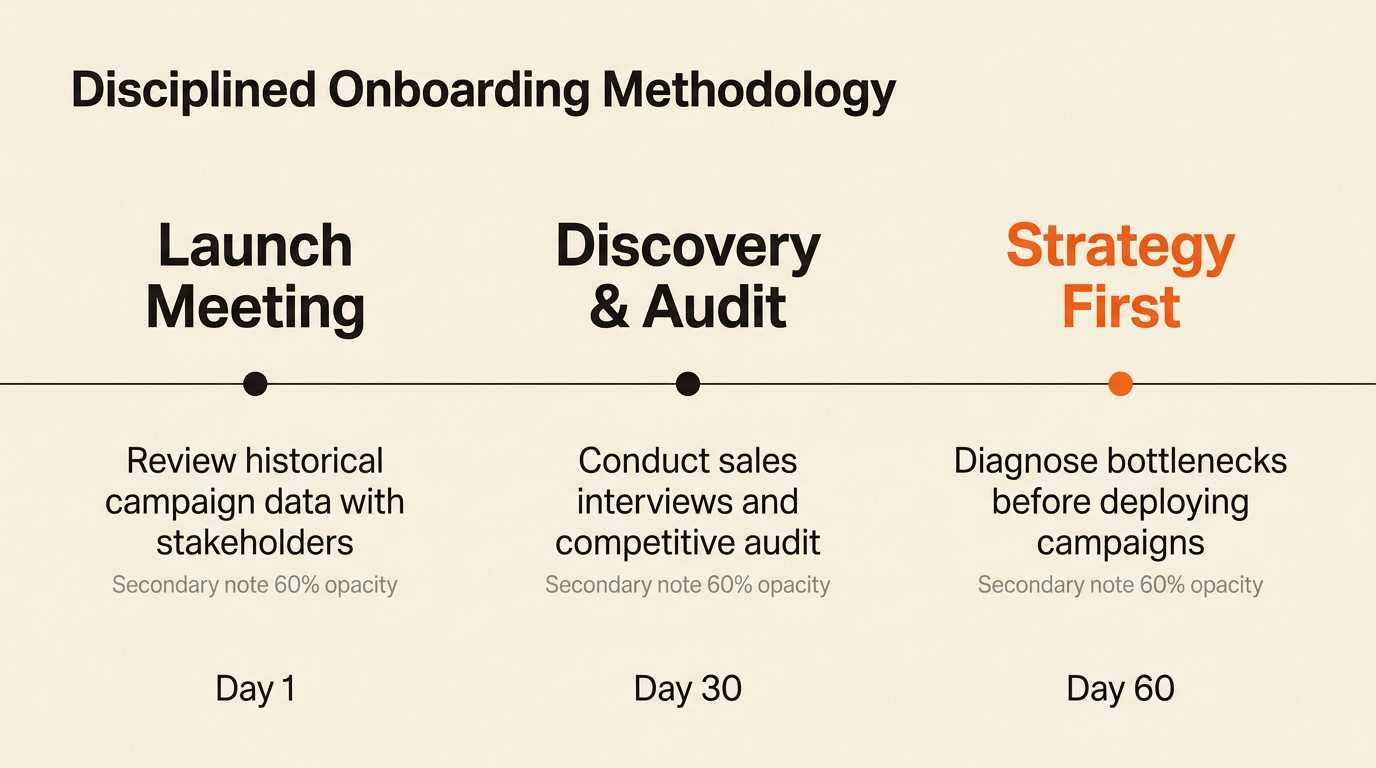
No doctor prescribes complex treatments without reviewing lab work first, yet bad agencies launch campaigns without an initial audit. A disciplined operational baseline relies on three sequential stages during the initial 30 to 60 days of an onboarding deep dive:
- Review historical campaign performance data and pull data reporting preferences with internal stakeholders across an initial 2 to 4 hours launch meeting.
- Conduct sales team interviews, audit existing marketing assets and analytics, and review the competitive landscape during the first 30 to 60 days.
- Execute a “strategy first” discovery to diagnose underlying offer and positioning bottlenecks before deploying tactical campaigns.
Stay open-minded during discovery, because an agency is not always the culprit when onboarding exposes an inaccurate initial brief. Positioning flaws often masquerade as “lead problems,” hiding what is truly broken in your go-to-market engine. For instance, an ABM initiative that seemed broken was actually tracking flawed signals, burning budget across 3000 accounts when focusing hard on 40 accounts would have generated real pipeline.
Platform Access and Asset Portability
Renting your own marketing is the inevitable result whenever an agency runs campaigns inside proprietary ad accounts, giving them total leverage to erase your historical performance data if you leave. Total ownership of your accounts is the only operational baseline you should ever tolerate.
Direct, real-time administrative access to your Google Ads account, analytics platform, and SEO tools must be guaranteed at all times. Ask every prospective partner one simple question: “If we part ways in 12 months, what do we walk away with?” The only acceptable answer is everything. An agency that demands ownership of your site hosting, analytics, or advertising accounts is manufacturing captive dependency, whereas every digital asset you fund should remain your property from day one.
Commercial Terms, Pricing, and Scoping
Commercial structure dictates day-to-day execution, so drill into both fee frameworks and engagement models before committing your company’s capital to an outside firm.
Bring up billing models in your first conversation so you can immediately filter out vendors who don’t match your budget realities. World-class firms will naturally charge a premium, but expecting a binding quote before they dig into your actual account data is completely unrealistic. When a shop quotes a flat day rate before auditing the actual project requirements, treat that as an immediate warning on your end.
Scoped Paid Pilot Projects
First-Time Engagement Scoping Starting out with a paid pilot gives you an unvarnished look at how an outside team thinks, communicates, and executes before you commit to an expansive retainer. Solid operators typically propose a 30 to 60 day project to confirm mutual fit, whereas predatory outfits try to lock you into an inflexible 12 month contract upfront.
Paid Pilots Versus Free Pitches Don’t confuse a paid pilot with speculative free pitching, because expecting an agency to prove its value without compensation devalues the work from day one. You should always fund that test run before you make a definitive hiring decision.
Preliminary Diagnostic Audits Preliminary diagnostic audits let an agency review your Google Analytics and Google Ads accounts under an NDA. This setup gives them direct access to pull performance data and return actionable strategic notes before you sign off on final scoping.

Ad Spend Management Transparency
Demand clear line items showing exactly what portion of your monthly check goes directly to platform media versus agency management fees. When you’re paying $10,000 every month for Google Ads management without line-item visibility into that distribution, you operate completely blind regarding what portion of your capital actually buys ad inventory.
Contract Flexibility and Exit Clauses
Exit Benchmark Clauses Examine the fine print of your master services agreement to verify exit mechanics and establish unambiguous outs if the vendor misses agreed performance benchmarks. Some strategies genuinely need 6 to 12 months to show results, and that is reasonable. Once you clear an initial 90-day onboarding period, mandate 30 days of notice when terminating for breach, while capping convenience termination notice at no more than 60 days. Eliminating extended 90-day cancellation windows on monthly retainers stops your company from bankrolling two full months of unmotivated agency labor after you decide to part ways.
Multi-Year Lockup Hazards Multi-quarter engagements aren’t inherently broken, particularly when complex B2B pipelines legitimately require 6 to 12 months to show measurable returns on spend. But handing over a three-year lockup without performance thresholds is an immediate red flag that signals an agency running on autopilot. Locking into a rigid twelve-month deal without early out provisions protects their revenue rather than your operational health. Retainers that hold you hostage typically fracture around month nine anyway, simply because keeping clients handcuffed to sluggish campaigns builds deep resentment rather than pipeline growth.
Budget Vulnerability and Proof Timelines Flexible termination terms protect your balance sheet far better than the agency’s interests, aligning with recent CMO budget research from Gartner revealing agency fees get slashed first whenever corporate purse strings tighten. Giving a partner Ninety days serves as the realistic operational window to validate an enterprise acquisition hypothesis. Any vendor peddling faster pipeline transformations is just selling vanity activity, whereas elite firms rarely lean on ironclad retainers because their verified commercial output earns retention month after month.
Critical Agency Red Flags
Deceptive Presentation Skill Sets During early sales conversations, operational warning signs rarely surface on their own, particularly when a vendor gives a brilliant pitch, which is the exact talent you should treat with skepticism.
Intentional Strategic Confusion When a discovery call leaves you puzzled instead of clear, vendors usually deploy jargon to hide that they have no real plan. Demand client references and watch them stall, just like asking for granular reporting makes them flinch. Questioning their team roster triggers similar dodges, even though basic transparency is a mandatory baseline rather than an added perk.
During the scoping phase, audit proprietary account rights across Google Ads, LinkedIn Campaign Managers, and your CRM with this 3-step check:
- Verify that all Google Ads, LinkedIn Campaign Managers, and CRM portals are created under your corporate domain.
- Require that custom dashboard code, tracking scripts, and tag containers reside in your repositories.
- Include a clause confirming that upon contract termination, all active campaigns and historical conversion data remain untouched and client-accessible.
Ultimately, knowing how to choose a b2b digital marketing agency comes down to auditing their day-to-day operating habits rather than buying slick pitch presentations. Unfiltered access to specialists doing the work removes guesswork from the relationship, especially when pairing legal ownership of every advertising account and code container with deliverables tied straight to verified pipeline revenue. Sales decks easily mask sloppy diagnostic thinking, but daily operating routines never lie. Ground your evaluation in these exact operational criteria before signing any agreement, and confirm every user permission on day one.