If you’re asking how long for meta ads to start working, you’re probably trying to decide whether to give a campaign more time or make a change while sales are still coming in. The short answer to how long for Meta ads to start working is 3-7 days for learning and 2-12 weeks for a fair read, and this guide explains why.
This guide helps you choose what to watch, how to think about budget and campaign changes, and when performance is ready for a fair read. A one-second delay on a landing page can reduce conversions by 7%, so the issue may not be the ad you’re watching.
How Long for Meta Ads to Start Working in Practice
Most Meta ad sets need about 3-7 days to exit the learning phase when budget and setup are sound; Advantage+ Shopping campaigns tend to sit at the faster end, while manual campaigns can take 7-14 days. Stable, judgeable results usually take 2-12 weeks depending on the business model.
The algorithm alone rarely brings in sales. You also need creative with the right message, an offer that matters to users, and a landing page that earns their trust. Those pieces have to work together.
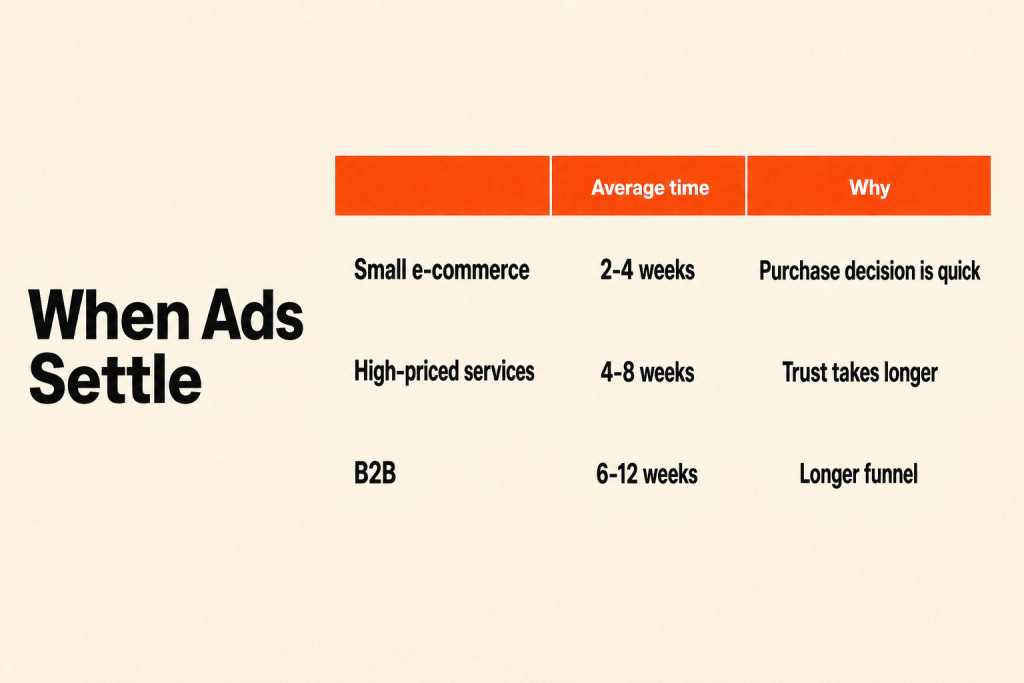
The kind of business you run affects the wait, since purchase decisions, product price, and perceived risk all shape how long buyers take. The table shows how settling times differ by business model and why.
| Business model | Average time before ads settle | Why |
|---|---|---|
| Small e-commerce | 2-4 weeks | Lower product prices mean quick purchase decisions, so the algorithm collects conversion data faster. |
| High-priced services | 4-8 weeks | Users research before deciding. Trust takes longer to build, and remarketing plays a critical role. |
| B2B | 6-12 weeks | Several people usually share the decision. The funnel is longer, and a sale rarely follows a single ad exposure. |
Treat these timelines as averages, not a verdict on early results. For B2B, compare one period with the next instead of relying on immediate conversion counts.
First 72 Hours
Use the first three days to gather data, not to judge performance. Ads may start getting impressions within hours of approval, but those early numbers are preliminary. CPMs (cost per 1,000 impressions) may spike, CTRs can swing hour to hour, and conversions will be sparse while the algorithm tests placements, times of day, and audience segments.
Leave the account alone during this stretch. Changes to budget, creative, or targeting reset the learning phase and waste data you’ve already paid for. Watch the numbers in Ads Manager and take notes instead.
Meta has to approve each ad before delivery begins. Most ads are reviewed within 24 hours; some go live in minutes, while sensitive or flagged categories take longer. Meta may also check an ad again after it goes live, and a policy review can pause an ad that’s already running.
When an ad stays under review past 24 hours, don’t keep resubmitting it. Repeated submissions can push it to the back of the queue, so wait and contact support if it gets stuck.
Days 4 to 7
Ad sets with enough budget may leave the learning phase by day seven. When that happens, Ads Manager changes the status from “Learning” to “Active”; performance becomes more consistent, though results can still fluctuate.
Now make a rough assessment by comparing CPA (cost per acquisition) with your acceptable range and ROAS (revenue divided by ad spend) with its target. Check these minimum thresholds before making a decision:
- Minimum time: 3-5 days of stable delivery, excluding learning phase fluctuations
- Minimum spend: At least 2-3x your target CPA per ad variation
- Minimum impressions: 1,000+ impressions before judging CTR
If results remain outside your range after a full week of steady delivery, the creative, offer, or landing page is usually the issue, not the algorithm. A week shows which ads are working, but it’s still too soon for confident scaling decisions.
Weeks 2 to 4
Conversion data. The first month is the shift from learning to refining. By now, conversion data should reveal real performance patterns instead of early signals.
Creative fatigue. Ads that did well in week one may show lower CTRs and higher CPAs by week four as people see them repeatedly. Plan creative refreshes every 2-4 weeks, depending on audience size and how fast frequency grows.
Unit economics. After 30 days, check whether your unit economics make sense. Scaling sustainably starts with a healthy MER (marketing efficiency ratio) and a sustainable blended CPA. If they don’t hold up, “spend more” is rarely the fix; the creative or landing page usually needs attention.
Landing page. A landing page converting at 1% instead of 3% triples your CPA, even with qualified traffic. What looks like an ad issue often comes down to slow page loads, unclear value propositions, or needless checkout friction.
The Learning Phase
Meta’s learning phase runs thousands of small tests at once, with every impression adding a data point. Each conversion and non-conversion feeds a model that predicts who’s most likely to take the desired action, and fresh data keeps updating those predictions.

The threshold. Judge progress by conversion volume, not by how long the campaign has been live. Meta’s algorithm has enough data to move beyond exploration at roughly 50 optimization events in a rolling 7-day window. Once it reaches that mark, the ad set status switches from “Learning” to “Active.”
The rolling window. The 50 events can come in any 7-day stretch, not just the first week after launch. An ad set with 47 events in its first 7 days is still learning; if days 3-9 together reach 50 or more, it can exit then.
The optimization event. Count only the event the ad set is optimized for. For a Sales campaign optimized for Purchases, that means Purchase events; AddToCart, InitiateCheckout, and ViewContent don’t count, even if they fire frequently.
Costs and resets. CPAs during the learning phase typically run 20-50% above post-learning averages. That’s expected and doesn’t mean the campaign is broken, but every reset brings those higher costs back and drags on ROAS for the following week.
How Much Budget Do Meta Ads Need to Exit Learning?
Each ad set needs enough daily budget to generate about 50 optimization events per week. For Meta and Facebook ads, calculate it this way:

Weekly minimum budget = 50 × estimated cost per optimization event
Worked example: At a $35 average cost per purchase, a store needs 50 × $35 = $1,750 per week for 50 purchases, which is a $250 daily minimum per ad set. In short, multiply your target CPA by 50, then divide by 7.
| Target CPA | Minimum daily budget per ad set |
|---|---|
| $10 | $71/day |
| $20 | $143/day |
| $40 | $286/day |
| $80 | $571/day |
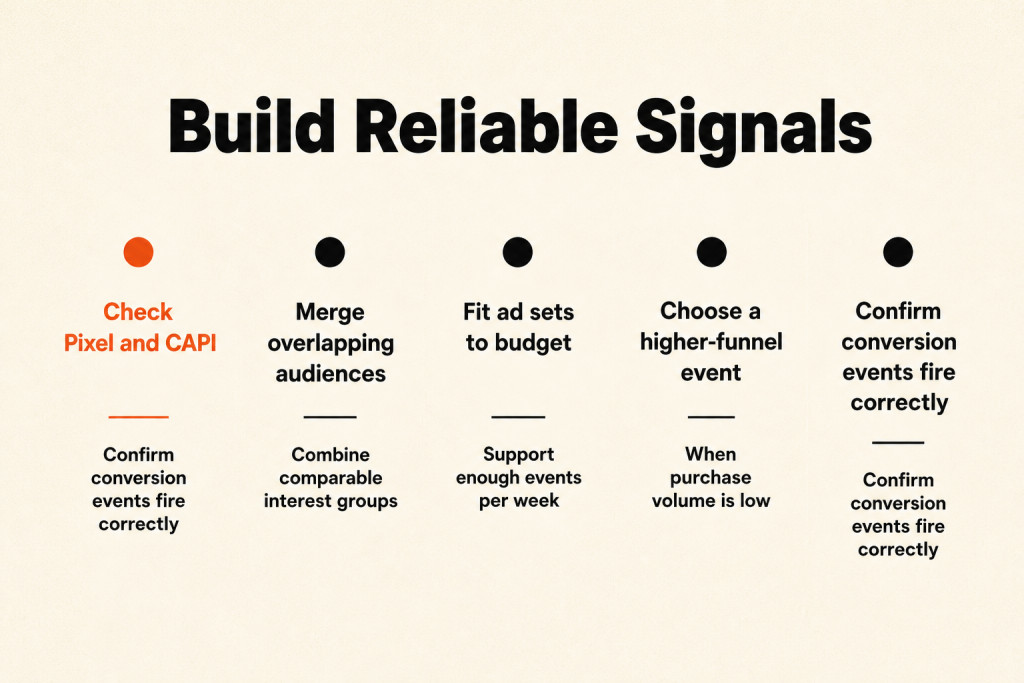
If your budget can’t reach that level, expect learning to last longer, or shift optimization to a higher-funnel event (covered below). For typical spend levels by industry, see how much Meta ads cost.
How to Optimize Meta Ads to Exit the Learning Phase
Clean conversion signals come first. Before launching, check your Pixel and Conversions API (CAPI) setup, then use Test Events in Events Manager to confirm conversion events fire correctly. Check Event Match Quality too; a score under 6.0 indicates tracking gaps that can delay leaving the learning phase.
Ad Set Consolidation
Audit active ad sets. Flag any ad set that has stayed Learning Limited for over 14 days; it is a candidate for consolidation or shutdown.
Merge overlapping audiences. If three ad sets target comparable interest groups, combine them into one broad ad set; Meta usually finds converters more effectively than manual interest stacking.
Run only as many ad sets as your budget supports. At 50 events per week per ad set, the table shows roughly how many ad sets a monthly budget can carry out of learning.
| Monthly budget | Estimated purchase CPA | Max ad sets to exit learning |
|---|---|---|
| $3,000 | $30 | 1 ad set |
| $6,000 | $30 | 2 ad sets |
| $15,000 | $30 | 4-5 ad sets |
| $30,000 | $30 | 8-10 ad sets |
Consolidate creatives inside each ad set. Group 3-5 creatives inside every ad set you keep, then let Meta handle rotation. Giving each creative its own ad set adds learning burden without improving signal quality. For a structured setup, see how to run Meta ads.
With Campaign Budget Optimization (CBO), Meta shifts budget between ad sets as delivery changes, and may push extra budget to an ad set close to 50 events to help it exit learning. For most brands spending under $10,000/month on Meta, run one or two CBO campaigns with no more than 3 ad sets each, so every ad set has enough budget to generate a meaningful signal.
Choose a Higher-Funnel Event When Purchase Volume Is Low
When purchase volume can’t support 50 events per week per ad set, optimize for a higher-funnel event during the initial learning window.
Funnel optimization hierarchy for DTC e-commerce:
- Purchase (when volume supports it)
- Initiate Checkout (strong proxy for purchase)
- Add to Cart (useful for broad prospecting)
- View Content (awareness campaigns only)
Pick the lowest-funnel event that can still reach about 50 events per week. Higher-funnel events build signal faster, but they don’t directly optimize for purchases, and the proxy only works while your cart-to-purchase rate stays stable.
Choosing an event means weighing two trade-offs:
- Higher-funnel actions give the algorithm data faster, but can train delivery toward casual visitors instead of high-intent buyers.
- Once you have enough volume, switch back to Purchase optimization. The switch resets learning, so make it outside peak revenue windows.
Campaign Edits That Trigger Resets
Meta treats some edits as significant enough to restart learning, while others leave it alone.
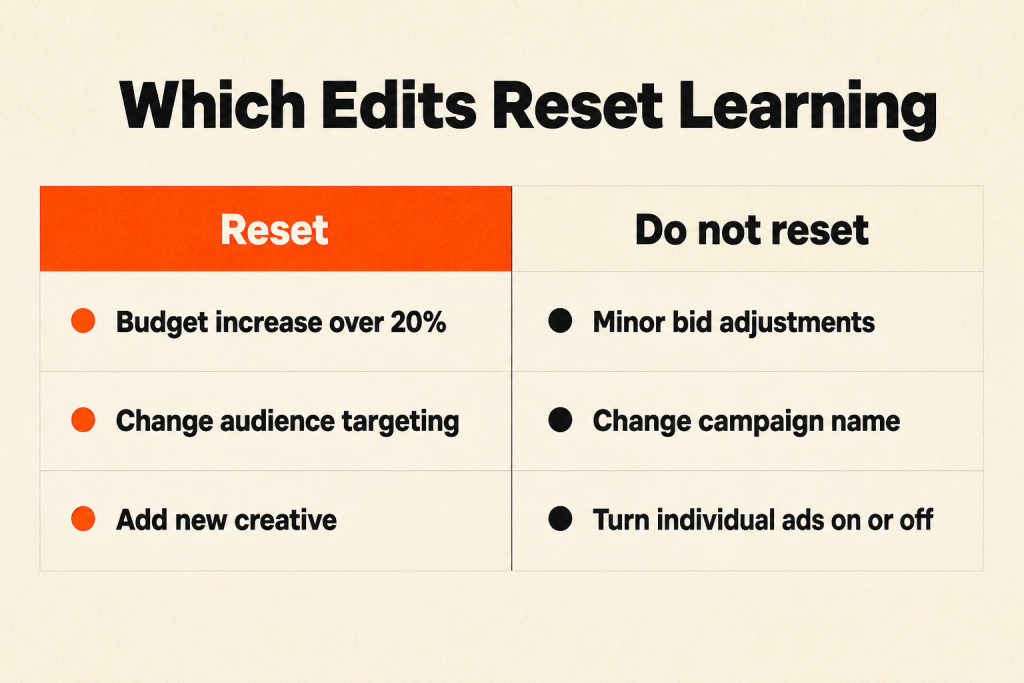
Edits that reset the learning phase:
- Changing the bid strategy, such as switching from Highest Volume to Bid Cap
- Changing the optimization event, such as moving from Add to Cart to Purchase
- Increasing the budget by more than 20% in one change
- Changing audience targeting, including adding an interest, changing the lookalike percentage, or updating a custom audience
- Editing creative, ad copy, or headlines, or adding a new ad to an active ad set
- Pausing an ad set for 7 or more days, then reactivating it
Edits that usually do not reset learning:
- Changing the ad name or campaign name
- Budget changes under 20%
- Turning individual existing ads on or off within an ad set
Some advertisers report that recent Meta delivery updates make even smaller edits more disruptive than before. If you must make changes, bundle them into a single editing session, then leave the campaign alone for 7-14 days.
Treating daily cost swings as an emergency is a frequent mistake. Changing budgets, bids, or copy every couple of days keeps the delivery model from settling into a steady pattern.
How to Improve Meta Ads Performance by Fixing Learning Limited
Learning Limited flags a structural issue: the ad set isn’t getting enough optimization events to exit learning, and time alone won’t fix it. Use these checks to see whether the problem is your account structure or the limits of your campaign:

- Check the share: if more than 30% of active ad sets show Learning or Learning Limited, the account structure has a problem that creative testing or bidding changes will not fix.
- Check volume: pull a 7-day conversion report by ad set. An ad set with fewer than 10 conversions is almost certainly stuck.
- Accept hard limits: a small niche, an expensive product, or low demand can make Learning Limited unavoidable.
- Judge results, not the label: Learning Limited means performance is less stable, not necessarily bad. If 30-day ROAS is good, keep running it.
Frequently Asked Questions
Is $20 a day enough budget for Facebook ads to work?
It can work, but slowly. At $20 per day with a $50 cost per conversion, you get roughly one conversion every 2-3 days, which can keep an ad set in learning for several weeks. Optimizing for a higher-funnel event helps it exit sooner.
What happens if my Facebook ad set never exits the learning phase?
It stays Learning Limited, and the algorithm can’t optimize delivery fully. Combine ad sets to pool spend, raise the budget, or widen the audience so it can reach about 50 optimization events a week.
How does Advantage+ affect how long Facebook ads take to work?
Advantage+ campaigns often get through learning faster, because broader targeting lets the algorithm find converters across Meta’s full inventory. Creative quality and landing-page performance still decide how good the results are.
Do Facebook ads work faster for retargeting than prospecting?
Yes, retargeting usually brings initial results sooner because those people already know your brand. Retargeting audiences are small and run dry quickly, while prospecting takes longer to settle but supports sustainable scale.
Does editing a Meta ad reset the learning phase?
Significant edits do: targeting changes, budget increases above 20%, bid strategy changes, a new optimization event, creative edits, adding ads, or pausing for 7+ days. Renaming ads or campaigns does not.
Should I pause my ads during the learning phase?
Pause only when the campaign is losing money at an unsustainable rate. Learning-phase results don’t fully predict post-learning performance, and pausing for 7+ days restarts learning from scratch.
Conclusion
How long for Meta ads to start working depends on conversion volume more than on the launch date. Give each ad set enough budget to reach about 50 optimization events a week, avoid edits that reset learning, and judge results only once the data has matured: about a week for the learning phase, and 2-12 weeks for a fair read depending on your business model. Keep these timelines in mind whenever you ask how long for Meta ads to start working, and resist changing campaigns too early.