
Choosing between content marketing vs social media marketing gets harder when a social post can lose its audience within hours, while a website resource may keep drawing organic traffic. The tricky part is deciding what that difference should change about your plan.
You’ll get a practical way to compare the work each approach requires, decide what to measure, and find ways to connect them—so your choice fits the growth goal, not just the channel.
Content Marketing vs Social Media Marketing: Foundational Definitions
The content marketing job shapes a brand’s promotion online and in person, while social media marketing gives brands a way to communicate with consumers throughout the buyer journey. Content marketing sets what to create and why, with materials such as blog posts, ebooks, videos, and other media; social media carries posts and conversation across platforms. They do different jobs.

Content Marketing Overview
Content marketing
Original content can bring in new customers; content marketing lays out what to create and why, along with how those materials should be made and shared. Useful, consistently relevant materials tailored to the intended audience can deliver value, draw in new customers, keep current ones, and increase sales. In a MarketingSherpa case study, McGladrey doubled site traffic and attributed $427,000 in business to its content marketing process since July 2011.
Content marketing has many faces
Content can entertain an audience, encourage buyers to convert, teach newcomers about a brand, and raise brand visibility and notoriety. Formats include blog posts, ebooks, videos, infographics, podcasts, and other media, with each giving brands a distinct way to share useful information. The goal is trust and action, including buying goods or using services.
Social Media Marketing Overview
Brands use social media marketing to engage target audiences, build awareness, and support sales through platform-specific content.
These benefits are explored in the social media scenarios below.
Social media profiles bring people together. Consumers use them to chat with friends and family around the world, talk to favorite brands, and get updates; each profile serves two audiences.
These platforms
Brands use social media content marketing to plan, create, and post content on one or more social media platforms, engaging target audiences in an accessible way. Posts can promote products, drive traffic, start conversations, build community, and make a brand more relatable and human (the format depends on the platform). Use Facebook, Instagram, Twitter, LinkedIn, and TikTok to connect with target audiences, build a brand, increase awareness, and boost sales. The list names five platforms.
Difference Between Social Media Marketing and Content Marketing
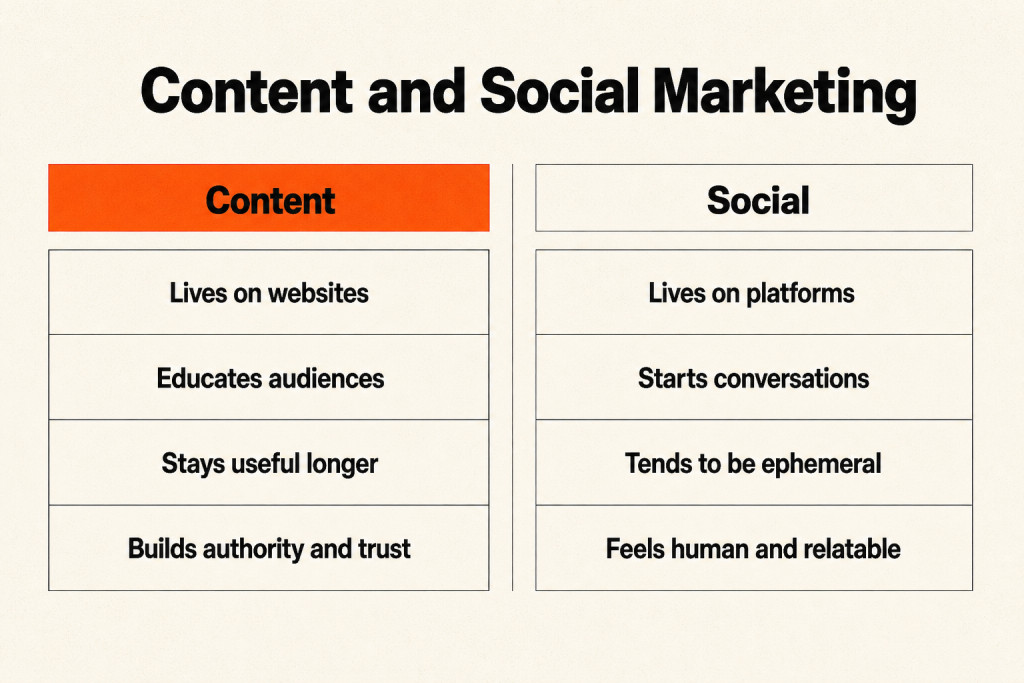
The difference in content marketing vs social media marketing comes down to where each appears, what it’s for, how long it lasts, and the mark it leaves on a brand. One builds authority and trust; the other helps brands feel human and relatable.
- Marketing content most often lives on a website, or sometimes someone else’s site; social content is made for platforms such as Facebook, X (formerly Twitter), or Instagram.
- Content marketing educates and influences an audience; social media marketing engages audiences and starts conversations.
- Marketing content is usually long-form and in-depth, built to stay useful over the long term. Social content tends to be short-term and ephemeral.
- Content marketing builds authority and trust. Social media marketing makes brands more human and relatable.
Primary Objectives
Content marketing
Content marketing can move prospects through the funnel while strengthening client ties along the way. Gated white papers may bring in leads, and targeted email campaigns can nurture them in the middle of the funnel. Strong webinars and resources can deepen relationships with current customers and establish a brand as a thought leader.
Social media
Social media strategy is built around conversation between a brand and its target audience. Posts can get people talking and taking part, while the broader aim includes raising brand visibility among active audiences through timely messages and prompting real-time interaction. For example, social content might appear on Facebook, X, formerly Twitter, and Instagram.
Distribution Channels
Owned platforms
Company blogs, resource hubs, email newsletters, and search engines give content marketing places to publish and circulate material over time. SEO tools and email automation can extend its reach and keep people interested, even when each channel works differently. The business builds an asset on ground it owns.
Third-party platforms
Social media marketing relies on third-party networks to deliver content and support interaction with an audience. For example, businesses use Facebook, Instagram, LinkedIn, TikTok, and X to share updates and run ads. Along with audience habits, each network’s rules and algorithms can shape how widely a brand’s posts are seen and how customers can engage.
Content Shelf Life
Content marketing
A useful website resource can draw organic traffic for years, with value that compounds over months or years as long as it stays useful. HubSpot found that 10% of its blog posts generated 38% of its total blog traffic, and 14% were still compounding 12 months after publication. It has a long runway.
Social media marketing
Social media marketing can bring bursts of visibility within hours or days. A post often earns much of its engagement quickly, though it may continue to perform afterward: Scott M. Graffius’s 2026 analysis, based on 2025 data, found that half of lifetime engagement arrived within 52 minutes on X, 86 minutes on Facebook, and 2.5 hours on Reddit.
Creation Resource Demands
Content marketing
Content marketing takes planned work, detailed fact-finding, and long-form production. Writers, editors, designers, and SEO specialists may all contribute to strong assets, depending on the job. Keeping that material useful and relevant takes time, expertise, and a steady publishing schedule. The process covers keyword research, drafting, editing, and improving the finished piece.
Social media marketing
Social media marketing moves through quicker production cycles and calls for real-time response. Social media managers coordinate with copywriters and content creators to produce visual posts and short videos. They also need to come up with ideas fast and engage audiences during live exchanges, tailoring each piece for its network. Keeping pace takes speed and volume.
Brand Authority Impact
Content marketing
By sharing expertise and detailed material through channels it owns, content marketing can build a brand’s authority. It can improve search rankings and topical relevance, helping a brand become a trusted source. Depth and accuracy let brands tackle complex subjects and support thought leadership.
Social media marketing
Social media marketing raises brand awareness through visibility, frequency, and the chance of viral reach. Hashtags help visuals travel quickly to large audiences, while influencer engagement can carry brand messages. The approach can also make brands seem more human and relatable.
Audience Targeting Methods
Both content marketing and social media marketing rely on knowing the audience. Market research and customer feedback, including insights from buyer personas, can help, though each shapes targeting in its own way.
- SEO and discoverability: Both approaches use well-researched keywords to improve visibility in relevant search results. Content marketing SEO leans on long-tail keywords and natural language processing, while social media SEO uses elements such as hashtags to support discoverability and engagement.
- Audience segmentation: Segmentation helps personalize marketing content and deliver the right options to the right people. Social media posts need to fit individual platforms, and understanding the algorithm can help put them in front of the right audience.
- Paid advertising: Paid advertising can support ongoing organic efforts in either type of marketing and provide quick bursts of traffic when needed.
Trend Adaptability
Content marketing
Content marketing tends to follow a planned course, with long-term plans and evergreen content at its center. Research, writing, and production take time, so trends move through the process slowly. Refreshes to existing content and SEO adjustments let brands respond, as can new topics.
Social media marketing
Social media marketing can move quickly when daily trends or networks shift. It can respond to viral topics and algorithm changes as audience behavior shifts, then adjust its words and visuals as events unfold to stay relevant.
Capital Investment Requirements
Content marketing
Content research, writing, design, and SEO take upfront investment. As the material matures, returns can compound and the cost per lead can fall.
Social media marketing
Content creation and audience management, alongside paid promotion, require ongoing spending. Reach can come quickly, but results can fade without continued investment.
An average content marketing campaign runs from $6,000 to $60,000 a month. For social media management, a basic campaign costs $500 to $5,000 per month.
Performance Measurement Metrics
Content marketing
Content marketing performance comes down to traffic, engagement depth, and lead quality. Page views, time on page, bounce rate, keyword rankings, and conversions help track results, while analytics tools show long-term performance and content value.
Social media marketing
Social media marketing tracks immediate engagement and audience interaction. Likes, shares, comments, impressions, click-through rates, and follower growth show campaign results and audience response in network dashboards.
Conversational Engagement Models
Content marketing
Content marketing usually shares educational material without asking clients for feedback. It can speak to customer pain points or communicate about the brand.
Social media marketing
Social media includes feedback and conversation as part of the experience. Prospects and clients can message a brand or comment on a post, giving the brand a feedback cycle it can use to improve customer service and products. Posting information on social media pages can also generate activity and discussion.
Social Media Marketing vs Content Marketing for Your Brand
When buyers face complex decisions, owned content can educate while social media suits quick choices or brand sentiment. Goals, audience, resources, technical details, and commercial trade-offs shape the choice; longer buying cycles need more education. Typical monthly costs also vary between content campaigns and basic social management.

Content Marketing Scenarios
Long-term visibility
If a business needs lasting visibility and organic traffic growth, while also seeking audience trust, content marketing is a strong fit. It can improve search engine rankings and bring in high-intent leads, while guiding potential customers through decisions, especially when products are technical or services are complex. A MarketingSherpa case study on technical software vendor Sherpa Software reported a 137% increase in site conversions; its VP also said blog pages often appeared ahead of the company’s standard website pages for target keywords. Longer buying cycles fit this approach.
Actively search for solutions
For people actively looking for solutions, content marketing can offer detailed information. B2B companies, financial services, healthcare providers, and software firms can use it to answer questions and clear objections, since trust and expertise can sway buying choices. Useful guidance can carry audiences through the decision-making process.
Thought leaders
Consistent, expert-led content can build brands’ authority as Thought leaders. Its value can grow over time, and it can reduce reliance on paid traffic. Keep your knowledge base current to support customer retention and post-sale engagement. Older material may continue bringing in search traffic at minimal ongoing cost.
Social Media Marketing Scenarios
Social media marketing fits when timely visibility matters or customers need a direct way to reach the brand for care.
- Identifying demographics and markets that could be a solid fit for your products
- Using cost-effective ways to bring more eyes to your marketing content and drive traffic to your website
- Generating useful analytics to help optimize your entire marketing strategy
- Engaging directly with your audience on a one-to-one basis
- Providing better, faster customer care options
- Building overall brand awareness and recognition
Strategic Integration Methods
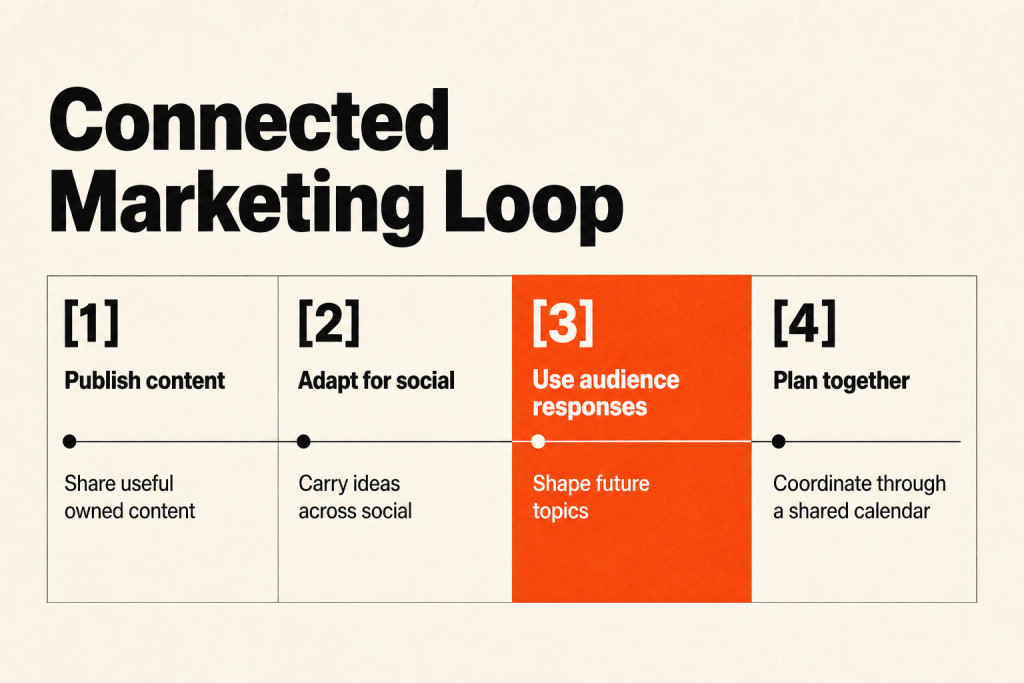
Coordinated publishing, social sharing, audience feedback, and planning create a repeatable loop that keeps both approaches connected.
Social Promotion of Owned Assets
Social reach can carry your owned content farther and put new product drops in front of more people. Share articles and recent articles, then use infographics and videos to give people something useful to pass along beyond your immediate followers.
Audience Research Through Social Listening
Ask people directly what they think about specific products or about your content and ideas. Social listening tools can track conversations about your brand across multiple platforms.
Look for recurring questions, reactions to specific products, and topics people return to across conversations. Use those patterns to prioritize article ideas, clarify product messaging, or choose which useful points to turn into infographics and videos for social sharing.
User-Generated Content Campaigns
Mobilize them
Invite customers to create and post user-generated content on social media, whether they’re sharing photos or videos. You can also ask them to share your content with people who follow their feeds.
Leveraging social proof
Customer stories can serve as social proof and help people see your brand as credible and trustworthy. Testimonials and case studies provide similar reassurance.
Brand Voice Consistency
A consistent brand feel starts with keeping your traits steady across every platform. Whether people find your content in an email newsletter, on a Facebook page, through an X profile, or on your blog, it should feel consistent with what they’re already reading from you. Your social profiles and owned content should sound like the same brand.
Unified Editorial Calendars
A shared calendar helps a growing team stay on the same page. Put editorial content and social posts on it, then look for ways to bring them together for your audience as more team members take on different tasks.
Cross-Channel Promotion
Promote your latest blog posts and product launches
Put product launches in front of people through social channels, where they can catch attention and offer value. Add visual material such as screenshots or custom images to the posts, and include infographics where useful.
Embed tweets and YouTube videos
You can place YouTube videos within written pieces, and tweets can appear there too. Screen grabs of social posts can also add visual interest to blog posts and other written content.
Content Repurposing Workflows
Use a detailed white paper as the basis for an educational slide carousel. It can also become discussion posts or a short video brief.
Creative content repurposing takes several forms:
- Break YouTube videos and how-to guides into graphic sequences for Instagram.
- Turn key points and important takeaways from popular informative blogs into an infographic to share on Facebook, Pinterest, X, or Threads.
- Expand your best long-form blogs into ebooks, then use social media to promote them.
- Turn long-form content into social media-friendly short-form videos.
- Translate a popular webinar or e-course into a series of Instagram reels or TikTok videos.
External Agency Support
Outsourcing
As your business grows and its content needs expand, partnering with a Content Marketing Agency can scale production while keeping quality and fresh ideas coming. Some businesses also buy pre-written articles to fill key content gaps.
Full-service content creation service
Hire a trusted, full-service content creation service to help manage the whole process.
Strategic Benefits of Unified Marketing
Elevated Audience Engagement
Feedback across digital channels can guide content toward what your audience likes and finds useful. That understanding can draw attention, get people interacting with what you’ve shared, help shape material more precisely, and drive traffic to your website.
Stronger Brand Loyalty
Consistently answering customer questions with useful information can build trust and encourage loyalty. Social media signals can help your business identify questions worth addressing.
Improved Search Visibility
Frequent posting across social platforms won’t directly lift your place in search results. Sharing content widely can put it in front of creators, editors, and industry analysts, who may link to it from their own sites. Audience feedback also shows what customers respond to, helping you raise engagement, bring visitors to your website, and support broader SEO efforts.

Maximized Marketing Return
Audience feedback can help you connect with your audience more often and send ROI way up. Your time, labor, and mental energy count as business investments, just like money and budgets; the costs you can’t see still count. A strong return on those resources matters for content and digital outreach efforts. That makes careful use of those resources worthwhile.
Implementation Case Studies
INK
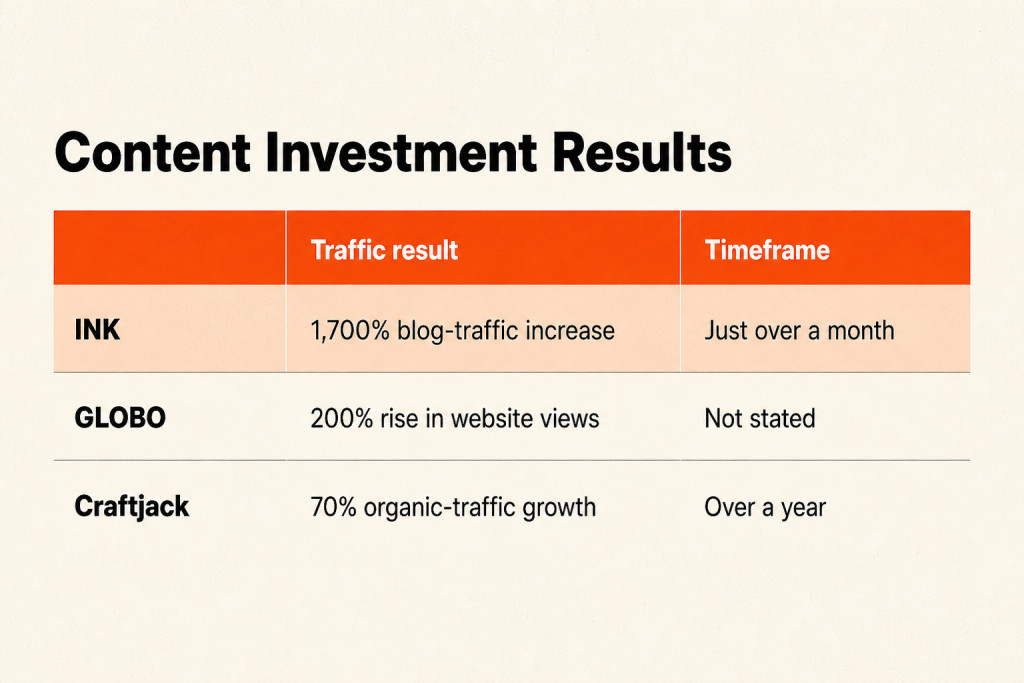
INK showed customers what its content optimization tool could do for SEO. Rather than simply tell them, it sought help from a content partner, and blog traffic increased by 1700 percent in just over a month.
GLOBO
GLOBO, a language-support company, wanted to improve its messaging and encourage more readers to become service subscribers, so it used a strategy that matched content to customers at different stages of the sales funnel. Website views rose by 200 percent, and brand messaging improved accordingly.
Craftjack
Craftjack, a lead-generation company, needed a reliable way to keep its marketing content flowing but could not manage the work alone. An external content partner gave Craftjack immediate access to experienced niche writers. Skilled project managers, eagle-eyed editors, and those writers (all part of the partner arrangement) worked together to increase production. Craftjack also connected with skilled Spanish-language writers to reach another sector of its client base more effectively, and Organic traffic increased by 70 percent over a year.
How Content and Social Media Work Best Together
Owned educational content builds authority that lasts, while social networks put brands into fast-moving conversations; together, they pair lasting credibility with social media’s conversational reach.

Use content marketing to build durable authority and support search discovery, then use social media to distribute those ideas and learn from audience response. As a next step, choose one audience need, shape it into a useful piece of content, and decide how social media can carry it into conversation.