When you search “what is performance max google ads,” you may really be deciding how much budget control and placement visibility to trade for automated reach. This guide helps you decide whether it fits your goals, which signals and assets to prepare, and what limitations to account for before launch. One detail worth weighing: broader ad reach can also affect Search campaigns, so the trade-off is not just about where your ads appear. The sections below answer what is Performance Max Google Ads in practice: how it works, what to prepare, and where it falls short.
What is Performance Max Google Ads and how it works
Performance Max is a goal-based campaign type in Google Ads, using Google AI to find more conversions across Google’s advertising inventory. It is an automated option within broader Google Ad Services.
Once you upload assets suited to each advertising channel, Google optimizes across its inventory with images, videos, logos, and ad copy for your brand or products. It builds ads automatically and tests combinations to learn which generate conversions and conversion value (the uploaded assets supply the ingredients). More assets give Performance Max a wider range of ad formats to run across Google’s network.

To increase conversions and get more value from your budget, Performance Max combines machine learning and automation with smart bidding and the audience signals you provide. Manual bidding isn’t available (Smart bidding is fully automated). You can still guide it by setting a target CPA or target ROAS for the campaign.
Choose the campaign’s focus based on the values of your goals:
- Conversion Value (where you can set target ROAS): use it when multiple goals have different conversion values.
- Maximize Conversions (where you can set target CPA): use it when all your goals have the same value.
The algorithm uses your conversion goal and guardrails to decide how to allocate delivery across Google’s networks.
Where Performance Max Ads Can Appear
Google’s advertising channels can display ads that the campaign adjusts automatically, matching each ad to its placement. These cross-channel visual surfaces differ from the demand-generation focus discussed in what is demand generation google ads.

- YouTube
- Display
- Search
- Shopping
- Discover
- Gmail
- Maps
Audience signals
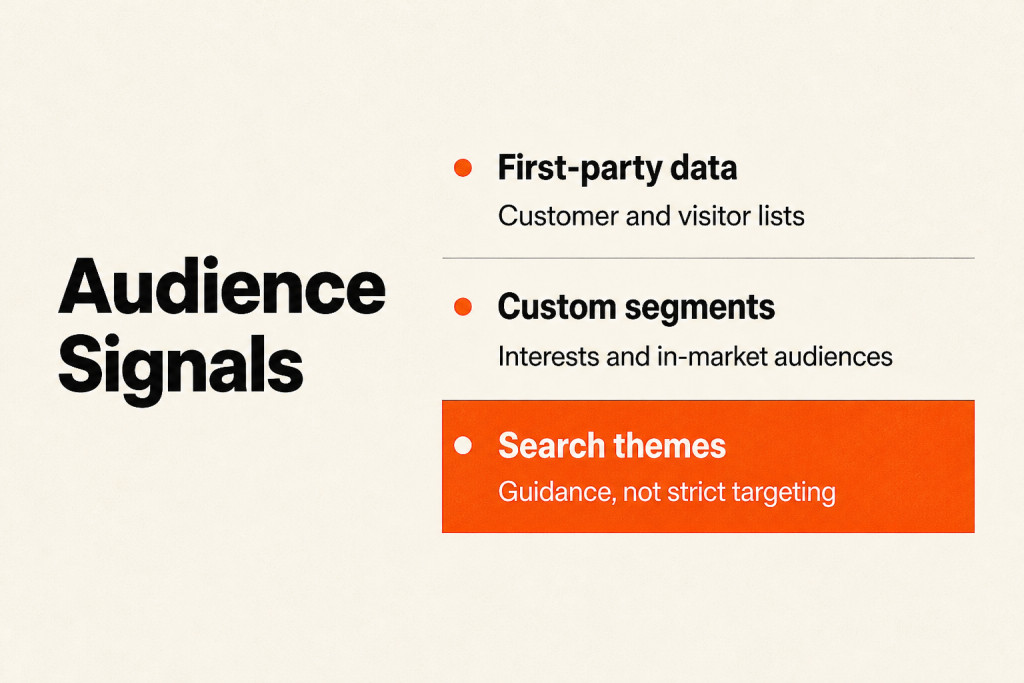
First-party data
When you’re choosing key audiences, upload whatever first-party data you’ve got, including these lists.
- Website visitor lists
- First-party customer lists
- App user lists
- Email subscription lists
- Video viewer lists
Custom segments
Build Custom segments with Interests, in-market audiences, and other factors.
Search themes
Search themes remain in beta testing. In Performance Max, they add context to campaign data, helping PMax understand your business and deliver ads more effectively to relevant audiences; they can be particularly useful for businesses without extensive campaign performance data.
Each PMax campaign may contain up to 25 unique Search themes.
Highly specific Audience Signals may help you reach the right audience, though they aren’t traditional targeting. Give the algorithm these signals as guidance; Google can ignore them. They aren’t strict targeting lists. Google uses them as its starting point, then searches wherever its system predicts potential buyers.
Campaign benefits
Google reports an average 27% increase in conversions or value for advertisers using Performance Max, at comparable CPA or ROAS and beyond the audience signals they provide. The figure comes from Google’s data covering October to November 2023, compared with the campaign types PMax replaced. That 27% reflects conversions counted, rather than verified.
Expanded reach
Performance Max is built to run alongside keyword-based Search campaigns, and can find more converting customers across Google’s channels than relying only on keywords.
Performance Max can help uncover new audiences and give you more chances to reach them, even with a clear ideal customer profile already in hand. Reaching those people can help grow your business and bring in more revenue.
Responses to your ads can guide stronger, more targeted creative down the line. Use Asset Audience to learn how different customer groups react, then pick out the images, videos, and copy that connect with them. Those responses can guide campaign changes and help shape better, more targeted ads in the future.
A YouTube ad followed later by a product search can register as one journey rather than two separate events.
Time savings
Automation and shared campaign management save time, though both still call for ongoing human oversight.

Campaign setup
Setting up Performance Max takes less time because you supply inputs instead of building separate campaigns across different platforms, and PMax handles the process. Monitor and adjust the automated campaign to match your objectives, freeing up valuable time.
Unified campaign management
You can set up, monitor, and report on all networks through one interface, giving lean teams managing spend across many channels a single place to work.
Human oversight
Google’s previous campaign types gave PPC marketers more control than Performance Max does now, so you can’t launch a campaign and walk away. Without active human supervision, you risk significantly overspending or bringing in low-quality conversions and leads. Monitor PMax campaigns continuously to help lower those risks.
Campaign limitations
Performance Max mainly coordinates activity across channels automatically, but you get less visibility into individual results and where budget goes, leaving the reporting broad overall.

Opaque reporting
Channel performance reporting
The channel performance report now shows how Search, Display, YouTube, Discover, Maps, Gmail, and Search partners each contribute to results.
Placement reporting
Google offers a Performance Max placement report, but frames it chiefly as a tool for protecting brand safety rather than evaluating placement performance.
Search category
A Search category groups similar search terms, and its report lets you check:
- Whether Google PMax is concentrating on brand or non-brand searches
- Whether PMax is reaching new searches or targeting the same searches already covered by your search campaigns.
Invalid Activity Credit Report
The Invalid Activity Credit Report became available for Search and Performance Max campaigns in April 2026. It reports how many clicks and interactions receive credit, together with the credited sum for each campaign and network.
Credits may be applied in a month different from the month of the click that generated them. Google says the click is recorded in the month it occurred, while its corresponding credit is posted in the subsequent month. Because of that timing, the CPA reported for the click’s month is still not accurate, and every decision made using that figure is likewise wrong.
You gain coordination across channels that Manual bidding can’t match, but have a narrower view of precise search queries and spend distribution by channel.
Channel cannibalization
Performance Max can claim results other campaigns would have generated, making its added value harder to measure. Brand terms can skew that count. Without brand exclusions, high-performing brand search terms will likely dominate PMax; it also includes retargeting and dynamic search ads (DSAs), so you may no longer need to run those campaign types.
Without brand exclusions, PMax can pull in branded queries your Search campaigns would have converted anyway, then claim credit for those conversions.
Run standard campaigns for branded keywords instead.
When PMax and Shopping campaigns run at the same time, Shopping gets priority for an identical user query when that query qualifies under any Shopping keyword match type in your account. Ineligibility factors can sometimes leave existing keywords showing in Performance Max instead of Shopping campaigns.
Setup prerequisites
Before launch, decide whether to use CRM systems, enhanced conversions, or offline conversion tracking with Performance Max.
Poorly defined goals can leave a Google Ads Performance Max campaign underperforming significantly, with results falling short of what you want and money at risk. Know your numbers before you start.
Before setting goals, answer the practical questions: “What is your break even ROAS? What is your break even cost to acquire a new customer? Is your first sale more valuable because you can upsell more on the backend, or is your first sale typically less valuable than the ones that follow?” Knowing your numbers inside out (including the value of later sales) lets you turn those answers into concrete goals. Those answers shape your goals.
Google recommends a minimum of 20-30 conversions per PMax campaign per month.
When opening a new account, begin with “Maximize Conversions” so the system can collect data. Once conversions arrive consistently, move to tCPA or tROAS to reach your desired outcomes.
To pursue new customer acquisition, the approach needs both of the following:
- Set the bidding strategy type to “Maximize Conversion Value.”
- Use an audience segment with a minimum of 1,000 active members to help identify existing customers.

Each campaign must include images in these dimensions:
- 1 x 1200×628 landscape (4 images recommended, up to 20 allowed)
- 1 x 1200×1200 square (4 images recommended, up to 20 allowed)
- 1 x 960×1200 portrait (2 images recommended, up to 20 allowed)
- 1 x 1200×300 landscape logo (up to 5 images allowed)
Video is technically optional when you set up Performance Max campaigns, but if you leave out video assets, Google will create one for you automatically.
Making a 15 to 20-second video yourself beforehand is worth considering. You can supply video assets in these formats:
- 1 x 16:9 landscape (up to 5 allowed)
- 1 x 9:16 vertical (up to 5 allowed)
- 1 x 1:1 square (up to 5 allowed)
Campaigns also need text assets, with these minimum requirements:
- 3 x 30-character headlines
- 1 x 90-character headline
- 3 x 90-character description
- 1 x 25-character business name
- 1 x call to action (length is automated)
- 2 x 15-character URLs
Performance Max can discover new patterns with dependable conversion tracking and a clean history of data. If your tracking is fresh or unverified, use standard Search while you build that foundation.
Frequently asked questions
What did Performance Max replace?
The replacement came in 2022, when Google automatically upgraded both Smart Shopping and Local campaigns to Performance Max.
Can Performance Max cannibalise Search campaigns?
Yes, Performance Max can significantly affect existing Search campaigns. Unless excluded, its broader range of ads means high-performing brand search terms are likely to dominate PMax.
When should an advertiser run Performance Max?
Set a specific conversion goal before running PMax, such as more leads or sales; it works best with first-party CRM data, meaning your customer records. Custom audience signals help the algorithm learn who your customers are and which assets reach them, shortening the learning period.
Conclusion
Performance Max works best as goal-led automation guided by sound conversion data and assets, not as a hands-off replacement for campaign judgment. Google upgraded both Smart Shopping and Local campaigns to Performance Max in 2022, and its broader range of ads can affect Search campaigns. Excluding high-performing brand search terms can help keep them from dominating PMax. To judge fit, understand what is performance max google ads for your business by checking the conversion goal, first-party CRM data, custom audience signals, and the assets that reach customers. PMax follows the goal you give it. Once you know what is Performance Max Google Ads and what it needs, review its results monthly alongside your Search campaigns.