Planning content for social media marketing starts with a short list of formats: short-form video, user-generated content, and behind-the-scenes series.
You’ll leave better able to choose formats, plan production you can sustain, and decide when customer posts can build trust. There’s a small but important risk to watch when you reuse customer posts: editing a customer’s words too much can make them seem less trustworthy.
Which types of content for social media marketing work best?
Short-form video, user-generated content, and behind-the-scenes series are the formats that work best.
Short-form video on Shorts and Reels
The best YouTube Shorts pair quick-moving visuals with a clear payoff, catching attention fast and getting straight to the point.
For a service business, demonstrate your process or walk viewers through a useful result, like a sales email script, a software tutorial, or a kitchen plan. These tutorials can support social media video marketing by keeping viewers watching.
How-to YouTube Shorts can serve two purposes:
- gaining new subscribers.
- quickly testing what your audience prefers or wants to learn.
On Reels, make funny sketches, record a personal voiceover, or answer customers’ questions.
A distinctive soundtrack and voiceovers can hold viewers’ attention on Reels while giving you space to express your creativity.
Using original audio and voiceovers in Reels
People may stick around to find out how a video ends. These sounds and voiceovers also allow creative choices, with an occasional chance of going viral (though that’s never a sure thing).
User-generated content and creator partnerships
UGC (user-generated content) is content made by people rather than brands, usually by customers without pay.
Your customers are 2.4 times more likely to engage with UGC than with content created by the brand.
Ask customers to post with a hashtag, then share their photos or videos in your feed.
You don’t need a big audience to use UGC, since authentic-looking content can be paid for, too. In 2025, some creators were paid to make content resembling posts from organic customers.
UGC can give products a softer touch than a hard sell, while leaving you with content to reuse.
UGC is useful for:
- promoting products without coming across as too salesy.
- collecting a variety of assets to republish in your social media accounts or reuse for other content.
A testimonial or transformation story from a customer can build more trust than talking about yourself. A detailed quote paired with a photo can earn that trust, too. Customer content loses value when it starts to feel staged, since scripted client quotes or over-polished wording can erase the candid perspective audiences trust.
A brief customer interview gives you more material to share. Cut it into several versions, then share them across LinkedIn, TikTok, Reels, Instagram Stories, and YouTube videos, keeping social videos under 60 seconds for the best results.
The social media trends report says 28% of small businesses work with creators; among companies with more than 1,000 employees, the figure is 42%.
Influencer campaigns that are not connected to new-product launches have been associated with ROI increases of up to 30.5%. An influencer doesn’t have to cost a million euros; micro- and nano-influencers can be more budget-friendly and more effective than very large creators at getting people to click through or buy.
Collaborations with creators can put your brand in front of audiences who trust the creator and give you material to use later.
Creator partnerships are useful for:
- reaching valuable audiences who trust the creator introducing you, often for much less money than ads.
- collecting high-quality photos or videos you can use in future campaigns, on your website, and so on.
Behind-the-scenes series
A behind-the-scenes series lets your audience see how things work inside your business and can build a deeper connection. Build a daily or weekly series rather than joining generic trends like #ThrowbackThursday or #SundayFunday. A series of your own feels more original and makes planning easier.
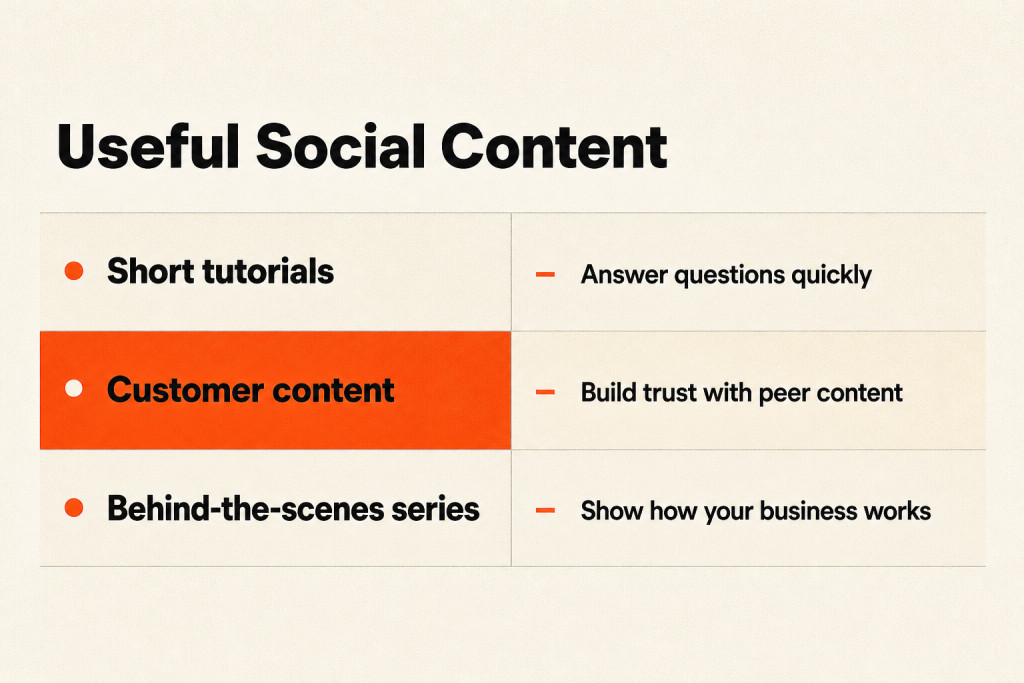
A behind-the-scenes series can also keep your schedule on track, show your expertise, and build anticipation.
A content series is useful for:
- building anticipation ahead of a product launch or event.
- demonstrating your expertise and earning trust.
- sticking to a consistent publishing schedule.
Show followers behind-the-scenes details they can picture:
- What does your office look like?
- How do your team meetings go?
- What did you do at your last holiday party?
Your followers care about the people behind your products as well as the products themselves.
How to streamline social media marketing content creation with series and batches
With a recurring format and topic set, you can batch content creation for social media marketing and schedule posts. A recurring format gives you a clear starting point and keeps the people behind your products visible, so you can spend the time creating rather than scrambling to come up with three new post ideas for the coming week.
Write down every idea before you start making content. You can shoot one episode a week, or film and schedule posts in one sitting a month or more in advance; either route can speed up production and scheduling while helping you reach different customer types and audiences.
Easy content is useful for:
- handling production and scheduling in batches, so content gets produced faster.
- reaching multiple customer types and audiences.

Content series
A content series gives you a set format and topic to return to. With those decided, you can keep producing without having to come up with new posts every week.
Easy content
Start with an idea you can make in 5 minutes or less. Choose one, then create a full batch in a single sitting; your scheduling tool can take up to 350 pieces of content at once. Gather the raw assets in one focused session, and you can avoid deciding from scratch what to make each day. Uploading content for automatic publishing is called bulk scheduling.
AI content tools can fill gaps in your idea list, ease writer’s block, and leave more time for the work that moves your company forward.
AI content tools are useful for:
- filling a list of content ideas so you can start creating faster.
- breaking through writer’s block.
- saving time on ideation so you can focus on the work that moves your company forward.
AI content tools
When ideas run dry and you can’t post as often as you’d like, AI content tools can help you find a starting point.
When should you outsource your social media marketing content to an agency?
Specialized agencies, including a Social Media Marketing Agency, can shape social media strategies to meet defined objectives and run successful campaigns, whereas an in-house hire is safer if content depends on prompt access to in-house engineers or daily office happenings.
Hourly rate
Agency campaign pricing depends on the hours worked by the people involved, with industry rates ranging from 60 to 150 euros per hour. When organic reach falls short, paid advertising adds a charge of between six and nine euros per 1,000 impressions.

Three quarters of all social media users
Across platforms, 75 percent of social media users expect a brand to reply within 24 hours. If the brand misses that window, it risks losing customers to competitors.
Specialized editing or high-level creative direction
An agency can fill a gap in Specialized editing or high-level creative direction when your team lacks it. When content needs real-time access to in-house engineers or daily office happenings, an internal hire is safer.
Aligning your content with business goals through topics, analytics, and community
Content for social media marketing supports business goals when companies choose relevant subjects and shape posts around audience interests. Strategic planning connects those posts to commercial goals and helps you plan your social media content. Those posts should prompt interactions that grow engagement, loyalty, and, ultimately, revenue.
Relevant topics
Topics that matter to an audience can create an emotional bond with a company, opening the door to engagement, loyalty, and more revenue.
Individual interests
In 2026, social platforms may give more visibility to posts that match users’ interests and earn engagement such as comments, shares, or saves, making audience relevance one factor in reach.
Reviewing and adapting content
Visibility slips when companies don’t revisit their posts and tune them to what their communities care about. To draw useful responses instead of chasing likes, brands can ask questions, run polls, and tell stories.
Continuous optimization
Among successful social media campaigns, 84% make ongoing changes based on performance data. Reviewing campaigns regularly lets companies respond to shifts faster and noticeably improve results.

- Analyzing engagement rates and user behavior
- Identifying peak times for posts
- Testing different content formats and ads
Review social media analytics to assess reach and engagement alongside conversion; sift through the numbers regularly to see which content lands and where a campaign needs adjustment.
Active community management
78% of companies fail to grasp the extent to which hands-on community management drives online success. Users expect prompt responses and individualized attention that continues through ongoing dialogue.
Responding to comments, messages, and reviews can give companies a clear edge as customer loyalty grows more fleeting.
Micro-communities
Micro-communities make room for personal exchange, unlike large, anonymous networks, and can build a closer brand connection. Higher interaction rates than in large mass communities can come from shared interests, supporting engagement and brand loyalty.
- Higher interaction rates than in large mass communities
- Fast, immediate feedback on new products or offers
- Stronger identification with the brand
Micro-communities can also spark ideas, inspiration, and user-generated content.
Conclusion
Each social format can serve a purpose along the buyer journey, from building awareness to supporting a purchase. Reach, engagement, and conversion show whether a campaign is finding people and prompting the right response. Comments, messages, and reviews keep the conversation going, while micro-communities leave room for direct feedback and shared interests. Let audience response guide the next adjustment to your content for social media marketing.