
For law firm leaders, content marketing for law firms is a decision about where to invest time and budget—and how to publish useful material without losing attorney oversight.
You’ll leave better equipped to assess outside support, turn attorney input into a workable review process, and judge whether content is reaching the people your firm wants to serve. An agency may point to millions of general visitors—but were they looking for legal help?
How to Choose a Legal Content Agency
A content marketing agency for law firms must account for strict bar-association rules governing attorney ads. The rules prohibit misleading statements, unsupported claims of expertise, and the unauthorized practice of law.

Audience size alone doesn’t show whether an agency can promote a law practice successfully; generic, high-volume traffic rarely reaches clients dealing with acute legal problems, a key criterion when selecting a Content Marketing Agency. Ask how attorneys will shape topics and review drafts for accuracy and ethics, what deliverables are included, and how results will be measured beyond traffic. Broad academic articles may draw visitors, some with no intention of hiring a lawyer, while sales pages alone can miss prospective clients early in their decision-making journey.
Running Attorney Content Workflows
Attorney expertise feeds a three-step workflow, while the marketing team turns those contributions into content the firm can publish.
- Have attorneys record short audio outlines or take part in brief interviews (they provide strategic direction and core insights).
- Professional writers and content strategists handle execution, while the marketing team turns attorneys’ insights into optimized, multi-format assets.
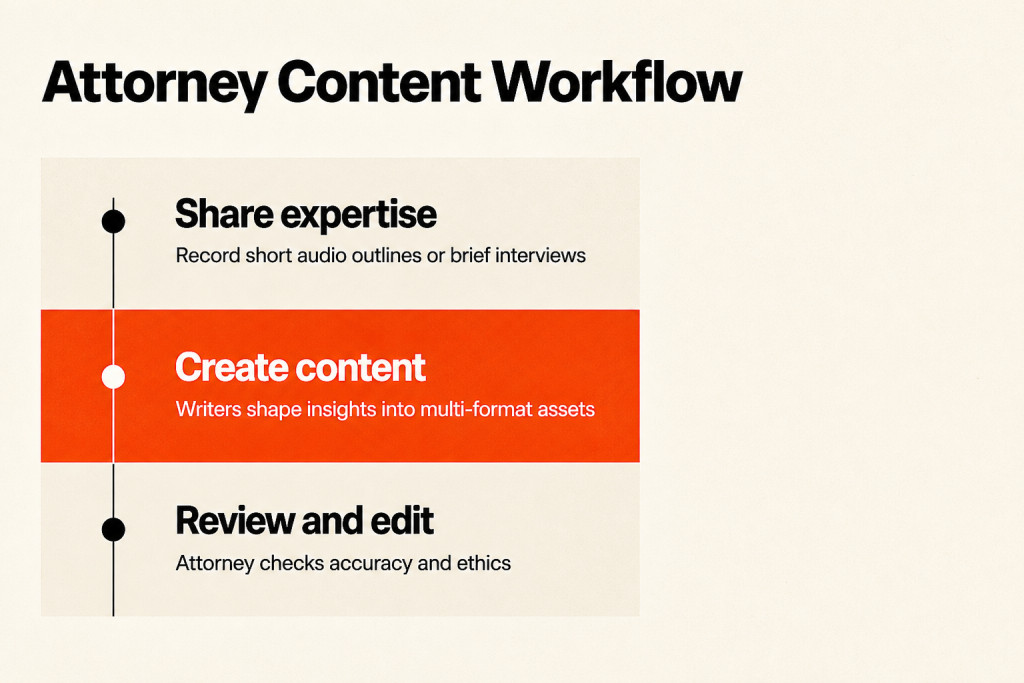
- An experienced attorney reviews and edits every piece of content created with AI before publication (AI tools can produce generic or occasionally inaccurate information), providing final quality control. Automated content without rigorous human oversight poses a significant compliance risk. The final content must reflect the firm’s actual expertise, follow all applicable professional responsibility rules, and include appropriate disclaimers so educational information is not mistaken for formal legal advice.
Tracking ROI for Law Firm Content
When you judge content’s return, weigh early reach against qualified inquiries and revenue, then connect content activity to financial results.
Vanity metrics
Website visits and social engagement can signal early reach, but without signed cases or revenue, they’re still vanity metrics for the firm.
Qualified inquiries
For every content asset, track promising prospective clients, the rate at which they become scheduled consultations, and the ultimate client acquisition cost tied to that asset.
Attribution model
A clear attribution model shows leadership which content topics and formats deliver the highest return on investment.
Financial returns
Within three to six months of consistent publishing, early signs may include more organic traffic and improved visibility for targeted terms. The financial return typically arrives between six and twelve months, once published assets start compounding: older articles can keep drawing traffic and leads at no added cost, while fresh content grows the firm’s digital footprint. The money takes longer.

Building a digital content system calls for an upfront investment of time and resources. Compare content marketing pricing with the lifetime value of a client when assessing that investment. Its organic reach and ability to build trust grow as its published assets accumulate over time. Together, that reach, trust, and growing library can create a continuous discovery loop, bringing qualified prospects to the firm without paying for each individual click. Over time, this organic acquisition channel can become highly efficient and significantly lower client acquisition cost compared with paid advertising models.
Which Formats Work Best for Lawyers
The right content formats answer prospective clients’ questions and give online search tools useful material to put in front of them. Comparing b2b content marketing examples can show how high-performing formats work across professional service industries. A firm’s mix can include Service-focused blog posts, Long-form guides of 3,000+ words, Short-form Q&A content, Attorney introduction videos, Email newsletters, Targeted service pages, Infographics and visual explainers, Podcasts, and Case studies and testimonials, with each format serving a different need. Our B2B content marketing strategy guide covers the wider framework.

Long-form guides can reach 3,000+ words.
| Content Marketing Idea | Purpose |
|---|---|
| Service-focused blog posts | Capture clients searching for answers |
| Long-form guides (3,000+ words) | Build authority and earn backlinks |
| Short-form Q&A content | Get cited by AI tools like ChatGPT and Perplexity |
| Attorney introduction videos | Build trust before the first call |
| Email newsletters | Nurture leads who are not ready to hire yet |
| Targeted service pages | Rank in relevant search results |
| Infographics and visual explainers | Earn shares and simplify complex legal topics |
| Podcasts | Reach the large portion of the population who listen regularly |
| Case studies and testimonials | Convert high-intent visitors into consultations |
Clear, accessible writing can speak to prospective clients’ worries while answering a high-intent question they might bring to an initial consultation. Writing at an eighth-grade reading level can make legal information easier to follow.
Practice Area Clusters
A topic cluster lets a firm show the depth of its knowledge across one practice area. Deep-dive insights should be grouped around a central pillar.
Topical authority
In 2026, Google favors firms that demonstrate expertise across a practice area over articles that stand alone, making that breadth important for establishing ownership. A central Pillar Page can anchor focused subtopics, giving people and bots a clear path through the material. One example places Determining Fault in Tesla Autopilot Crashes and New 2026 E-bike Regulations beneath that page alongside other related topics. Like a primary legal brief supported by individual case citations, each focused topic strengthens the main practice area’s credibility and helps position the firm as a definitive resource on the subject.
The Setup
Build one large Pillar Page about Personal Injury Law and link it to specific, high-value subtopics. Those could include Determining Fault in Tesla Autopilot Crashes and New 2026 E-bike Regulations.
Repurposing workflow
A comprehensive long-form guide can serve as the starting point for an entire campaign. Turn its main points into short-form social media updates and an informative Email newsletter; a podcast episode can cover them in detail. This approach keeps the firm top-of-mind across digital touchpoints while reducing the effort needed to create fresh material. See content marketing on social media for channel-level tactics.
Anonymized Case Studies
Anonymized case studies show potential clients how a firm handles legal challenges and achieves outcomes while protecting client identity from identifying details.
- Highlight specific legal challenges
- Describe strategic approaches taken
- Showcase measurable outcomes
- Maintain client anonymity
- Use clear professional language
Good case studies make complicated legal situations relatable, helping potential clients understand how a firm handles a case. For example, a personal injury attorney might explain how they helped a client recover compensation after a workplace accident without sharing specific identities. The names stay out.
Effective case studies pair technical legal details with an emotional story, showing expertise and a compassionate commitment to client success. Accounts of problem-solving and positive outcomes can build trust before a potential client makes initial contact.
Keeping a client anonymous takes care: too much detail may make them identifiable, while too little can leave people considering legal help unable to see their own situation in the resolution.
Attorney Video Explainers
Attorney video explainers help lawyers clarify complex legal concepts, connect with potential clients, and show professional credibility.
Attorney led video explainers and frequently asked questions
Attorney led video explainers and frequently asked questions make complex legal concepts easier to grasp. A potential client might use TikTok to learn about a lawyer’s work before deciding whether to call, while others may watch for entertainment.
Breaking down barriers of intimidation
A straightforward, professionally made video can make an intimidating process easier to approach. A clear explanation can encourage a hesitant prospect to reach out.
- Keep videos concise (2 to 5 minutes)
- Address common client questions
- Use clear professional language
- Include visual graphics or animations
- Maintain a conversational yet authoritative tone
Search engines indexing video transcripts
A raw video lasting sixty seconds that explains a new regulation can inspire greater confidence than a polished 2,000-word white paper. Search engines are increasingly indexing video transcripts in 2026, so a video can help a firm rank as much as a 2,000-word article.
Improving Site SEO for Legal Content
Law firms should combine SEO with Answer Engine Optimization and Generative Engine Optimization to stay visible as search expands to AI-powered answer engines. Law-firm SEO now has to account for more than ten blue links. In 2026, AI-powered answer engines, from search overviews to conversational platforms, respond to more than half of all legal-related queries. AI answers now show up in search.
Generative engines pull information from different sources and turn it into direct answers in everyday language. For AI models to cite content as a trusted source, machines need to verify content they can read and extract; a page that works only for people won’t do. Use direct headings and schema markup to make relevant legal concepts and terms easy to identify. Search systems favor pages that answer specific questions plainly, like a reference treatise, over pages built around repeated keywords.
The table sets SEO beside AI-driven GEO across five areas: Meta tags, clean URLs, basic link building, structured data, and entity verification.
| Optimization Dimension | Traditional SEO | AI-Driven GEO |
|---|---|---|
| Primary Target | Keyword-focused search engine algorithms | Conversational AI engines and large language models |
| Content Structure | Long-form articles optimized for keyword frequency | Structured Q&A formats with clear semantic definitions |
| Technical Requirements | Meta tags, clean URLs, and basic link building | Schema markup, structured data, and entity verification |
| Authority Signals | Domain authority and total backlink volume | Digital trust, direct citations, and brand mentions |
| User Experience | Skimmable text with clear calls to action | Conversational clarity and immediate, extractable value |

That comparison points to AI-driven GEO’s emphasis on conversational engines, which deliver answers in a structured format and rely on signs of digital trust.
Cover both short-tail and long-tail keywords when you plan your search terms. For example, “divorce lawyer” is a short-tail keyword with high competition and broad reach, while “divorce lawyer for high-net-worth individuals in Boston” is a more specific long-tail keyword capable of drawing highly targeted traffic and more likely to turn visitors into clients.
Place chosen keywords naturally in titles, headings, Meta tags, including meta descriptions, and image alt text. Stuffing pages with keywords can hurt rankings. Google favors user-friendly websites, so check that your site works well on mobile and loads quickly. Smaller practices can start with content marketing for small businesses.
Add structured data and FAQ Schema, which can help AI engines pull answers into their summaries.
- Action: Use structured data and FAQ Schema to help AI engines extract your answers for their summaries.
- The Goal: Even when a user does not click through to the site, aim for the firm to be cited as the primary source in the AI-generated answer.
Every published piece should include a high-quality headshot and concise professional bio, with the bio linking directly to the attorney’s LinkedIn profile. In 2026, social signals enable prospective clients and AI search engines to assess “Authenticity.” LinkedIn provides evidence of professional connections and recent activity, including real-world commentary. When readers follow a blog post link there, they can see the real expert behind the information, a trusted advisor they can reach in the real world.
The Long-Term Value of Law Firm Content Marketing
Attorney-guided editorial content can keep answering prospective clients’ questions after an ad campaign wraps, extending the value of a real expert’s knowledge.
Rented attention
For years, law firms have presented legal services as interchangeable, relying on billboards, TV spots, and hard-charging paid search campaigns. Those ads can produce brief visibility spikes, but rented attention builds no lasting business equity in a highly competitive digital market: lead flow disappears the moment the budget stops. Firms spend capital inefficiently, while daily operations remain under pressure.
Owned editorial assets
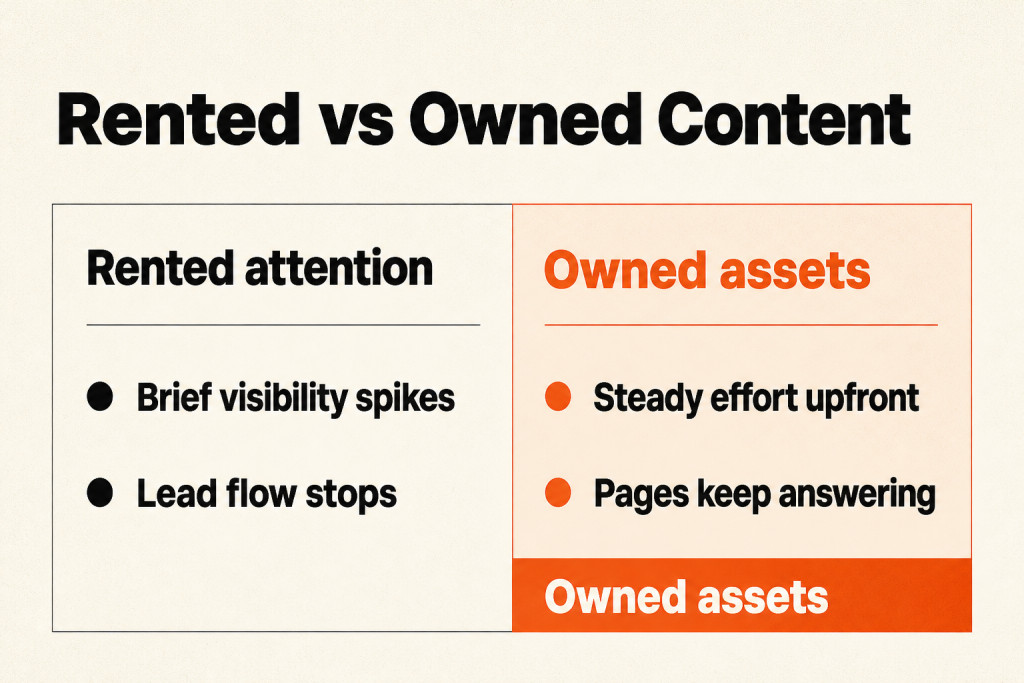
Building owned editorial assets takes steady effort upfront, but those pages can keep answering prospective clients’ questions once an ad campaign is over.
Search engine use
In the course of seeking legal advice, 96% of people use a search engine. Before taking any action, 74% of people visit a law firm’s website; nearly 90 percent of American adults search online for legal answers at some point before consulting an attorney. High-quality digital content matters more than ever for law firms.
Pre-qualify prospects
Use Content systems to pre-qualify prospects before they speak with the intake team.
Frequently Asked Questions
How long does it take to see measurable business growth from content marketing?
Measurable growth from content marketing takes time because organic content systems need to earn search authority and build trust with search engines. Paid advertising can bring traffic right away; content gains add up over time.
Should attorneys write their own content or outsource the execution?
A strong partnership keeps legal insight in-house and gives execution to outside marketing professionals. Busy partners, whose hours are highly billable, can spend that time writing long-form articles, editing video transcripts, and managing technical optimization. Marketing professionals can handle those tasks more efficiently.
How does AI impact legal marketing compliance and ethics?
AI can make legal marketing workflows more efficient, though it also brings questions about compliance and ethics. At our agency, AI helps with drafting and research, not as a replacement for human expertise.
How often should law firms update their content marketing strategies?
Law firms should assess their content marketing approach regularly, preferably every quarter, and make adjustments so it continues to work well in support of business objectives. Data can guide SEO refinements that can maintain or improve search rankings over time and support a steady flow of potential clients to the website.
Organic content systems need time to build search authority and trust with search engines, so growth from content marketing for law firms takes time. Internal legal minds can provide insight while external marketing professionals handle execution. At our agency, AI helps with drafting and research, not as a stand-in for human expertise. Review the strategy quarterly, as discussed above.