
Content marketing for nonprofits can become a stream of campaign posts and emails without a clear goal or audience behind them. Campaign pages may already hold useful stories and photos, so the challenge is making that material add up to something meaningful for the people you need to reach.
Read on to build a practical content plan, find formats and stories that fit your supporters, and assess whether your content is moving people toward meaningful action.
How to Plan Content Marketing for Nonprofits
Plan nonprofit content by setting goals, defining key messages and themes for a target audience, and choosing channels and measures; these decisions give the work direction. Teams that also work with business partners can borrow ideas from our B2B content marketing playbook.

- Content marketing goals
- Key messages
- Content positioning
- Content themes
- Target audience information
- Content channels
- Measurement practices
Every goal needs a measure and a deadline. Use the objectives and key results model in strategic planning and marketing planning, so each goal has a result you can check and track.
Mission-Aligned Goals
Derive nonprofit content goals from the strategic plan, then connect each goal to a measurable KPI. That connection gives each email or post, including campaign updates, a reason to exist. Track results over time to see what’s working.
- Awareness: New email subscribers and follower growth
- Conversion: First-time donor rate and donation CTA click-through rate
- Retention: Recurring donor rate and repeat gift rate
Set one primary goal for each campaign or planning window. Trying to move every metric at once makes the plan harder to run and judge.
Check that the goals in your nonprofit’s strategic plan fit with the marketing plan. If the connection isn’t clear, revisit the overall marketing strategy before you build a content marketing strategy. Your content marketing goals should support both plans.
Your Content marketing goals can go beyond the cause itself. You might work to raise brand awareness or encourage engagement, with improved donor retention as another aim. Weigh your mission, what your target audience needs, and the outcomes you want. SMART goals let you track progress and review it over time.
“Raise awareness” doesn’t tell the team what to do. A clearer target would be to grow monthly donor signups by 15% this quarter with a blog series about program impact.
Content Audit
Take stock of what you’ve published before you make more. Check which pages draw traffic and which blog posts still get engagement. Also check whether any information is outdated or no longer accurate. Start with those pages.
Find pieces to refresh or reuse, and combine related items. A three-year-old impact report may still have stories you can tell again (after updating the data). Give a weak blog post a better headline and current stats. Update or remove stale material, since it can chip away at the trust you’re building.
Your campaign pages belong in the content mix, too. Bring their stories, impact details, photos, and updates into emails, social posts, and future fundraising appeals instead of making everything from scratch.
Audience and Personas
Identify your intended audiences and create personas before writing. Donors, volunteers, beneficiaries, board members, and community partners may all visit, yet someone new who wants proof of impact needs a different experience from a lapsed donor looking for a reason to come back. Be clear about who you need to reach.
Create personas for first-time donors, recurring supporters, major gift prospects, volunteers, beneficiaries, and community partners. For each group, note its primary driver, what it needs from you, and how its members find your site.
For your nonprofit content marketing strategy, keep a record of:
- Each audience member’s “primary driver,” or the main reason they would get involved with your organization
- The communications channels that work best for reaching that audience
- The messages or themes most likely to resonate on each platform and at each stage of the relationship with your organization
Ask your community what matters to them. Talk with staff and volunteers, and ask frontline workers what they hear; pay attention to the patterns.
One broad “supporter” profile can hide why people care: the concerns of a corporate grant officer may differ from those of a monthly micro-donor or a hands-on weekend volunteer.
Key Messages and Positioning
The “point” of your communications
What central idea should audiences associate with your organization? A Content positioning statement gives them that point of connection. Keep it to 1-2 sentences and make the point of your communications clear. For instance, a nonprofit that runs creative-writing workshops for Chicago students could say it believes writing can open doors for young people and hopes more children and families will experience that power. Keep the “why” close as you create content; the statement gives the team a clear idea to return to.
A framework for all communications
A Key messages framework can steer all of a nonprofit’s communications, content marketing included.
Themes that carry the message
With a Content positioning statement in place, choose Content themes that express it and fit both the marketing and strategic plans. A creative-writing nonprofit might build themes around:
- Analysis of data about student challenges in Chicago
- Creative prompts for students, teachers and parents
- Published creative works by the students themselves
- Stories about students whose creative writing have had a positive effect on their lives and their communities
- Inspirational ideas about the power of creativity
Lead with the outcome
Lead with the result your audience can expect, and write with empathy and clarity instead of starting with the org chart.
For example, the R3 Program brings groups from different sectors together to reduce recidivism.
A more audience-focused version might say, “We work with returning citizens to rebuild their lives and avoid prison in the future.”
Tone and Brand Voice
Feelings to evoke
When several people create content, agree on the tone they should use. Choose an emotional response for your audience, with empathy at its center; aim to leave them energized or empowered. Say whether you want them ready to create change with you or hopeful about the answers you offer to community challenges. Be clear if you want them to join a movement you’re part of. Add these details and specific examples to your nonprofit content marketing strategy, then keep the same voice and tone across every channel.
A conversational voice
Write the way you’d speak in a conversation or tell a story. Keep the words human, not like a dry brochure.
A human touch
Write emails so they sound like they came from a trusted friend, not a faceless institution.
Editorial Planning and Workflow
A content calendar sets when and where each piece will appear, helping the team keep a steady publishing rhythm and coordinate the work.

- Record when and where each piece of content will be published.
- Assign tasks and set deadlines for content creation and publication.
- Start with one or two marketing channels where supporters are already active. Set a sustainable rhythm, then expand when the team has capacity.
Before you add a channel, make sure the team can sustain regular publishing and supporter responses on its current channels, with results tracking covered too. Follow the channel and cadence approach above. A smaller, steady presence is better than an abandoned account.
What Content Pillars Should a Nonprofit Build Around?
Across your content plan, use content pillars as prompts, not fixed boxes. These recurring themes tie what your nonprofit creates and shares to its mission and fundraising goals. Rotate among a small group, and your team won’t have to start brainstorming from zero each week.

The table pairs the Donor appreciation & stewardship pillar with its content formats, including Email and SMS, as well as social posts.
| Content pillar | What it includes | Best channels & formats |
|---|---|---|
| Donor appreciation & stewardship | Thank-yous, donor spotlights, and updates that deepen relationships | Email, SMS, social posts |
Plan supporter-focused content with this pillar, keeping its themes flexible rather than fixed.
Mission and Impact
The campaign traces
The campaign charts growth from serving 15 families to reaching 3,300 children through 194 classrooms and 26 community partnerships.
What they did:
The campaign used four email blasts and a detailed campaign page, and shared updates on sponsors and fundraising opportunities.
What they raised:
It brought in $220K+, reaching 152% of its $145K goal.
Why it works:
The page pairs its emotional founding story with concrete impact figures and organizational milestones, while offering a clear view of the future. That helps supporters see where the organization began and whom it serves, showing why continued support matters.
Supporters see the organization at work.
Strong nonprofit case studies show the problem and response, then explain the outcome.
Donor Appreciation
Donor appreciation content keeps supporters connected to your work between asks. Only 19% of people who give for the first time make a second gift, so donor retention is hard. Without steady follow-up, most supporters your campaigns worked hard to reach may drift away. This steady presence helps supporters feel connected to your work when you make an appeal.
Community and User-Generated Content
Engagement and user-generated content
An active online community can increase the impact of a nonprofit communication campaign. On social media, nonprofits can help people feel they belong by replying to comments and sharing user-generated content (UGC). Those posts offer authentic testimonials and extend reach, while showing real-world impact and encouraging more people to support the cause. For platform tactics, read our guide to content marketing on social media.
Ambassadors and their networks
Social media ambassadors can carry a nonprofit’s message farther through user generated content marketing, sharing it with their networks to expand its reach and impact.
Choosing Content Formats and Channels That Reach Supporters
Match each channel to the campaign goal, and make the pieces support one another. Treat the website as the main destination you control, with clear routes for different audiences. Create each landing page for one audience, and limit the homepage to 2-3 main calls to action.
- Plan each channel around campaign goals, and give each piece a clear next step.
- Email helps build trust and maintain supporter relationships.
- Video can prompt people to act; use it to explain a campaign or show its impact.
- Use social media for discovery and engagement, then bring people to a relevant landing page.
Blog posts bring visitors in through organic search. Organic search drives 44% of visits to nonprofit websites, and steady blogging builds visibility that lasts.

Email gives you a way to build trust and stay connected with supporters. Group subscribers by interest, and send a useful monthly newsletter instead of emailing just to keep up a schedule. Impact and annual reports can show results. Turn PDF material into web stories and highlights that show current and potential donors what their support makes possible.
Video can move people to act. After viewing a charity’s work in a video, nearly three out of four donors report being highly inclined to donate. Nonprofits see roughly a $7 return for every $1 spent on video marketing. Keep videos short, honest, and focused on action, with a clear call to action.
Use social media to help people discover and engage with your work, then guide them back to the website you control. A useful lead magnet, such as “Free Guide: What to Expect in Family Therapy,” can help build your email list and group people by interest.
Storytelling That Turns Readers Into Supporters
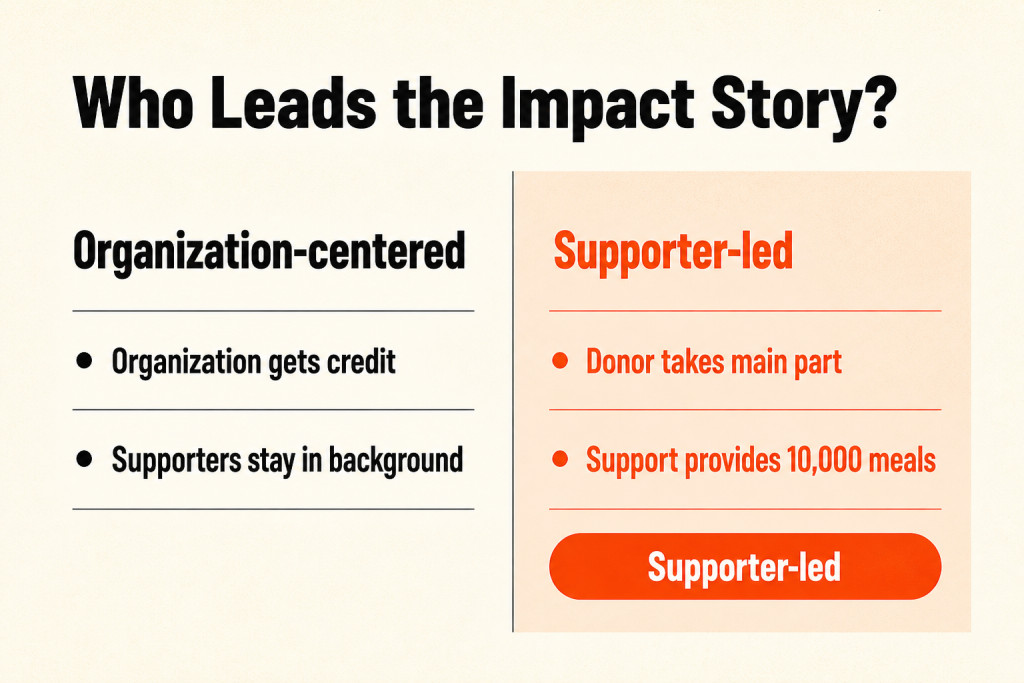
Supporter-Centered Stories
When a nonprofit tells an impact story, putting the organization at the center can push supporters into the background; a supporter-led story gives the donor the main part. Compare “We served 10,000 meals” with “Your support provided 10,000 meals”: the first credits the organization, while the second centers the donor and shifts how the story feels to readers. The donor leads.
Show how supporters help address real-world problems, and explain how the organization guides their efforts. The organization shares its experience and gives supporters ways to act. Before drafting, ask these questions.
- Who is my intended audience?
- What does my audience need?
- How does my nonprofit uniquely meet that audience’s need?
Cause-and-Effect Structure
Make the path from a supporter’s gift to its result clear and personal. Show what the gift sets in motion. For instance, readers can follow “Your $50 provides a week of meals for a family” directly to its effect, unlike the broader statement that the organization served 10,000 meals last year.
Broad claims about impact rarely move people. Concrete, specific details help donors picture themselves as the catalyst: they show what changes because of a donor’s involvement and keep that link as direct as possible. That gives donors a clear picture of the outcome.
Measuring What Matters and Improving Over Time
Key Performance Indicators (KPIs) and benchmarks help a nonprofit judge how its marketing work is doing. They make progress visible. Track results and note where the plan needs work. Use what you learn to guide future choices. Benchmarks can also help direct resources well and keep activities tied to the organization’s goals.

Key Performance Indicators
A nonprofit might track these Key Performance Indicators (KPIs) for a fundraising campaign or marketing plan. Allocate resources efficiently as you set KPIs.
- Volunteer engagement.
- Event attendance and participation.
- Grant success rate.
- Corporate sponsorship acquisition.
- Impact measurement.
- Volunteer signup completions: Particularly those from content-driven pathways.
- Content-assisted conversions: Whether someone read a blog post or watched a video before taking action.
Touchpoint Analysis
Use Google Analytics to track Page views, bounce rates, and conversions across content touchpoints. Review the numbers to judge how well the content works, see which topics connect with your audience, and spot topics that may need another look.
Look at these measures together rather than in isolation: strong page views with high bounce rates can point to a mismatch between the topic and what readers need, while conversions after a content touchpoint can show which pieces are helping people take the next step. Use those patterns to revise the relevant content—clarify its connection to the mission, strengthen the next step, or revisit topics that consistently underperform—then check the same measures again.
Testing and Iteration
Donation pages can improve through A/B testing. You might tailor content to better meet the needs of key donor segments or revise outreach strategies to boost engagement and retention.
Match your feedback method to site traffic. If traffic is low, call donors directly and use short surveys to collect qualitative feedback. When traffic is steady and high, run structured split tests on page headlines and donation button copy.
Frequently Asked Questions
Does content marketing work for small nonprofits?
Content marketing works for small nonprofits because it gives lean teams a repeatable way to share stories and updates across channels, without starting from scratch each time. Many of the same principles apply to content marketing for small businesses, where budgets are also tight.
Why would a nonprofit organization hire a marketing team?
A nonprofit marketing team can make sure the right people create the right content at the right time. That can keep staff from filling their days with a lot of “stuff.” A content marketing strategy helps the organization make effective use of its marketing and communications team’s time and talents, while partnering with a Content Marketing Agency can provide specialized support.
How do you acquire more donations for your nonprofit with digital marketing?
Clear calls to action and intuitive navigation guide visitors to donation opportunities, volunteer sign-ups, and other actions. Segment your email list by donors’ interests and preferences. Every subscriber gets relevant, targeted messages.
The Short Version: Key Takeaways
Content marketing is widely used by nonprofits, yet documented strategies are less common; donor emails can also reflect subscribers’ interests and preferences.
- Research from the Content Marketing Institute found that almost all, 92 percent, of nonprofits use content marketing in some way, but only about a quarter said they had a documented content strategy or used content marketing effectively.
- Email 💌 works for newsletters, campaign stories, fundraising appeals, and donor updates; 33% of donors say email is the tool that most inspires them to give.
Research from the Content Marketing Institute shows that almost all nonprofits, 92 percent, use content marketing in some form. Still, only about a quarter report having a documented content strategy or using content marketing effectively. Content marketing for nonprofits can use email 💌 to share periodic publications, campaign narratives, requests for financial support, and updates with donors. For 33% of donors, email most prompts them to give. See the FAQ for more on email segmentation.