
If you’re responsible for fintech content marketing, the hard part is helping readers make sense of a financial choice without letting the details—or the calculations in an interactive tool—drift out of date.
Reading on will give you practical ways to keep that content within regulatory boundaries, choose formats and channels for your audience, and connect search and performance signals to improvements that help the right buyers take the next step.
How to Keep Fintech Content Compliant and Low-Risk
A compliance-first approach to fintech regulations meets legal obligations while building audience trust, and it can reduce delays, protect your brand’s reputation, and build confidence among financial buyers.
Key Regulators and Frameworks
Relevant governing bodies include the FTC, SEC, FINRA, and CFPB; applicable rules may include the FTC’s Truth-in-Advertising Law, Equal Credit Opportunity Act, Investment Advisory Act, AML/KYC, CAN-SPAM, GDPR, and CCPA. The rules that apply depend on your fintech company’s offers, products or services, and affiliations; knowing which ones matter can help you avoid problems.
- Regulatory agencies: The Federal Trade Commission (FTC), SEC, FINRA, Consumer Financial Protection Bureau (CFPB), and other agencies oversee fintech and financial services.
- Financial laws: Relevant laws may include the FTC’s Truth-in-Advertising Law, the Equal Credit Opportunity Act, the Investment Advisory Act, and Anti-Money Laundering/Know Your Customer (AML/KYC).
- Data privacy and security regulations: Content marketing must also follow rules such as CAN-SPAM in the United States, GDPR in Europe, and CCPA in California. These laws set regulatory guardrails for content marketing financial services and protect consumers from unlawful use of their data, especially when fintechs use email marketing.
Compliance Review Workflows
Fintech teams can keep content compliant by simplifying legal language, prioritizing transparency, embedding legal checks early, collaborating with compliance teams, using factual language, and adding disclaimers where needed.

- Simplify legal language: Break regulations into insights readers can understand.
- Prioritize transparency: Explain risks and benefits in straightforward terms.
- Embed compliance reviews early: Add legal checks to workflows to prevent last-minute rewrites.
- Collaborate early with compliance teams: Early collaboration can prevent bottlenecks.
- Use clear, factual language: Avoid exaggerated claims.
- Include disclaimers where necessary: Disclaimers help maintain transparency.
Think of compliance review as a software code test: check small components early, so you don’t face a full rebuild right before release.
Regular audits and assessments can help maintain compliance by flagging areas of non-compliance or potential risk, and technology can support the process. Web analytics platforms can track compliance-related metrics and show how people interact with your content.
4 Content Formats That Earn Trust in Fintech
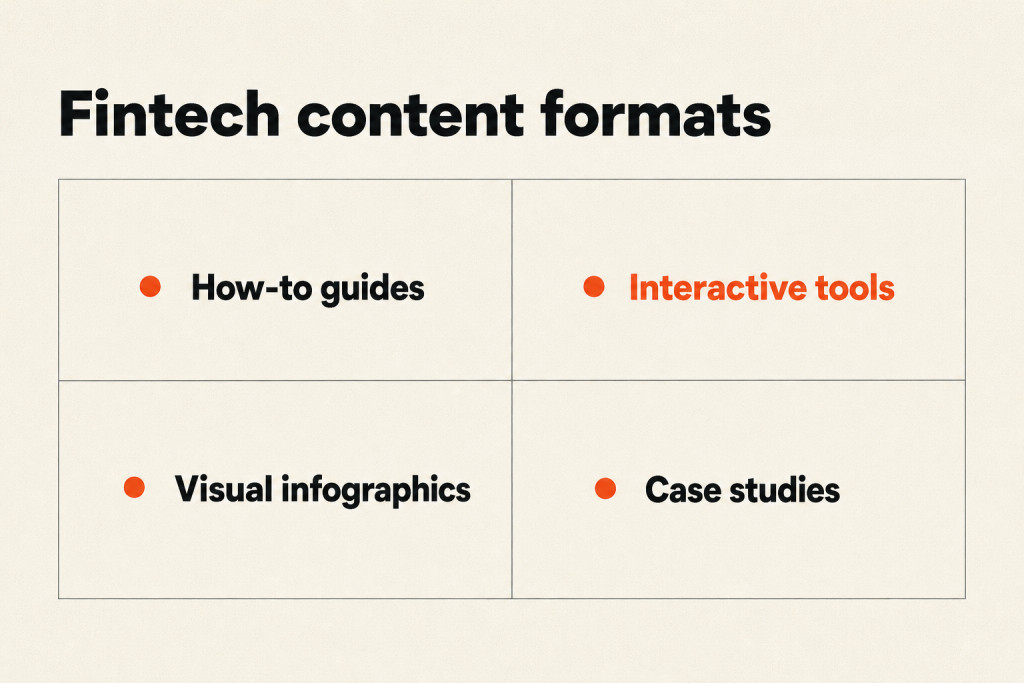
B2B fintech marketing works when content formats match what potential customers need at each stage: awareness, lead nurturing, or sales support. Use blog posts for detailed insights, podcasts for expert interviews, and videos, infographics, and webinars to keep the mix fresh and engaging; each format gives you another way to attract, educate, or convert a potential customer. For a broader view of the business-to-business playbook, see our guide to B2B content marketing.
Educational Hubs and Guides
Explain products and financial concepts
Use How-to guides and tutorials to show readers how to use fintech products; explain complex financial concepts in other articles, with reliable data and statistics to support the explanation. Those details build credibility and authority in the fintech space.
Answer audience questions
Research can help you identify common questions and real-life financial scenarios to cover. Readers turn to fintech content to make better financial decisions, so an educational strategy can include beginner articles as well as detailed content for professionals and experts.
Address different financial needs
Readers’ financial interests can differ by age group, so match topics to the needs that matter to each audience. Gen Z may seek budgeting and beginner investment options; older readers may seek retirement planning and wealth preservation.
Calculators and Evaluation Tools
Interactive tools give prospective buyers hands-on ways to evaluate financial decisions. ROI (return on investment) calculators, loan comparison models, compliance checklists, quizzes, and personalized recommendations based on user inputs turn static content into an engaging experience. Use these tools to keep visitors on-site longer and strengthen confidence in fintech solutions. Longer sessions and more interaction can improve search engine rankings, while the tools also generate deep user engagement and high-intent data; ongoing engineering maintenance and strict validation keep calculations accurate as financial terms change. Our roundup of content marketing tools can help you choose the right stack for building them.
Explainer Videos and Infographics
Explainer videos and visual infographics capture attention and convey complex information succinctly, making data easier to understand and extending its reach.
- Infographics: Infographics can distill data into an easily digestible format for a broader audience and break complex information into digestible pieces.
- Videos: Videos can illustrate processes dynamically and explain complex financial topics and services in a clear, entertaining way.
- Sharing and understanding: Visual content can improve understanding and increase the likelihood that people share it, extending its reach.
Case Studies and Peer Testimonials
Client testimonials, customer reviews, and case studies draw on peer experiences that financial buyers trust and can shape fintech buying decisions.
- UGC builds credibility in a highly regulated industry.
- Brands using UGC see higher conversion rates.
Where to Distribute Fintech Content for Maximum Reach
Share fintech content on the channels your audience uses to reach the right people:
- Content atomization: Turn one high-value report into blogs, videos, LinkedIn posts, and downloadable assets. Find more ways to atomize it, increasing its impact and content marketing ROI.
- Paid amplification: Use LinkedIn Ads, Google Ads, and native advertising to put fintech content before fintech executives.
- Sales team support: Give sales teams and SDRs content that addresses objections, nurtures leads, and helps close deals.

Before choosing where to promote fintech content, check which online channels your audience uses, where they often spend time, and which are worth tending for future growth. You don’t have to appear everywhere at once; focusing on the right channels can maximize ROI and help you use your resources well.
Email Newsletters and Personalization
Newsletters and drip campaigns
Newsletters and drip campaigns can keep your audience up to date on fintech solutions while helping you nurture customer relationships.
Personalization
Build personalization around audience segments, then match content to each group’s needs and interests. Exclusive deals or insights in promotional campaigns can drive conversions and repeat engagement.
Executive Thought Leadership on Social
Fintech executives can use LinkedIn for brief conversational posts, detailed articles, and industry insights, while Twitter suits quick updates and direct engagement with followers. Our guide to content marketing on social media covers platform tactics in more depth.
- Executives prefer quick, digestible insights.
- LinkedIn’s algorithm prioritizes conversational content.
- Text-only posts often surpass blog-driven social shares.
Fintech executives tend to engage more with brief LinkedIn posts than with longer pieces, but LinkedIn is also a fit for detailed articles and industry insights. Twitter works for quick updates and direct engagement with followers.
When to Bring in an Agency or Freelance Partners
For cross-channel support, the fintech team can engage Content Marketing Agencies and Freelance Content Writers.
- Content Marketing Agencies: Provide full-scale content strategy, planning, production, editing, optimization, and analytics.
- Freelance Content Writers: Provide flexible, on-demand content support.
Keeping fintech content flowing can put real pressure on an internal team. A specialist agency is a stronger fit when capacity or financial-writing expertise is the gap and it can work within your review process; keep production in-house when ongoing coordination with risk and engineering is central. The criteria below can help you assess the fit. Outsourcing can speed things up while keeping quality high, and outside specialists bring flexibility and expertise without adding overhead.
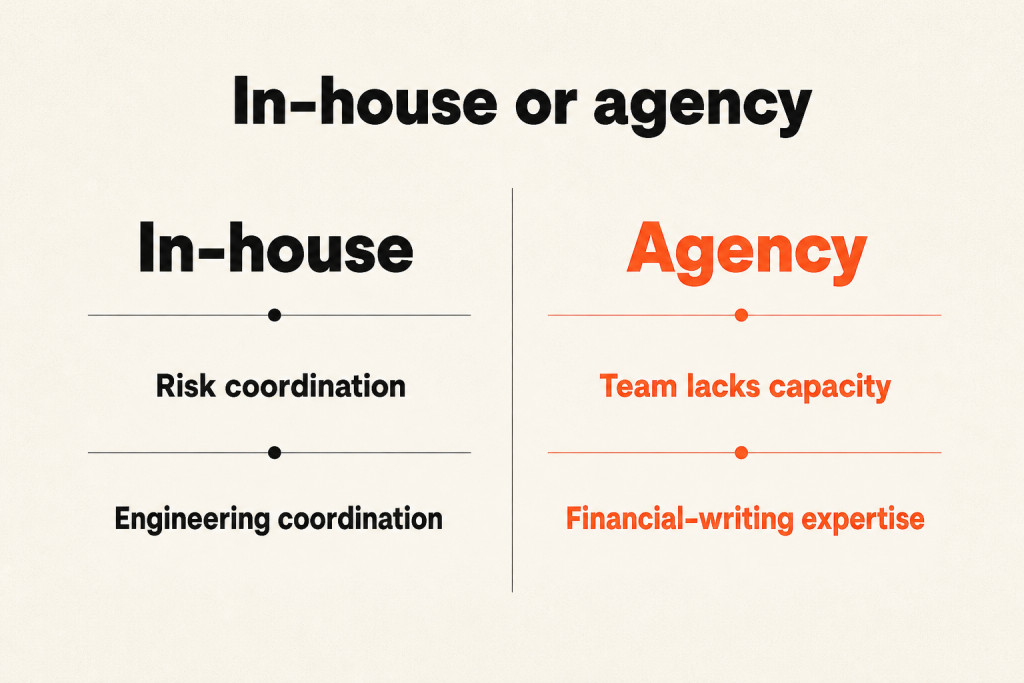
Choosing between in-house production and a fintech content marketing agency comes down to capacity, expertise, and review needs. Keep production in-house when content requires steady coordination with risk and engineering; hire and vet a specialized Content Marketing Agency when your team lacks capacity or financial-writing expertise and the agency can work within your review process.
Set Content Goals That Sales Can Measure
SMART Goals and Benchmarks
SMART goals give fintech teams clear, attainable targets for their work, tied to the company’s main business aims. A company might set goals such as generating 20% more leads within six months or improving customer engagement by lifting email open rates 5%. Specific, measurable, achievable, relevant, and time-bound goals should reflect the company’s strategic vision; use data analytics to keep targets realistic and responsive to audience needs. Revisit each goal as the market or company changes, so it stays relevant.
Revenue Alignment
Align content with business KPIs and buyer needs to support revenue, earn continued investment, and connect even low-volume technical guides to sales conversations.
- Track content’s pipeline impact using attribution models.
- Equip sales with content that converts by providing objection-handling assets.
- Demonstrate cost efficiency by showing how SEO-driven content reduces reliance on paid acquisition.
Executives look for content that drives revenue. Content that matches business KPIs can gain approval more quickly and help ensure continued investment. High organic traffic alone does not prove success: business buyers may read niche, low-volume technical guides before booking a sales demo.

Know Your Buyers Before You Write a Word
Dynamic Personas
Personas give you a clear picture of the people whose needs your content should meet, so create one for each person involved in the buying process. Include education, job title, job seniority, age, and other important characteristics, and make each persona as specific as possible. Use existing client data and traits of potential customers to make each profile accurate, then map the pieces of content each person needs. As more audience data and insights become available, update the personas so the content stays relevant and compelling.
Cross-Team Feedback Loops
Marketing, sales, and product teams learn different things from consumers because they engage with them in different ways: sales speaks with prospects regularly, while product communicates with clients to address issues and improve the product or service. Combining these perspectives gives your team a basis for content shaped by prospect interests and client issues.

Talk with your fintech’s sales, customer support, or product team about the problems your audience encounters; use those conversations to guide topic brainstorming.
Competitor and Topic Gap Analysis
Competitor analysis can show you how others approach market positioning, engage their audience, choose platforms, and decide what content to publish; gaps in their coverage may reveal subjects your content can address. Review their platform choices and content, then use what you learn from their successes and failures to inform your own content strategy. Those lessons can help you avoid pitfalls and capitalize on opportunities.
Competitor analysis gives you ideas, not a strategy to copy. Review competitors’ marketing channels, key messages, and frequency; if they occupy a lot of digital real estate in the Google SERPs, use ahrefs or Semrush to see what they are doing and how.
Ranking in Search and AI Answers
Search Intent and GEO
Fintech brands can improve visibility by targeting intent-driven buyer queries and structuring content around searches that trigger Google AI Overviews. When buyers make specific searches, search engine optimization helps fintech brands appear before the right audience at the right time. That makes SEO an important part of content marketing.
For finance companies, these practices point toward searches that show buyer interest:
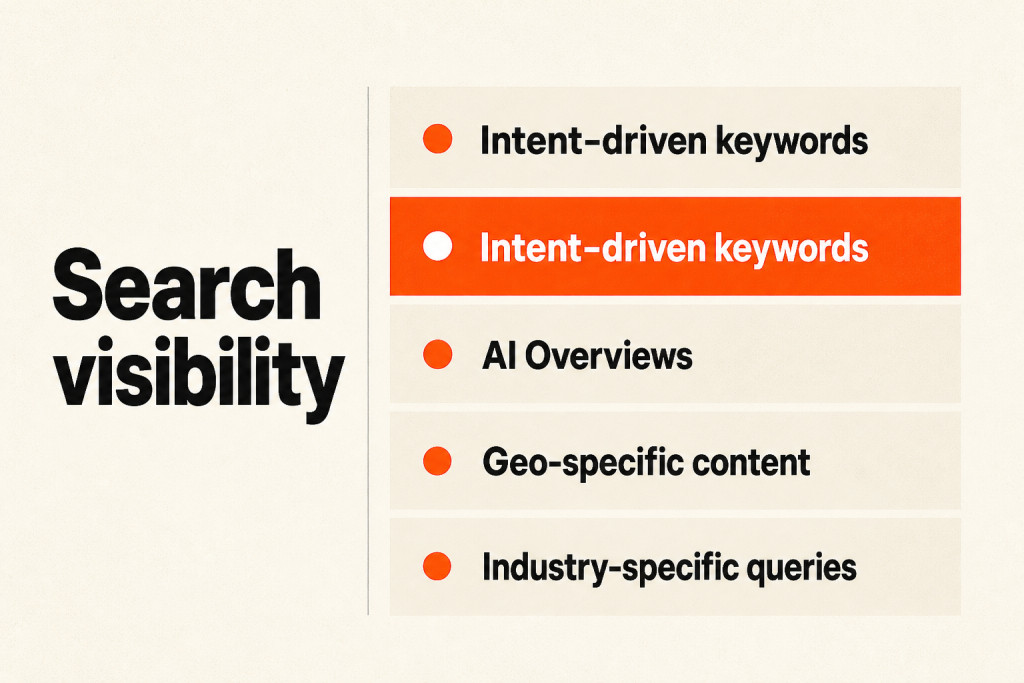
- Focus on intent-driven, relevant keywords: Instead of broad financial terms, choose queries that show real buyer interest. Ahrefs and SEMrush can identify problem-aware and solution-aware search behavior.
- Adapt for AI Overviews (AIO) in search results: Google’s AI-powered results affect visibility. Learn which fintech-related queries trigger AI-generated answers, then refine your content structure around those searches.
- Use geo-specific content where relevant: Banking laws, tax regulations, and financial products differ by region. Region-specific pages, compliance guides, and country-specific FAQs can make educational content more relevant.
- Optimize for industry-specific queries: Buyers often search for comparisons, security standards, and compliance details. Addressing searches such as “best global payroll solution” and “PCI-compliant payment processing” can improve search visibility.
In its analysis of 20 fintech companies, Stratabeat found TOFU keywords continue to account for the majority of search volume, while also showing how often AI Overviews affected rankings:
- For smaller B2B websites, only 3.5% of non-branded ranking keywords included AI Overviews.
- For large fintech companies, only 5.3% of high-volume TOFU keywords were impacted by AIO.
- TOFU content still presents a massive opportunity.
When fintech brands overlook TOFU SEO, they miss that opportunity. AI Overviews may change over time, but foundational searches can still put brands on the winning side. Examples include:
- “Global payroll solution”
- “Ecommerce payment processing”
- “Accounts receivable automation”
On-Page Structure and Accessibility
Include keywords in page elements
Once you’ve chosen keywords, on-page optimization puts them in website meta titles, descriptions, and headers.
Support mobile use and navigation
Give visitors a site that adapts to mobile devices, along with a clear internal linking structure, and usability and search engine rankings can improve.
Check clarity and accessibility
Have people outside the field check whether the content reads clearly, and follow Web accessibility standards so educational content is usable by all users, including people with disabilities.
Organize each page around a clear sequence of descriptive headings, and link to related pages with labels that tell visitors what they will find. On mobile, keep navigation concise and make key links easy to locate and use. For accessibility, use headings in a logical order, write clear link text, and check that the page can be navigated and understood by people using assistive technology.
Fintech Content Marketing in Action: 3 Real Examples
Plaid
Plaid provides a secure API that connects fintech apps to banks; its search-oriented content and compliance expertise attract firms seeking fintech solutions.
What Plaid Does Well:
Plaid informs firms already researching fintech solutions:
- Captures search traffic from buyers actively researching fintech solutions.
- Provides authoritative content on compliance and open banking.
- Showcases real-world customer success stories.
Key Examples:
Plaid’s guides include “5 Ways Plaid Simplifies Expansion into Europe,” alongside regulatory insights and customer stories:
- SEO-focused guides like “5 Ways Plaid Simplifies Expansion into Europe.”
- Regulatory insights on open banking policies and compliance.
- Customer case studies, including Plaid’s role in real-time cash flow insights.
Wise
What Wise Does Well:
Wise reaches people weighing international banking with comparison pieces and useful financial explainers:
- Creates competitor comparisons to capture purchase-ready searches.
- Educates buyers on hidden banking fees and transparent pricing.
- Develops step-by-step guides on international banking processes.
Wise’s comparison content simplifies international transfers and converts high-intent buyers through clear, transparent pricing.
AdvisorStream
Build an editorial calendar through licensing
Since producing content can be costly, AdvisorStream partnered with a licensing provider, drawing from a global newspaper and a business publication to fill its editorial calendar.
Turn clicks into conversions
AdvisorStream runs a digital marketing platform that has earned awards, drawing on licensed material from reputable publications to help financial advisers turn clicks into conversions. Its content strategy also relied on licensed content to build trust and credibility with consumers.

Increase views and lead capture
AdvisorStream used licensed pieces to stand out as an authoritative thought leader amid the crowded mix of other brands in the industry. From January 2020 to June 2020, views of licensed content rose by 200%, while lead capture through its platform climbed by 260%.
Measuring Results and Improving Over Time
Core Performance Metrics
Among the KPIs you could track for blog content are Keyword rankings, organic traffic, engagement rate, impressions, clicks, and CTR.
These tools show how users behave and how traffic moves, alongside keyword performance; Time on page and scroll depth, together with interaction rates, show content effectiveness, helping you find what works and what needs optimization. These tools also provide insights into traffic patterns.
A/B Testing and Iteration
Use A/B testing to compare content elements, such as headlines and images, and test calls-to-action to learn what your audience responds to and what drives engagement and conversions.
Begin with a specific hypothesis about one element—for example, that a clearer headline will help the intended audience recognize the page’s value. Choose a success metric that matches the goal, such as CTA clicks for engagement or conversions for action, and compare the versions using that same metric. Apply the result by keeping the stronger approach or revising the content and testing a new hypothesis; record what you learned to guide the next iteration.
Content Refresh Cycles
- Refresh and repurpose existing content: Keep high-value content relevant by updating it with new data, examples, and regulatory changes.
Fintech content marketing works best as one connected system: it makes complex financial choices clearer and guides the right buyers toward action. These measures help you track blog performance, while A/B testing helps you see how headlines and images perform, and whether calls-to-action drive engagement and conversions. Keep high-value content relevant by updating data and examples to reflect regulatory changes. Together, these practices link visibility and content improvement to the choices readers make.