
If you’re using user generated content marketing to drive revenue, the challenge is making customer posts useful at the point of choice—not simply collecting them. A customer video can draw views without telling you whether it helps someone picture the product in use.
Read on for a practical path to source customer media, clear it for reuse, and place it where buyers are choosing. You’ll come away with a way to treat reviews, photos, and videos as decision support rather than content to fill a feed.
Why User Generated Content Marketing Pays Off
Customer voices carry influence that brand messaging alone may not: 92% trust peer recommendations over brand messaging, and 79% say UGC impacts their purchasing decisions. That influence shows up in advertising, where UGC ads achieve 4x higher click-through rates than traditional ads and 50% lower cost-per-click. Beyond clicks, UGC increases revenue per visitor by 154%, giving businesses a direct revenue measure alongside ad-spend efficiency. Marketers can assess both stronger response and returns.
A systematic user generated content marketing program can reduce the cost and time required to produce campaign assets, and partnering with a specialized Content Marketing Agency can streamline asset production. A successful program is a highly efficient content engine, producing high volumes of material while saving brands up to 70% on content creation compared with professional production. Commissioned UGC averages $212 per piece, compared with $45,000 for a single top influencer post. Ketone-IQ achieved a 29% website revenue increase, while She’s Birdie saved $10,000+/month on content creation.
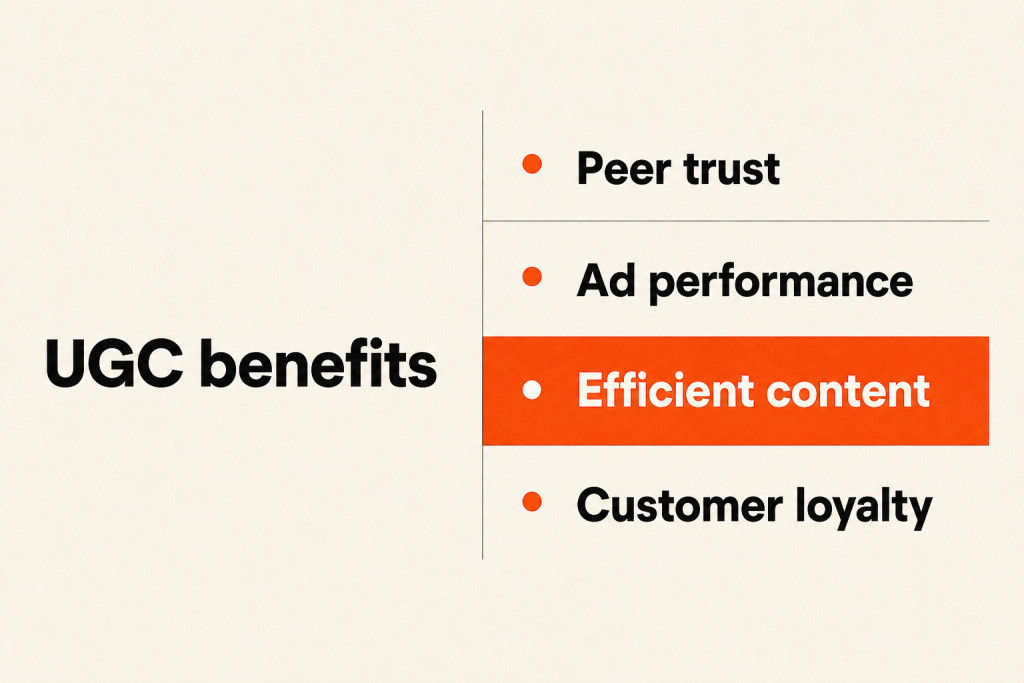
UGC drives social engagement, generating 6.9x more engagement than brand-generated content. Social media campaigns that incorporate UGC achieve 50% higher engagement rates than campaigns using only branded content, and customers who engage with UGC are 97% more likely to become repeat buyers. When customer content helps people feel seen and valued, belonging can deepen engagement, foster loyalty, and increase customer lifetime value over time.
Sporadic mentions are hard to scale; a systematic program makes UGC predictable and measurable, helping you de-risk content investment.
What Types of User Generated Content Work for Marketing?
The three types of user-generated content (UGC) in marketing are text, pictures, and videos. A UGC plan should use several formats, since each can help at a different point in the marketing funnel.
Customer Reviews
Peer trust
When people are deciding what to buy, they often put more weight on other customers’ opinions than on a brand’s claims. That gives customer reviews a real say in the choice.
Low-friction ratings
A rating is a simple way for all customers to weigh in, and they can send one in with only a few clicks. Ratings also offer an easy way to engage. Submitting a rating takes just a few clicks.
Critical decision points
You can feature this flexible content on product pages and in email campaigns, as well as through content marketing on social media, giving shoppers social proof as they make important decisions.
Tried and true value
Good testimonials and product reviews act like case studies customers shared on their own, without advertising’s extra polish. They show tried and true value. Collecting these reviews can support a customer testimonials content pillar marketing strategy.
Unfiltered feedback
Reviews, comments, and social media updates give people candid feedback that can shape buying choices. A considered note about product fit or usability, including a service experience, may land harder than polished brand messaging. Paragraphs about fit, ease of use, or service can also give customers useful details.
Customer Photos
Everyday pictures help shoppers imagine a product in their own homes and routines. A living-room photo of furniture or a meal made at home can connect marketing images with how a product gets used. Stylized product photography and videography still have a place when you’re showing off a product or service. But photos and videos customers share “in the wild” can come across as more authentic and help brands connect with consumers.

As you source UGC videos and photography, choose content that feels authentic and clearly features your brand, product, or service. Those standards help keep it recognizable and useful:
- Authenticity is key. Users trust effective UGC because it feels real rather than produced. Avoid studio photography and videography that looks slick or staged; content captured in a natural setting and showing a real experience performs best.
- Quality still reigns. Authenticity matters most, but images should still have good lighting and be in focus.
- Brand relevance. Content should fit your brand’s personality and values while making your product or service identifiable. Otherwise, your message or product may get lost in the shuffle.
Customer Videos
Unboxing videos can show products being used, and testimonials offer another view of them in action. On YouTube, user-generated videos draw 10x the views of brand content. The same trend holds on short-form video services including TikTok and Instagram Reels: native creator videos consistently attract more views than polished brand productions. A demonstration can reassure viewers about quality and usability.
- Unboxing videos, tutorials, and testimonials demonstrate products in use. A short clip showing how an item is assembled or performs under normal conditions can reassure viewers about its quality and usability.
- User-generated videos on YouTube receive 10x more views than brand content. The same difference appears on short-form video platforms like TikTok and Instagram Reels, where native creator content consistently outperforms polished brand productions.
UGC photography and video can show a product or service, including a travel destination, through the eyes of customers, fans, or others outside the brand. The material may look casual and unfinished or highly polished. Unlike professional photography, it isn’t commissioned.
How to Source Customer Content
Start with a simple sequence: source customer media, clear it for reuse, then place it where buyers choose. This keeps the work focused on decision support, not collecting posts.
A reliable content-sourcing framework starts by choosing the outcome and metrics, then invites customers to create content that supports them. Customer-made content can keep your brand supplied with an unlimited stream of material: one person’s post about your product or service can get other customers talking about you, too.
Possible outcomes include lifting conversion rates on particular product pages, cutting content production costs, or growing engagement on a new social channel; each outcome points to the metrics to track.
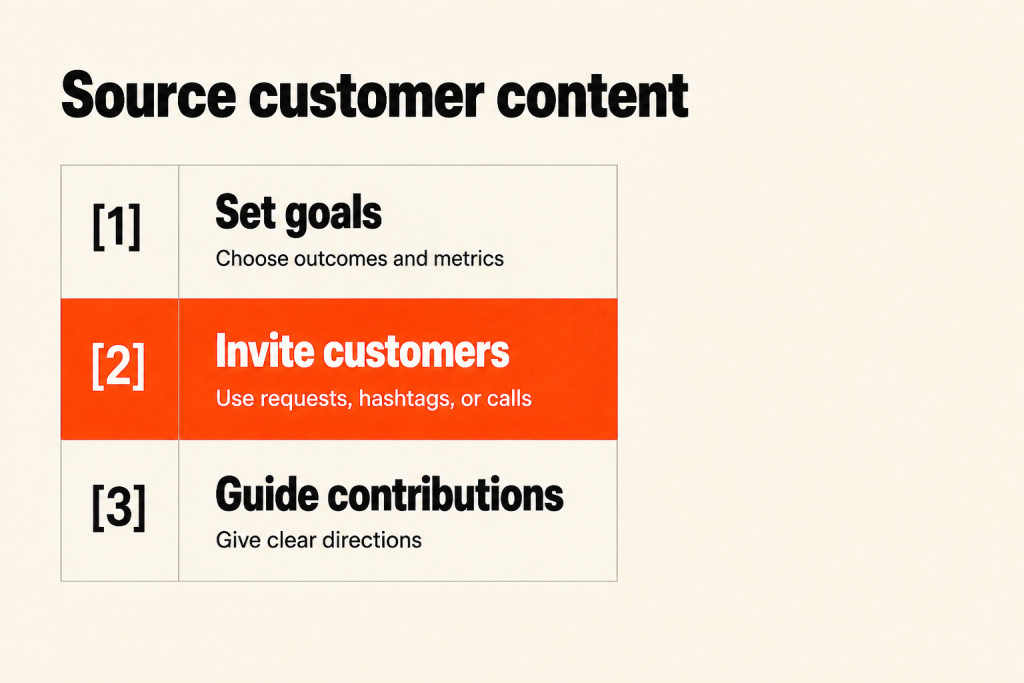
Searching for customer posts rarely surfaces useful material. Ask customers to make and share the kind of content you want.
Post-Purchase Outreach
Add review and testimonial requests to the steps customers or clients already follow, so you can collect feedback after a purchase or service. Possible goals include increasing conversion rates on specific product pages.
- Send an email or text request in a follow-up message after the purchase or service is complete.
- Keep the request brief, and make the process quick and easy to maximize responses.
- Focus your request on the customer’s experience.
- Make sure you have the customer’s consent before sharing their feedback publicly.
Ask customers for reviews in an email campaign.
Branded Hashtags
Make sharing simple and worthwhile, and use branded hashtags to invite customers to join in.
- Create and promote hashtags related to your brand or a specific product. For added visibility or an incentive, run a social media contest asking people to use the hashtag; submission contests are among interactive content marketing examples. When you find content you like, contact the creators to discuss permission or compensation.
- Search existing hashtags related to your brand. If you find creators sharing great on-brand content, reach out, start a conversation, or comment on a post to build a relationship. Use those hashtags in your own content to get more eyes on it.
- Put out an open call: Ask followers to share content showing them engaging with your brand in a post on your brand’s social profile.
Product Seeding
Product seeding means giving bloggers, vloggers, or influencers free products to test, with the possibility of coverage. It may lead to positive coverage while preserving candid enthusiasm and avoiding agency production fees. Recipients may share content on social media and online review and culture sites, including visual content, product reviews, or case studies. You give up editorial control, and recipients may never post. Smaller brands can start here, as covered in content marketing for small businesses.
Getting Rights and Compliance Right
A successful UGC strategy needs a centralized system to find customer content, organize it, and manage permissions in one place.

Creator Permission
Get creator permission before you share customer content, and credit the creator wherever you use it. A public post or brand hashtag does not give you permission to reuse content in marketing; ask the creator first, then acknowledge the original creator wherever the content appears.
Likeness Clearance
Secure permission from identifiable people caught in the frame. A passerby in a customer photo is like an uncredited actor in a commercial: the photographer’s consent does not cover everyone identifiable in the image or remove their privacy rights.
Sponsorship Disclosure
Unpaid UGC
Users create and share unpaid UGC about a product without compensation.
Paid UGC
Paid UGC is content users create in exchange for a fee, free or discounted products, or other incentives.
“Pay to play” UGC has raised questions about the authenticity and effectiveness of user-generated marketing. The “Mommyblogger” scandals of the mid-2010s showed users who had gained fame and some fortune through user-generated marketing exposing the contracts behind their reviews and advocacy for certain products and services on their websites and social media channels. This co-opting of trusted influencers led to skepticism about the authenticity of user-generated content marketing.
How to Moderate UGC at Scale
Moderation systems pair automated checks for obvious spam and profanity with human review of the content’s context and brand fit, taking its visual clarity into account. That helps keep user-made campaigns aligned with brand values and protects the brand’s image from legal trouble, while leaving creators in charge of making the content.

Manual Screening
Manual quality screening checks creator content against campaign directions and brand-alignment guidelines. Set clear guidelines for nano influencer campaigns to make moderation easier and content more brand-aligned.
- Research shows 53% of users actually prefer specific directions on what to create.
- In nano influencer campaigns, moderation helps maintain consistency by ensuring small-scale influencers’ content aligns with the brand and avoids inconsistencies.
Review each submission against the campaign directions: check that it fits the brief and brand values, is visually clear, and contains no obvious spam or profanity. If a submission misses a guideline, flag it for review rather than treating polish alone as proof of fit; approve content that meets the criteria while leaving room for the creator’s own approach.
Responding to Critical Reviews
Address negative UGC
A poor customer experience calls for a direct response to negative UGC, and you shouldn’t wait to make it. Reply quickly so the customer knows someone heard the complaint and everyone else can see that the company acts on problems promptly.
Consumer review sites
On review platforms, people can share comments about brands and services with a wider community. Yelp is one example: customer service teams can help moderate its user content, even though marketers don’t control the site.
A cruise ship response
A cruise ship’s sprinkler pipe burst in May 2018, spilling water from the ceiling across decks and into staterooms. One passenger recorded water flooding a hallway, added the caption “Worse than the Titanic,” and shared the clip on Facebook. After local television covered it, national news picked it up, and the video drew hundreds of thousands of views.
The company told reporters the scene appeared worse than the actual damage: water from an internal leak had come from supplies already aboard, rather than through a break in the hull. It then shared user-generated content to explain what happened and show its response, asking passengers to film and post the crew cheerfully bailing water from flooded hallways and staterooms, then laying new carpet.
The company offered each of the one hundred affected passengers a flight home departing from the next port, along with a full refund, but only two accepted. Clips showing the company’s positive response spread far more widely than the original video. That coverage shifted, to some extent, a possible hit to the brand’s image into positive publicity.
Where to Place UGC: Integration and Distribution
Customer media works harder when it appears on a brand’s digital properties, especially product pages and email campaigns, instead of staying only on social media. Customer photos and reviews can answer prospects’ questions, address objections with authentic validation, lift conversion rates, and shorten the sales cycle.
Digital Asset Management
Democratize access
Bring user-generated assets together in a shared digital asset management (DAM) system, allowing teams throughout the organization to locate and reuse them outside siloed folders or spreadsheets. Social, email, and web teams can access high-value, authentic material, discover what’s useful, and reuse it to maximize its impact.
Tagged content across platforms
Tagged content from Instagram, TikTok, and YouTube can be captured automatically 24/7. This replaces manual screenshot workflows, which cause brands to miss approximately 30% of community content.

Product Pages and Email
Build image galleries and testimonial blocks ahead of time to ensure every item of user content supports brand identity; the examples illustrate how these components can serve different products.
- Homepage videos: The pillow brand added user-generated TikTok videos to its homepage. Videos made by actual users show potential customers real-life benefits, including improved sleep quality and comfort. They provide social proof and credibility while creating a deeper emotional connection with the audience.
- Products where size or texture shapes the decision: Prioritize photos showing varied everyday use.
- Complex software or services: Prioritize screenshots that make specific workflow outcomes clear.
Email marketing can serve as a UGC distribution channel when it fits your marketing strategy. Choose other suitable channels, including social media platforms and influencer partnerships. Teams selling to businesses can adapt the same tactics inside a B2B content marketing program.
UGC in Action: Brand and Gaming Communities
GoPro
GoPro built customer-created content into its marketing strategy, using #GoPro to make customer work part of its marketing. The company also launched initiatives, awarding 55 creators a share of $1 million for their best footage, and users could see their photos and videos featured on GoPro’s platforms. By 2013, GoPro had received over 128,000 photos and 93,000 videos, engaging potential customers while promoting cameras and supplying its own marketing channels with content. That gave GoPro an endless stream of high-quality, engaging content that served as both product testimonials and advertisements.

Fortnite
Fortnite and Minecraft gave players tools to contribute directly to the game experience, building thriving communities around in-game user-generated content. Players could create custom maps, mods, and skins.
Minecraft
Minecraft’s player-created content strategy extended the game’s lifespan and kept experiences fresh. This approach also fostered loyal communities that sustain long-term engagement.
Measuring What UGC Delivers
Social Engagement
Four measures can serve as engagement KPIs for a social media campaign:
- Mentions
- Likes
- Shares
- Comments
On-Site Conversion Lift
E-commerce conversion data
E-commerce conversion data puts conversion on product pages with user-generated content 74% above pages without it.
Longitudinal studies
Longitudinal studies report an average 161% increase in conversion rates among shoppers who interact with UGC throughout their buying journey.
Embedded A/B testing
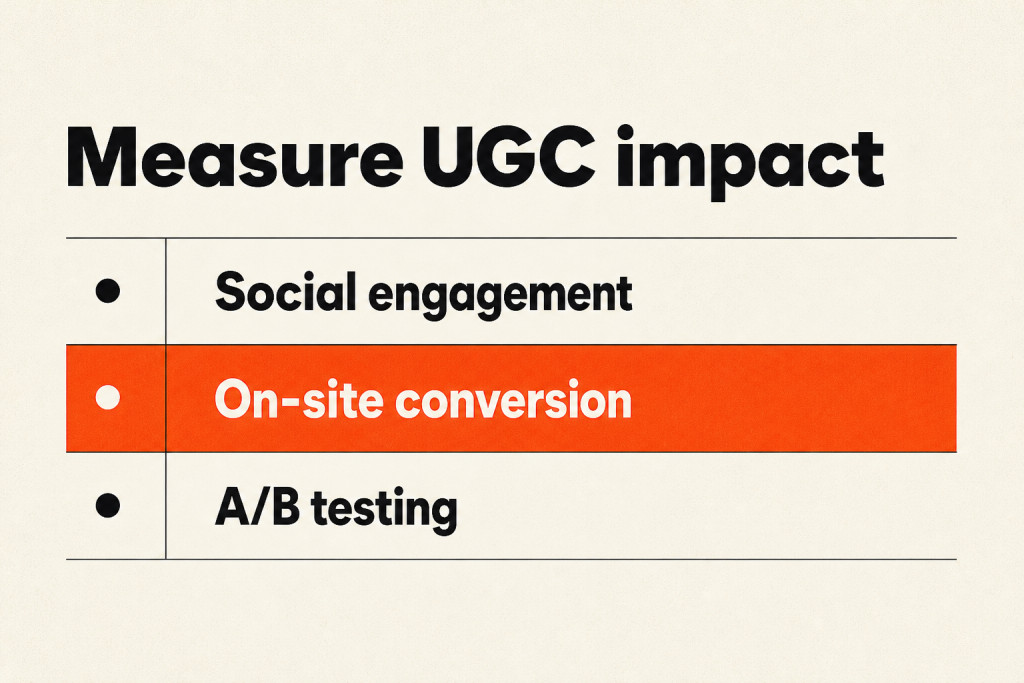
Run embedded A/B testing to compare customer photos and reviews, then see which UGC gets the most engagement and conversion. Use the comparisons to guide data-driven changes to site layout and content tailored to different audience segments, linking UGC to business impact.
Sound underlying funnel
Conversion still depends on a sound funnel; customer media can’t offset slow page loads, hidden shipping fees, or poor product-market fit.
Frequently asked questions
What is UGC?
Customer-created photos, videos, reviews, and social posts tied to a brand are UGC; the brand itself doesn’t make them.
What is UGC in social media?
Instagram, Facebook, and Twitter are common social channels for UGC campaigns, where customers share photos of themselves holding products, attending events, or enjoying a company’s experience with others.
Why is content moderation important for user-generated campaigns?
Moderation screens out inappropriate or off-topic submissions, including copyrighted material and false claims that can expose brands to legal risks. It also keeps campaigns on message and helps protect the brand’s reputation.
How does user-generated content affect purchasing decisions?
UGC helps buyers see what a product offers without staged visuals or ad language making them feel manipulated.
What are some UGC examples?
Someone buying for the first time may share an unboxing video on their Youtube channel as they try your products. Another customer might post a TikTok haul featuring several of them.
Conclusion: Treat UGC as a Repeatable System
User generated content marketing works best when brands source customer media, clear it for reuse, and place it where buyers make their choices.