
B2B growth work is shifting before buyers reach websites, as these b2b content marketing trends take hold.
LLMs are showing up in buying decisions, and agentic AI is rewiring campaign workflows (the work now begins before a buyer submits a form). Privacy regulations are finally wiping out the last holdouts of third-party cookie dependence. Marketers need to build campaigns around AI-assisted discovery and first-party data rather than cookie-based targeting.
Looking at b2b content marketing trends 2024, the old playbook no longer fits the ground marketers now cover, so take a closer look at the budget and pipeline before the year gets away from the team.
That is the 2026 problem.
The guide leaves buzzwords posing as strategy at the door and zeroes in on what B2B teams are changing first (the useful parts, not the conference-stage fog). Read the shifts in plain language, and keep focus on the work ahead. The choices are practical.
For 2026, B2B digital trends run from LLMs and agentic AI through privacy regulations. The guide tracks what’s changing, what those shifts mean for the pipeline, and where budget and attention should focus this year.
Agentic AI in B2B content marketing trends
Agentic AI pushes B2B teams toward coordinated, autonomous execution. These systems can plan campaigns and set budgets while tuning results in real time. Gartner expects around 40% of enterprise applications to include AI agents by the end of 2026, up from less than 5% in early 2025.
People are testing the water, but few have made agents central to their plans. Some 28% of B2B marketers and 43% of pacesetters experiment with AI agents, while only 3% overall and 6% of pacesetters call agents core to their strategies. Reported gains include 52% better operational efficiency and 21% stronger customer engagement, alongside 19% higher campaign performance and ROI.

The operating model is moving beyond one-off automation toward harnessing marketing automation for b2b content marketing, with several agents working together. Content agents can coordinate account-based campaigns with media-buying and analytics support, using buying signals to test variants and shift spend toward what converts. HubSpot, Salesforce, and 6sense are already shipping agent-based features.
That promise rests on clean data. Poor CRMs and attribution can drive fast, confident execution of a bad strategy, while 52% rate their governance as pacesetter and 48% remain exploratory or developing. First-party data improves targeting and personalization for 52%, and customer insights for 44%. Data quality or compliance issues affect 24%, while management complexity affects 21%. Automation frees staff for positioning and messaging, with 87% reporting better productivity and 39% better content performance.
Generative engine optimization
Generative engine optimization (GEO) helps B2B brands earn visibility by making product, audience, and use-case information clear to answer engines. Alongside those productivity gains, B2B discovery now runs through AI-generated answers. In 2025, 94% of B2B buyers incorporated an LLM into their buying journey. Ask ChatGPT or Perplexity for recommendations, and your brand may show up in the response or vanish from it entirely. There’s no page two waiting in the wings. Google’s shift is moving quickly too: between early and late 2025, AI Overviews grew by 115%, and Google’s AI Mode launched across 180+ countries in 2025. The bvik Trendbarometer 2026 found that 86% of respondents regard GEO as a must-have for content and website improvement over the next two years.
As a practical observation, clear explanations of what a product does and who it serves, tied to use cases and outcomes, can make content easier for LLMs to interpret. They also look at trusted mentions outside your site, so your authority has to travel beyond your own domain.
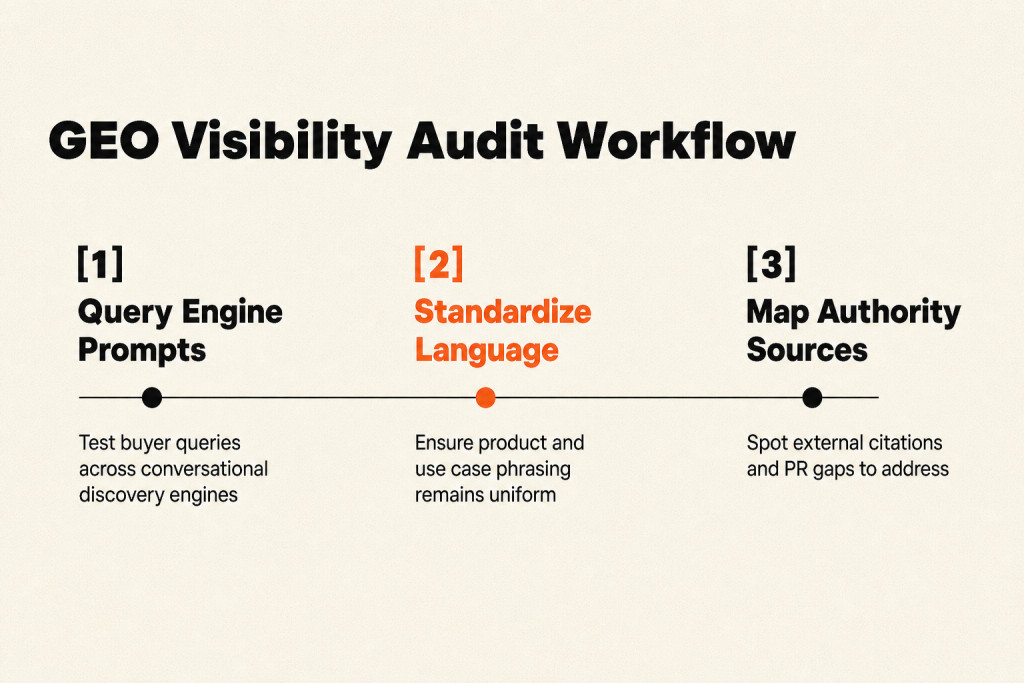
Run a visibility audit by moving through three checks.
- Search representative buyer questions in several answer engines; record whether your company, competitors, and third-party sources appear.
- Check whether important pages use consistent product and use-case language.
- Review the publications and expert sources answer engines cite, then identify authority gaps that digital PR and thought leadership should address.
Commentary from trade media, respected industry publications, and relevant journalists can strengthen search visibility and AI discovery. Since LLMs use outside mentions to build answers, digital PR belongs in your GEO plan.
FAQ pages and technical documentation are important resources for AI discovery. Group them by topic, then build one authoritative pillar around the main subject and supporting pieces around related subtopics. Add reciprocal internal links to tie the cluster together.
Buyer enablement
Buyer enablement gives buyers self-serve proof and resources to assess fit and build an internal business case without a demo. The buying group is bigger, and the buying cycle takes longer. Buyers expect to handle much of the process themselves before they talk to sales. What they need is useful proof that lets them judge fit and build an internal business case without a demo; piling on information won’t solve that. Comparison pages and first-90-day implementation guides address specific concerns, while Regulatory FAQs answer others. Show pricing, or make the next step to get it clear, and you’ll remove friction.
Short video tutorials and an explainer series can make complicated processes and product features easier to grasp. When software has a complex interface, interactive product tours can beat screenshots or feature lists during evaluation.

Test the site through the buyer’s eyes: can someone decide in under three minutes whether the product fits their situation? If they can’t, buyer enablement is falling short. White papers belong in the consideration phase and can bring in leads when they’re gated behind a download. Show the value before the form and ask only for essential contact details. Back up the benefit with real data and results. Letting people access assets freely widens reach and goodwill, but it gives up immediate contact details for outreach.
Gartner warns that weak buyer enablement can push brands out of consideration, turning it into a revenue problem in 2026.
Decision-support content
Decision support
Give decision-makers the support they need to weigh options, justify a purchase internally, and reduce the chance of a wrong decision. Another thought leadership piece repeating industry dynamics buyers already know won’t do that job. They need less inspiration and more practical help making the decision.
Depth over volume
Google, LLMs, and buyers now favor depth and specificity over volume, which matters for B2B digital marketing trends in 2026. Teams may get more from 15 pages that answer buyers’ real questions than from 50 blog posts that skim the surface. The formats performing in 2026 point in that direction, and fewer pages can carry more weight.
Reported challenges
B2B marketers report the top three content marketing challenges at 40%, 24%, and 23%. (Content Marketing Institute)
- Creating content that prompts a desired action, e.g., conversion (40%)
- Differentiating content from competitors (24%)
- Aligning content with the buyer’s journey (23%)
- Comparison pages: Answering when solution A fits versus solution B, these pages generate more qualified traffic than blog posts and honestly stack your product against alternatives.
- Implementation guides: Step-by-step explanations of how the project works convert better than feature overviews.
- ROI calculators: Built on honest assumptions, ROI calculators create more trust than polished case studies using vague metrics.
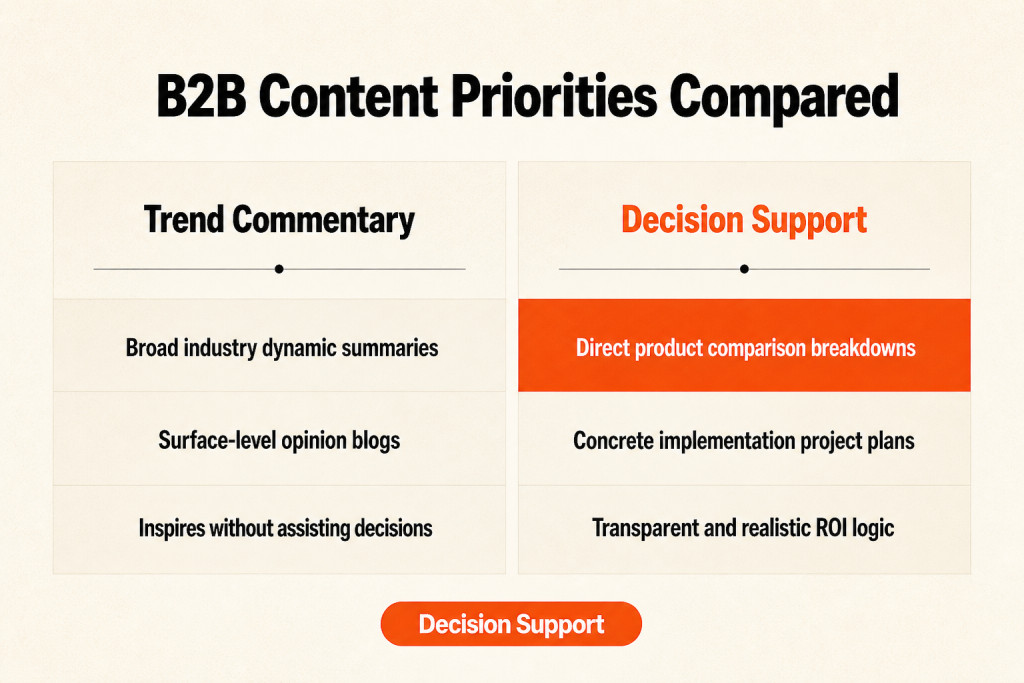
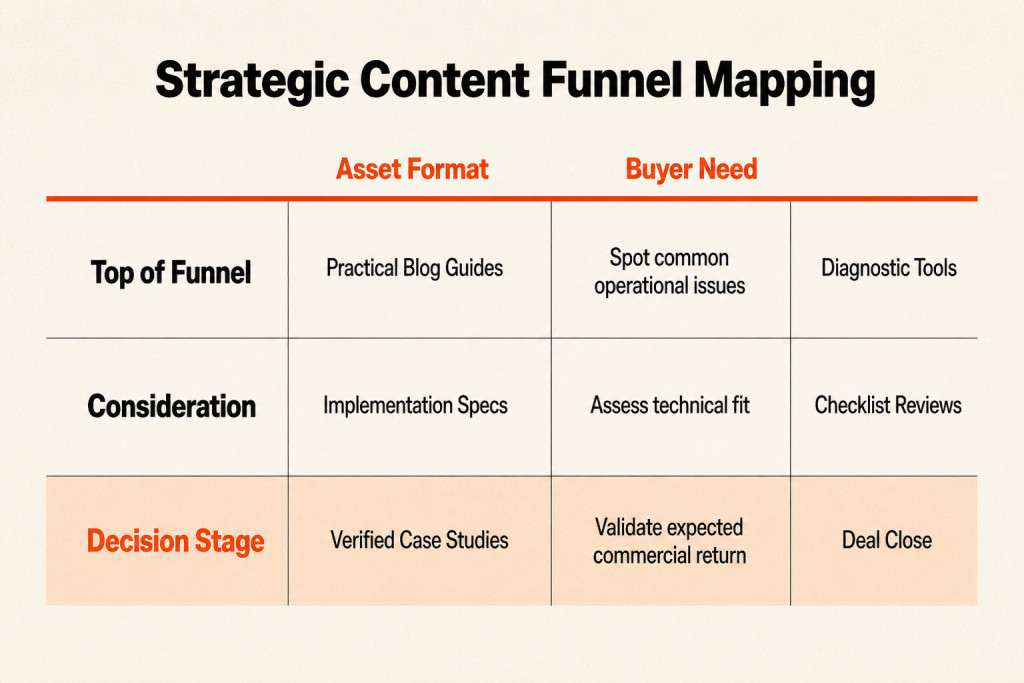
Decision-Support Formats by Funnel Stage
Buyers need different information at different funnel stages, so each stage calls for its own format; the examples below show how those pieces line up.
| Funnel Stage | Recommended Asset Format | Primary Buyer Objective |
|---|---|---|
| Top of the funnel | Blog Posts | Draw in new audiences with practical guidance, industry news, or solutions to common challenges; promote visibility, support SEO, and keep the brand front of mind with ongoing value. |
| Decision | Case Studies | Show the solution in action through real-life success stories so potential clients can see themselves in the customer’s situation. |
Start Top of the funnel with Blog Posts. Use Blog Posts for regulatory updates, such as regular guidance a science consultancy might publish on that subject. As prospects near a Decision, Case Studies can present real-life success stories and help potential clients picture themselves as the customer.
Comparison pages help buyers choose between options, while Implementation guides explain how a project will run; ROI calculators estimate its likely return. Each format offers a different kind of decision support. Together, they support lowering the risk of a wrong decision and help buyers understand how a project will work.
Strong B2B content marketing teams build content systems rather than isolated assets. A single topic can be adapted into a web page with substantial detail, a LinkedIn carousel, a short video explainer, an email sequence, and a sales enablement doc. Each piece can support a different buyer journey stage or speak to a different member of the buying committee.
Authentic practitioner content
Stronger B2B content assets rely on real voices and hands-on expertise, not generic volume. Crowded markets change what a multi-use topic has to earn. With AI, any B2B team can turn out five blog posts a day, and every other team can do the same. That leaves the web packed with generic pieces that all sound alike. The backlash against “AI slop” makes that standard more urgent.
Real employees on video bring a clear point of view where stock footage brings none. Podcasts give practitioners room for candid judgment instead of scripted talking points, while social posts reveal the untidy work of building a product rather than another polished corporate message.
First-hand surveys or industry analysis can produce useful material others can’t replicate, and respondents must match enterprise buyer profiles. Research-backed thought leadership should turn findings into actionable frameworks for decisions and challenge conventional wisdom. According to Marketer Milk’s 2026 trends report, premium advertising environments include creator-led YouTube channels alongside trusted independent newsletters and niche podcasts.

Thought leadership scaling
Scaling thought leadership means treating it as a business asset and turning employee expertise into distinctive reach. B2B thought leadership has broad adoption, with 96% of marketers saying their organizations produce it, yet only 7% call their programs advanced and 4% leading. LinkedIn at 76%, email newsletters at 54%, and speaking events or webinars at 52% are the leading distribution channels.
Internal participation remains thin: among employees with specialized knowledge, 37% report minimal participation and 30% report limited participation; only 18% describe their involvement as substantial or widespread. Sure, producing more content sounds like the obvious fix. But employee-shared material tied to specific roles can reach professional networks with greater authenticity and trust than corporate posts alone. Build for distributed expert participation.

At 80%, audience engagement is the most tracked measure; business impact follows at 63%, while brand authority stands at 38%. Pacesetters more often track commercial results (75%) and brand authority (51%), making their figures useful benchmarks for comparison. A scalable program ties activity to direct business impact, so leaders see value beyond content volume or surface-level response.
Experiential marketing
Experiential marketing is seeing budgets climb even as maturity lags. 78% of B2B marketers put money into it, but only 30%, less than a third, call their efforts established. Most spending remains modest, with 40% putting 1 to 10% of spend here. Engagement leads the scorecard at 70%, so attendance and participation still outrank business results. Measurement hasn’t caught up yet.

Experiences are making a stronger investment case by joining digital and physical interactions that build trust and loyalty. Virtual events widen reach and speak to audiences directly. Looking to 2026, planned spending puts AI-powered marketing tools first at 45%, with experiential marketing next at 33%.
Overall, shorter sales processes show up for 51% when deals include experiential touchpoints; Pacesetters report 53%. Treat each experience like an accountable product tied to outcomes, not a headcount contest. Turn webinars and long-form resources into posts, snippets, and videos. Pacesetters measure sales-timeline effects at 89%, compared with 73% overall.
Interactive content formats
For years, B2B’s AR, VR, and interactive formats seemed distant; in 2026, specific use cases are moving beyond the proof-of-concept stage.
B2B campaigns are adding game-like elements through interactive assessments such as “Evaluate your security posture in 5 minutes” and configurators such as “Build your ideal tech stack”; challenge-based formats draw engagement that passive content can’t match. First-party data is the natural byproduct, and these tools tie directly to the privacy-first strategies covered earlier.
The tools behind these experiences have matured, too. ZapWorks, Adobe Aero, and WebAR frameworks now let mid-market companies, not only enterprises, build immersive experiences without massive budgets of their own.
Infographics turn dense stats or processes into visuals people can take in quickly. On LinkedIn, their popularity helps busy decision-makers understand prevailing benchmarks and important trends at a glance.
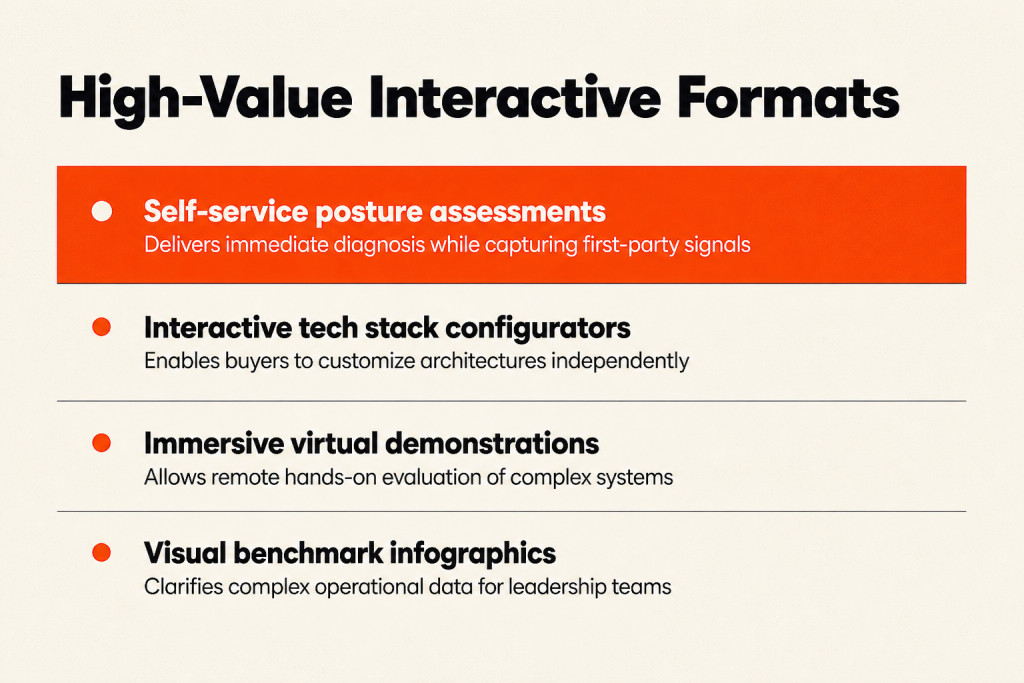
Self-service assessments
Self-service assessments give buyers concise, persona-specific tools to evaluate their needs. Processes can also be simplified into graphics.
- Adapt Research Reports for Multiple Formats: Turn your single research paper into bite-sized assessment tools or podcast episodes, with each format aimed at different buyer personas.
Immersive product demonstrations
Complex product demonstrations are where immersive content often makes the clearest case. A prospect evaluating industrial equipment, construction technology, or enterprise hardware can interact with the product virtually before buying or scheduling a site visit, meaningfully shortening sales cycles.
Videos give prospects a fast visual read on an offer, whether they show product demos, feature expert interviews, or walk viewers through service processes.
Paid LinkedIn amplification
Build a dependable set of LinkedIn formats to anchor organic reach, even as that reach declines. Put budget behind your strongest posts through targeted promotion, conversation ads, or Sponsored InMail, because paid distribution and earned credibility work better together. Retarget visitors with case studies and comparison content aimed at company or role audiences. Point each campaign to a purpose-built landing page with one clear next step, not a generic homepage. Employee advocacy remains limited: reported participation is 30% at 5-15%; 15% at 16-30%; 8% at 31-50%; and 10% above 50%.
Specialized marketing teams
Generalist marketing skills
Employee advocacy participation remains limited, and that’s pushed the bar for acceptable execution almost to the floor. Anyone can ask an AI assistant for decent copy or a basic landing page, then request an ad campaign. Generalist marketing skills are quickly becoming commodities.
Specialist value
Come 2026, specialists with deep pattern recognition in a specific discipline are gaining value. Their edge shows up in how they work with AI: domain knowledge shapes how they frame questions and review output, as well as the custom workflows built from hard-won expertise. They ask better questions and catch weak output, helping AI amplify their judgment.
No-code AI tools

No-code AI tools let marketers build early versions of landing pages and campaign workflows, as well as internal tools, without waiting on engineering. Those prototypes are turning marketers into part-time product managers.
Domain expertise
An SEO professional who’s worked through hundreds of B2B website audits knows which problems deserve attention and which “best practices” can make things worse. A paid media specialist with millions in LinkedIn ad spend can spot waste that a generalist using AI tools may miss.
Industry experience
When you assess marketing capability and consider hiring a dedicated Content Marketing Agency, look for a track record of delivering content across law firm content marketing and sectors such as technology and financial services. For regulated sectors, check their familiarity with compliance requirements.
Strategic funnel alignment
Business foundation
Build effective b2b content marketing strategies around business goals, so each piece has a job rather than adding to the blog pile. Define the content’s purpose and audience, then show how it backs the company’s wider vision.
Cross-functional alignment
Sales and marketing need a shared direction supported by leadership. A focused content plan should tie each asset to a funnel stage: awareness, consideration, decision, or post-sale loyalty. Without that link, the pieces start pulling away from one another.
Funnel stage mapping
Choose formats based on the account’s current situation; diagnostic worksheets and implementation checklists address buyer questions that migration specs address differently.
- Internal operational bottleneck: Offer diagnostic worksheets while an account is still identifying the problem.
- Alternative evaluation: Provide transparent implementation checklists and migration specs while an account is vetting alternatives.
Content creates business results when it fits the wider strategy and the funnel stage. Decide what each piece should achieve, then place it where it can support that outcome. Begin with the outcome and map the asset afterward.
Business objective integration
Business Goals: Leads, Conversions, and Awareness
To determine whether content is raising awareness in new sectors, check dashboards for topics and formats that attract and engage your target audience there. Assign every piece a clear, measurable job against these goals. That job needs a measurable result.
A lot of B2B teams still lose this connection. DemandScience commissioned research reported by Demand Gen Report found that senior marketing leaders estimated 25% of their budget went to campaigns that scored well on campaign measures but failed to drive revenue. That was their estimate, not a finance team’s audit. Meanwhile, 76% said they produce content without tying it to a data-driven strategy, while better-connected data, signals, content, and orchestration could unlock 32% in additional annual revenue. Setting objectives and tying measurement to revenue goes beyond keeping reports tidy.
Open content performance dashboards to see which topics and formats attract and engage your target audience. Regular reports give stakeholders measurable figures for lead generation and ROI against set targets.
Why Depth Matters Across Your Content Strategy
Topic cluster architecture organizes related content around a focused subject to build depth rather than breadth. Depth over breadth shapes decisions about content, team makeup, channels, and AI rollout alike.
Multi-format content repurposing
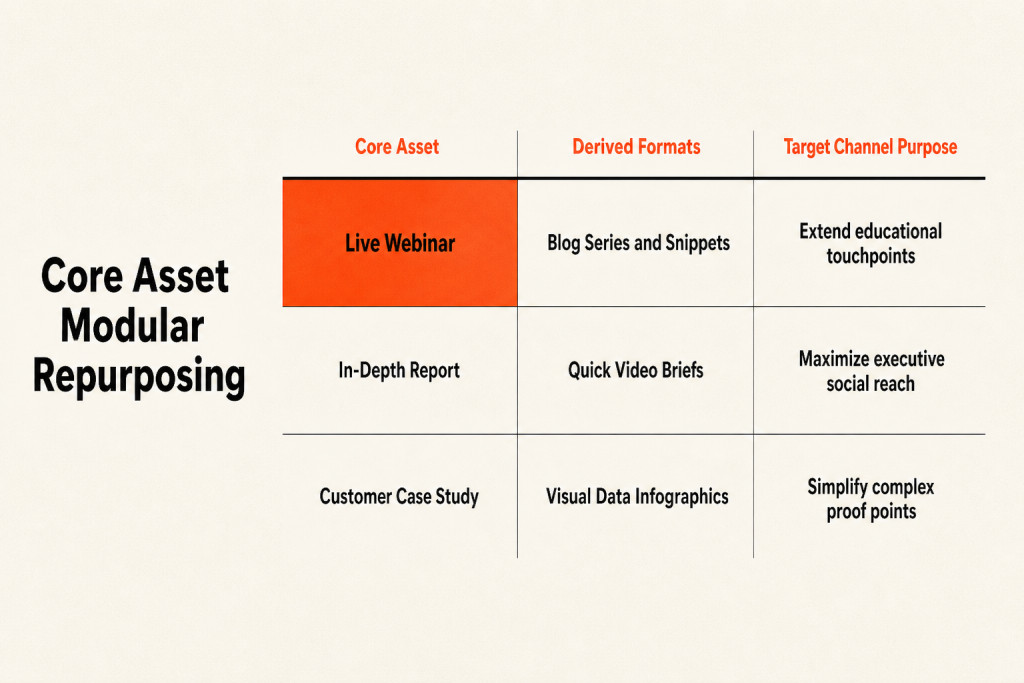
One topic can travel across several channels while teams build authority and reach. A single Webinar might fuel a blog series, infographic, and social snippets, so the original material finds more readers without demanding the same effort each time.
Modular asset distribution
Rework one source asset into formats built for each channel and its job.

| Pillar Asset | Derivative Modular Format | Target Channel & Purpose |
|---|---|---|
| Webinar | Blog series, infographic, or social snippets | Reach more people with less effort |
| Long-form resources | Short, shareable videos or quote graphics | Maximise distribution |
| Case Studies | Visual infographic | Support quick reads and sharing on social platforms |
Video content adaptation
These creative tools and formats round out the content mix:
- Creative asset tools for generating and editing images, videos, and visual materials (53%)
- Video (15%)
Visual asset transformation
Turn a detailed success story into a visual infographic, converting Case Studies into material for quick reads and sharing across social channels.
Key takeaways
Fundamentals first: these are the key choices teams can make to strengthen business basics while giving AI a more deliberate role.
- Build fundamentals before adding more prompts: Teams winning in 2026 are doing more than playing with prompts, churning out more content, or managing to the algorithms. They build stronger muscles in marketing fundamentals, then let AI bring more creative life to those efforts.
- Choose strategy over scale: Sure, more budget is the obvious lever. But the biggest driver of improvement was refining the plan: fewer random acts of content and more coordinated direction.
- Treat technology as an amplifier: New tools, including AI and automation, were credited by 51% as a contributing factor (behind good old-fashioned strategic refinement). Tools do not create strategy; they amplify it.
- Invest in skilled marketers: Better technology will not save mediocre teams. Without skilled, empowered marketers, AI only makes mediocrity faster, louder, and more efficient.
- Rebalance the mix: Fund what you control, including owned media and experiences, and manage those areas like products. Give them charters, roadmaps, and outcome metrics beyond asking whether people showed up.
- Make AI deliberate: Move past faster drafts by choosing a few high-value use cases, such as predictive insights, smarter routing, and agent automation. Set guardrails and measure performance lift, not volume.
- Focus on first-party data: Put governance before use cases, remove vanity gates, and connect the signals already available through CRM and behavior. Use those signals for trust-building personalization, not creepiness.
Frequently asked questions
Which B2B content marketing trends 2025 matter most?
The 2025 priorities include AI-powered marketing tools, events and experiential marketing, owned media, and investment in human resources. First-party data sets the direction. The 2026 mix brings together agentic AI for campaign operations, GEO/AEO, self-serve research support, first-party data strategies, and Marketing Mix Modeling, where the budget tells the story. The priorities are clear.
- AI-powered marketing tools: 45% on generative AI and predictive analytics
- Events and experiential marketing: 33%
- Owned media: 32% on content assets, website, blog, and email
- Human resources: 9% on salaries, training, and development
How is AI changing B2B marketing in 2026?
B2B marketing is shifting through autonomous campaign workflows, LLM-led buyer research, and AI-created content, which makes authenticity and specialist depth matter more. The volume keeps climbing.
Autonomous workflows
Agentic AI now handles campaign planning and execution, then tunes performance through autonomous workflows instead of isolated tools. That shift already feels overdue.
Primary research channels
Large language models are becoming channels for primary research, making GEO visibility a key priority for B2B buyers.
Volume explosion
AI-powered creation is driving a volume explosion, which puts more weight on authenticity and specialist depth.
Our findings show that 95% of B2B marketers use AI-powered applications, while 12% of content creators say AI lowered quality. The number is 12%.
Why does Generative Engine Optimization matter for B2B?
Generative Engine Optimization, or GEO, helps AI systems discover, understand, and cite brands across the AI interfaces of ChatGPT and Perplexity, as well as Google’s AI Overviews. That’s the new discovery layer.
Google is speeding up the shift as buyers turn to LLMs for purchase research. If AI-generated answers leave you out, pipeline can suffer before standard marketing numbers show it.
How should B2B companies prepare for the end of third-party cookies?
B2B companies should collect first-party data, using content and tools to invite voluntary sharing while pairing audience-based approaches with contextual targeting. The cookieless marketing strategy is fairly practical.
Clean CRM records, subscription preference management, and privacy-transparent communication with prospects all sit inside the cookieless marketing strategy.
- Data quality or compliance issues (24%)
- Data management complexity challenges (21%)
- Resource constraints for collection/maintenance (13%)
What is Marketing Mix Modeling and why is it relevant for B2B marketers in 2026?
Marketing Mix Modeling ties total marketing spend to revenue and pipeline, showing which channels produce results. It’s a statistical method, not a fresh dashboard label.
MMM matters to B2B marketers because privacy rules, cross-device fragmentation, and walled gardens have weakened old multi-touch attribution.
How can B2B brands build trust with buyers in 2026?
Trust grows from independent research, third-party validation, real employees, honest perspectives, and transparent data practices. It’s a short list, but every item has a job.
Buyer enablement
Buyer enablement lets prospects handle their own research before sales enters the conversation too early.
Third-party validation
Influencer and analyst relationships give buyers the validation they use to judge a vendor; LinkedIn reaches 76%.
Authentic content
Real employees and honest perspectives reveal the people and thinking behind the brand to buyers.
Data practices
Transparent handling of data helps preserve trust throughout the buying process.
That trust still has to hold through the buying process.
Conclusion
A strong B2B content strategy now links AI discovery and execution with human proof, reflecting the latest b2b content marketing trends. The useful work happens where those pieces meet: first-party data people willingly share, GEO content AI systems can read, self-serve research support, and evidence from employees alongside analysts and influencers. Track spend with Marketing Mix Modeling when attribution breaks down, then watch the numbers already available. More content by itself isn’t the operating plan. Start by choosing one priority buying decision, then map the discovery, self-serve support, and human evidence your team can put behind it.