
Account-based marketing for B2B starts with accounts that can change the business.
Revenue doesn’t come from every company in a B2B funnel. It comes from winning accounts that can change the business. Leads still sit in the funnel, but those wins bring customers and revenue forward.
With ABM, teams ask a different question: instead of counting leads this quarter, they choose twenty, fifty, or five hundred companies that could become customers and move revenue, then plan the attention and coordination those accounts need.
The working list can include twenty, fifty, or five hundred companies.
Begin with accounts that can change the business, then give them the attention and coordination required to move forward. That’s the ABM shift (the lead count alone isn’t the whole job anymore).
The key decision is which companies can move revenue if they become customers. For B2B teams, that means trading a broad lead count for a focused list of twenty, fifty, or five hundred companies, then giving those accounts the attention and coordination needed to move forward.
Account-Based Marketing for B2B Tiers
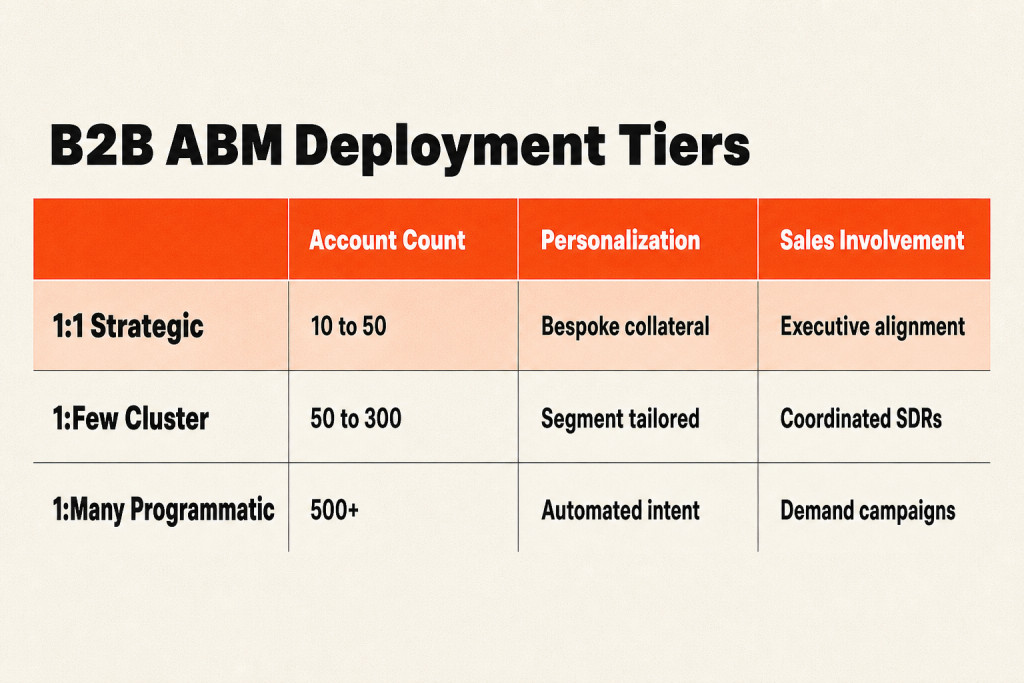
Different accounts need different levels of spend. A tier decides the personalization, budget, and sales involvement each account gets, so choose the tier first.
Strategic One-to-One Marketing
Must-win accounts usually number ten to fifty companies, with company size shaping the range. Each account gets an individual strategy, tailored materials, a designated account executive, and often executive-to-executive contact. One win can move the quarter, and this tier gets the most resources.
Cluster One-to-Few Marketing
Which accounts have similar industries, technology environments, regulatory demands, or jobs to be done? Group those accounts together, create the strongest campaign for each cluster, then make light account-level changes across usually fifty to a few hundred accounts. Personalization still has a ceiling.
Programmatic One-to-Many Marketing
Picture the broadest reach: the one-to-many tier often covers five hundred accounts or more. Automated programs, intent signals, and AI-assisted tailoring keep messages relevant without requiring every touchpoint to be built by hand, although the work still resembles demand generation. Targeting remains account-based.
Strategic One-to-One Marketing
Major opportunities may earn strong executive support through custom campaigns, but those campaigns demand concentrated operational effort and cannot expand across a large volume of accounts.
For one-to-one accounts, dig into strategic priorities, competitive position, technology, organizational structure, and the influence of people involved in the purchase, from the company’s perspective. Identify stakeholders, influencers, and blockers along the way.
Use that digging to answer questions such as:
- What are the company’s top strategic priorities for the next year and the next three years?
- How is the company performing against its main competitors, and why?
- What would a SWOT look like from the company’s perspective, and where does your solution fit?
- Which technologies and tools does the company use, and how does your solution fit with them?
- What are key executives saying in the press and in conference keynotes?
- How is the company structured across LOB and Geo, and is it centralized or decentralized?
- Who are all the stakeholders, influencers, and potential blockers?
- Have there been recent leadership hires or exits? Which key roles is the company filling or trying to fill?
- Who is active on social media, and who blogs? Find them, follow them, and learn from them.
Then turn those answers into an account plan covering:
- Where are we with the account today?
- Where do we believe this can go in a year, in two years, and in five years?
- What stands in the way?
- How will we know we are making progress?
A 1:1 campaign can use a bespoke microsite and demo. After the team names a high-value target, it builds that account’s microsite as a digital front door. The headline includes the company name, and the copy speaks to challenges that account is known to face.
The page connects the product to those challenges, then adds a customized demo video showing exactly how it handles the account’s unique needs. That tailored introduction handles the first round of sorting.
Under the video, show the account’s pain points and then add relevant social proof. The sequence gives buyers recognition, “we get you,” followed by reassurance, “we’ve solved this before.”
These microsites keep producing results. One recent campaign drove:
- Average on-page time: 5.6 minutes.
- 70+ visits since launch.
- 150+ interactive demo views.
Those engagement numbers show what the format delivered.
Cluster One-to-Few Marketing
For each cluster, research should identify:
- What key changes are affecting the cluster?
- What are the biggest threats facing it?
- What are the biggest opportunities it can exploit?
- Does it face a common behemoth competitor?
Custom built landing pages
Campaign type: Focused acceleration (1:Few).
Use audience-building functionality to narrow the account list for personalised landing pages. Start with the target accounts, then shape each page around the companies on that list.
Open with a value-led, highly personalised headline above the fold and use a proven page structure. Once the page is live, test and iterate from engagement and ad results. Keep it moving.
AI can speed the landing-page digging by finding a company’s business model, strategy, direction, and competitors. Using a landing page marketing CustomGPT, the team reduced creation time from 3 hours to 30 minutes.
Programmatic One-to-Many Marketing
Programmatic ABM reaches ICP-matched segments through paid media and content hubs, while programmatic paid media builds awareness across those same segments.
In one test, the team changed the homepage hero, a key entry point for many target segments even though it wasn’t a dedicated ABM page. The new message addressed mid-market scale-ups directly, replacing the generic headline. The homepage hosted the test.
Against the original, the new variation lifted conversions by 777%, raised conversion rate by a 14% sustained lift from 1.36% to 1.55%, and increased average session length by 12-58%. The team had its answer.
The numbers showed what changed, and surveys asked the ICP what drove it. “Ambitious scale-ups” struck respondents as unclear or overused, whereas “high-growth” landed better.
Respondents also considered “book a demo” too restrictive, since many wanted self-serve options. Some said the message didn’t clearly differentiate the solution for marketing buyers.
Hard numbers and direct ICP feedback exposed both the “what” and the “why” behind the engagement shifts. The team used those findings for new iterations, keeping the message relevant and impactful rather than stale.
Blended Tier Deployment
Teams with a real ABM strategy often run all three tiers together. A small strategic tier gets white-glove attention, while a broad programmatic tier captures good-fit accounts that don’t yet justify one-to-one investment. The tiers can operate side by side.
Only one type of ABM is deployed by two third of companies.
Treat the tiers as a spectrum, not silos. An account can move up or down as its engagement changes.
- Focused acceleration (1:Few): Custom landing pages, tailored SDR outreach.
- High-stakes deals (1:1): Personalised gifting, executive webinars, account-specific ads.
Run a pilot before funding the full tier rollout. A small account group, often from future tier one or tier two, can trial messaging, workflows, and sales coordination before the full budget covers all three tiers. Start with the pilot.
Ideal Customer Profile Development
Building your ICP starts with industry, company size or revenue, geography, and technology, which together show which companies are most likely to benefit from the solution. Since ABM takes time and money, aim at large businesses with deal sizes typically over $20k.
Don’t lean on generic intent data alone; stack signals instead. Combine firmographic fit with hiring activity, leadership changes, and intent spikes to identify accounts most likely to convert. That gives SDRs and AEs a clear reason to decide which accounts deserve priority.

Check the profile against closed-won and closed-loss opportunities. Accounts that converted can show high-value patterns, while lost opportunities may flag churn risks and show why missed accounts failed to convert. Comparing both sides tests whether the proposed ICP matches actual results.
With that market view validated, map the addressable market through the TAM SAM SOM Model; CRM data can also identify potential high-value accounts. CRM then helps build a focused account set in order to support the ABM strategy. Demand generation targets the whole market, while ABM begins with a specified group of named accounts.
Target Account Selection
Sales leadership should be involved before launch. Then work with sales to pick accounts worth winning and worth having, using firmographic and technographic data, sales judgment, and AI technology to sift through customer data. Start with sales.
Sales and demand teams should work from the same CRM account lists, then rank those accounts by fit and buying signals. Fit shows product match; buying signals show inclination to purchase. Recency and engagement point to active evaluation. Educate high-fit, low-signal accounts and build familiarity, while sending accounts with rising signals and active engagement straight to sales for outbound follow-up.

Most clients use 1-to-Few ABM, usually 20 accounts with about three decision-makers each; the third sizing scenario shows one €10k win, 20 pilot wins worth €200k, a 5% win rate, and 400 accounts needed.
| One win | €50k | €1m | €10k |
| Pilot win | 10 for €500k | 3 for €3m | 20 for €200k |
| Estimated win rate | 10% | 15% | 5% |
| Accounts needed | 100 | 20 | 400 |
A list that’s too large spreads personalization thin and weakens ABM. Start with a tight, well-vetted set, prove the model, then scale.
Buying Committee Mapping
The 1-to-Few model still needs the full buying group in view. Complex B2B deals usually land with a committee, not one buyer, because the logo itself doesn’t sign the contract. ABM focuses on the individuals within an account, rather than its logo alone.
That group may include an economic buyer, technical evaluator, end-user champion, procurement, legal, and an outside consultant. Buying-group studies put the usual B2B purchase at around ten people. The typical B2B Decision-Making Unit includes 6.8 buyers, which turns staff inside the account’s market into potential clients.
Decision-Making Units
After you’ve built the target-account list, start the Decision-Making Unit Canvas. Then match every member to contacts within each organization you’re targeting.
The committee may hold economic buyers, technical evaluators, champions, and blockers. Map the priorities, objections, and role-specific content tied to each person.
Match content to both the account tier and the person’s committee role. Economic buyers may want ROI material, evaluators technical documentation, and functional leaders peer case studies.
When content reflects personal needs, DMU members are 40% more willing to purchase from a vendor. The research boils down to two questions.
- What motivates everyone who would have an input into purchasing your product?
- How can you reach each person with messaging that makes them want to buy?
ABM also calls for a discovery phase with the sales team, bringing in senior and junior members. Have the team walk through the current sales cycle in detail, because the CRM version rarely tells the whole story.
That walkthrough should cover the current steps and phases, blockers and objections, customer timescales, the shape of the customer journey, and the time between initial inquiry and conversion. Together, those details show the current sales path.
Committee Coverage Scoring
Account coverage tracks how many genuine decision-makers in the committee you’ve reached. Put simply, it tells you how many of those decision-makers are receiving your outreach.

Connect account engagement to pipeline impact with a small set of practical measures. Review each account monthly.
- Engagement depth: Who is interacting with ads, emails, and content?
- Meeting conversions: Is interest creating real sales conversations?
- Pipeline movement: Are opportunities progressing faster?
Bring those measures to an ABM forum monthly, with marketing, SDRs, AEs, and ops at the table. Make the forum a cross-functional working group.
Multithreaded Outreach Cadences
Relying on one contact leaves an enterprise deal exposed. If that champion changes jobs or gets overruled, the entire deal can collapse like a bridge held up by one failed cable.
The win-rate evidence makes a case for moving beyond single-threaded opportunities. One contact leaves the deal resting on that person, while several committee contacts can raise account responsiveness over single-contact prospecting.
One analysis records win rates rising from 5% for opportunities with one thread to 30% when five stakeholders were engaged, a 6x difference in an illustrative comparison as of 2026.
Bring several contacts and B2B marketing channels together in one coordinated multi-touch launch for the account.. Schedule an email, LinkedIn ad, mailed note, and one-to-one phone call so all four touchpoints land during the same week.
Accounts reached this way report meaningfully higher engagement and faster pipeline movement than those reached through one channel. Keep the channel mix coordinated.
If Sales wasn’t interested last time, shift the outreach to Marketing or Finance. Tailoring the message to the function keeps the door open.
Send these messages through carefully planned nurture sequences. Personalise every email, and make sure the rep’s note adds value instead of crowding the inbox. The goal is a relationship between the decision-maker and the assigned sales rep. The rep’s message should provide value rather than clutter the inbox. This dependency resembles a bridge suspended from one cable.
That contact may come through paid ads, cold calling, or a landing page.
Campaign Strategy Formulation
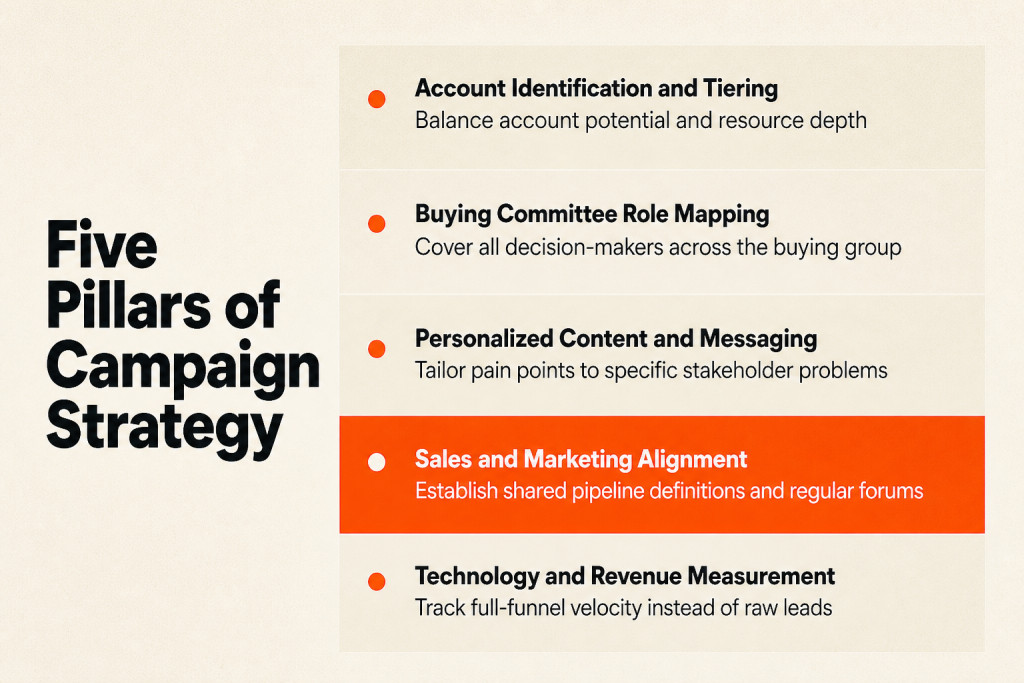
Five connected pillars support a sound B2B digital marketing strategy, yet skipping even one can quietly pull the whole programme apart.
The pillars are:
- Account identification and tiering.
- Buying committee mapping.
- Personalized content and messaging.
- Sales and marketing alignment.
- Technology and measurement.
After the objectives are clear, the team needs a plan for reaching them. In most cases, that plan takes the form of an ABM programme overview.
Every client-facing team needs to help build the plan, working together to decide how they’ll reach the destination they want.
Growth Matrix Alignment
When the targeted organisation is treated as the market, the Ansoff Matrix can help establish the strategic direction for an ABM strategy from the outset.
The intended outcome should set the direction:
- What do you want account-based marketing to achieve?
- Is ABM being used to launch a new product?
- Is the target a new market?
- Are you trying to upsell existing B2B customers?
Prospects aren’t the only fit for ABM; existing customers can enter the plan when the aim is to build and nurture lasting relationships.
Spending on retention can lift the odds of repeat purchases, upsells, cross-sells, and subscription renewals. ABM is also expected to put more focus on cross-selling, upselling, and other retention work.
Relationship Milestones
Pipeline movement offers a relationship milestone worth watching: are opportunities moving forward faster?
Genuine engagement matters most as an ABM advertising metric, and Account based engagement needs more depth than a tally of who clicked what or downloaded what. A stronger signal comes from time spent on particular parts of a particular document.
Content Personalization
Start with the account and its lead decision-maker, then widen the lens to the buying group’s separate concerns. Personalised account content should draw on the account’s own context, not generic copy; the useful details are already in the deal. Personalised account content should draw on the account’s own context, not generic copy; the useful details are already in the deal. Build an ROI model from the target’s numbers, or pair B2B digital marketing case studies from a close industry peer with a technical walkthrough covering the integration questions that matter to engineering. This educational material should build trust and create demand by explaining your solution’s value clearly enough to convince other stakeholders. Keep every piece specific.

AI and automation can compare what target accounts have in common and where they differ, then recommend content and experiences likely to appeal. Test those recommendations before trusting them. Try different value propositions and content to learn what converts; sales and promotion teams should share supporting statistics and testimonials, using the same terminology. Feedback and facts make the case for the solution and build trust.
Tailor the message to each social channel, and make one-off material for specific needs instead of pasting generic copy everywhere.
Execution Management
At the start, run a small pilot with a shortlist of high-value accounts. Sales and customer service can identify shared traits among the strongest targets and use their pain points to shape messages. Review the results together, then test which messages and outreach get a response so you know what to carry forward later. Turn those findings into useful personas and scale only where the evidence supports it.

As the program grows, keep each account’s experience joined up across email, social media, digital advertising, and tailored web pages. Layer CRM data into the setup so sales and marketing can see the full record of account interactions in one place.
Keep tracking what lands, put more effort behind it, and change what falls flat. Team alignment still matters, while over time analytics and AI can help the team work more efficiently as the program matures. Keep the work responsive to what you learn.
Performance Measurement Frameworks
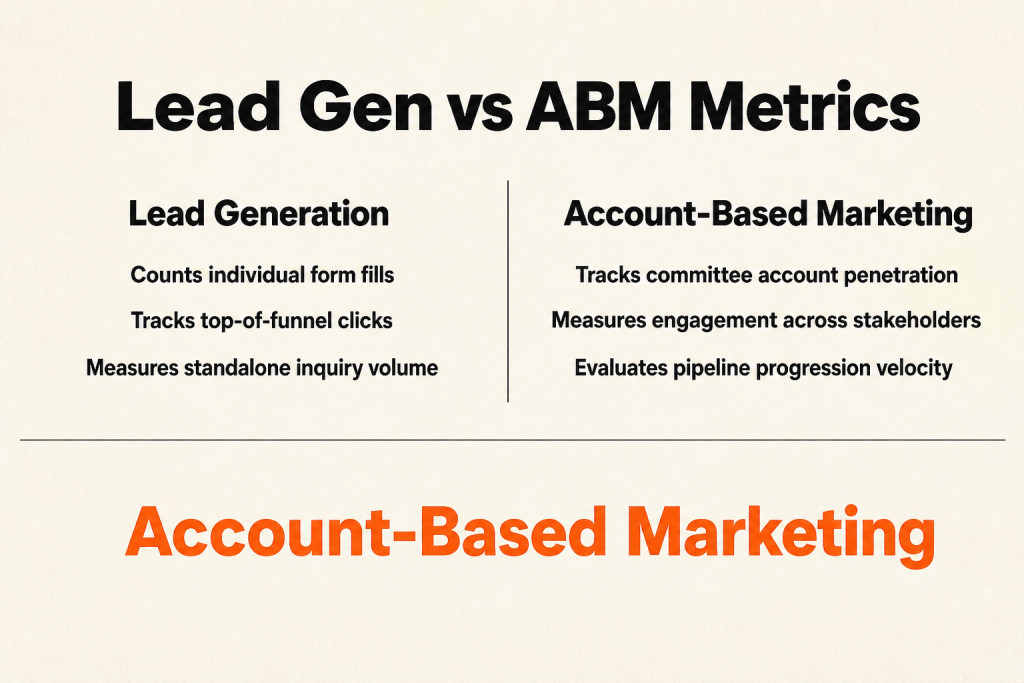
Because ABM runs at the account level, its numbers look different from the B2B marketing metrics most teams reach for first.
Clicks and impressions offer some context, but they can’t show much about program performance alone; better measures connect activity with revenue from priority accounts.
Measure account engagement and pipeline impact using four measures:
- Penetration: How many decision-makers are we reaching?
- Engagement depth: Who is interacting with ads, emails, and content?
- Meeting conversions: Is interest turning into real sales conversations?
- Pipeline movement: Are opportunities progressing faster?
A B2B Decision Making Unit includes 6.8 buyers on average. Build account-level dashboards, then define “engaged account” and “account progression” before the first campaign launches, not afterward.
Account Engagement Scoring
An account engagement score brings activity from every channel into one view of account warmth. It covers site visits, content consumption, email replies, ad clicks, and event attendance.
AI can give teams more room for deeper, more creative strategy within the ABM mix. It prioritises the best leads without extra analysis, improves results, and makes the team’s work easier.
AI-powered behavior scoring examines prospects’ behavioural patterns, then gives scores that prioritise accounts for nurturing and sales engagement.
Companies have turned behavior-scoring insights into selection rules and contact points, producing as much as 2,500% ROI.
Pipeline Progression Velocity
As of 2026, illustrative data links reliance on buyer intent with sales cycles shortened by roughly 30%.
Track the time from deal to close as a core ABM KPI, then check the percentage of deals closed to confirm gains in velocity.
Relevant, personalized content shown before a rep reaches out means the prospect conversation starts further along.
Technology Stack Architecture
Account identification and tiering come first, followed by buying committee mapping. Start with those pieces.
Personalized content and messaging run alongside sales and marketing alignment. Together, they connect the work.
Technology and measurement finish the connected capability set.
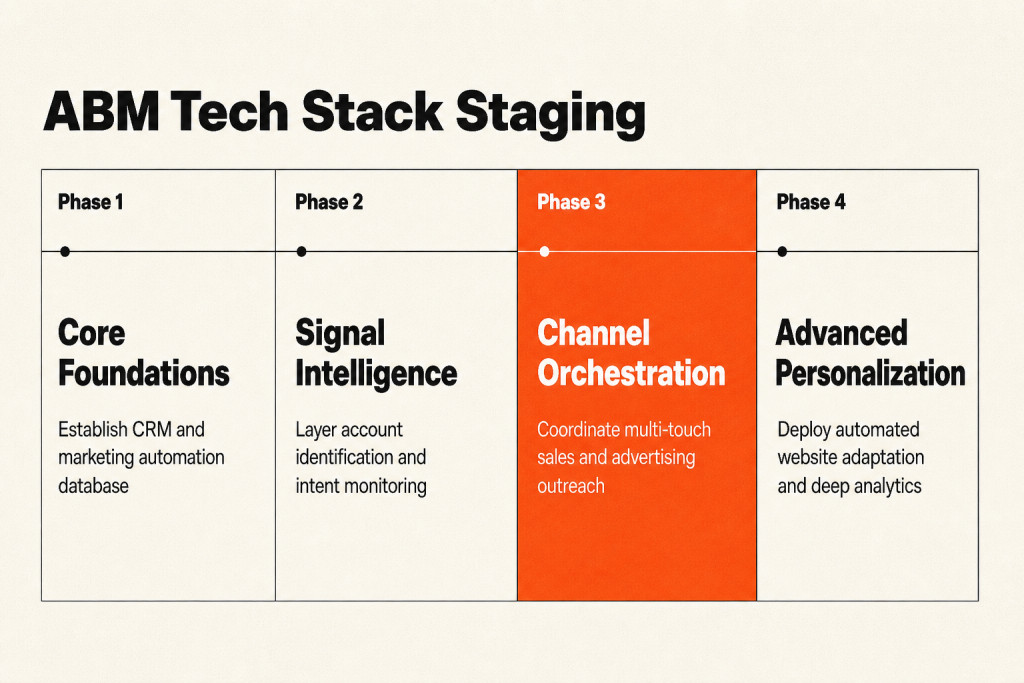
CRM and B2B marketing automation form the base layer before anything else is added. Intent data providers and ABM engagement platforms extend it, with orchestration tools connecting signals to action, while reporting tracks account-level outcomes.
Technology marketers at firms with annual revenue of at least $100 million devote, on average, 21% of their total marketing budget to ABM programs.
Customer Relationship Management Platforms
A CRM stores and manages customer data, including what sits on top accounts, so teams can create the personalised experiences ABM depends on.
CRM dashboards bring customer interactions and other data into one centralized location. Marketing channels and teams can use that shared view to keep branding consistent and high quality.
Account Identification Platforms
Marketing automation and artificial intelligence can automate parts of ABM, including account identification and buyer engagement.
Using advanced algorithms and data analytics, ABM platforms sort and segment accounts. They rank target accounts according to organizational scale, sector, expected revenue upside, and past interactions.
Intent Data Monitoring
Because generic intent data is only a blunt instrument, build an ICP-first scoring framework.
Teams often mistake third-party intent surges for immediate purchase readiness. The spike may reflect non-purchase activity, such as casual curiosity or competitor analysis, and may even come from student research.
Web Personalization Systems
Once you know an account’s challenges, show how the product can solve them.
Technology Maturity Staging
Make CRM and marketing automation the base layer, rather than adding them later on day one. Intent data providers and engagement platforms can extend that foundation afterward, with orchestration tools doing the same.
Buying an expensive platform before the target list, committee research, and sales alignment are solid usually wastes the tool.
Buy ABM technology before the process exists, and expensive tools end up running against a weak strategy.
Teams can do ABM without technology. While they learn and roll out ABM, they shouldn’t rush into tech stack decisions. Regular meetings between sales and marketing can establish a plan for each account, while CS can help teams use the knowledge they already hold.
Common Execution Pitfalls
But ABM keeps tripping over the same weak spots, and each one calls for its own operating discipline; lists and definitions rebel.
Departmental Silos
Before launch, sales and marketing can drift apart when they work from separate lists or can’t agree on what qualifies as a good account.
At just 36% of companies using ABM, sales and marketing are tightly aligned. That alignment takes deliberate work; nobody simply inherits it.
Unmanageable List Sizing
Execution quality starts to thin out once the list grows too large. A focused list of a hundred to a few hundred accounts, managed carefully, reliably beats a sprawling list handled shallowly.

Superficial Personalization
Sophisticated buyers need more than a company name to be persuaded. Make your message point to a specific market position, recent announcement, or technical stack.
Exclusively Digital Outreach
ABM should include offline activity too.
Meeting people at events or face to face still matters, and it can help you build a solid relationship with a potential client.
Premature Software Procurement
The technology stack starts with a CRM: it uses it to collect and manage customer data.
Decision-Making Unit Omission
On average, 6.8 buyers make up the B2B Decision Making Unit. Omit members of that group, and the purchase decision can go unaddressed.
Target Account Email Blasting
Picture a generic blast landing while target accounts remain on the send list. That undercuts the personalized experience ABM is meant to deliver, so target accounts should be suppressed from broad sends.
Fundamentals of Account-Based Marketing
ABM treats chosen companies as separate markets, with sales and marketing aligned around the people who matter inside each one. Results are tracked by account.
In this B2B go-to-market model, sales and marketing pick a defined group of high-value target accounts together. They run coordinated, personalised campaigns to win and grow those companies, rather than throwing a wide net and working through whoever answers. The account is the unit of work, not the lead, and ABM handles each one as a “market of one” for campaigns, buyer experiences, and account needs. Use B2B data to build highly personalised campaigns and buyer experiences for each account. Focusing on a small set of specific accounts and their needs pulls sales and marketing into closer coordination.

Core Definition
Sales and marketing join forces through account-based marketing to build ultra-targeted campaigns for chosen accounts. Progress is measured at the account level.
Fundamental Mechanics
ABM focuses on the people within an account, rather than its logo alone.
Frequently Asked Questions
How does ABM work?
ABM addresses people within a single account, so your plan needs aligned sales and marketing, several channels, and ABM software.
Sales and marketing have to pull toward the same goal. Reach the account through several routes, and budget for ABM software as part of the plan from the start. A multichannel approach works best because the account can be reached through more than one route.
How many accounts should be on an ABM target list?
For the usual tiers, think ten to fifty must-win accounts in tier one, fifty to a few hundred in tier two, and five hundred or more in tier three.
Your first draft will probably name too many accounts. A hundred to a few hundred accounts, when executed well, consistently beats a sprawling list handled shallowly.
Does ABM replace demand generation?
No. In mature B2B organizations, demand generation and ABM sit alongside each other. Demand generation builds broad awareness and fills the pipeline, while ABM concentrates coordinated effort on strategically important accounts within or adjacent to it.
How do I choose the right type of ABM?
Use deal size, lifetime value, and the conditions surrounding your target accounts to pick the right ABM type; the list below sorts that out.
Consider these factors:
- Deal size
- Complexity of your product/solution
- Size and complexity of customer / prospect orgs
- Number of customer / prospect stakeholders
- Strategic importance of particular clients
- Current perception (if any) of your firm
- Competitive environment
- Internal factors (budget, talent, alignment, etc.)
How much does an ABM program cost?
You don’t need a huge budget or a complete technology stack on day one. Begin with day one.
Do you need tech to support the ABM process?
Technology handles only part of the process, but marketing automation and artificial intelligence can automate tasks such as finding accounts and engaging buyers.
What metrics should you track to reap the benefits of account-based marketing?
Make account progression your main measure: it reveals movement from identified to engaged to opportunity to customer.
Watch that movement to see whether target accounts pass through the defined stages. The sequence stays identified, engaged, opportunity, then customer.
What is the difference between ABM and ABX marketing?
ABX reaches beyond marketing and sales, since the account experience carries on through service.
ABM continues after marketing and sales engage an account; the broader account experience carries on through service.
Account-based marketing for B2B works best when the account list, buying group, channels, and stages line up with the value of the deal. The practical choices are straightforward: keep demand generation side by side with ABM, choose fewer accounts when the work calls for depth, and use technology when it removes repeat tasks. Track account progression from identified to engaged to opportunity to customer, then keep service in the wider account experience once the motion becomes ABX. Start with the scope your team can actually run.