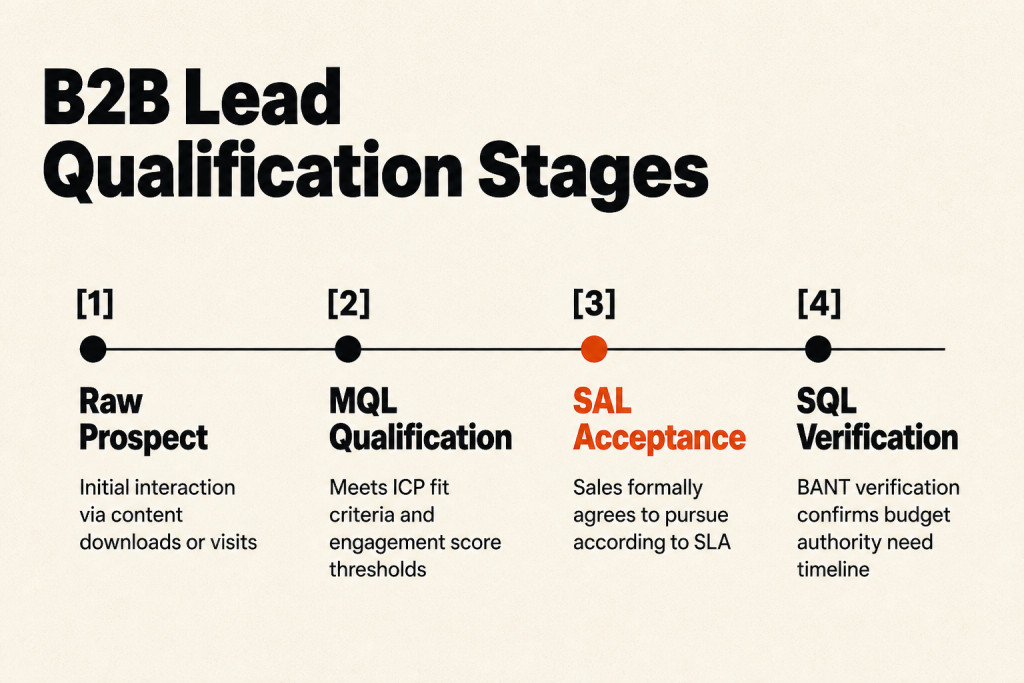
B2B buying seldom runs from a first impression to a sale along one path, so B2B marketing channels must work together.
First impressions rarely carry a B2B buyer all the way to purchase. Build a channel mix that reaches target accounts and keeps your business visible through evaluation. Keep that mix working while several people weigh the purchase, then turn their interest into sales.
Several people evaluate a purchase.
B2B teams have several channels available. This guide covers the main options (a buyer’s path rarely stays in one lane). Use it to shape a focused, profitable mix for your business, one that reaches target accounts, keeps you visible while multiple stakeholders assess a purchase, and turns interest into sales.
What Are the Main Types of B2B Marketing Channels?
The B2B marketing channels help companies find, engage, and convert other businesses. They fit into three broad groups:
- Owned channels: Platforms and assets you control, including your website, blog, email list, and resource library.
- Earned channels: Visibility built through steady effort, including organic social media, SEO rankings, word of mouth, and PR coverage.
- Paid channels: Visibility you buy through PPC ads, LinkedIn sponsored content, and content syndication.
Account-Based Marketing (ABM) arranges channel activity around a chosen set of high-value accounts.
Compared with B2C, B2B buying involves more people and takes longer. A single touchpoint almost never seals the deal.
B2B buyers move through an average of 10 channels, with 42% engaging across more than 11 touchpoints before they choose. The average deal takes 272 days to close, spans 88 touchpoints across 4 channels, and requires approval from about 10 stakeholders.
No single channel can carry the full plan. Connect owned, earned, and paid channels so they strengthen one another.
Email (87%), content marketing (86%), organic social media (83%), and paid advertising (82%) have become table stakes for marketing teams. Only 13-18% of companies run without these foundational channels.
The teams that keep beating the field and are most successful generally pick 3 to 5 channels, then build depth and coordination instead of spreading themselves across 10 or more.
Channel ROI satisfies only 15% of marketing leaders. Many teams split their budget too widely and end up being average everywhere.
McKinsey’s B2B Pulse found that companies using 7 or more channels expanded their market share in 72% of cases, while companies using fewer channels grew it less often.
Content Marketing
Content marketing gives people useful, educational material rather than pushing a product or service at them. It ranks among the strongest B2B marketing channels, from blog posts and eBooks to infographics and anything else that solves a user’s problem.
This approach supports three outcomes:
- It establishes brand authority.
- It helps the audience trust you.
- It guides potential buyers toward a decision.
Demand Metric found that 91% of leading B2B marketers regard content marketing as a major part of their strategy. Blogging, case studies, eBooks, and webinars can pull audiences in and create quality leads.
Content marketing and SEO make up 32.3%: nearly 1 in 3 marketers would pick content as their only channel if forced to choose. Seven out of 10 marketers call content marketing and SEO top performers, which puts them well ahead of the other digital options.
For companies prepared to stay the course, SEO and content marketing return roughly 748% ROI over three years, the highest return among the channels covered here. Paid digital advertising sits at 10.9%, while content marketing & SEO reaches 10.6%, putting both figures nearly level and together above one-fifth of total marketing investment.
Content quality drives the outcome. Build for a specific audience by accounting for its interests, activities, and current problems, then turn high-engagement subjects into several formats to widen reach cheaply.
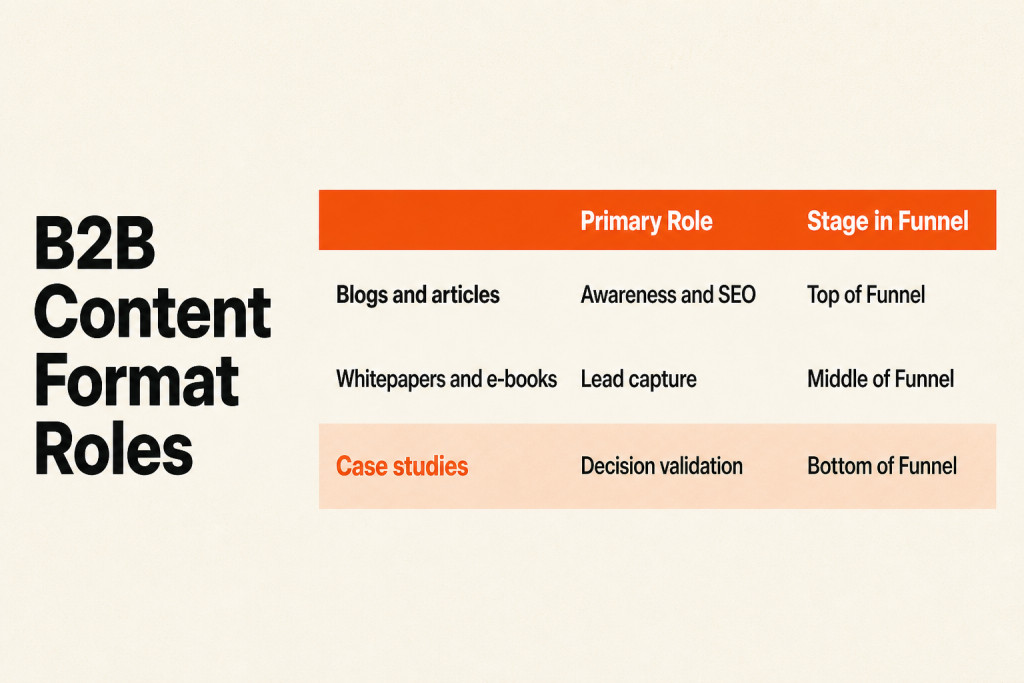
Different content formats do different jobs:
- Blogs and articles: For awareness and SEO.
- Whitepapers and e-books: As gated content for lead capture.
- Case studies: For companies in the decision phase.
Search Engine Optimization
Search engine optimization (SEO) tunes website pages and content for organic appearances in search engine results pages around the keywords you want to rank for.
People still turn to search more than any other online information source, making Search Engine Optimization a major B2B marketing channel in 2026. On an average day, internet users submit 3.5 billion queries to Google.
SEO can create steady growth, but the payoff takes time. A website can climb and earn trust with consistent effort, though the early work comes before the return keeps moving.
Effective B2B campaigns focus on:
- Long-tail keywords with commercial intent.
- Informative content that answers your target audience’s questions.
- Technical SEO and fast loading times.
SEO is just a traffic score when nobody can tie that activity to the company. Keep ungated content beside gated content, since search engines and AI channels need open material to index the website.
AEO shapes content for AI tools, including Google’s AI Overview, ChatGPT, and Perplexity, so they can cite your brand in answers.
Pay-Per-Click Advertising
Paid search puts ads close to the top of search results for relevant terms and queries. PPC offers quick visibility, while Search Engine Advertising (SEA) can bring traffic during the long wait for SEO.
PPC fits B2B campaigns aimed at keywords with high buying intent. Google Ads can place a company in front of buyers precisely when they’re looking for a solution.
Paid advertising earned a top-performer rating from 51%. PPC brings around 36% ROI, a positive result that still trails organic channels by a wide margin.
LinkedIn Ads let you aim at people by job title, company size, or industry. Paid channels move quickly, but results rest heavily on budget and on landing-page and offer conversion; stop paying, and the channel stops producing.
Across digital channels, paid digital advertising makes up 23.6% of outsourcing mentions, the highest share of any option.
Email Marketing
Email is still a dependable, strong B2B marketing channel, even after decades as a digital tactic. Adoption reaches 87%, and it’s the only channel used by at least 75% of companies regardless of company size, giving it broad reach across organizations.
HubSpot puts email marketing’s average ROI at $36 for every $1 spent. Other figures put the return somewhere between $36 and $42 for every $1 spent.
Segmentation sorts email lists by audience needs or by place in the buying process. B2B marketing automation then handles welcome messages, follow-ups, and drip campaigns without someone sending each one by hand.

Cold email cadences should reflect the target audience and include personal details that show you know who you’re contacting. Keep the copy to a sensible length and make sure the design loads well and adjusts on mobile.
You can pair email data with website behaviour. When someone on the email list visits the website, visitor identification can flag the visit so the team can follow up directly.
Leadinfo can tie email activity to website behaviour too. When someone from the list comes back, the team can identify that visit and respond directly. A return visit is the strongest timing signal because the prospect chose to come back, rather than receiving a message on the sender’s schedule.
Email remains a must-have B2B marketing channel, but crowded inboxes and stricter spam filters make messages harder to spot and open.
Even with 87% adoption, 48% of companies are only keeping email running, and 15% intend to leave the channel.
Social Media Marketing
Social media now covers the B2B digital marketing funnel from awareness and lead generation through nurturing, post-sale loyalty, and advocacy.
CMI and Marketing Profs report that 93% of B2B content marketers distribute organic content through LinkedIn, while 77% call it the best social media performer.
LinkedIn works as a leading B2B marketing channel because decision-makers, industry experts, and potential clients already spend time there. Its professional setting and ad options make it easier to reach the people you want to see your content.
People stay on LinkedIn to build networks, search for jobs, and consume useful material. The LinkedIn scheduler can help teams post more consistently and improve engagement.
Twitter offers direct conversations with prospects and has over 330 million active users. Hashtags and trending topics let B2B marketers listen for demand and see which solutions and products fit their audience.
Instagram gives companies room to show culture through behind-the-scenes videos and photos, helping potential buyers understand brand values. More than 200 million business accounts receive daily visits, creating a visual route to B2B buyers.
Facebook, Instagram, and X/Twitter can still earn a place in the mix. Facebook has three billion users, Instagram has two billion, and X/Twitter has 250 million.
Organic social carries the highest maintenance rate at 64%, alongside minimal growth at 21% and low abandonment at 13%. Adoption sits at 83%, but effectiveness reaches only 26%, and just 4.2% of marketers choose organic social media as their single channel.

Video Marketing
Google reports that 70% of B2B buyers and researchers watch video during the buyer’s journey, showing that video engagement has grown. DemandGenReport also found that 91% of buyers prefer interactive visual content.
Wyzowl’s 2023 Video Marketing Statistics report says 91% of marketers believe video has helped users understand their product or service. It can unpack complex ideas without forcing the audience through a wall of text.
The format should match the product. A business might share a demo, tutorial, or client testimonial, alongside explainers, interviews, product reviews, demos, and live-streaming.
You can place video on YouTube, social media feeds, a company website, and other environments.
Video grew by 51% even though 69% of marketers already use it, which suggests many still see the format as underused. Its effectiveness is 21%, while video and podcasts outsourcing accounts for 17.4%.
Webinars and Virtual Events
Webinars let businesses teach important or timely topics without asking attendees to meet at one fixed time and date. They also open a direct line to the audience.
Since people can watch webinars more than once, marketers can reuse them as content marketing. Longer sessions can also become shorter videos and podcasts when possible, keeping the investment relatively low.
Attendance takes real time, so participants show serious interest. Digital events & webinars have 33% effectiveness, while webinars and virtual events deliver an average ROI of 213%.
Successful B2B webinars:
- Address a specific problem of your target audience.
- Offer concrete, practical insights.
- Include a clear next step.
Webinars give back the time they consume.
Account-Based Marketing
Account-Based Marketing flips the usual funnel approach by focusing on a selected group of high-value accounts instead of reaching broadly.
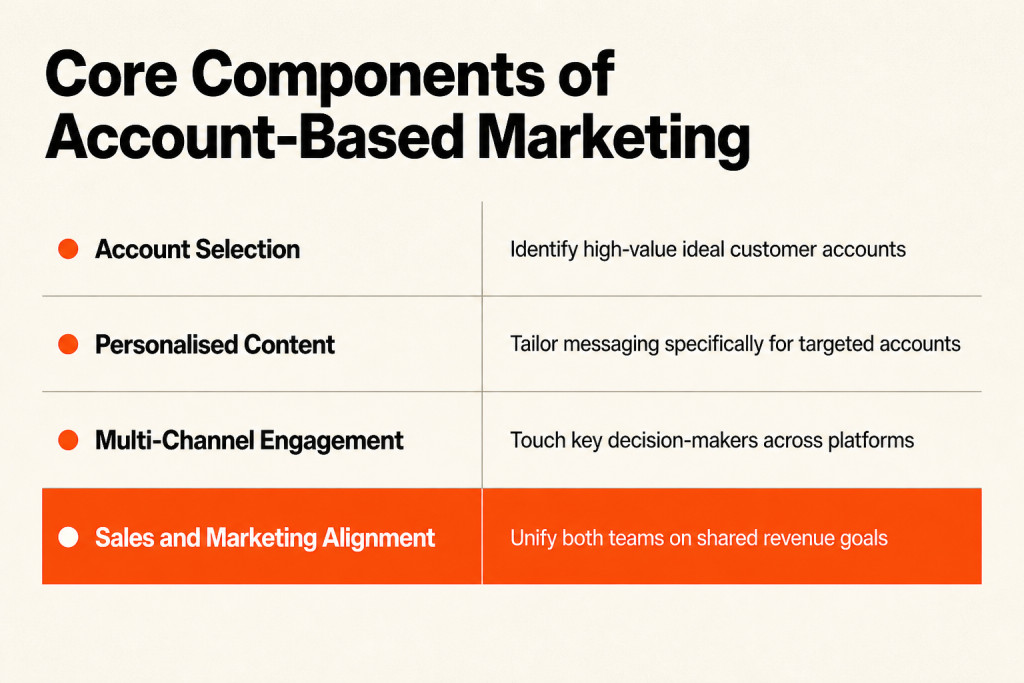
A workable account-based marketing strategy combines:
- Account selection: Identify your ideal customers.
- Personalised content: Create content specifically for those accounts.
- Multi-channel engagement: Reach decision-makers through multiple touchpoints.
- Sales and marketing alignment: Have both teams work on the same accounts.
This focused setup directs budget at priority accounts. It creates a smaller pool of active opportunities, though it leaves little space for finding buyers you didn’t expect.
Industry Directories and Review Sites
Most industries have several aggregate sites available. Service providers may appear on places such as Clutch.co and ‘Yell’.
Create at least a free profile on every relevant site you can find (even when the main payoff is a free backlink). Prospects may also use these directories when comparing providers.
A paid profile on a particularly strong site can increase your brand presence there.
Peer reviews shape whether people see a business as worth working with, so a larger set of good reviews helps. You can’t control testimonials, but you can ask happy customers to leave one.
Review platforms reach 45% adoption among B2B marketing teams, with 13% effectiveness and 46% abandonment.
Their lead-generation value has fallen sharply because prospects can ask ChatGPT or Claude to compare products instead of browsing review sites.
Partner and Referral Networks
Partner and referral channels borrow trust from someone the prospect already knows. A recommendation puts the first conversation in a very different place from a cold email or ad.
Trust-based channels often convert better than outbound or paid channels because the lead arrives with an endorsement attached. The catch is time, since these channels are harder to scale predictably.
Strategic partnerships pair a business with companies serving the same buyers while selling something else. Affiliate programs and referral systems make that process clear by giving people a reason to recommend the product to their network.
Reseller models take the idea another step. Third parties sell the product directly, widening the sales team without adding headcount.
Networking and referrals reach 60% adoption among B2B organizations. Their effectiveness is 61%, they receive 3.6% of the marketing budget, and they lead the pack with 45% growth.
Product-Led Acquisition
With Product-Led Acquisition, the product handles the selling. Rather than having a sales rep persuade someone to try a tool, the business removes that hurdle and lets buyers experience it themselves.
A free trial gives prospects a set period to test the product before committing. A freemium model keeps a free tier available and introduces paid features when the user is ready to upgrade.
Self-serve onboarding supports both approaches. When new users can reach value without talking to anyone, the channel can grow on its own.
Product-led channels suit SaaS products with low-friction adoption, quick value, and setup simple enough to finish alone. Complex or high-ticket products are harder to run this way without sales support.

Outbound Sales Outreach
Outbound marketing goes looking for buyers instead of waiting for them. The team identifies the right accounts and contacts them directly.
Outbound is the quickest way to build pipeline when inbound hasn’t had time to mature. It creates pipeline faster than any inbound channel, but the team must know exactly who it’s targeting and why those prospects should care.
Cold email campaigns rank among the most scalable outbound tactics. They can create leads, though success calls for a detailed plan and ongoing refinement, and the spreadsheet will have opinions. A clear ICP and value proposition can keep meetings booked without a huge team.
Cold calling remains effective because it’s direct, personal, and capable of creating a live exchange no other channel matches. LinkedIn outreach now sits in many outbound programs between email and a phone call in formality.
Account-based sales puts the whole team behind a defined list of priority targets, coordinating every touch around a particular account.
Before you ask for a meeting, use an introductory email to confirm the prospect’s interest and put an appealing offer in front of them.
How to Choose the Right Channel Mix for Your Stage
After interest is confirmed, base the channel choice on audience behavior and the buying cycle. A clear trigger and short cycle favor outbound and paid channels. Longer, more involved cycles call for inbound and content that can warm buyers over time.
Company stage and available resources will narrow your options. Early-stage companies should first get three channels working by using a primary discovery channel, such as LinkedIn organic or SEO, with email for owned nurture and one paid channel for acceleration. Enterprise companies can build that base into an omnichannel strategy through account-based marketing and industry events. Keep each of those roles separate.
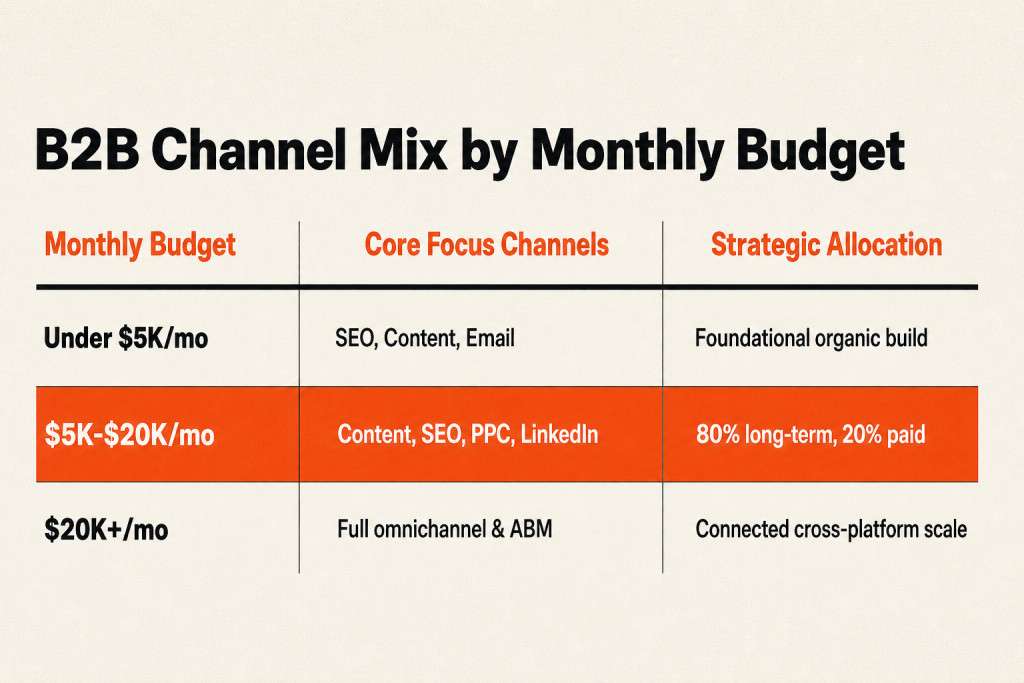
Your budget and available time set the pace. Teams with time but little capital can build gradually, while teams with budget and a need for rapid validation can turn to targeted paid channels. Under $5K/month, prioritize SEO and content marketing, with email supporting the system. From $5K to $20K/month, keep the 80/20 split: roughly 80% for long-term channels such as content and SEO, and 20% for paid activation, including PPC campaigns or LinkedIn Ads. At $20K+/month, a full omnichannel strategy becomes practical.
Tie the mix to the job you need it to do right now. LinkedIn Ads and Google Ads can generate qualified leads. Content marketing and LinkedIn organic can build recognition, while email and webinars can nurture existing opportunities. Use email and webinars especially when 6 to 10 people take part in one buying decision.
Pick one anchor discovery channel and support it with a nurture channel such as email, adding paid acceleration alongside it. Add more than three only after the first three deliver predictable, measurable results.
Multi-Channel Versus Omnichannel Integration
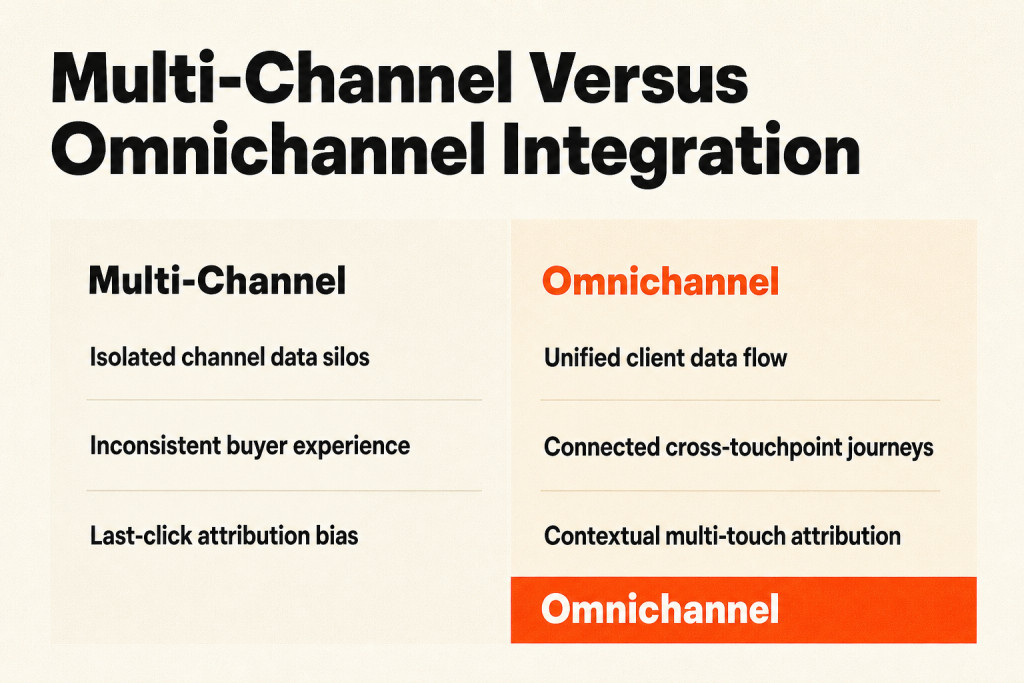
Both approaches reach buyers through several channels, but they part ways in how those channels connect. With a multi-channel setup, each channel keeps its own data and buyer journey, so switching between them may force the buyer to start again. The channels stay siloed.
Omnichannel marketing builds around client insights, carrying them through one connected experience. That creates smoother handoffs and cuts needless effort for the client.
McKinsey says hybrid sales bring in up to 50% more revenue through broader, deeper customer engagement.
The Pitfall of Channel Isolation
When channels operate apart, buyer confidence can take a hit. Someone might spend an hour with your technical evaluation guide, then get a generic cold email the next morning asking whether their company knows the category. That message has missed the work already done. Connected processes reduce unnecessary client effort.
Each channel eventually hits a ceiling, and the pipeline may dry up quickly once it does.
The same trouble shows up when the message changes from channel to channel. Prospects get conflicting stories, and trust can suffer before a conversation even starts.
Source and campaign tracking tie a lead to the channel that produced it. Without those records, you can’t see what each channel contributed.
Across B2B deals, buyers average 88 touchpoints, meaning that assigning all credit to the last click before a demo request shortchanges content, email, and organic social.
Building an Integrated Omnichannel System
A connected setup gives every channel a job in the next step. Your blog can grow the email list, which can fill webinar registrations, a fairly sensible handoff for once. Webinar material can become LinkedIn posts, and LinkedIn engagement can build the familiarity that helps paid ads convert. Every channel adds something to the others.
The journey may begin with an outbound email sent to a cold prospect. Follow what happens next: they ignore it, find your content through search, see a retargeting ad while weighing options, and finish with a sales call. No single touch closes the deal by itself. The sequence does.
Connect visitor identification with your Google Ads data to see more than which search terms convert. You can also spot valuable companies that reach your site without converting directly, since buyers rarely follow the tidy path reports like. Feed those companies into Google as offline conversions, allowing Google to learn which companies to bid on instead of chasing clicks.
Across many channels, the job is to send traffic to your website and move contacts into your database, ideally through integrations with your CRM system.
Use B2B digital marketing software such as scheduling tools and workflows to build one central setup for promotional channels.
Frequently Asked Questions
Which channels increase B2B sales fastest?
Among these choices, Visitor identification is the fastest because it works with existing traffic and needs no extra media budget.
Google Ads for strong-intent searches come next, followed by focused LinkedIn Ads.
Cold outreach with no intent signal is the slowest route because the sender carries the timing risk.
How do I generate better quality leads?
Lead quality gets better when ICP filtering meets intent signals. Define your Ideal Customer Profile from traits shared by the best customers, including company size and sector, then use it to filter every lead generation activity.
Leadinfo can help sort leads that show active buying behaviour, using signals that measure buying intent.
Turn on real-time notifications when a company matching your Ideal Customer Profile visits your website.
One lead showing buying intent is worth more than ten cold leads from the same budget.
What is an example of a B2B channel?
Outbound email qualifies as a B2B channel when a sales team identifies target accounts, sends personalised emails in sequence to prospects who show interest, then books meetings with them. That sequence puts the channel in motion.
It stays a channel because the process is direct, measurable, and repeatable, rather than merely a tactic.
Sender gives businesses of all sizes an affordable, powerful tool for email and SMS automation, built to create effective email campaigns.
A practical B2B digital marketing strategy is a connected system: match a few channels to buyer behavior, then make those channels work together before you add anything else. Visitor identification, Google Ads, LinkedIn Ads, and Outbound email each bring their own timing and intent signals. Lead quality improves when ICP filtering and real-time notifications steer the work. Track each channel by following lead progress toward the next action. Keep B2B marketing channels focused on the next action.