Orthodontic social media can fill a calendar without giving prospective patients a solid reason to book. The main job in social media marketing for orthodontists is spotting which posts earn trust and which channels deserve the practice’s time.
A patient’s braces-off selfie can reach more people than a polished promotion. This guide covers how to pick channels, plan content, and connect social activity with consultations.
Which Platforms Work Best for Social Media Marketing for Orthodontists?
For an orthodontic practice, Instagram and Facebook make the strongest starting pair, with the choice shaped by who you’re trying to reach. Parents of teens use both, while adult clear aligner inquiries call for visual Instagram content and direct messages. Begin with those two.
The table compares the three channels.
| Platform | Target Audience | Content Format | Acquisition Strength |
|---|---|---|---|
| parents, teens, young adults; users under 35 | Before/after photos, patient stories, Reels, polls, Stories | Build trust and social proof | |
| parents over 35; other adults over 30 | Live Q&As, patient testimonials, event promotions, educational articles | Nurture relationships and community | |
| TikTok | younger audiences and teens | Short myth-busting videos, dental hacks, day-in-the-life clips | Reach younger audiences with viral potential |
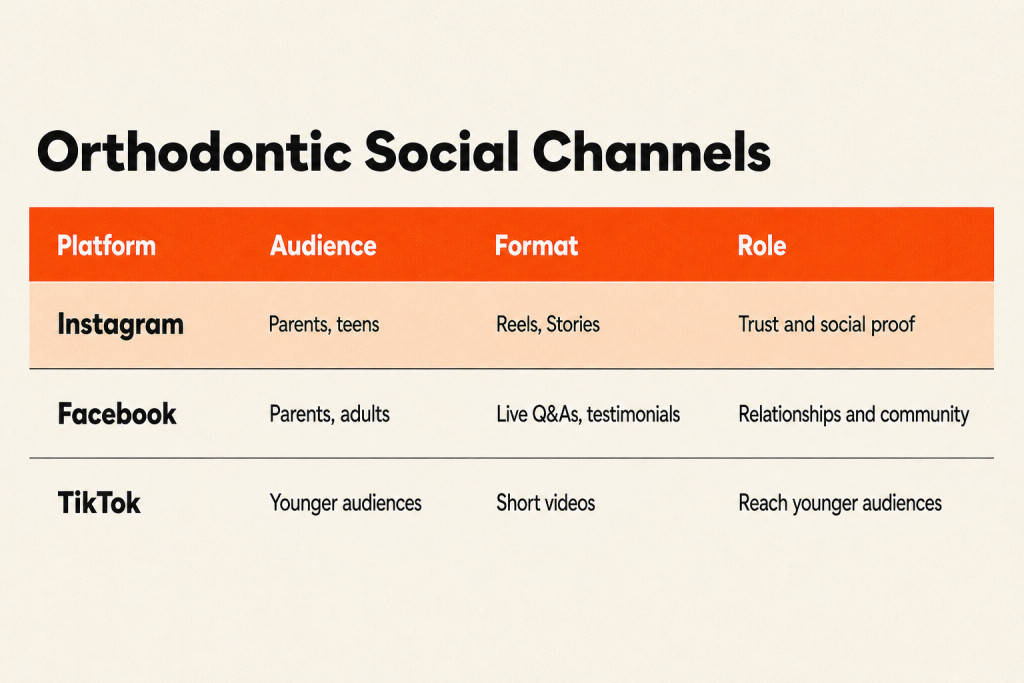
A practice can usually manage two or three channels well. Together, Instagram and Facebook reach a wide age range and offer strong advertising options to bring in patients.
Parents over 35 often use Facebook (a natural fit for family orthodontics and early treatment). Join local parent groups, school community pages, and neighborhood groups, then take part authentically instead of posting promotional links to build organic visibility.
TikTok can be harder to predict. A team member who’s comfortable on camera and knows the platform’s culture can help the practice reach a large audience at virtually no cost. Use TikTok only when that style suits your team. For a more natural TikTok presence, keep videos lightly produced and let the team’s personality come through.
For professional networking, LinkedIn may be the better fit.
How to Plan Useful Orthodontic Social Content
Build the plan around recurring content pillars: before-and-after photos, educational posts, staff highlights, and community involvement. Together they keep the feed varied, with every post doing a clear job.

For a more personal feed, feature your team, equipment, and office alongside any polished ads.
Set a pace the practice can keep without letting quality slide. Three solid posts each week beat seven rushed ones. If the team can only manage two posts a week and a few Stories, that’s still a respectable plan; just don’t let posting lapse for weeks at a time.
Use a content calendar and schedule posts ahead with Hootsuite to prevent gaps. Slot each pillar into the calendar.
Smile Transformation Posts
Smile-transformation content should showcase the confidence and emotional change behind a patient’s new smile through authentic patient stories and real reactions. Cheek-retractor photos may impress colleagues with their technical skill, yet put off prospective patients looking for a familiar face. The suggestions below pair patient stories with imagery that may resonate with people in Peekskill.
- Show the emotional change: Use your Instagram feed to show transformations, leading with the emotional change a straighter smile brings instead of the braces. Research indicates that 88% of prospective patients look for social proof before booking a consultation. When planning orthodontist instagram ideas, focus on confidence: share a short video of a patient seeing their new smile in the mirror, rather than relying on a static image. That raw moment can make a connection clinical diagrams cannot.
- Share patient stories: A teenager who couldn’t smile in photos for two years and now can’t stop has a story worth telling. Get permission, capture the moment as it happens rather than staging it, and share it. These stories may be saved and shared more often than promotional content, though response varies by audience.
- Keep the visuals consistent: Set a ring light to 5600K for natural skin tones and clear dental details in every shot. On Instagram Reels, use the “Remix” feature to make a split-screen video of the 18-month journey in under 15 seconds.
- Invite patient-created posts: User-generated content (UGC) can build trust, so encourage patients to tag the practice in their own updates. A “braces-off” selfie shared with a patient’s 500 followers can work as digital word-of-mouth. Add a dedicated “selfie station” with professional lighting and branded backdrops.
- Make tagging easy and rewarding: Practices with a physical photo booth see a 40% increase in organic tags within the first 90 days. Offer a $5 local coffee shop gift card or a branded t-shirt to patients who tag the practice in their debonding photos.
Educational Posts
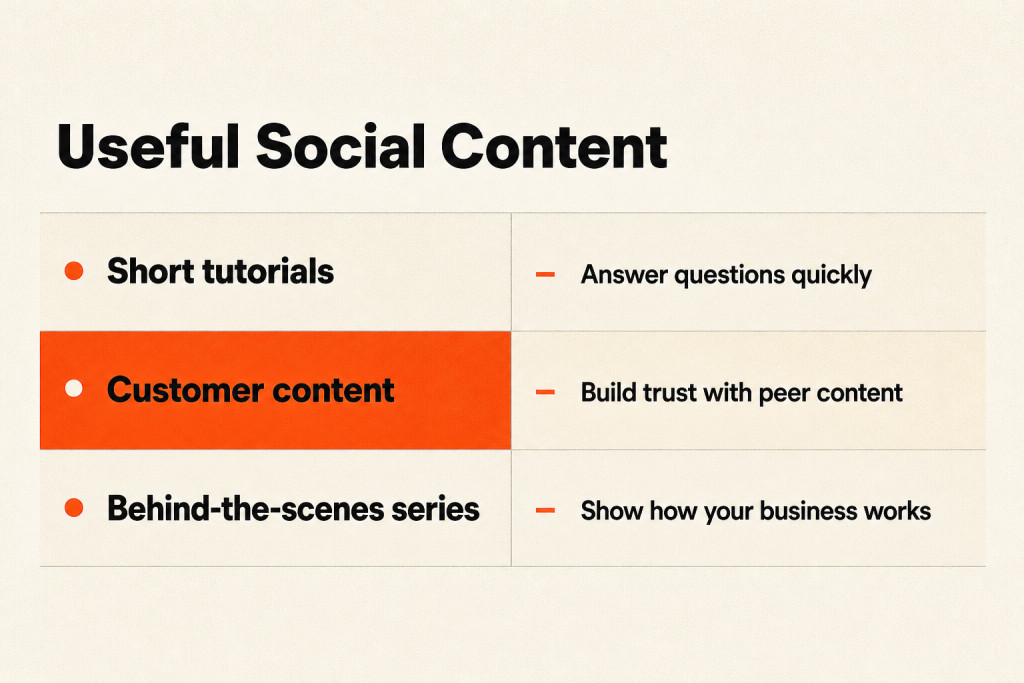
Educational posts answer common questions, clear up misconceptions, and give patients information to pass along.
Answers to common questions
Write short, plain answers to the questions people ask: how long treatment takes, what they can eat with braces, and how Invisalign compares with braces. These posts can establish the practice as a trusted source without reading like a textbook. They may also appear in searches and give parents a useful answer to pass along when friends ask those same questions.
Myth-busting
Myth-busting posts can show the practice’s expertise, build trust before a patient visits the office, and lower barriers to care. One myth is that clear aligners can’t treat complex malocclusions, though current systems have changed what’s possible. Clinical data indicates these systems can treat 90% of orthodontic cases.
Interactive elements
Instagram Stories “Ask Me Anything” (AMA) sessions give the practice a way to talk with people in real time. Use them to answer common questions about treatment costs and duration. Other posts can give practical care advice, such as cleaning clear aligners with specific solutions or getting through a holiday dinner with standard braces. Others can show how teeth move with AI-enhanced visuals, including 3D scans from an iTero or Trios scanner. Because they provide tangible value, these care-advice and tooth-movement posts are saved 45% more often than standard lifestyle imagery.
Short-form video
Create 60-second videos explaining the American Association of Orthodontists’ recommendation that children have their first check-up no later than age 7, a timing parents should know. Quick videos on orthodontic emergencies, from a poking wire to a loose bracket, can show the practice’s commitment to patient care. Compare standard metal braces, Invisalign, and 3D-printed LightForce brackets so patients can make informed choices as they get ready to start treatment.
Converting Social Media Interest into Consultations
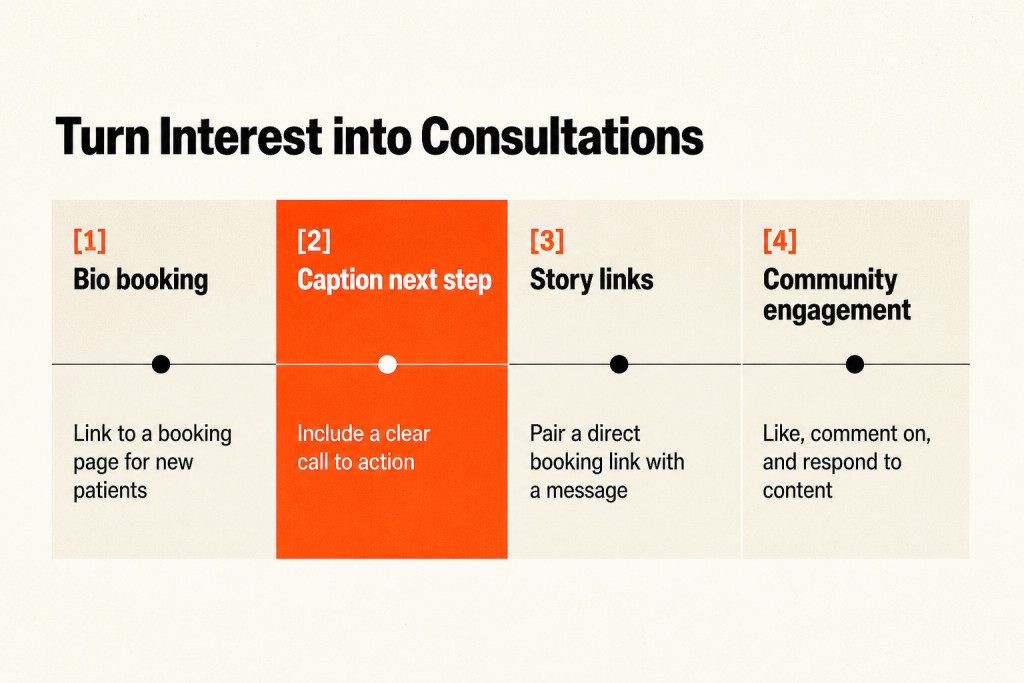
Practices can turn social visitors into consultations by making booking easy and using clear calls to action across profiles, captions, and Stories.
- Make booking easy from your bio: Make the call to action in your Instagram bio clear, then link to a booking page or landing page for new patients, rather than your homepage.
- Add a next step to captions: Include a clear call to action regularly, though not in every post. For example: ‘Curious if you or your child would benefit from a consultation? Click the link in our bio, first visits are free’. Saying the first visit costs nothing removes friction.
- Link Stories to booking: Stories can be a high-converting touchpoint when you add ‘swipe up’ links or link stickers (depending on your platform). Pair a direct booking link with a message such as ‘We have a few consultation spots open this week’ to reach people already engaged with your content.
- Engage with the community: Set aside 10 minutes each day to like, comment on, and respond to content from followers, local businesses, and community accounts. This two-way interaction fosters a loyal community and signals to algorithms that your practice is socially connected.
When an Instagram profile or booking path feels confusing or takes too many steps, visitors can leave before scheduling an evaluation.
Paid Social Campaigns: Audience, Offer, and Tracking
Reach the right audience
Facebook and Instagram ads can be shown to parents and other adults nearby, with audiences selected according to age, where they live, their interests, and life milestones such as becoming a new parent. Pair that audience with an offer like “Free Invisalign Consult” or a limited-time new-patient special, then send clicks to a focused landing page rather than your homepage. Give the page a clear headline, form, and call-tracking number.
Track campaign results
Track each campaign’s cost per lead (CPL) and conversion rate to see how the ads are doing. Dental ad performance standards commonly cite conversion rates of 12-20%. A well-run strategy can bring a 3-6x return on investment, making targeted paid ads a strong tool for growth. Practices managing complex local ad spend and campaign testing may partner with a top SMM agency to refine their approach.
- Boost high-performing posts: Use Meta Ads to double the reach of a high-performing organic post within Peekskill. For example, when a post about a local event reaches 500 people, use ads to extend the post’s reach beyond that initial audience.
How to Measure Social Media’s Impact on Patient Bookings and Growth
Saves and Shares give you a better read on growth than Likes, while Booked consultations show whether social posts are filling appointment slots. A parent may save a post to revisit while planning finances or considering treatment. That kind of engagement is a proven leading indicator of future consultations and increased ROI from your social efforts.
Track the following to see how social activity brings in patients:
- Booked consultations per month
- Where each consultation came from
- Cost per consultation (for paid ads)
- Consultation-to-case conversion rate
- Average case value
- Number and rating of Google reviews

Start with the monthly case target and work backward from signed cases: 10 new cases per month means 20 consultations if half of consultations turn into signed cases. At about a 5% website inquiry rate, you’d need around 400 visitors to generate 20 inquiries. Bringing in half of those visitors through paid search means paying for about 200 clicks, so multiply 200 by your current cost per click to set the monthly ad budget. Google Business Profile, reviews, and referrals account for the remaining visitors.
Review the numbers monthly, then decide which campaigns to keep, adjust, or cut:
- Working well: Increase it. If “Invisalign [city]” is bringing in cases, raise its budget.
- Not working so well: Change the message, channel, or offer. Fix a consultation page that does not convert before spending more to send traffic there.
- Clearly not working at all: Cut it and move the budget elsewhere. Broad clicks from price shoppers who never book are spend you can reallocate.
What Privacy Rules Apply When Featuring Patients on Social Media?
Federal privacy laws call for a media release form, signed and in writing, before patient images or success stories are shared.
Willingness to be featured varies by patient. Some patients, including teens, may prefer to keep their treatment private. Add the permission request to the day-of-debond appointment workflow, and you can build a steady stream of authentic content.

If a negative comment appears, respond within 24 hours and ask the person to take the discussion to a private channel. A professional reply such as, “We value your feedback and would like to discuss this privately,” helps maintain your reputation while complying with HIPAA guidelines.
Frequently Asked Questions
How often should an orthodontic practice post on social media?
Keep the main feed active 3 to 5 times per week, and post to Instagram Stories daily. 2025 data indicates that practices posting 4 times weekly converted at a rate 22% above the rate for daily posters. Put 60% of your content on Reels to maximize reach in the Peekskill community.
How do you turn social media followers into consultations?
Give followers a clear path to consultations with direct profile links and clear calls to action. Retargeting ads and prompt replies to incoming direct messages can drive conversions, too.
Do I need a professional photographer for my practice Instagram?
You don’t need a professional photographer for every post. Authentic smartphone content often performs better, so save professional sessions for an annual website refresh or team headshots.
Is TikTok better than Instagram for orthodontic marketing?
Instagram is the stronger choice for orthodontic marketing, with local targeting and an audience of parents who make healthcare decisions. TikTok can help build brand awareness. In Westchester County, 70% of parents say they turn to Instagram when looking into local healthcare providers, and Instagram’s direct messaging and booking options produce 15% higher ROI for treatment starts than TikTok’s current conversion tools.
Should I share my personal life on my professional practice account?
Share personal milestones or hobbies to make your brand feel more human, while keeping professional content in the lead. For building rapport, the accepted industry standard assigns 20/80 of the content mix to personal and clinical posts respectively. Images showing your team at a Peekskill community event can increase prospective patients’ trust score by 12%.
How do I handle negative comments on my Instagram posts?
Reply to every comment: thank positive commenters and address negative feedback professionally in a private conversation. Delete comments only when they contain profanity or medical misinformation.
Conclusion
A steady approach to social media marketing for orthodontists gives followers regular chances to find your practice and get to know the team before booking consultations. Keep Instagram Stories active daily. Make booking easy with direct profile links and clear calls to action, and use authentic smartphone content for routine posts. Choose Instagram, Facebook, or TikTok based on the audience and campaign’s role. Share personal content selectively while handling negative feedback professionally and privately. For your next post, choose one platform and one clear booking action, then check that your profile link makes the action easy.