Social media marketing for nonprofits can bring plenty of attention without that attention turning into support. The hard part is deciding where a limited team should focus, and how to help followers become donors, volunteers, or advocates.
This guide helps you make those choices with a workable channel mix, content supporters connect with, and a way to judge whether your effort is earning its place. Facebook and Instagram have fundraising features, and those are one factor in deciding where your team’s time belongs.
How to Plan Social Media Marketing for Nonprofits
Plan around SMART goals, a defined audience, and consistent branding across channels.
A clear plan ties each post to the mission and goals, helping nonprofits avoid spreading their effort too thin while aiming for maximum engagement and impact. Nonprofits can also partner with a Social Media Marketing Company to build their strategy; when evaluating providers, look for support with channel planning, content production, and measurement that matches your goals and staff capacity.
SMART goals
SMART goals give you a way to check progress. Set targets that are Specific, Measurable, Achievable, Relevant, and Time-bound, name key channels, and decide each channel’s role.
Start with audience demographics and behaviors to figure out who each goal needs to reach. List students, educators, donors, policymakers, parents, or community leaders (those groups guide your choices), then match content to what connects with them. For example, younger viewers on TikTok may prefer concise, candid student-led videos, while LinkedIn users may be more receptive to professional updates, in-depth captions, and thought leadership.

Consistent branding across platforms
Brand guidelines give supporters familiar cues from one channel to the next. Keep the logo, color palette, and tone of voice consistent across your posts.
As a SMART example, target a 20% rise in monthly donations attributable to social media sites, with May 31, 2021 as the deadline. Track donations from those sites to check whether you reached the goal.
For nonprofits, a social media strategy documents how channels like Instagram, LinkedIn, and Facebook can advance the organization’s mission. It names the audiences and goals, such as Fundraising or Recruiting volunteers. Content pillars, posting cadence, and measures of success complete the plan; purposeful storytelling that prompts measurable action replaces ad-hoc posting.
Define your nonprofit’s goals on social media:
- Fundraising
- Recruiting volunteers
- Raising awareness
Identify your target audience by
- Age
- Country
- Devices used
- Interests
- Job title
Where Should a Nonprofit Focus Its Social Media Efforts?
Choose channels by matching your audience and content to platform features.
Choose the campaign goal first, whether fundraising or mobilizing support through volunteer recruitment and advocacy. Match it with your audience’s profile and location, along with its interests, then compare platform demographics and built-in features before choosing channels.
Focus on two or three channels done well rather than spreading thin across every network.
Putting time into two or three networks means reaching fewer people overall. For a small team, that trade-off can keep profiles from becoming thin, abandoned feeds as you try to maintain every account.
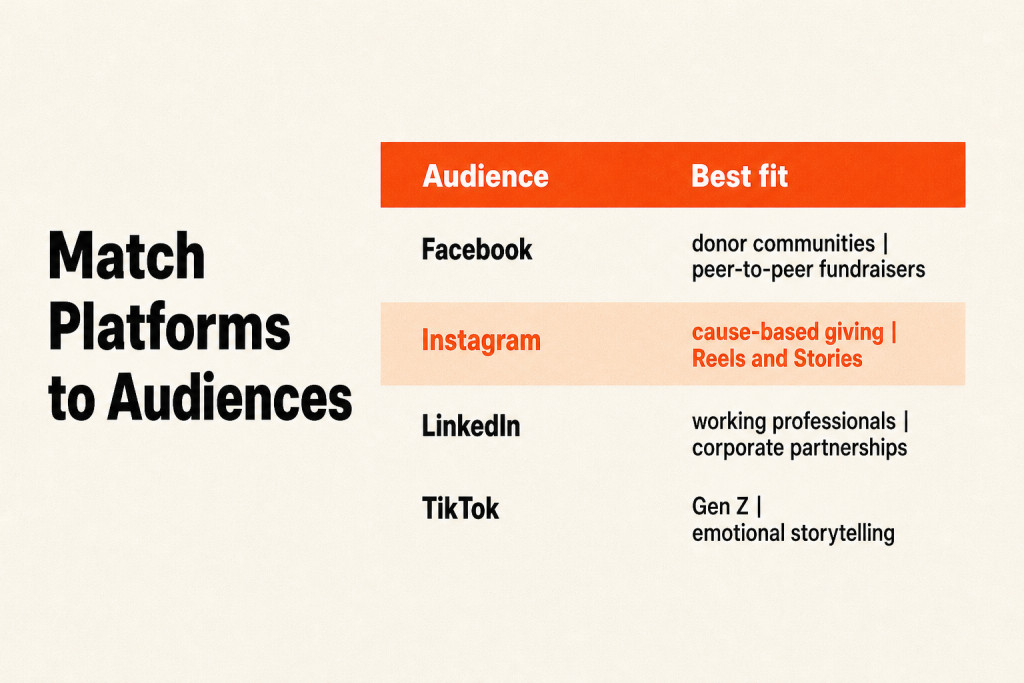
Donor habits should guide your choice: Facebook remains strong for peer-to-peer fundraisers and older donor communities. Instagram drives cause-based giving through Reels and Stories, LinkedIn suits corporate partnerships and workplace giving, and TikTok reaches Gen Z through emotional storytelling.
Facebook Fundraising and Engagement
- The 2020 Global Trends in Giving Report Infographics found Facebook was the social media platform nonprofits used most often. In the same report, 25% of donors worldwide said social media was the communication tool that most inspired them to give.
- About one-third (32%) of donors said they had donated through Facebook’s fundraising tools. Of those donors, 89% said they were likely to give through Facebook again.
- Facebook’s users have diverse demographics, including gender, age, generation, ethnicity, and country.
- Nonprofits that collect donations can add the Donate button to their Facebook page or place it next to posts. Supporters can click it, enter a donation amount, and provide their credit card numbers.
- Nonprofits can check whether they qualify for Facebook’s fundraising tools, available to nonprofit or charitable organizations in certain locations. Eligible organizations may enroll as a charitable organization with Facebook payments.
- Facebook provides fundraising features and groups for community building.
- 65% of Facebook users use Facebook to view photos.
- The average engagement rate for Facebook video posts is 0.26%, compared with an overall average engagement rate of just 0.18%.
LinkedIn Professional Networking
Nonprofits can use LinkedIn to make professional connections, form partnerships, find skilled volunteers, and share thought leadership.
When most of your audience consists of working professionals, LinkedIn can raise mission awareness, build credibility and trust, reach donors and volunteers alongside corporate partners, and drive action.
Instagram Visual Storytelling
Instagram gives nonprofits a visual place to tell their story through impactful images and videos. It also supports popular fundraising campaigns, with cause-based giving through Reels and Stories.
Use a 9:16 aspect ratio for mobile-first videos, and keep them to 20-30 seconds to maximize engagement. Partner with local artists or influencers for Instagram takeovers.
Content That Connects With Supporters: What to Post
Nonprofits connect with supporters through a balanced mix of educational posts, beneficiary stories, behind-the-scenes content, and public thanks, posted on a steady schedule.
A balanced mix
Educational posts help people understand the cause, while stories about beneficiaries show its human impact. Add clear invitations to donate or volunteer, along with glimpses of the team’s day-to-day work, so the feed includes more than fundraising asks. Platform algorithms can guide your format choices, and short videos, carousels, and live sessions are among the options. Frequent donation asks can make the feed feel repetitive and leave less room for updates about the work itself.
Visual storytelling
Strong videos and graphics can make the impact of your work easier to see and help supporters feel more connected to it.
Consistency
A regular posting rhythm keeps your mission in supporters’ minds, and steady posting matters more than posting as often as possible. Sharing 2-3 times per week across your channels can be a sustainable starting point. Engagement tends to be strongest with 3-5 posts per week on each platform, so build toward that cadence only when your staff can sustain it.
Set up a content calendar and schedule posts ahead, especially for Giving Tuesday and year-end drives.
- Build a content calendar around advocacy days, school milestones, or awareness months.
- Use native scheduling tools to plan posts in advance.
An impact report packed with data
An impact report lays out what a project has achieved. Include information about beneficiaries. Report funds raised and volunteering hours so people can see the results in concrete terms. Those results may encourage readers to keep supporting the cause or share the success story with their network. Showing what you’ve done also backs up your nonprofit’s legitimacy and helps build trust. We recommend posting updates on your nonprofit’s progress quarterly on its social media pages.
Behind-the-Scenes Posts
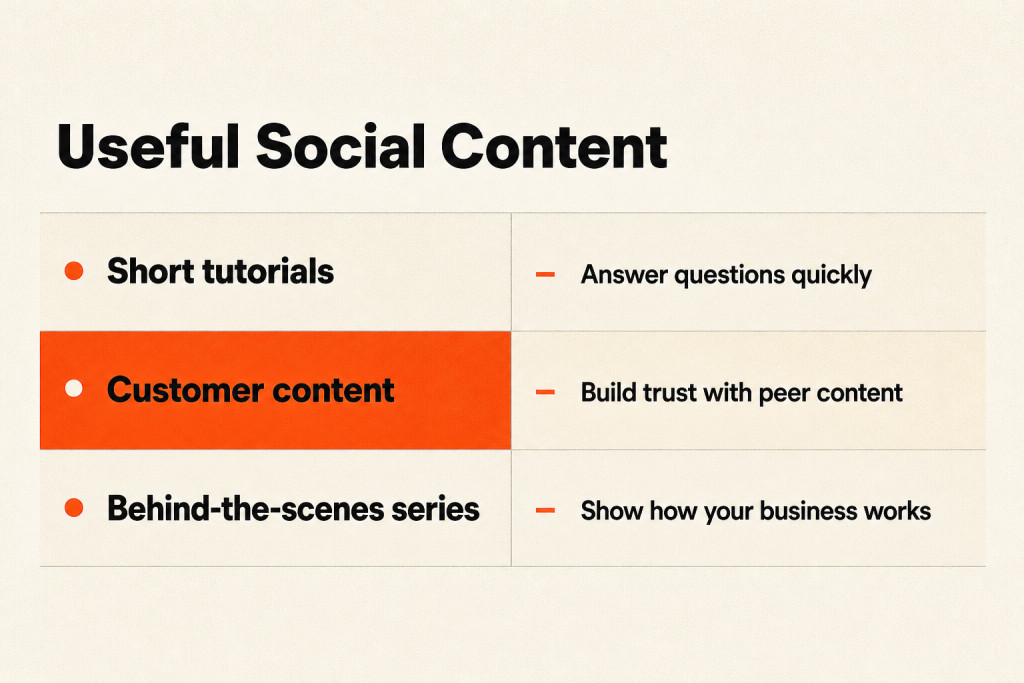
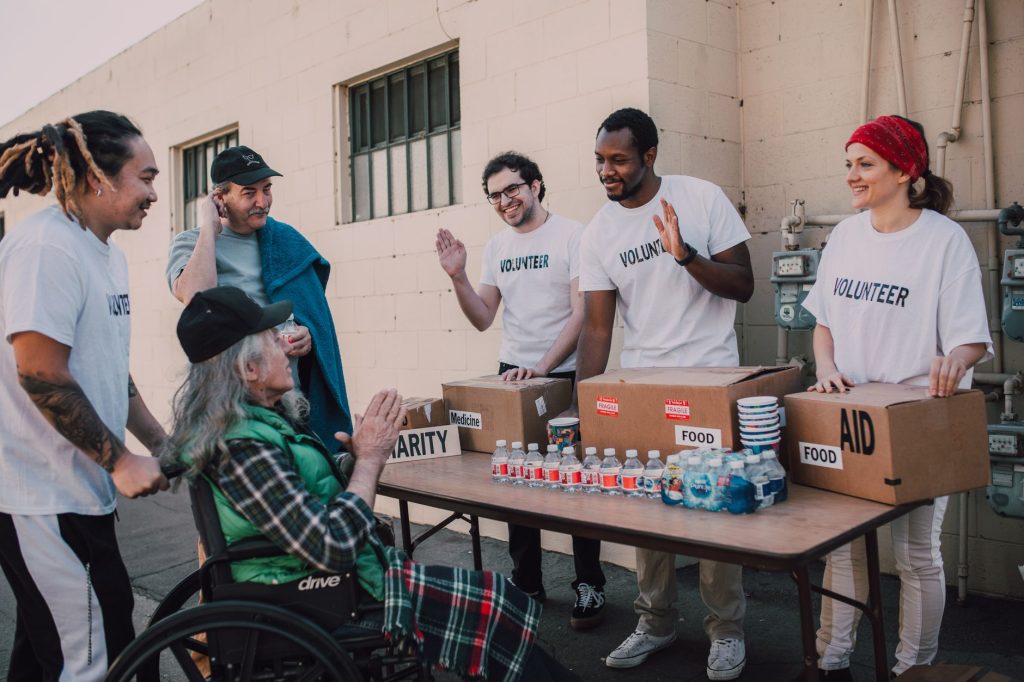
Behind-the-scenes (BTS) posts let donors and volunteers see how campaigns and events come together, giving them a closer look at the nonprofit. Show the unpolished work that goes into a campaign or a successful event alongside prepared posts about impact. Staff conversations, idea sessions, event setup, and lighthearted videos about fundraising all belong here. Video tours of your organization’s inner workings can show how it operates and build trust and transparency. Create a regular series of “Behind the scenes” videos that takes viewers through all the organization’s departments, then publish the videos on a regular schedule. Posting 2-3 times per week is suggested for visibility without overwhelming staff resources.
Public Thank-Yous
A public thank-you gives volunteers visible recognition for the time and effort they contribute. A volunteer’s family and friends may repost or share the recognition, carrying the thank-you to more people. Recognizing supporters can help build a meaningful relationship with your audience.
For volunteers, online thanks can include:
- A thank you video
- A blog post celebrating your volunteers
- A “Volunteer of the Month” campaign to recognize outstanding contributions
Photos of volunteers can help donors trust your organization. Pictures or videos that show volunteers alongside beneficiaries put your impact in action and can build that trust. Tag all supporters in your “Thank you” social media post, then share images and videos each week to show your gratitude.
Running Time-Bound Social Fundraising Campaigns
Effective campaigns
Time-bound fundraising campaigns built around a specific goal can be more effective, with Giving Tuesday and a cause awareness day as examples. Options to consider alongside standalone appeals include user-generated content, matching gift periods, peer-to-peer challenges, partnerships, and social media challenges, which can support fundraising goals.

Every post
Put a clear, simple CTA in every post so supporters know exactly how to help, such as “Donate Now,” “Share This Story,” or “Join Our Event.”
Hashtags
Hashtags can raise visibility and help new audiences find your cause; join trending conversations or create a hashtag campaign of your own to unite supporters.
How to Measure Social Media Return on Investment (ROI)
To assess social media ROI, pair leading indicators (such as engagement rate and reach) with the actions supporters take after seeing content. Track both, then begin with these measures.
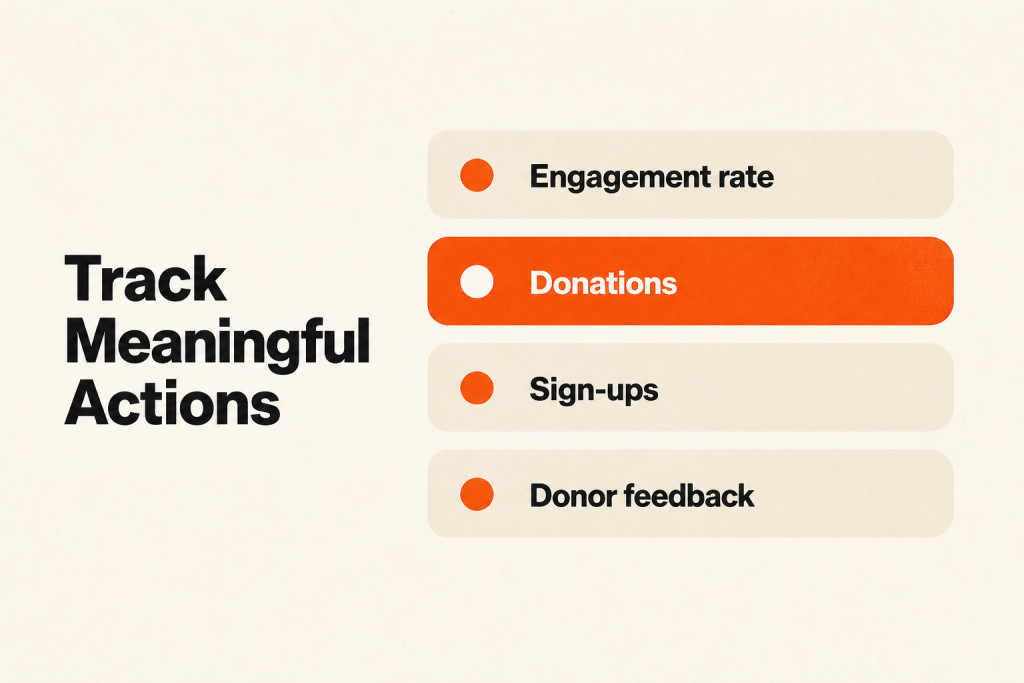
- Leading indicators: Measure engagement rate, reach, follower growth, and click-through rate on campaign links.
- Fundraising: Track donations attributed to social channels and average gift size.
- Volunteering: Track sign-ups from platform-referred traffic.
- Monthly audience counts: Put the social media sites you use in the far-left column, then add 12 columns on the right, one for each month of the year. On the first day of every month, record the current number of friends, followers, fans, and subscribers.
- Website and sign-up activity: Combine those figures with website and e-mail/mobile sign up stats, and note how online donors and volunteers found you.
- Traffic quality: Unique Visitors is the number to watch; Hits are meaningless.
- Donor feedback: After someone donates on your website, ask them on the next page to answer a poll about what message prompted them to donate and where they read it.
- Follower activity: Audience size alone does not prove success. Passive page views are not the same as genuine donor commitment. 40% of folks fan brands on Facebook, and 34% of those folks then visit their website before purchasing or donating.
Frequently Asked Questions
How often should nonprofits post on social media?
Sharing 2-3 times per week across your channels can be a sustainable starting point, and engagement tends to be strongest with 3-5 posts per week on each platform. Nonprofits should post regularly on a consistent schedule, with updates, progress reports, and success stories as examples of what to share.
Which social media platforms work best for nonprofit fundraising?
Facebook and Instagram offer fundraising features that let nonprofits collect donations directly from engaged followers. Facebook, Instagram, LinkedIn, and TikTok can all help nonprofits engage supporters, present compelling stories, and strengthen fundraising efforts.
What are common social media mistakes nonprofits make?
Common mistakes include treating every post as a donation ask and using generic corporate language. Ignoring comments and posting the same image across every platform without formatting it for each are common too.
How can nonprofits build community through social media?
Facebook Groups and LinkedIn communities support sustained conversation, while Instagram and TikTok expand top-of-funnel awareness. Supporters feel included when they are seen rather than marketed to.
Conclusion
Social media marketing for nonprofits works best as a steady rhythm of regular updates, progress reports, and success stories, shared on platforms that offer ways to reach supporters and support fundraising. Facebook and Instagram have fundraising features, while Facebook Groups and LinkedIn communities support sustained conversation. Use those roles to guide your channel mix. Keep posts useful beyond donation asks, and let supporters feel seen. Choose a pace and channels your team can sustain.