Organic search plays a major role in online visibility for companies, accounting for roughly 62% of B2B website traffic. It also happens to be one of the hardest channels to unwind when decisions go wrong. A good SEO program builds quietly over time. A bad one burns months of budget and leaves you wondering why nothing moved.
This is why hiring an SEO agency may feel confusing. With costly retainers, long timelines, late feedback, you often don’t know whether the work was solid or sloppy until you are already deep into it.
That is when this article by Golden Owl Digital comes in handy. We will walk you through the most practical questions to ask SEO companies before hiring them, why each question matters, and what answers tend to signal a good partnership versus a bad one.
Questions about SEO Strategy and Industry Expertise
1. What is your specific SEO strategy for my niche?
Avoid agencies that immediately talk about packages, templates, or “our proven framework” without first grounding it in your business model. SEO is not transferable in that way.
If the answer sounds reusable across any industry, that is the problem.
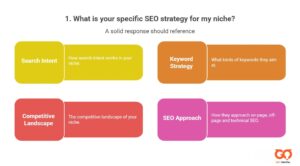
A solid response should reference:
- How search intent works in your niche
- What kinds of keywords they aim at
- The competitive landscape of your niche
- How they approach on-page, off-page and technical SEO
This is one of the questions you must get right from the get-go. A serious SEO program must be an ongoing process of aligning every step with how your market searches.
That’s why in our SEO service, the first step is usually stripping away shallow tactics and rebuilding the strategy around what can realistically drive qualified demand in that specific niche over the next 6 to 12 months.
2. Have you worked with businesses in my industry before?
Industry experience is not mandatory, but industry understanding is. For example, if you work in the healthcare industry, it is crucial that you hire an SEO company that understands seo for healthcare well, including compliance policies and industry nuances.
Ask for recent case studies or references from similar sectors. You are looking for proof that they understand the search behaviors of buyers in your industry.
Follow-up questions to ask:
- How many businesses have you worked with in my sector?
- What were the most common challenges?
- How did you solve those problems?
- What improved after you’d stepped in?
If they can’t answer these questions clearly, they’re probably not the right fit.
3. How do you integrate SEO with our existing content and marketing efforts?
Effective SEO should connect directly to your existing digital marketing strategy, which includes content, paid campaigns, sales funnels, and brand messaging. We advise you to ask how they plan to work with what you already have, instead of tearing everything down and starting from scratch.
A solid answer should include:
- A review of existing content to decide what to keep, update, or remove
- Clear alignment between SEO priorities and sales or lead-generation goals
- Coordination with paid landing pages
- Collaboration with content, social, etc. to avoid duplicated effort
Questions about Measuring SEO Success and Accountability
4. How do you define and measure SEO success?
A reputable SEO agency brings clear primary KPIs tied to business outcomes, such as organic leads, conversion rates, and ROI, not just surface-level metrics that don’t drive actual growth.
A good answer should cover:
- How success connects to your actual business goals, not just rankings
- Which KPIs they treat as primary metrics
- How they evaluate traffic quality and traffic volume
- How often performance is reviewed and adjusted
5. What tools and analytics platforms do you use?
Each tool must have its own use cases rather than just being another software. Most reputable teams rely on a mix of Google Search Console, Google Analytics, and a commercial SEO platform like Ahrefs or Semrush.

Ask practical follow-ups:
- Which tools drive strategy versus reporting only
- Whether you will have access to the same dashboards they reference
- How data from search connects to leads or CRM reporting
6. How often will I receive reports, and what will they include?
You know you have chosen the right SEO agency when their reports explain performance in a way you can act on. You should be able to see what work was done, what changed as a result, and what the agency plans to do next. Ensure reports interpret the data rather than just listing numbers.
A solid report typically includes:
- Performance against agreed KPIs tied to traffic quality, leads, or conversions
- A summary of actions taken during the reporting period
- Observations on what helped or slowed progress
- Clear priorities and action items for the next cycle
Clarity is the essence here. If a report makes you scratch your head with dozens of pages of jargon, that’s not a good sign.
7. When can I realistically expect to see results?
In most cases, meaningful SEO impact shows between three and twelve months. The exact timeline depends on your site history, competition, and how much needs fixing before growth can happen.
Ask them to explain:
- What typically happens in the first three months
- Which signals indicate progress before revenue shows up
- What would cause timelines to extend
Questions about Technical SEO Execution and Ethical Practices
8. What is your approach to link building?
Link building is one of the fastest ways to damage a domain when done carelessly.
You should ask them directly how links are acquired. You want clear confirmation that they avoid link farms or paid link schemes and rely on white-hat methods instead.
That typically includes:
- Digital PR and editorial links earned through content and outreach
- Links placed on sites with real audiences and topical relevance
- Clear criteria for evaluating domain quality before pursuing a link
9. How do you handle Google algorithm updates and follow Google Search Essentials?
You should request a concrete example of how they adjusted strategy after a major update. Listen to the specifics such as diagnosis, prioritization, and specific changes.
Also, remember to confirm that their work aligns with Google Search Essentials. This reduces risk from black-hat SEO tactics that may look good short-term but create long-term exposure, such as cloaking and keyword stuffing.
Things to listen for:
- How they monitor impact after updates
- How decisions are made when performance shifts
- How they follow and adapt to compliance
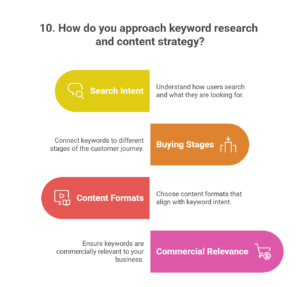
10. How do you approach keyword research and content strategy?
Keyword research shapes what your business becomes visible for.
Ask how they identify search intent, not just search volume. Strong strategies connect keywords to buying stages, content formats, and commercial relevance.
Practical signals of a sound approach:
- Grouping keywords by intent rather than single terms
- Mapping content and creating topic clusters to specific business outcomes
- Clear guidance on what to create, update, or remove
11. Can you explain your process for a technical audit?
A technical audit sets the direction for everything that follows.
Ask them to walk you through the audit process step by step. The goal is to understand how issues are identified, prioritized, and resolved.
A credible process usually includes:
- Crawl and indexation review
- Site speed and performance checks
- Mobile usability and structured data analysis
- Clear prioritization based on impact and effort
A proper audit should be catered to your business and website only. It helps surface what is blocking growth, wasting effort; and what deserves priority. That’s why running a focused SEO audit before committing to long-term work helps teams avoid months of misaligned execution and gives them a clearer baseline to judge any agency’s recommendations.
Questions about SEO Pricing, Contracts, and Working Relationship
12. How do you communicate with us?
You want to talk to the actual specialist doing the work and not an employee that doesn’t follow your campaign closely.
Communication shapes how effective the relationship will be, so this needs to be clear upfront. Ask how communication works in practice.
Make sure you understand:
- What communication methods the agency uses, such as email, phone, or video conferencing
- How often communication happens, such as weekly, monthly, or quarterly
- Who will communicate with you and your team on an ongoing basis
- Whether the agency can meet any custom communication needs you have
This question helps you understand who is accountable day to day, and how easy it will be to get answers when priorities shift or issues come up.
13. What will be my role and required time commitment?
Ask what the agency needs from you to operate effectively. This includes access, approvals, and input that cannot be automated.
Common areas where your time may be required:
- Content approvals and feedback
- Technical access or coordination with your development team
- Product, service, or customer insight needed for keyword and content decisions
You should leave this conversation knowing how much involvement is expected in the first few months and how that changes over time.
14. What is your pricing structure and what exactly is included?
Pricing of SEO agencies only makes sense when scope is clear.
Ask how fees are structured. Most agencies work on a monthly retainer, while others offer hourly consulting or project-based work. What matters more than the model is what is included.
Clarify these details:
- Whether content creation is included or billed separately
- Whether technical fixes are handled by the agency or recommended only
- Whether tools, reporting, and ongoing optimization are part of the fee
15. What happens if I terminate the contract?
Ask what you retain if, in the worst-case scenario, the engagement ends. You should maintain ownership of all work completed during the contract.
That typically includes:
- Website content created or optimized
- Keyword research and strategy documents
- Technical audit findings and recommendations

Companies usually answer this question based on how you end the partnership, which can be because of undesirable results, sudden budget cuts, etc.
Clear answers here signal professionalism and confidence. It also gives you peace of mind before committing to a long-term engagement.
SEO Agency Red Flags to Watch Out For
Guarantees of #1 rankings
No one can guarantee specific ranking positions.
Search algorithms change constantly, competitors move, and results depend on factors outside any agency’s control. Agencies that promise #1 rankings are selling certainty where none exists.
A more grounded discussion focuses on:
- Improving visibility across groups of high-intent queries
- Increasing qualified organic traffic
- Translating search demand into leads or revenue over time
Secretive or vague SEO methods
If an agency cannot clearly explain what they do, how they do it, and why it helps, that is a warning sign. In many cases, secrecy hides shady tactics that cut corners or violate guidelines.
You should be able to understand:
- How links are built
- How content decisions are made
- How technical changes affect performance
If you only hear a bunch of buzzwords or unclear processes, accountability becomes difficult very quickly.
Unusually low SEO pricing
SEO takes time and skilled labor.
Ultra-low pricing often signals automated work, outsourced execution with minimal oversight, or tactics designed for speed rather than durability. These approaches may create short-term movement, but they often leave behind issues that damage long-term performance.
Before focusing on price, make sure you understand:
- How much hands-on work is involved
- Who is actually executing the work
- What corners are being cut to keep costs down
Cheap SEO rarely stays cheap once cleanup is required.
Final Thoughts
The questions in this article are designed to surface how an agency thinks, how they operate, and how they handle risk before any contract is signed. When answers are clear, specific, and grounded in real execution, partnerships tend to last. When they are vague or overly confident, problems usually follow.
At Golden Owl Digital, we usually get involved after teams have already learned this the hard way. Our role is often to help diagnose what to stop, what to fix, and what actually deserves investment going forward. If you are evaluating SEO partners, these questions should help you do so with fewer surprises and more control.
If you want a second opinion on an SEO proposal, audit scope, or agency pitch, that conversation is usually worth having before work starts.

Jaden is an SEO Specialist at Golden Owl Digital. He helps brands rank higher with technical SEO and content that resonates