Strong moving work alone won’t guarantee your company shows up locally.
Reliable trucks and seasoned crews won’t help, even with solid service, if the next customer can’t find you. Moving company local SEO get your business into local results in your area (including Google’s Map Pack), alongside organic listings and AI answers. Keep your Google Business Profile complete. Make citations consistent, keep reviews real, and create content specific to each location. Those are the local signals that put movers in front of customers.
A moving quote often starts with a search, before a recommendation enters the picture. A customer may use a phone to search “movers near me” and ask ChatGPT which mover to contact for a moving quote. If your company appears, it gets the quote request; if it doesn’t, trucks and crews won’t keep it from being invisible.
Why Local SEO Is Your Best Source for Moving Leads
Local search places a moving company in front of customers who are ready to act.
A local search result puts your moving company in view when someone’s ready to make a call. Around 97 percent of consumers turn to search engines when they need a local business, and 88 percent of people who use local search on their phone contact or stop by a business within a week.
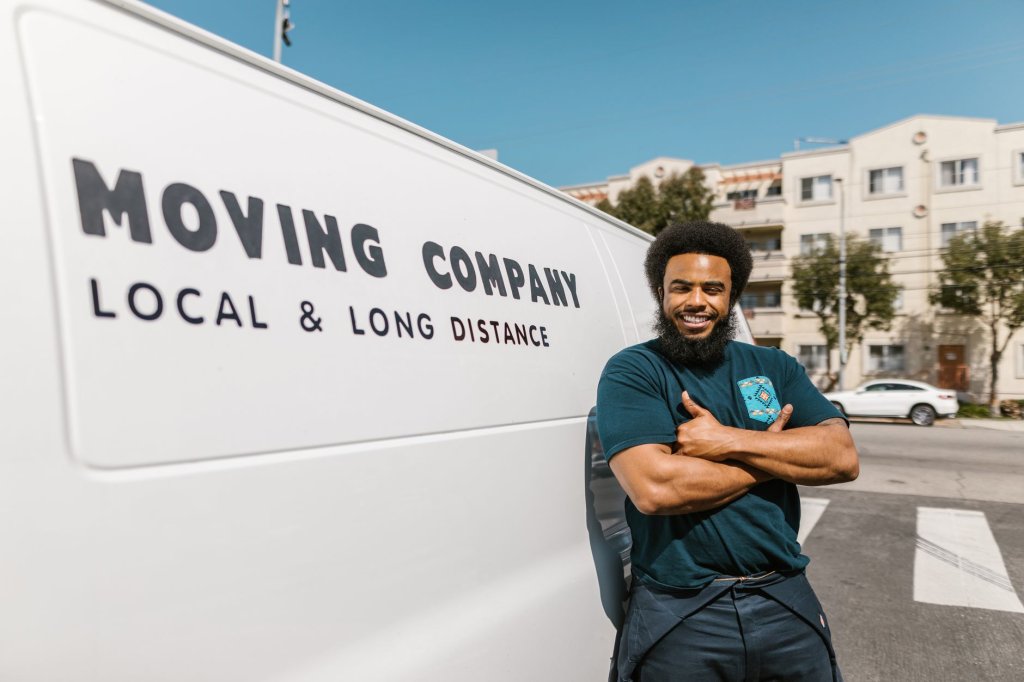
People usually look before moving, and “movers in my city” signals someone who wants to book, not just browse. That reach covers the full customer path.
Google, or increasingly an AI assistant, is where most people look for a moving company. Miss those results, and the call can go straight to a competitor. Local search can make or break a mover.
Summer brings demand spikes, each metro has movers fighting for the same searches, and a single result position can bring in thousands in revenue. Strong local search visibility pays off for movers because people are ready to hire, jobs carry real value, and plenty of competitors still botch the basics. That’s the local field.
Local rankings also shape how customers judge a mover.
Showing up high in local results can make a mover look reputable and dependable, while good reviews back that up before a prospective customer picks a company. Treat positive reviews as a key part of your local search effort. A large volume of positive feedback can lift local visibility and sway a prospective customer toward one mover over another.
This kind of search visibility belongs to you. Leads can keep coming without a cost for each lead, and customers who find you directly often place more trust in you than in a listing on a lead marketplace.
One moving search can carry several decisions at once. Urgency, geography, service type, date, trust, and price sensitivity can all show up together, leaving a generic “Moving Services” page unable to answer them properly.
Your Action Plan for Moving Company Local SEO
A connected local SEO setup gives each nearby trust signal something to support. Bring your Google Business Profile, business citations, reviews, Service & Location Pages, local links, and the details AI tools draw on when recommending you into the same plan. One repair rarely books a move, so keep the pieces tied together.
- Claim and Fully Optimize Your Google Business Profile:
For nearby leads, your Google Business Profile, or GBP, carries the most weight.
- Generate a Steady Stream of Customer Reviews:
Keep Customer Reviews flowing because they build trust and still stand as a major ranking factor.
- Ensure Your Business Info (NAP) is Consistent:
Make your Business Info, or NAP, match everywhere online: your Name must stay identical, as must your Address and Phone.
- Build High-Converting Service & Location Pages:
Build a dedicated website page for every service and each area you cover.
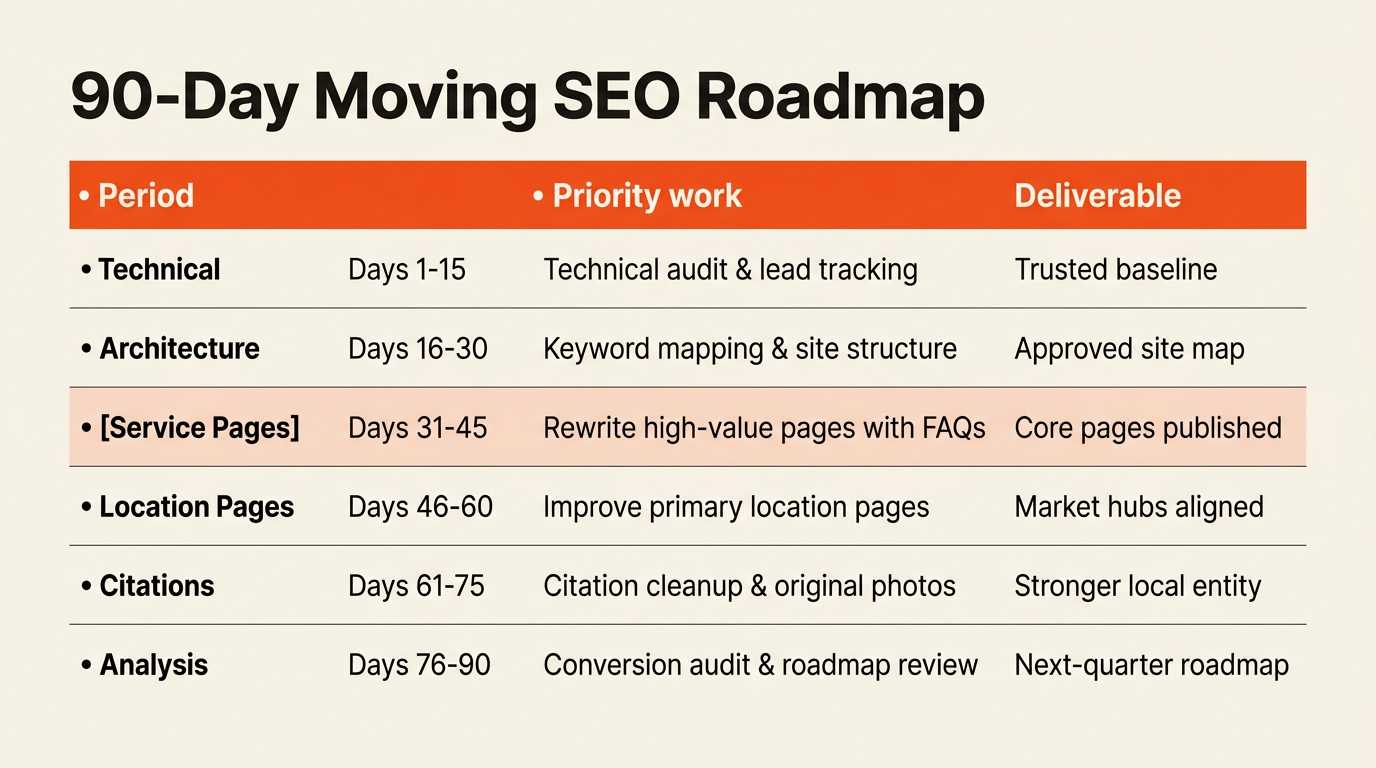
This table lines up high-impact tasks, starting at a technical baseline and moving toward repeatable local growth, before the detailed 90-day plan.
| Period | Priority work | Deliverable |
|---|---|---|
| Days 1-15 | Technical audit, Search Console baseline, GBP audit, lead tracking, form and phone QA | Trusted baseline and prioritized defect list |
| Days 16-30 | Keyword-to-page map, architecture, duplicate consolidation, titles, internal links | Approved site and content map |
| Days 31-45 | Rewrite highest-value service pages with scope, process, pricing factors, proof, and FAQ | Core money pages published |
| Days 46-60 | Build or improve primary location pages with unique local evidence; remove weak doorway-style pages | Market hubs aligned to real service areas |
| Days 61-75 | Review workflow, citation cleanup, partner outreach, original photos, trust and FMCSA content | Stronger local entity and trust signals |
| Days 76-90 | Publish one high-value cost/planning resource, analyze behavior, improve conversion, review early query movement | Next-quarter roadmap based on evidence |
Fully Optimize Your Google Business Profile
Local customers can find needed details through a complete Google Business Profile, which also reinforces signals that feed local leads.
- Fill every field in your Google Business Profile, choose the right primary and secondary categories, add real photos of your trucks and crews, then keep accurate service areas listed and regular posts published.
- A complete, active profile tells Google the business is real, responsive, and worth showing first when local customers search for moving help.
- Audit the business name, address, phone number (NAP), and hours of operation; keep every detail accurate and up-to-date.
- Choose categories that match the work: “Moving Company,” “Moving and Storage,” or “Piano Moving Service.”
- List every service you offer: packing and unpacking, loading and unloading, and transportation.
- Add photos showing your team, equipment, and completed moves.
- Upload videos that show services or include customer testimonials.
- Answer customer questions and reviews promptly.
Show photos that capture both the jobs you handle and the people doing them, so the profile has more pull.
- Team Photos: Show your actual crew in uniform to build trust and humanize the business.
- Branded Trucks & Equipment: Clean, branded trucks communicate professionalism.
- Action Shots: Show the crew carefully wrapping furniture, loading the truck, or navigating tricky spaces.
- Before & After: Show a packed room, then the empty, clean room after the move.
- Video Testimonials: A short clip of a happy customer at the end of the move can be powerful.

A moving company that visits customers instead of serving them at its address should be set up for local seo for service area businesses and keep its address hidden from the public. A real staffed location may qualify as a hybrid or storefront business during stated hours.
A virtual office, mailbox, or unstaffed location shouldn’t be used to manufacture map visibility.
Set up a separate profile only for a legitimate, eligible location that’s staffed and accurately represents the business, then match it with its location page, phone handling, hours, and local proof. Don’t create profiles solely to rank in neighboring cities.
Building Trust with Customer Reviews
Reviews are one of the strongest local ranking factors and the single biggest trust signal a customer, or an AI assistant, weighs when choosing a mover. Ask every satisfied customer for a review, respond to all of them, and keep the flow steady rather than in bursts.
- Ask real customers right after a completed move, while the experience is fresh.
- Provide a direct review link or QR code so leaving feedback takes seconds.
- Respond promptly to both positive and negative feedback.
Cadence matters as much as count. A steady trickle of fresh reviews signals an active, healthy business, while a pile of old reviews and nothing recent reads as a company that has gone quiet.
Every review, good or bad, is a public chance to show your professionalism and commitment to customer service, so treat a negative review as a place to respond well rather than one to ignore. Keep your review practices within Google’s rules: don’t offer discounts, cash, gifts, or services in exchange for reviews, don’t request only positive ones, and don’t pressure customers to change criticism. Google explicitly prohibits incentivized and fake engagement, including incentives to post, change, or remove reviews.
Your Website Design for Converting Leads
A moving company website should let customers and crawlers move from the business overview to a service, market, proof, and estimate without navigating an artificial maze. Every indexable page should be linked from a logical hub or navigation path, and breadcrumbs should carry the hierarchy instead of dozens of keyword links stuffed in a footer.
/
├── services/
│ ├── local-moving/
│ ├── long-distance-moving/
│ ├── apartment-moving/
│ ├── commercial-moving/
│ ├── packing-services/
│ └── storage/
├── locations/
│ ├── denver-co/
│ ├── aurora-co/
│ └── lakewood-co/
├── moving-resources/
│ ├── moving-cost-guide/
│ ├── moving-checklist/
│ └── how-to-choose-a-mover/
├── reviews/
├── about/
└── request-an-estimate/
A service page should help a customer decide whether the company can handle the move, not simply repeat the phrase “professional movers.” Build each one around these elements:
- Specific promise: identify the move type, market, and genuine differentiator.
- Who the service is for: apartment, household, office, senior, military, student, specialty, or another supported segment.
- What is included: crew, truck, equipment, packing, disassembly, protection, loading, transport, unloading, and setup.
- Process: explain estimate, scheduling, preparation, move day, delivery, and follow-up.
- Pricing factors: distance, volume, access, labor, packing, storage, valuation, season, and minimums.
- Service boundaries: clearly state what the company can and cannot handle.
- Proof: licenses, registration, insurance, real photos, relevant reviews, case examples, and team experience.
- FAQ: answer actual pre-sale and support questions.
- Estimate CTA: phone and form with a clear response expectation.
Every claim should be verifiable and current. Don’t invent prices, insurance coverage, licenses, service areas, review counts, years in business, or “#1” status.
How to Create Content for Local Services
Movers rank by matching real searches, so build a page for each thing people look for: your main city, the suburbs and metros you serve, and each service such as local moves, long-distance moves, packing, and storage. A dedicated page for movers in each city you cover will always outrank a single generic page trying to target them all. Write each one for a real person deciding who to hire, not just for the keyword.

Blog posts that address common moving concerns in your area, such as “Tips for Moving in [Your City]” or “How to Choose the Best Movers in [Your Neighborhood],” help you rank for local searches and establish your business as the local expert. Packing guides and posts on local moving regulations work the same way.
A few on-page basics carry each page:
- Title tag: include your primary keyword and make it compelling enough to earn clicks.
- Meta description: give a brief overview of the page and work in relevant keywords.
- Header tags (H1, H2, H3): structure content into a clear hierarchy, and include your main keyword in at least one header, ideally the H1.
A location page is justified when the company genuinely serves the market and can provide information that helps a person plan a move there. Changing the city name across otherwise identical pages creates little value and can resemble doorway or scaled-content abuse. Don’t publish a page when the only unique text is the city name, the company can’t realistically serve the area, or another existing page already satisfies the same intent. A page earns its place with:
- Services genuinely available in that market.
- Clear service boundaries and dispatch expectations.
- Local moving constraints: building rules, parking, elevators, permits, access, weather, or seasonal demand where accurate.
- Real moves, photos, customer stories, crews, or partnerships connected to the area.
- Pricing factors and estimate requirements specific to the market.
- A unique FAQ based on calls, estimates, and customer questions from that area.
Keyword Research for Moving Companies
Keyword research is the foundation of the whole plan, because it identifies the exact terms customers use and points each one at the right page. Map the terms to categories before you write anything.
| Keyword category | Examples | Intent | Target page |
| Core local | moving company [city], movers [city], movers near me | Hire locally | Primary location/homepage |
| Service | apartment movers, office movers, packing services | Find a specific service | Dedicated service page |
| Service + location | apartment movers [city], office movers [city] | Hire local specialist | Best matching service/location page |
| Distance | local movers, long-distance movers, interstate movers | Choose move type | Local or long-distance service page |
| Route | moving from [city] to [city] | Research a specific relocation | Route guide only when genuinely supported |
| Specialty | piano movers, senior movers, labor-only movers | Find specialized capability | Specialty service page |
| Cost | moving cost [city], how much do movers charge | Estimate budget | Cost guide or calculator |
| Trust | licensed movers [city], insured moving company | Reduce hiring risk | Service page with verifiable proof |
| Informational | moving checklist, how to pack dishes | Prepare for move | Guide or checklist |
Hyperlocal keywords add specific geographic terms such as zip codes, neighborhoods, or street names, like “moving company in Ditmars Queens” or “movers in 10021.” Long-tail keywords are more specific phrases with lower volume but less competition, such as “best local moving companies in [your city]” or “affordable long-distance moving services in [your state].”
Create a keyword-to-page map before writing. If the homepage, “local movers” page, and city page all target “Denver moving company,” Google and users get no clear destination. Select the page best able to satisfy the query, then have supporting pages link to it with descriptive, varied anchors. Search volume doesn’t equal value, so score each topic by service availability, geographic fit, margin, lead quality, seasonality, current visibility, page gap, and competitive difficulty.
Establishing Authority with Citations and Backlinks
A citation is any place your business name, address, and phone number appear online, from directories to review sites. When that information is inconsistent across the web, it confuses Google and the AI tools that read the same data, and it drags down your local rankings. Make every name, address, and phone number identical across your website, social profiles, Google Business Profile, and local directories, and audit them regularly to keep the details accurate.
Citations work like listings in different phone books: the more consistent listings you have, the more legitimate your business appears. Backlinks are more like a personal recommendation from another respected business, carrying even more weight. A few sources are worth prioritizing:
- Yelp, Yellow Pages, and the Chamber of Commerce: essential general directories for movers.
- Foursquare: valuable for location-based discovery of nearby businesses.
- Industry directories such as Movers.com: add credibility and attract potential customers.
Links from local and industry sources tell Google your business is established and trusted in its market. Local sponsorships, partnerships, and useful content, like a guide to moving costs in your city, earn the kind of coverage that builds authority. Creating valuable, informative content such as blog posts, how-to guides, moving checklists, or industry news updates is one of the most effective ways to attract those backlinks.
Essential Technical SEO for Movers
Technical SEO keeps the backend elements search engines rely on in solid shape, so they can crawl and index your pages efficiently while the site stays fast and easy for visitors to use. Four things carry most of the weight for a moving company.
Mobile-friendliness comes first. Google prioritizes mobile-friendly sites in local results, and most “movers near me” searches happen on a phone. Use a responsive design that adapts to any screen size, keep menus intuitive, and put contact details, services, and reviews within easy reach. Optimize page titles, meta descriptions, and header tags for local intent, then test the site on real devices and with Google’s Mobile-Friendly Test to catch issues early.
Page speed protects the experience. A slow site raises bounce rates and lowers rankings, and Google recommends pages load within 3 seconds. Optimize images, minify CSS and JavaScript, and leverage browser caching, then use Google PageSpeed Insights to check performance and apply its suggestions.
Schema defines your business for Google. Structured data helps search engines understand your business information; it doesn’t guarantee a rich result or a ranking. It acts like a standardized label on a package, telling engines exactly what’s on your page, your address, hours, and services, in a language they instantly understand. Use the most specific LocalBusiness subtype available, include required and relevant recommended properties, and validate with the Rich Results Test and URL Inspection.
<script type=”application/ld+json”>
{
“@context”: “https://schema.org”,
“@type”: “MovingCompany”,
“@id”: “https://example.com/#moving-company”,
“name”: “Example Moving Company”,
“url”: “https://example.com/”,
“logo”: “https://example.com/images/logo.png”,
“image”: “https://example.com/images/crew-and-truck.jpg”,
“telephone”: “+1-303-555-0100”,
“priceRange”: “$$”,
“address”: {
“@type”: “PostalAddress”,
“streetAddress”: “123 Example Street”,
“addressLocality”: “Denver”,
“addressRegion”: “CO”,
“postalCode”: “80202”,
“addressCountry”: “US”
},
“areaServed”: [
{“@type”: “City”, “name”: “Denver”},
{“@type”: “City”, “name”: “Aurora”}
],
“openingHoursSpecification”: [{
“@type”: “OpeningHoursSpecification”,
“dayOfWeek”: [“Monday”, “Tuesday”, “Wednesday”, “Thursday”, “Friday”],
“opens”: “08:00”,
“closes”: “18:00”
}],
“sameAs”: [
“https://www.facebook.com/example”,
“https://www.linkedin.com/company/example”
]
}
</script>
Replace every placeholder with verified information. Don’t publish an address customers can’t visit if policy requires it hidden, and don’t add self-serving review markup expecting stars on your own LocalBusiness page. Keep website, profile, and schema information consistent.
An XML sitemap guides search engines through your site’s structure and helps them locate every page. Submit it through Google Search Console for proper indexing, and keep it limited to canonical, indexable URLs.
Measuring SEO Success and Driving Conversions
Clear SEO reporting starts once visitors can use the site and you split vanity scores from business results. Rankings can help, sure, but calls, form submissions, and any other action that ends in a booked job deserve your attention.
Check your results regularly to see whether SEO is producing the results you expected. Open Google Analytics and Google Search Console, then track site traffic, query positions, and user behavior.
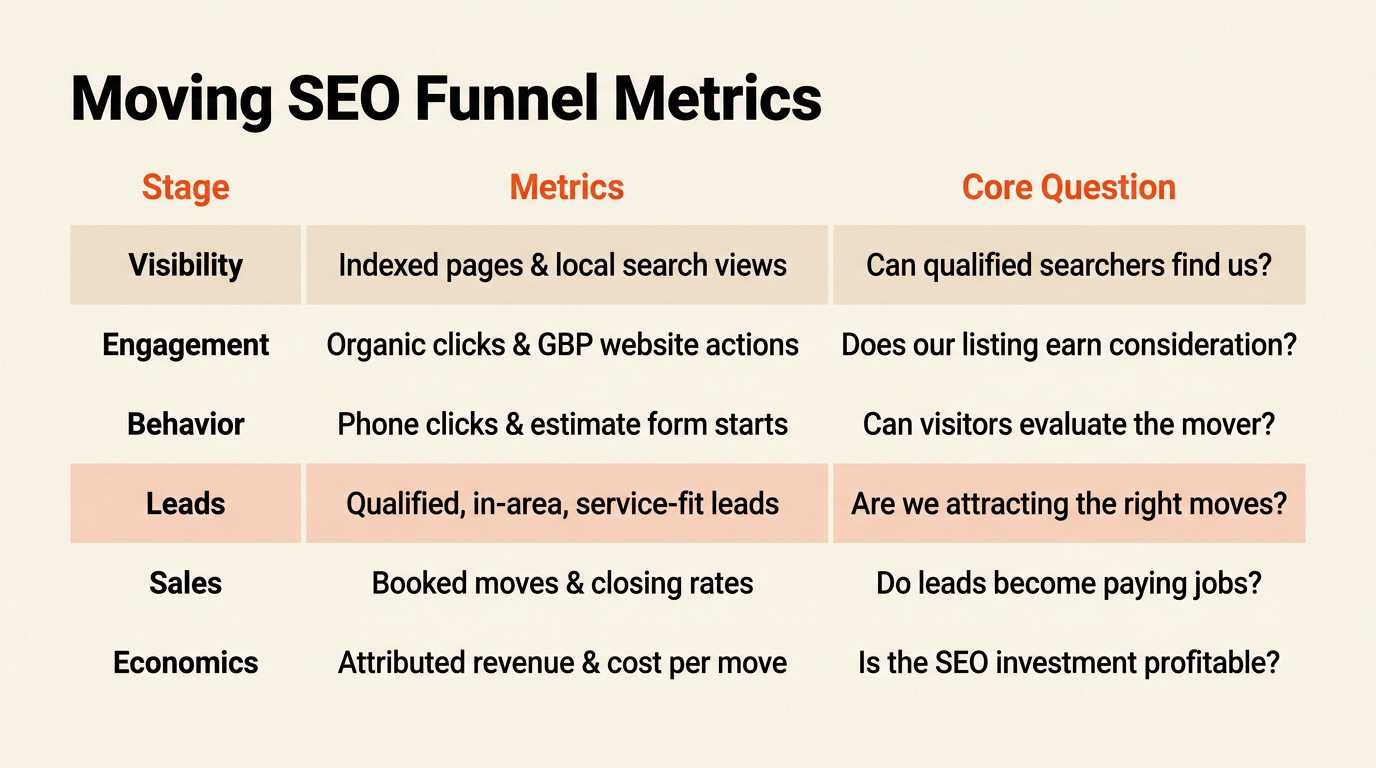
The funnel stages that follow tie moving-company SEO scores to the questions each set of numbers can answer.
| Stage | Metrics | Question answered |
|---|---|---|
| Visibility | Indexed pages, impressions, query coverage, local profile visibility | Can qualified searchers find the company? |
| Search engagement | Clicks, CTR, landing pages, GBP website/call actions | Does the result earn consideration? |
| Website behavior | Service views, phone clicks, estimate starts, form errors, completion | Can visitors evaluate and contact the mover? |
| Lead quality | Qualified, in-area, service-fit, spam, duplicate | Is SEO attracting the right moves? |
| Sales | Quotes, booked moves, close rate, days to booking | Do leads become jobs? |
| Economics | Booked revenue, gross margin, cost per booked move | Is the SEO program profitable? |
Taken together, the stages take you past rankings and show whether search Visibility leads to consideration, qualified leads, Sales, and profitable booked moves.
Use these formulas to calculate key SEO results.
Qualified lead rate = qualified organic leads ÷ organic sessions × 100
Booked-move rate = organic booked moves ÷ qualified organic leads × 100
Organic revenue per session = attributed booked revenue ÷ organic sessions
Cost per booked move = SEO program cost ÷ organic booked moves
Attribution has gaps, so write them down before you let any one system stand in for the whole customer path. Someone may first find a mover in organic search, come back via brand search, call from Maps, or book after several visits. Pull together analytics, call tracking, CRM source data, and customer self-reporting.
Use Behavior Data to Prioritize Fixes
Use Plerdy to break out organic landing-page sessions, then watch Website behavior and see how people move through the site. Look for missing phone links, dead clicks, proof beyond a low-scroll point, people repeatedly checking price information, form drop-offs, and mobile layout issues. Fix Objective defects directly. When traffic is sufficient and the results for two valid conversion experiences remain unclear, use A/B testing to compare them.
Common SEO Mistakes That Cost Movers Money
Minor local search slipups can quietly drag a mover’s rankings down and cost it potential jobs.
Pages that differ only by a city name do little for your local search visibility and may resemble doorway pages or scaled-content abuse.
When customers or an AI assistant choose a mover, reviews rank among the strongest local ranking factors and stand as the single biggest trust signal.
Any listing with your business name, address, and phone number is a citation, including directories and review sites. Check those citation details all across the web, since Google and AI tools use the same listings, then make every business name, address, and phone number match. Mismatches can confuse those systems and drag down local rankings.
An incomplete or stale Google Business Profile costs your moving company visibility and leaves the most important local ranking factor neglected.
The mistakes below can weaken link authority and make the business harder for customers to find online:
- Ignoring AI search can leave a moving company out of consideration, since a growing share of customers ask an assistant for a mover before opening Google.
- Chasing quantity over quality, ignoring the relevance of linking sites, or using manipulative or ‘black hat’ SEO tactics are common link-building mistakes.
- Search engines may answer with penalties, while the business’s online reputation can suffer too.
- Put Quality backlinks from reputable, relevant sources first.
Preparing Your Business for AI Search
When a move is coming up, more customers begin with questions, not a search box. They may ask who are my city’s best movers and whether they can trust this company. They also want to know who can handle a long-distance move next month. That’s their starting point.
AI tools tend to lean on businesses that look trustworthy wherever they show up online. For moving companies, your local reputation also steers how often AI brings you up.

To recommend a mover, an AI assistant draws on much of the local credibility that helps a business win the Map Pack. The local work is the same, though its answer lands in a different box. A fully built-out Google Business Profile, matching citations, solid reviews, and useful local pages can earn citations in ChatGPT and AI Overviews.
Give AI tools details they can scan and cite without guessing. Clear service pages plus a complete Google Business Profile give them something solid to pull from. When someone asks for a mover, strong reviews and accurate details around the web help. Your existing local efforts can earn a recommendation if the information stays clean and consistent enough for a machine to trust.
The work described here led to 69 or more AI citations for one mover featured in this guide.
Showing up in AI-generated answers doesn’t call for a new secret trick. The job remains making your company the clearest and most authoritative source of moving information in your area, one people trust, using the same SEO fundamentals covered throughout this guide.
Check your AI visibility with one simple prompt. Type, “What’s the best moving company in [City]?” then see whether your business makes the answer. Insites’ review of 10,000 U.S. businesses showed that, for unbranded discovery questions put to AI tools such as ChatGPT and Perplexity, 41% did not receive a recommendation.
Using Paid Ads to Complement Your SEO
Paid advertising can bring immediate visibility while SEO builds a lasting source of leads.
Paid ads can put your moving business in view quickly. In Google Ads, build the ad around relevance and attention, then start with clear, action-led search terms like “affordable movers near me” and “San Diego moving services.”
Your ad copy should spell out why the company stands apart, whether that’s competitive pricing or excellent customer reviews. Add Call buttons and location details so potential customers can contact you without hunting around. Keep contact simple.
Strong copy still won’t save an ad shown to the wrong people. Set location targeting for the area you serve, so your ads show to people seeking moving services nearby. Then adjust Bids for site visitors, which can show ads more often when they’re ready to move and more likely to pick you. Returning visitors get the edge.
As people scroll their feeds, Facebook and Instagram give you another route to prospective customers. Use visual ad formats to show your services, from brief clips of a smooth move to photos of happy customers after the job is done. Both fit the feed.
Social ad targeting lets you narrow the audience further. Choose demographic and behavioral signals that may point to people looking for relocation help. Retargeting can bring back people who engaged with your website or social media profiles without booking a service, keeping your business on their mind afterward.
Retargeting keeps your moving company connected with people who showed interest but have not made a decision.
Someone who visits your website or engages with content without booking can later see Retargeting ads as they browse other websites or social media platforms. Those ads keep your relocation firm’s services in view.
Follow up when someone shows interest. Send personal messages, such as “Ready to make your move?” or a special discount, after a website visit or social interaction to nudge them toward your company. Keep showing up across websites and social media platforms. Staying in front of potential customers raises the chance they return to your site and become paying customers, while Retargeting makes those first ad efforts more cost-effective and keeps potential leads from slipping through the cracks.
Paid ads and SEO run on different clocks. Paid advertising may drive calls almost at once, yet they stop as soon as payment stops. SEO needs more time to build, then becomes a lasting asset that can keep bringing the business leads over the long term.
FAQ
What is local SEO for moving companies?
Local SEO for moving companies means showing up in local search results over time, where most customers are looking for a nearby moving service.
How long does it take for SEO to work?
You’ll usually see early local SEO changes over the first few months, especially in the Map Pack once your Google Business Profile and reviews improve. Organic results and AI answers tend to grow more over six to twelve months of consistent effort. Ongoing campaigns beat one-off fixes.
What are the most important SEO factors for movers?
A fully built-out Google Business Profile serves as your digital shopfront and does more than list business details. Accurate, consistent citations build trust with Google and strengthen your presence around the web.
Should I use SEO or buy leads from other sites?
Sure, there’s room for both options, but the long-term payoff splits quickly. Lead sites charge you for each lead while placing you beside competitors bidding on that same customer.
A 2026 review of over 7,800 home-service contractor accounts found SEO leads cost between $15 and $40. Yelp leads ran between $50 and $180, while Angi leads cost $80, $250.
Buying leads can bring volume right away, while putting money into your own SEO creates an asset that brings cheaper leads over time.
How do I rank for “movers near me” searches?
An active Google Business Profile, steady reviews, consistent citations, and city-specific pages all support near me and in-city searches. For near me searches, Google looks at proximity, relevance, and prominence, which help shape prominence.
Consistency pays off for moving company SEO, even though the tasks are straightforward and plenty of competitors still let them slide. Keep your Google Business Profile current, clean up citations, and keep earning reviews. Build pages for every city and service you cover, then arrange the details so AI tools can recommend your business.
A solid SEO agency sends regular reports, explains the numbers clearly, and speaks plainly about campaign results. With an experienced agency running the online side, you can run the moving company while its team fine-tunes the campaign.
You’ve got the key pieces now: moving company local SEO for nearby moving searches, a Google Business Profile and citations that build visibility, reviews and pages that support near me results, and reports that track campaign performance. Lead sites can bring volume, while consistent work builds over six to twelve months across the Map Pack, organic results, and AI answers. Keep the signals fresh and the reports easy to follow.