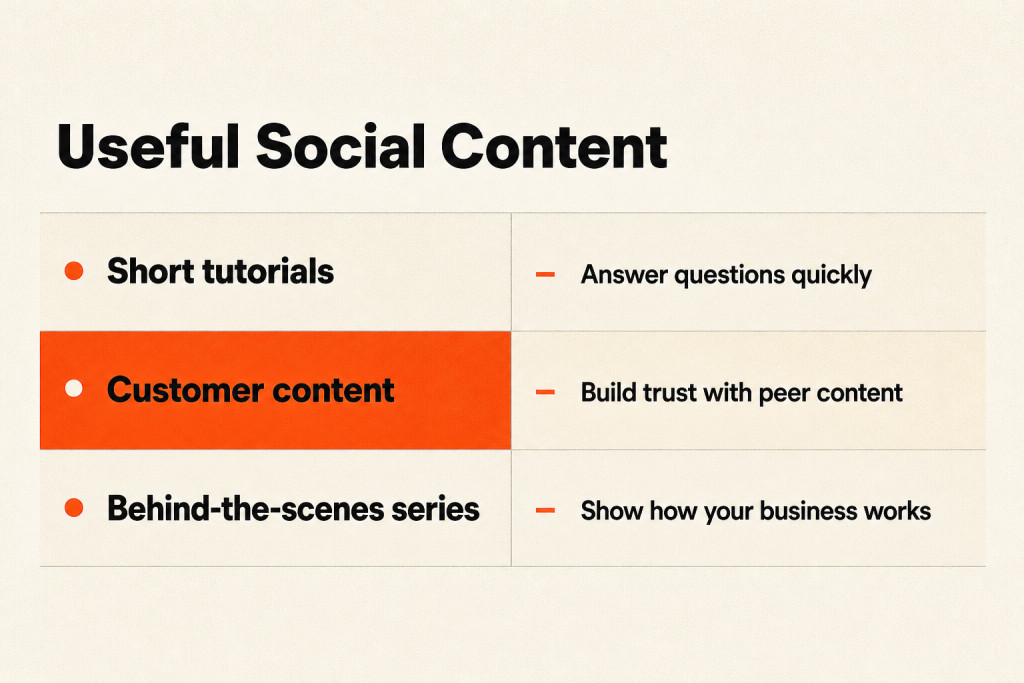
Insurance social media marketing can attract attention, but it can be difficult to know whether a prospective customer is closer to requesting a quote. In r/InsuranceAgent, an agent raised the issue: likes don’t tell you whether an actual buyer is getting closer to asking for a quote.
Use this guide to turn posts into appointments, choose channels that fit the buyers you serve, and assess whether social activity brings leads or only likes.
How to build an insurance social media marketing system in six steps
Build the system in six steps: make the first two decisions, then turn the last four into a weekly rhythm.

Step 1: Primary line of business
Choose one primary line of business for the next 90 days: personal lines, commercial lines, Medicare and health, or life. Each line has its own buyers, sales cycles, and rulebooks, so each one calls for a different approach to social content.
A local personal-lines agency
A local personal-lines agency competes on familiarity within a ZIP code, where neighbors often share recommendations.
A commercial producer
A commercial producer sells to other businesses, where credibility matters to a buying committee.
A Medicare agent
For a Medicare agent, product-specific rules and a hard seasonal calendar set the pace.
Trying to serve all four with one content calendar can leave your social accounts full of generic insurance quote graphics.
Step 2: Platforms your buyers use
Choose one or two platforms where your clients are already active, then build from there, using the buyer from step 1 as your guide.
Business owners read about operational risk on LinkedIn, so prioritize it for commercial coverage. For personal or Medicare lines, Facebook is where families and seniors share community recommendations.
Step 3: Customer question bank
Start with your service inbox; it already holds the questions your team answers each week. Think about what a deductible does during a claim, why a premium rose without a claim, and what a rider covers. Add what happens at renewal, whether a home business needs its own policy, and what the enrollment window is this year.
Write down each question you answer twice.
Aim for 25 to 30 questions. That gives you a quarter’s worth of posts before anyone drafts a caption, with each one answering something a real prospect is typing into a search bar.
Step 4: Educational video content
Talk through each video like you would with an insured client across your desk. Batch clips in one sitting to keep the framing and tone consistent, then schedule them out afterward.
Written posts work, but short video can do more when a product needs explaining and the buyer needs to trust a person. Simple explanations of policy exclusions build more confidence than polished agency commercials.
Step 5: One next step per post
Give each post one of these next steps, then use that same action across the batch:
- request a quote
- book a 15-minute review
- download a coverage checklist
- send a DM with a question
Check the destination on a phone and ask only for the minimum information you need to follow up. A post that explains a deductible well but ends there leaves a brand impression and no lead.
Step 6: Lead tracking to booked appointments
Track each social lead from its recorded source through quote requests, booked appointments, and bound policies in your AMS or CRM. At intake, record every inbound lead’s source, including “Facebook DM” and “saw a video.” Without that tag, social gets no credit and is the first channel cut.
Report the two tiers separately:
Diagnostic metrics
Reach, saves, and profile visits are Diagnostic metrics.
Business metrics
Quote requests, booked appointments, and bound policies are Business metrics.
Diagnostic metrics show whether people liked a post; booked appointments show whether your content brought in an actual buyer.
Wait a full quarter before judging. Organic content can take time to build momentum.
Which social media platform fits each insurance line?
Platform choice varies by insurance buyer; ranking guides don’t agree, so agents should choose by buyer and use case.
| Platform | Target Insurance Line | Primary Buyer & Use Case | Content Format |
|---|---|---|---|
| personal lines, local agencies and Medicare-age audiences | where families and seniors already spend time | educational posts, reminders, event promotion, and community-based content | |
| commercial lines and group benefits | where the buyer is another business | industry news, tips, and regulatory updates | |
| Instagram and TikTok | younger personal-lines buyers | short educational explainers | short, engaging videos |
| YouTube | all lines | searchable, longer answers that keep working months after you post them | breaking down complex topics |
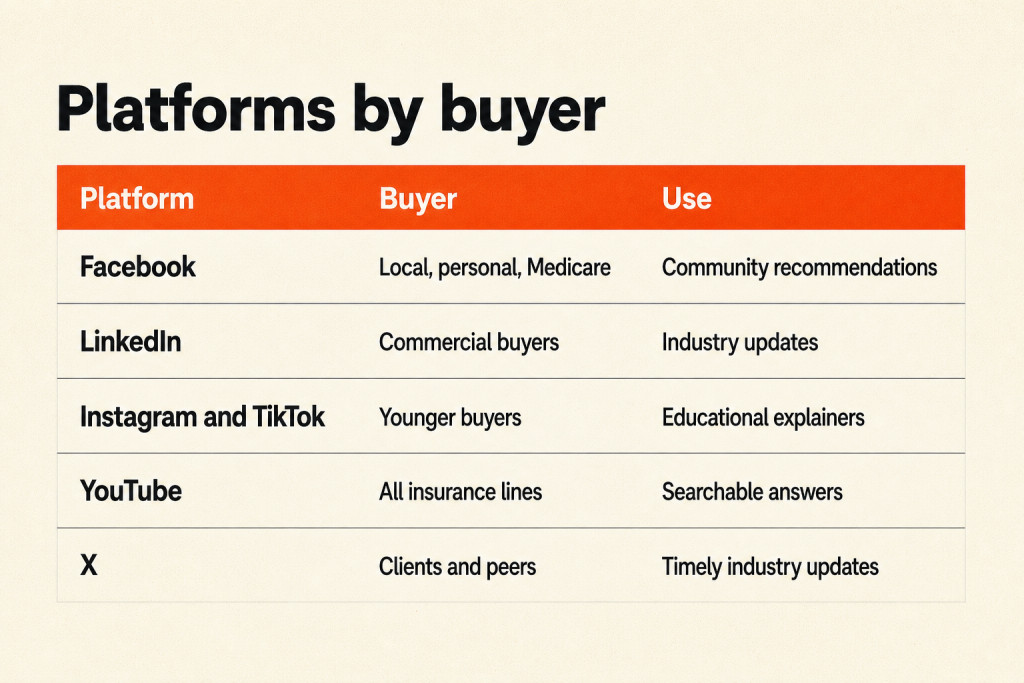
X (Twitter) moves quickly; agents can use it to engage promptly with clients and peers, sharing timely updates alongside industry news and regulatory changes. Your followers keep up with new health insurance laws and homeowners insurance policy changes, as well as relevant economic trends.
Pros and cons of hiring an insurance marketing agency
An agency can boost production, but which leads it brings in and how well it fits your needs remain open questions. A social media marketing consultant can also provide external support.

- Pros: Agency support can handle production, bring category-specific creative and compliance awareness, and free producers to sell. It is also faster to start than building those skills in-house.
- Cons: Until you can tell which leads came from the agency, the monthly cost can be hard to justify. Outsourced content can also read as generic when the vendor is not part of your service calls.
What compliance rules apply to insurance marketing?
Which rules apply depends on the product and the content type, and those rules can vary.
- Every agent, on every post: The FTC’s Endorsement Guides require clear, conspicuous disclosure of any material connection between an endorser and a business (the FTC says ordinary consumers must find the disclosure easy to notice and understand). Payment, free products, employment, and a family relationship all count, so an employee or relative praising your agency in a post is covered. Truth-in-advertising standards apply to your claims either way.
- Medicare and Part D: Before use, materials that promote plan benefits generally go through carrier and CMS submission. The line between “communications” and “marketing” has been unstable. For contract year 2026, CMS proposed broadening the definition of marketing, but left that provision out of the April 2025 final rule and noted it may revisit the proposals in future rulemaking. Check the current standard with your carrier or FMO each plan year; last season’s guidance may no longer fit.
- Securities and variable products: FINRA rules require communications from you or your firm to be fair and balanced, without false, exaggerated, or misleading claims under Rule 2210. Business-related communications also bring supervision and recordkeeping obligations. The rules cover variable annuities and variable life, and general P&C content falls outside them.
- Everything else: State insurance advertising rules and your carrier’s own marketing requirements apply, and both vary.

Note the rules that apply to each post in your content calendar. Before production starts, have posts that name a specific product, quote a rate, or include a testimonial reviewed. Before anything goes live or gets distributed, check its claims, disclosures, wording, and overall fit.
Templates, content that’s already been reviewed, approved campaigns, and carrier marketing libraries can save agents time and keep P&C posts within the carrier’s own marketing requirements. Those materials can speed up posting, but generic content may still need personal, local commentary to encourage direct inquiries.
Keep track of platform policies, Medicare-sensitive language, and campaign documentation. As your efforts grow, record approvals, versions, and final assets.
Mistakes insurance agents make on social media
On Facebook or LinkedIn, an outdated agency page can quietly cost you a referral. A referred prospect may hear your agency’s name at a barbecue, then check the page and find a post from 14 months ago, incorrect hours, or missing license information. Keeping the profile accurate remains the cheapest conversion work available.
A reply to a coverage question in a message may still go nowhere if the person disappears afterward. Create a clear handoff with a booking link or callback time, then send a short follow-up video tailored to their specific situation.

There’s no insurance industry standard for how often agents should post or what share of content should cover each topic. Different guides recommend approaches such as a 4:1 content ratio or a 5-3-2 split, while some specify a fixed weekly frequency. Choose a posting pace your team can maintain through open enrollment and storm season, then adjust it based on your own results.
Frequently asked questions
Can you run insurance ads on Facebook?
Yes, you can run insurance ads on Facebook, but insurance advertising must follow platform advertising policies, your state’s rules, your carrier’s requirements, and truth-in-advertising law. Medicare plan-specific ads also have additional CMS requirements.
Does social media work for life insurance agents?
Yes, social media can keep life insurance agents present until a trigger event (a baby, a mortgage, or a business partnership) starts the conversation. Short myth-busting clips and scenario-based content are effective life insurance social media marketing approaches. Inquiries may take longer than in personal lines because life insurance is a considered purchase, with no renewal cycle forcing the conversation.
How often should insurance agents post on social media?
For insurance agents, two to four quality posts per week is a good starting point for a social media schedule. Daily posting isn’t required; show up consistently enough to stay visible and relevant.
Conclusion
Insurance social media marketing generates leads when posts answer a real question and give people a clear next step. Start with one real customer question, shape it into a useful post, and make its next step clear. A schedule of two to four quality posts per week gives agents a workable starting point.