The debate around generative engine optimization vs traditional SEO is growing, but don’t worry about throwing out all your existing SEO work. GEO builds on top of it.
If SEO is the work of getting your facts and structure right, GEO is the work of projecting your brand’s authority so the AI uses your perspective in its synthesized answers. Standing still isn’t a neutral choice; it’s actively letting your competitors walk away with your market share while you wait.
Why Your Organic Traffic Is Dropping Due to AI
If you’re seeing your organic traffic fall off a cliff while your rankings are holding steady, it just means your old playbook is officially out of date. This is a fundamental change in how search works. Sticking to your guns is a quiet surrender.
The Rise of Zero-Click, AI-Generated Answers
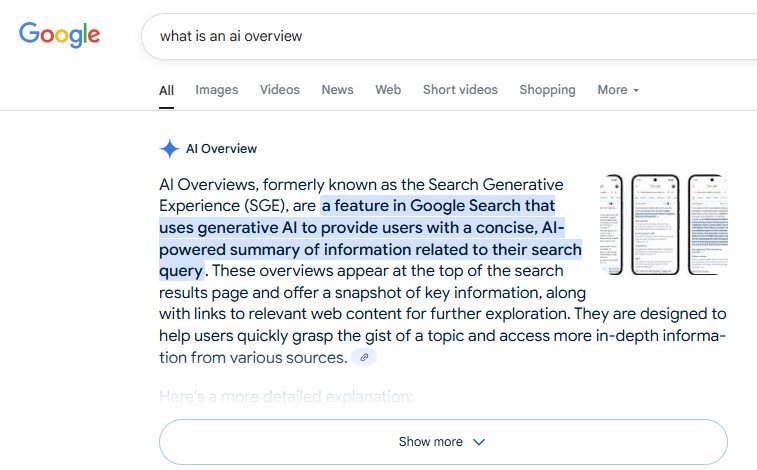
People get their answers right at the search results page there and leave, because platforms like Google’s AI Overviews, ChatGPT, and Perplexity are designed to give a complete answer on the spot.
An Ahrefs study found that Google’s AI summaries can slash click-through rates by 58% for content in the top spots. That’s a huge jump from the 34.5% drop they saw the year before.
The firehose of clicks is slowing to a trickle: for every 1,000 searches in the United States, only about 360 even go to the open web. In the European Union, it’s 374.
Most searches don’t lead to a click anymore. SparkToro’s 2024 ‘Zero-Click Search Study’ drove this point home, finding that 58.5% of searches in the U.S. and 59.7% in the E.U. end right there on the results page.
Why Google Is All-In on Generative Search
This isn’t happening by accident. Google is playing defense. Given that Google commands approximately 90% of the global search market, it has everything to lose.
New AI-first tools like ChatGPT, Perplexity, and Claude are a real threat, so Google’s only viable countermove is to retain users within the search result itself. That sounds really obvious, but it’s easy to forget that Google is a public company trying to survive.
So in this fight for its own future, Google has made a choice. Keeping users on its page is now the top priority. Every AI Overview that pops up is a deliberate decision to put Google’s business ahead of yours.
When Traditional SEO Isn’t Enough Anymore
High rankings just don’t guarantee clicks anymore. As Neil Patel from NP Digital points out, you can hold your position perfectly and still watch your clicks evaporate the moment Google’s AI Overviews show up for your keywords.
That’s because the AI is looking for different things. Conventional SEO signals like backlinks and keyword-optimized headers still secure SERP placement, but large language models disregard them. LLMs give preference to entity clarity, direct explanations, and corroboration from multiple sources.
You must first realize that you need to prove this is happening to your own site. You have to do things that don’t scale. Go into your Google Search Console and find 10-20 of your important keywords where clicks have dropped over the last 3-6 months, but the ranking has stayed stable in the top-5. Then, search for every single one of them manually.
If you see an AI Overview box pop up consistently, you’ve found your traffic thief. A major CTR decline for a stable top-5 rank that triggers an AI Overview is a clear indicator of AI siphoning clicks.
Generative Engine Optimization vs Traditional SEO: A Practical Comparison
Your traditional SEO work is for the classic search engines we all know: Google, Bing, and Yahoo. Generative Engine Optimization (GEO) is for the big conversational AIs like Microsoft Copilot, ChatGPT, and Gemini. And to make it more fun, there’s also Answer Engine Optimization (AEO), which focuses on getting you into AI-powered features like Google’s AI Overviews, Bing Copilot, and the direct answers on Perplexity.
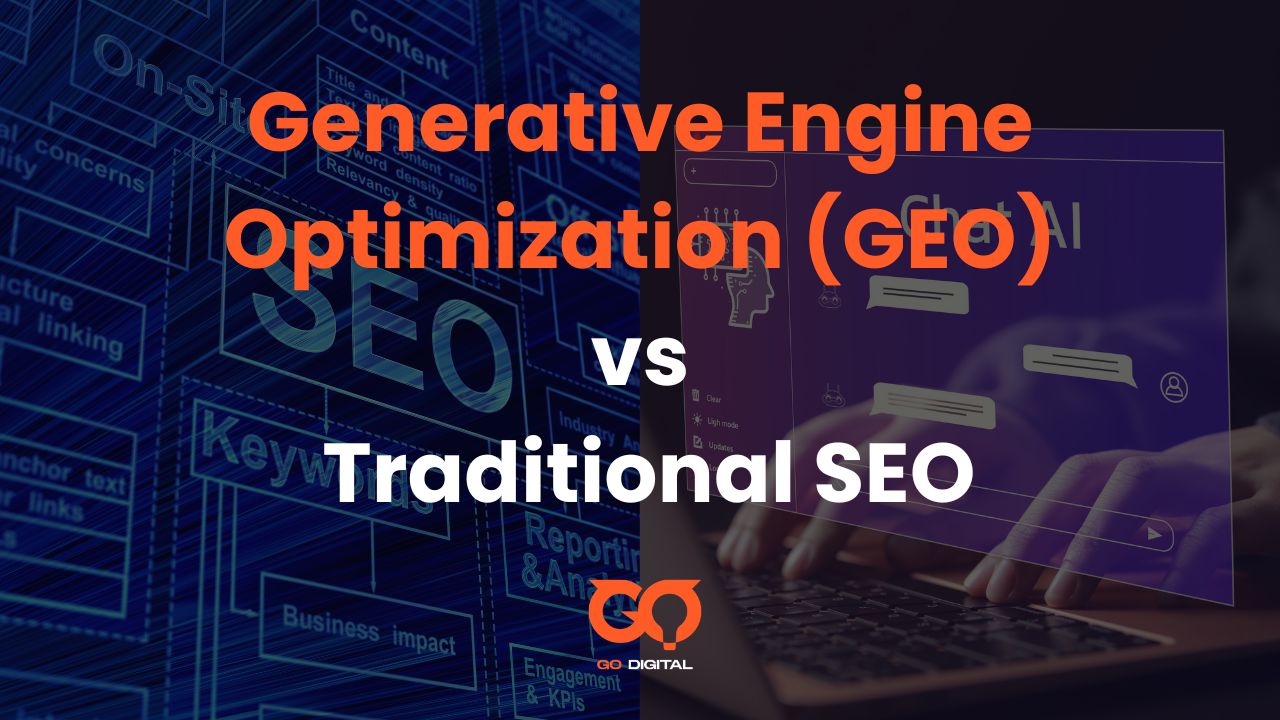
Generative Engine Optimization vs SEO Key Features
To understand the difference in the generative engine optimization vs SEO matchup, consider the core goal of each discipline.
Traditional SEO is a fight for a spot on the results page. The whole point is to get someone to click your link.
GEO is a fight for influence. The goal is to have your content cited directly in the AI’s generated answer. In that world, there is no click.
That means the tactics are different, too. With SEO, you’re focused on keywords, metadata, and getting backlinks. With GEO, the AI is looking for high-quality, contextually relevant content that answers a question in a conversational way.
Answer Engine Optimization (AEO) vs Generative Engine Optimization (GEO)
What is the difference between AEO and GEO? This question is at the heart of the answer engine optimization vs generative engine optimization debate, but they aren’t the same.
Think of it this way: Traditional SEO is getting your restaurant listed in a business directory.
AEO is making sure that directory listing has the right phone number and address so the automated phone system can read it out. And GEO? That’s becoming the restaurant the hotel concierge personally recommends when a guest asks for “the best pasta in town.”
To be truly visible in search now, you need all three working together. SEO gives you a baseline presence, AEO makes your key details accessible to automated systems, and GEO establishes your brand as the authority worth quoting.
Core Differences Between GEO and GEO
The operational differences here are huge. SEO runs on a foundation we’ve known for twenty years, built on things like PageRank, technical checks like Core Web Vitals, and measured by Click-through rate (CTR). It’s designed for humans reading an HTML webpage.
GEO is built for machines. It prefers clean, structured formats like JSON or Markdown, and its success is measured by how often you’re cited, not by clicks in Google Analytics.
GEO requires machine-readable endpoints, explicit entity connections, and provenance metadata. The old world rewarded a massive 1,500+ word article; the new world rewards the perfect answer delivered in the first 50 words (which is a lot if you’ve ever done it!).
Language models are skeptical. They cross-reference multiple sources to validate information before they’ll use it. This means that simply repeating what’s already out there is a losing strategy because of this multi-source triangulation.
What they’re looking for is unique data. I’ve personally seen ChatGPT ignore the entire first page of search results to cite a source from page two, just because that site had the best, most unique explanation.
This shift to citations changes how you should think about value. Being the source cited in a zero-click answer is a huge brand win, even if your traffic numbers don’t move. It builds trust and authority with the person who just got their question answered, and that elevates everything else you do. Traditional SEO is a battle for attention, whereas GEO is a battle for representation; one is a fight for position, while the other is a fight for inclusion.
So, where do you start looking for GEO opportunities? Begin by looking for your best content that’s starting to underperform. Find your informational pages that have a solid top-5 rank but a declining Click-through rate.
That’s a classic sign that an AI summary is stealing your clicks. Also, pull up any page that gives a definitive answer, like a “What is X?” or “How to do Y?” guide. If a page has original research or unique stats, it’s a prime candidate.
Where GEO and SEO Align
Despite their differences, GEO and SEO still share a common foundation. Both ultimately reward high-quality, relevant content from brands that demonstrate real expertise in their field. Quality benchmarks are essential, as both Google and LLMs strive to provide high-quality content that satisfies user needs. And both rely on precise, current content that demonstrates a thorough grasp of user intent.
Both Google’s algorithm and the large language models are trying to do the same thing: find the best answer for the user. Content that is clearly structured with headings, lists, and clean formatting is easier for both systems to parse and trust. And original research is prized by both; it attracts backlinks for SEO and provides unique data for GEO citations.
GEO and traditional SEO aren’t enemies. They’re complementary parts of a modern search strategy. Think of it like this: SEO gets you on the results page.
GEO gets you into the answer itself. You need both.
Building Your Generative Engine Optimization Plan
The shift to a citation-based economy has already happened, and winning here means changing how you think from the ground up. Real Generative Engine Optimization is a foundational change to your brand, your content, and your technical setup.

The plan has four parts, and they build on each other. This is the work. Follow them in order.
Start with Brand Clarity and Topical Authority
Most AI visibility problems are about brand clarity, not tactics. You might think this is just basic marketing, but AI models are pattern-matching systems, and they punish fuzzy messaging in a way we’ve never seen before.
You need to ask a different question: In which specific conversations must our brand be seen as the final word? Showing up consistently in those discussions is how you build topical authority, and it’s how AI systems learn that you’re the one to quote.
A simple three-step audit will tell you exactly where you stand.
- First, check your core identity. Is your company name, logo, and one-sentence description exactly the same on your website, your LinkedIn profile, and your Wikidata entry?
- Second, check for topical consistency. Do your homepage, about page, and service pages all use the same language to describe what you do?
- Third, see how the machines see you. Perform a search combining your brand name with your main service, for example “Salesforce CRM,” and review the information in Google’s Knowledge Panel. That information has to be dead-on accurate.
Create Content Designed for AI Consumption
Your articles and guides now have to be structured as self-contained facts that an AI can easily pull out and use. For GEO, every piece of content you publish should aim to be the most complete and authoritative answer to a specific question.
Your sentences need to be so clear that they can be quoted by themselves and still make sense as a standalone, citable fact. It substantiates assertions with data, illustrations, and professional insights.
Models process information in chunks, not long narratives. Pages that are well-organized with clear sections are easier for them to retrieve because they have more signals to work with. Use descriptive headings that sound like a question someone would actually ask.
Start every section with a direct definition or a straight answer. Use bullet points to break down complex ideas, add FAQ sections, and put a summary right at the top of your longer articles. If a model can’t figure out what your content is about in a few seconds, it will just ignore it and move on.
So, write with factual language. Organize your material so a machine can parse it. Publish authoritative content that gets you mentioned by other credible sources. Always support your own statements with links to trustworthy data and studies.
Strengthen Your Site’s Technical Structure
While the basics, along with things like hreflang, are still important, they’re just the price of entry. Now you need things like machine-readable endpoints and metadata that proves where your information comes from.
The new work is all about building connections. This means having a smart internal linking strategy and using the same terminology consistently across your entire site. It means using structured data, creating logical page hierarchies, and designing site navigation that leaves no room for ambiguity.
Your goal is to build interconnected topic clusters. The AI needs to see the map of your expertise, not a collection of random destinations.
Build Citations Across the Web
The real heart of GEO is building a pattern of authority that stretches across the entire internet. AI models look for a consensus among independent sources to feel confident in an answer. The more your brand gets mentioned as a leader on different platforms, the more an AI will see you as the default source.
You might be surprised to learn how many AI citations come from third-party platforms, not just your own website. This includes discussions on Reddit, product reviews on YouTube, and conversations in industry forums where real people are talking about your brand. The large language models also use external sources like Wikidata, Crunchbase, LinkedIn, and Quora to figure out how credible you are.
How GEO Changes the B2B Customer Journey
Influencing Decisions Before the First Click
Seeing your brand show up repeatedly in AI-generated answers is what builds the groundwork for someone choosing you. It creates familiarity and trust, the two things a buyer needs to feel before they’ll even consider you. Your brand’s name becomes familiar, sure, but more importantly, your expertise starts to feel real.
Users are exposed to the brand’s viewpoint and expertise, which are essential elements that precede brand preference. The discovery phase begins sooner, decisions are made more quickly, and brands gain influence through their presence rather than depending entirely on clicks. This is how you start winning over buyers before they even think about clicking over to your website.
The Business Case for B2B Companies
In this new world, getting into an AI’s answer is a winner-take-all game (and I’ll throw in ruthless too for a few of them). For years, I chased the same vanity metrics as everyone else, trying to climb to the top of Google’s first page. But there’s no second page in a generative answer.
There’s no “almost ranked.” You’re either the star of the show, or you’re not in the show at all.
The new reality is simple: the brand that gets featured wins. Every other brand is invisible. There’s no silver medal for being the fourth-best source when the AI only mentions three. For that specific search, you’re either part of the conversation, or for all intents and purposes, you don’t exist.
The Benefits of GEO for Traffic and Visibility
The big strategic trade-off with GEO is that you have to be okay with getting less traffic in return for getting seen by the right people. I know that feels completely backward to any marketer who’s spent a career trying to get more and more clicks. The objective changes from maximizing every click to winning critical moments of influence.
But the goal is shifting from winning every click to winning the moments that actually matter. A recent Semrush report backs this up, finding that traffic referred by an LLM achieves a conversion rate 4.4x higher than traffic from classic search. AI-referred visitors also show greater purchase intent.
A dip in your overall organic traffic doesn’t automatically mean your business is hurting. SEO expert Wil Reynold told a story about a site where organic traffic went down, but the number of email signups coming from organic search stayed exactly the same. It suggests that the traffic they lost wasn’t the good stuff anyway. The people who were actually going to do something were still finding their way through.
How to Measure GEO Performance
My worst meeting last year started with a beautiful dashboard. All our keyword rankings were climbing. Click-through rates were solid.
I was genuinely proud of it. Then the VP of Sales cleared his throat and asked why his team’s leads were falling off a cliff. My metrics had no answer.
In that quiet, awkward moment, I realized we were measuring the wrong things entirely.

Relying on traditional SEO reports to understand your GEO performance is exactly like that. It gives you a false sense of security while the ground shifts under your feet. A new set of tools is necessary because the old yardsticks just can’t measure this new Gemini world.
To do GEO right, you have to stop obsessing over clicks and start focusing on citation and influence. Your market share in AI-generated answers is what matters now.
Track Success Beyond Clicks and Rankings
It’s so tempting to keep staring at your keyword rankings, but those numbers are now dangerously incomplete. The metric that actually matters is ‘AI Share of Voice’. This is just the percentage of time your brand gets mentioned when someone asks a question to an AI like ChatGPT, Perplexity, and Google’s AI Overview.
You have to look past clicks and instead track things like how many times an AI Overview shows up for your key queries, how many times you get cited, and how visible you are for both branded and unbranded topics. Even long-term trends in direct traffic and branded search become more important, as they signal real-world influence.
How do you even do that? You can get a rough idea on your own. Just take 10 of your most important customer questions and plug them into Google AI Overviews and ChatGPT.
If your brand shows up in two of those ten answers, your share of voice is 20%. If your main competitor appears in five of them, their share is 50%. It’s a quick and dirty way to see where you stand.
Don’t go looking for this in Google Search Console, though. There is no dedicated report for AI Overviews. Ahrefs has pointed out that clicks and impressions from AI results just get lumped in with your standard organic search data, so you can’t pull out the AI-specific numbers to see what’s really going on.
Audit Your Visibility Across AI Platforms
Auditing is critical because these AI models can be wildly unpredictable. We saw this firsthand during a recent client audit. We searched for their main product category, and the Google AI Overview didn’t mention our client or their biggest competitor.
Instead, it pulled a quote from a forum discussion from three years prior where a user praised a much smaller company. This is a perfect example of how AI authority doesn’t always follow market share.
This is why you need tools built for the job, and understanding the differences between ai search optimization and traditional seo tools will help you choose wisely. It became clear that every AI engine employs its own unique methodology, training data, and stylistic output. Our own tests show that every AI engine has its own methods and data, so you have to think about each one separately. Two examples:
- In Ahrefs, you can go to Brand Radar and set up a filter for Google AI Overviews to see which prompts are citing your brand and what URLs they’re pulling from.
- In Semrush, the AI Toolkit can help you track brand mentions in general, but for specific Google AI Overviews citations, you’ll need the AI Overview Analysis report. As TechRadar notes, that one is part of their Enterprise plans.
Neil Patel’s Ubersuggest also has an AI Visibility report that you can use at no charge.
There’s a clear place to start your own GEO work. You have to begin with an honest look at where you are right now in AI answers. First, establish a baseline for your own brand’s performance.
Then, do the exact same thing for your top three competitors. The gap you find will tell you if you have a content problem, a brand clarity problem, or a distribution problem. That distance is the true competitive landscape you’re fighting in now.
Technical SEO Signals for AI Engines
Generative engines don’t care about your domain authority.
They work with passages, pulling specific chunks of information to build an answer. This means the technical work for your developers just got a lot heavier, because you have to fundamentally re-engineer your content. You can ignore it, but you’re just making your business invisible in the long run.

Structure Content for Vector Search Chunking
Content must be treated as a database of facts, not as pages. An AI doesn’t have time to read your whole “book” to find an answer. Your job is to give it a box of perfectly labeled index cards so it can find what it needs instantly.
When a user asks a question, the AI can swiftly locate the most pertinent card instead of scanning the whole book. These cards are self-contained chunks of content, and they’re the only thing a large language model really understands.
The process is simple, but it takes discipline. Conventional SEO includes keyword targeting, backlink acquisition, and crawl-budget adjustments. Content must be broken into these self-contained blocks at logical points, like a new heading or the end of a function.
As you create these chunks, make sure there’s a 50-token overlap from one to the next so the model has enough context to follow along. Here’s the test: if a developer copied and pasted just one of these chunks into ChatGPT, could they solve their problem without needing anything else?
When you get this right, the payoff is huge. Content broken down this way gets three times more citations from AI models than big, clunky pages. The sweet spot for these chunks, balancing context with efficiency, is approximately 800 tokens.
Publish Machine-Readable Entity Data
Next, the AI must be taught your language. It sees the world as a network of connected things, not a flat list of keywords. Every concept, API, and acronym from your content should be pulled out and defined in a knowledge graph.
You build this graph using JSON-LD templates. You use properties like @type to say what something is, sameAs to link to a definitive source like a Wikipedia page, and schema:about to connect it to bigger topics. Then you have to draw the lines between them, explicitly mapping out how a term like useState is related to React.Hook.useState and then to useEffect.
Adding an ‘Organization’ schema to your homepage is a really simple, powerful first step. It’s a bit of code you drop in the <head> of your site that tells an AI exactly who you are. For example, you can add a script with a type of application/ld+json and a context from https://schema.org to define your company’s name, url, logo, and provide sameAs links to your social profiles like https://www.linkedin.com/company/your-profile and https://twitter.com/your-handle.
It’s how you hand the AI your business card. From markdown files, extract every API surface, concept, and acronym.
Automate Content Freshness and Updates
Stale documentation is the fastest way to make an AI lie about you, and it kills user trust. The only way to fight this is to build a workflow where your content is always up to date.
This means you treat every merge to your main branch as a signal that something has changed, which should automatically kick off a content rebuild. The nice thing is this process can be set up to only re-process what’s new, so you can fix a typo without having to re-index your entire library. You also need to expose metadata like lastModified, datePublished, and dateModified right in your pages and sitemaps.
These are direct signals to the models. And that’s harder than it sounds. But you can even go a step further and use tools like Grafana to build dashboards that track how your update frequency impacts your share of citations.
Mine Real User Questions for Content Ideas
What happens when old keyword research tools no longer get you to the finish line? To get unprompted recommendations from an AI, you need to answer questions exactly how your users ask them. The best place to find these questions is in your own backyard: your GitHub issues, community forums, and support tickets. (Pay a lot of attention to your users’ opinions though!)
When you find a common problem, your job is to create content that covers at least five different ways someone might phrase that issue. The structure for each answer is a simple formula. Start with the error message, give a two-sentence explanation for why it’s happening, and then provide a clean code example with the fix.
There’s a clear tipping point for this work. Once your content provides answers for over 80% of the common problems people have, you’ll start to see models like ChatGPT recommend your library on their own, without you even asking.
The Future of Search and Integrated Strategy
Thinking about “SEO strategy” and “GEO strategy” as two different things is a sign of being behind; the future is about integrating the two, not debating generative engine optimization vs traditional SEO as a binary choice. The wall between classic search engines and AI models is crumbling. Customers aren’t going to care whether they’re “Googling” or asking an AI for help.
It’s all just finding an answer to them. Keeping teams and thinking in separate boxes will lead to losing on both fronts. This isn’t a guess about what’s coming; it’s what’s happening right now.

The only way to win is to have one, single strategy where everything works together, and partnering with an SEO agency can help you build it. SEO work should directly feed efforts to get cited by AI, and what is learned from AI should inform SEO. For instance, all that structured data used to get fancy rich snippets in Google? That’s the exact same stuff that helps an AI model decide content is trustworthy.
Those deep, expert articles written to build authority for search rankings are the very sources AI engines are hungry to use. It’s not a battle between them. The real job is getting them to work in lockstep.
A first move should be to look at all the best SEO content and figure out how it can become a go-to citation for AI.
Why Expertise and Zero-Click Searches Will Matter More
This new world means the customer’s path to finding a business is no longer a straight line. Users may switch back and forth between various AI platforms and traditional search engines. Someone might kick off their research by asking ChatGPT a few questions, then jump over to Google to check reviews or find a local store, maybe even bouncing back and forth.
AI will handle the broad explanations, but conventional search will hold its ground for product comparisons, local queries, and any task demanding verification or direct action. Whatever the specific path looks like, it is almost certain to be more diverse.
Which leads me to my next point: this shift makes proving expertise non-negotiable. It’s not a “nice to have” anymore; it’s the price of entry for getting seen. This is a huge trend for 2026 because both Google and the AI models are desperate for credible sources.
The actual work involves beefing up author profiles with real credentials, weaving in case studies, and creating original content that no one else has (and a large amount of work). It is also necessary to distribute expert insights that display deep knowledge. If this is not done, there simply will be no authority.
This trend also shines a light on why “zero-click searches” are blowing up. It’s not a new phenomenon, but it’s speeding up fast. We’ve seen studies for a while now showing that over half of all Google searches end right there on the results page.
The big driver for this now are features like AI Overviews. They put a neat summary right at the top, so people get their answer and just leave without ever visiting a site.
Generative Engine Optimization FAQ
How is GEO different from traditional SEO?
GEO’s goal is completely different. With GEO, you’re trying to get your brand named in an AI-generated summary, not just get a blue link on a results page. For years, I was obsessed with hitting number one on Google because a click was the only thing that paid the bills. With GEO, you can get in front of a customer even if they never, ever click, allowing your brand to connect with the buyer.
And this really matters. There’s research from NP Digital showing that well over half of all searches on Google now end without anyone clicking on anything. If you want to reach those people, being part of the AI’s answer is the only dependable method to engage that segment.
Is answer engine optimization and generative engine optimization the same?
They sound alike, I know, and they both involve AI, but they’re not the same thing. answer engine optimization (AEO) is all about getting your content into specific, boxed-off AI features inside a search engine, like Google’s AI Overviews. Generative engine optimization (GEO) has a much bigger ambition: to be cited by the big language models like ChatGPT and Claude when they’re just talking to a user. One is about winning a specific slot; the other is about becoming part of the conversation.
Is generative engine optimization the same as traditional SEO?
You can’t have a good GEO strategy without a strong SEO foundation to build it on. These AI platforms still lean on search indexes to find and judge content. If your technical SEO is a mess, your content isn’t structured, and you have no authority, the AI has no reason to trust you or quote you.
Despite a common misconception, geo generative engine optimization is not taking the place of SEO; it expands upon the solid groundwork established by SEO. It adds a new layer of visibility on AI search tools like Microsoft Copilot while your SEO keeps working on traditional search engines like Google.
What are the best content formats for GEO?
Genuinely helpful content is what performs best. What actually gets noticed are things like research studies, articles rich with data, detailed FAQs, instructional guides, and well-organized comparison pieces.
It’s about making your content digestible for an AI. If you have a complex topic, break it down with bullet points, numbered lists, and tables. And FAQ sections with short, direct answers are gold.
How often should content be updated for GEO?
You have to update your content, and you have to do it often. We know for a fact that these language models care about fresh content even more than traditional search engines do. LLMs assign an even greater weight to recency. To preserve its accuracy, you should refresh and revise your content frequently.
An Ahrefs study backed this up. They looked at ChatGPT and found it was way more likely to cite pages that were published recently. If you want the AI to quote you, you can’t let your content get stale.
How long does it take to see results from GEO?
If you’re a company that’s already doing the right things with content, you can start to see results in about three to six months. Effects become apparent within three to six months for companies that make a steady investment. That timeline assumes you’re already building authority, getting some digital PR, and showing up on different platforms.
But if you’re starting with a weak SEO presence, you have to fix that first. Businesses that are beginning with a weak SEO footing will have to fortify that layer first. The clock on GEO only starts after that foundation is solid.
Where is the best place to start with GEO?
You can start small instead of trying to boil the ocean. Do an honest audit of where your brand shows up in AI answers for your industry and, more importantly, where it doesn’t. A candid evaluation of where your brand is currently featured in AI-generated responses for your niche, and where it is absent, is a necessary first step. That will tell you if you have a content problem, a brand problem, or a distribution problem.
Pick one of your high-traffic pages and give it a quick audit. Rephrase the introduction into a direct, 40-word answer.
Chop up any long, dense paragraphs into smaller chunks of fewer than 200 tokens. Then, just watch tools like ChatGPT or Perplexity within a week and see if they start citing you.
You’ve just gone from theory to practice. From there, the questions are about how to scale what works, not about wondering if this whole thing is real. You’ll have a process for dealing with this new world instead of just hoping the old one comes back.
It won’t. But you’ll have a plan, and a plan that addresses the new reality of generative engine optimization vs traditional SEO is what separates the people who adapt from the people who end up in someone else’s slide deck as a warning.