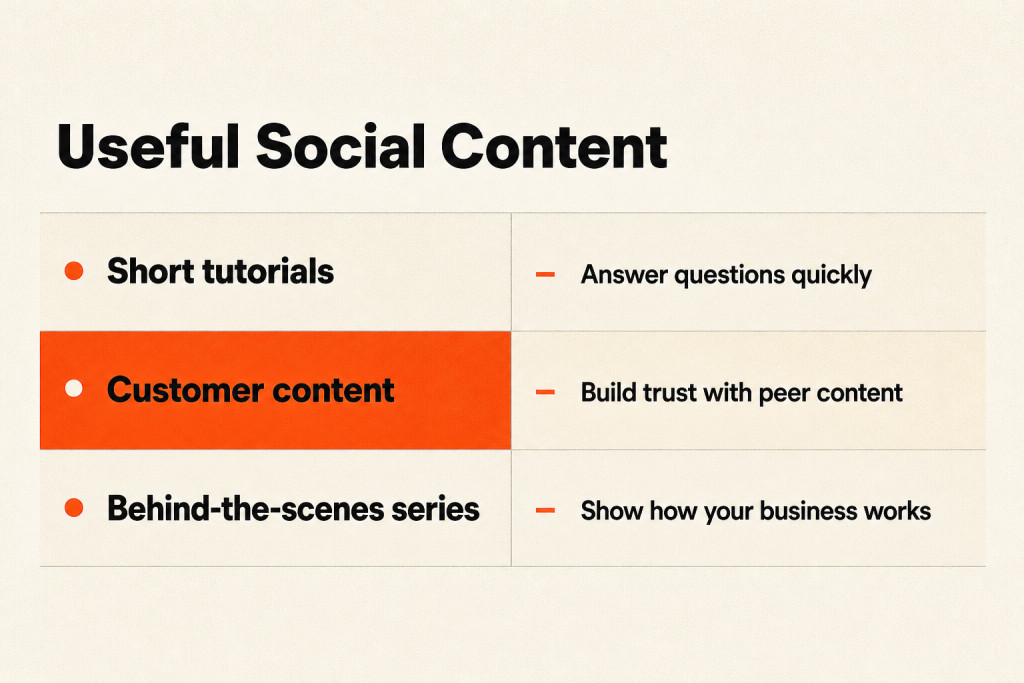
When shoppers arrive at different points in the buying journey, ecommerce content marketing can be hard to make useful at every step, and hard to tie to what your store sells.
You’ll leave better equipped to judge agency support, plan content around customer and search needs, and see which formats, channels, and measures deserve attention. A single blog article may also be reused as social media posts, a short video, or email campaigns.
How to Choose an Ecommerce Content Marketing Agency
Choose an agency whose solution fits your commercial model, catalog complexity, customer journey, integrations, and conversion goals. Ask for examples of work with businesses that have a similar commercial model and catalog complexity, confirm the proposed scope covers your customer journey and integrations, and agree how the agency will measure content’s contribution to conversions, including its assisted role.

Bring in expert help when a decision could affect SEO, conversion, integrations, or customer journeys critical to revenue.
What Strategy Work Should Come Before You Publish?
Before you publish, choose channels, research your audience and competitors, set a content calendar, and plan how to reuse each piece.
Channel Selection
Match each content piece to the channels that fit it, including your website, social media, and email.
Audience Research
Build each buyer persona from customers’ motivations, pain points, and daily struggles, then add the demographics and buying behaviors that help explain what each shopper needs. A busy parent trying to get dinner on the table quickly has a different set of questions from a home chef hunting for specialty ingredients. Your content should answer the needs of each. That focus has a clear payoff: for 80% of shoppers, a brand that personalizes the experience is more likely to win the purchase, while thin personas can leave your content disconnected and ineffective.
Run a competitive content audit to see where rival content is strong, where it misses the mark, and which keyword opportunities they may have overlooked. Use what works as a lesson; the review also brings their blind spots into view.
One competitor might explain topics well but offer few testimonials; another may have polished videos and weak product descriptions. Those content gaps give your brand a chance to stand apart and attract qualified traffic.
Put a content calendar in place to avoid last-minute panic and track content types, target audiences, keywords, distribution channels, and publication dates.
Decide how you’ll reuse material before you publish it. You can repurpose one blog post into a series of social media posts, an infographic, a short video, a podcast episode, or personalized email campaigns, so you can get more from the effort and reach more people.
Customer Journey Mapping
Customer journey mapping connects each purchase stage with the shopper’s main goal and the content suited to that stage, as shown in the table below.
| Stage | Primary Customer Goal | Recommended Content Assets |
|---|---|---|
| Awareness Stage | Customers are realizing a need. | blog posts, infographics, and social content |
| Consideration Stage | They are actively researching solutions. | detailed guides, comparison articles, and how-to videos |
| Decision Stage | They are ready to buy but need a final confidence boost. | Product pages, customer reviews, and detailed FAQs |
| Loyalty Stage | The journey continues after purchase. | personalized email campaigns and exclusive content |
Give the Awareness Stage, Consideration Stage, Decision Stage, and Loyalty Stage distinct places in your plan, with content matched to each purchase stage. One online-research study found that 80% of people research in depth before they buy.
Search-Friendly Content Structure
Build SEO around Long-tail keywords, internal linking, structured headings, and fast page speed to make content easier to find and bring in organic traffic.
- Focus on search intent as well as keywords.
- Answer questions directly and clearly.
- Use schema markup to improve machine readability.
- Build content using a pillar + cluster structure.
Informational guides point shoppers toward relevant products.
Matching Content Formats to Shopper Questions
Match each format to the question shoppers are asking and connect the answer to products they’re considering.
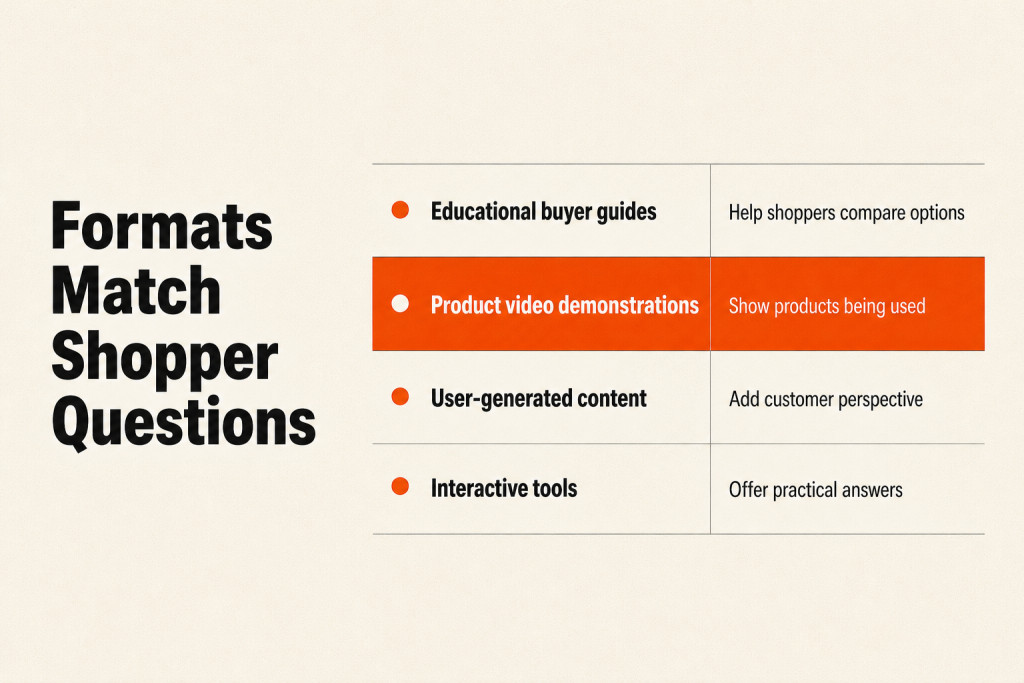
Content marketing has enabled 96% of e-commerce and retail companies to meet their goals. Over 80% of shoppers turn to the internet for research before they buy, so what your store publishes can help shape their choice.
Tools such as calculators, AI-powered generators, and planners can give customers quick answers to their biggest challenges.
Educational Buyer Guides
Give shoppers honest comparison guides and reviews with enough detail to weigh their options. These can help your brand become a trusted advisor and reach people close to buying.
For a kitchen-equipment shop, one article could list 10 essential tools for home bakers; another could explain how to season a cast iron skillet.
A travel backpack brand can build awareness through SEO, sharing travel tips, packing lists, and gear recommendations with people planning trips.
For someone traveling to Thailand, the brand offers useful advice and naturally recommends its own backpack.
Product Video Demonstrations
Shoppable videos can help sell products. Product detail pages that feature them recorded an average 23.8% sales increase compared with pages without videos.
Show products in action
Videos let shoppers see products being used, which can help build an emotional connection. Use demos, unboxings, tutorials, or live shopping to make the experience interactive. Short-form videos get 52% more shares, according to HubSpot’s State of Video Marketing in 2023.
Help customers picture using your products
Demos, unboxing clips, tutorials, and behind-the-scenes footage can make your brand feel more human and help shoppers picture themselves using your products.
An outdoors brand uses product walkthroughs on YouTube to give customers a clearer sense of what its products do. A beauty retailer reaches its audience with a fall makeup tutorial that features items sold on its website.
Include keywords in video details
Video can also help with SEO. Add relevant keywords to the title, description, and tags so your videos can show up in search.
User-Generated Content
User-Generated Content (UGC) is made by a brand’s customers rather than the company. It covers website comments and reviews, plus images and videos customers post on social media. Shoppers can look to this content as social proof when they’re judging a product.
Before making a purchase, 88% of shoppers intentionally look for UGC. Online reviews also carry weight, with 85% of shoppers trusting them as much as personal recommendations.
Influencer content earns the trust of only 11%, compared with 57% for fellow customers.
UGC can come across as more authentic than studio-made content, helping your audience connect with it. Reusing content customers already create can also be cost-efficient.
An apparel brand has purposely featured UGC in its social media and email marketing for years. Ask customers before sharing their content, then credit them when you do.
Collect authentic, detailed written reviews from real buyers. Invite customers to share their experience in writing with specific questions.
How to Distribute Content Across Owned, Earned, and Paid Channels
Content needs a route to shoppers, and owned, earned, and paid channels give you three ways to put it there.
Choose channels for your audience, content medium, business type, budget, tone, products, and services.
You can distribute content through owned, earned, or paid channels:
- Owned content is content your brand owns and runs in-house.
- Earned content is anything written about your business that you have not paid for or created yourself.
- Paid content is content you pay to put in front of an audience as an ad or sponsorship across social media, websites, newsletter placements, or search engines.
Select channels where your customers spend time: visual brands may use Instagram, while YouTube is a suitable home for educational material. With 40% of young people starting searches on TikTok or Instagram, a presence there is key. Social commerce is forecast to reach a $2.9 trillion market, and it reduces friction in buying.
Email and Text Message Marketing
Build an active subscriber list
To start an email newsletter, build your list with targeted ads, a freebie offered for an email address, or a website pop-up. A lead magnet makes that exchange: you offer a useful tool, and the user provides an email address to access it. An active email subscriber list remains one of the highest-ROI digital marketing strategies.
Keep subscribers engaged
Send quality content regularly to keep your brand top of mind and nurture prospective customers through the marketing funnel. Mix promotional and non-promotional content so subscribers do not feel constantly sold to; promote helpful blog content or repurpose it in email form.
Use customer behavior to guide messages
Customer behavior can guide automated email flows, including browse and cart abandonment messages. Segment your audience and tailor content to customers’ needs and interests. Personalizing messages through email segmentation can yield a 760% increase in revenue.
Text message marketing can supplement email marketing, with some added benefits. Within three minutes, 90% of text messages have been opened, while 27% of emails from retail brands are ever opened, so customers are more likely to see a text. SMS marketing can recover abandoned carts, build customer relationships, and provide customer service.
Paid and Organic Content Mix
Online businesses combine paid, organic, and user-generated content in an ecommerce content marketing strategy.
- Paid content (Promotional): Advertisements, influencer marketing, sponsored content.
- Organic content (Educational): Blogs, social media posts, emails, case studies.
- User-generated content: Testimonials, before and afters, reviews.
A hybrid strategy, or the 80/20 rule, puts this approach into practice: allocate 80% to organic content and 20% to paid promotion.
Keep advertising budget out of high-production articles until organic traffic shows shoppers find the advice useful. Test content organically first, then use what performs for paid advertising. Repurpose UGC as organic and paid content.
PPC ads are shown in search results, whereas display ads appear on websites. These paid strategies generate immediate traffic and suit lead generation and time-sensitive offers.
For a successful influencer marketing program, partner with influencers who fit your brand, share your values, and can authentically promote your products or services to followers.
You can use influencer-partner content in other marketing campaigns. Since it often costs less than studio shoots, you can spend less overall.
Which Metrics Show Whether Content Is Working?
The measures below show how many people content brings in, whether visitors take valuable actions, and whether they become high-value customers. They also show content marketing efficiency and whether the content resonates with readers.
- Traffic Growth: Shows how many people your content brings to your site.
- Conversions: Shows whether visitors buy or take other valuable actions.
- Customer Lifetime Value (CLV): Indicates whether your content attracts high-value customers.
- Customer Acquisition Cost (CAC): Shows how efficient your content marketing is.
- Engagement Metrics: Use Time on page and shares to see whether your content resonates with readers.

An educational post can shape a purchase without earning the final checkout click; a shopper might not have found the store without that post. Someone might read three blog posts over two weeks before buying. Multi-touch attribution models can account for that earlier influence when assigning content a share of the sale.
Older posts can still contribute to results, and updating and improving them can often deliver better ROI than making new content from scratch. A/B testing shows what works for your specific audience.
Frequently Asked Questions
What is the main goal of content marketing for ecommerce?
The main goal of ecommerce content marketing is to attract, engage, and convert a target audience by creating and distributing relevant, valuable content. It helps shoppers find useful answers and make informed choices, creating a practical path from discovery to purchase and, over time, brand advocacy.
How do you measure the success of an e-commerce content strategy?
Measure conversions and revenue from content marketing, using multi-touch attribution models to properly credit content’s role in driving sales.
What is the difference between a B2B and B2C e-commerce content strategy?
B2C customers are typically driven by emotion and seek immediate gratification, so their purchase cycle is short; B2B customers are driven by logic, ROI, and solving business problems.