If local social media marketing is getting your business noticed nearby but not bringing people through the door, it can be hard to tell what deserves your time and budget.
This guide gives you a practical way to judge where local content, paid promotion, and agency support fit, and how to connect the work to in-store results.
What do local social media marketing services include?
The work covers three areas: local listings, community partners, and social media ads.
Local listings
Across every place your business appears, matching address, hours, and contact details help customers and search engines find the right location. Keep the information accurate and line it up with your social profiles (people should see the same details in both places). That gives the business a consistent, reliable presence online.
Community partners
Build ties with nearby businesses, nonprofits, and community partners through local posts that tag them, share their content, or go out as joint posts to both audiences. These exchanges boost visibility, support each other, and often lift social media engagement. Stay active in the local online community to extend your reach and build relationships. Those ties can lead to collaborations in person.

Social media ads
Social media ads let businesses target audiences using the profile and interest options available on each platform. Compared with other approaches, social ads are also relatively inexpensive.
How to vet a local social media marketing agency
Choose an agency that can show how it adapts content to local behavior, humor, and values. Regional social media campaigns can become costly when they fail to connect with local audiences or, worse, offend them.
A copied campaign with swapped-in city names lacks the local behavior, humor, and values that drive impact. When vetting a dedicated partner, look for a Social Media Marketing Agency that can show relevant local campaign examples and explain how it measures actions that bring people into your store. Before committing, ask for a plan outlining local content ideas, goals, and reporting.

People increasingly find businesses through search, where social media now sits alongside Search Engine Optimization (SEO). Google and AI tools such as ChatGPT now draw information from social channels, so social content also shapes what people see in search. Add relevant keywords to captions, alt text, geo tags, and hashtags, making sure they fit both your business and its location.
Targeting nearby neighborhoods with paid hyperlocal ads
Hyperlocal ads target people in specific neighborhoods or communities, often within a few miles of your location. Keep hyperlocal ad spend in nearby neighborhoods, on streets your regulars travel, rather than across the whole metro area.

Adjust your spending based on how each ad performs.
Organic content: what to post and how to reuse it
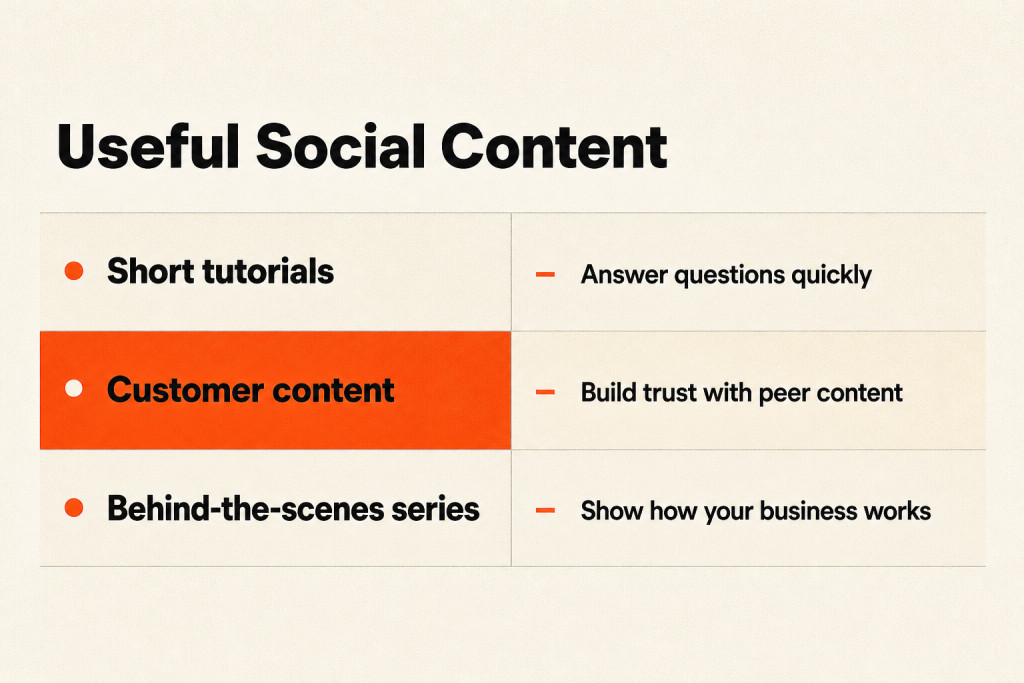
Useful, interesting material should lead your social media posts, with product and service pitches coming later; serving your audience this way naturally promotes your brand.
The 70-20-10 rule
For social media posts, the 70-20-10 rule gives you a practical way to divide your content mix.
- 70% informational: Benefit followers with education, advice, updates, news, and insights.
- 20% emotional: Connect with followers through expressions of company culture, core values, and fun, funny, or inspirational content.
- 10% promotional: Promote your business, products, or services directly.

Repurposing
Repurposing existing material into different formats helps you get more use from the time spent creating it.
- Create social media posts that link to your blogs, success stories, and guides.
- Turn your stats, short lists, or interesting excerpts from long-form content into posts.
- Record yourself summarizing the key points of a post.
- Regularly republish posts that link to your evergreen blog content.
- Re-share past posts that have performed well.
- Resurface seasonal content.
How do you measure social media performance and ROI?
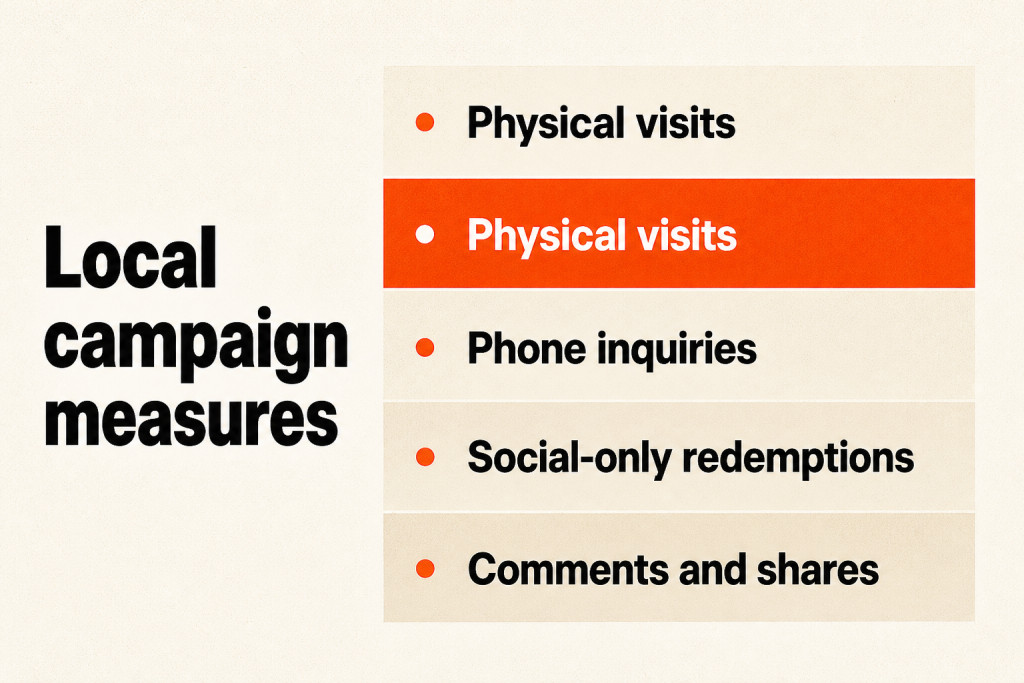
To judge revenue from social media, weigh physical visits and direct phone inquiries more heavily. Follower growth alone does not prove a business is healthy.
Campaign performance calls for tracking several kinds of metrics across awareness, engagement, and conversion. Reach and impressions measure awareness, while comments and shares show engagement; website traffic and sales are conversion metrics. For local campaigns, track foot traffic, local hashtag usage, and redemptions of social-only promotions.
A castle in England used visitor numbers and promotion redemptions to measure a campaign’s results. During Katherine Parr Week in September 2025, the castle offered free entry to anyone named Katherine. The campaign recorded a 23% increase in total visitors, with over 240 Katherines attending specifically for the event.
Social media drives revenue for 41% of local businesses.
Improved sales from social media marketing are reported by 60% of marketers.
Which social media platforms work best for local businesses?
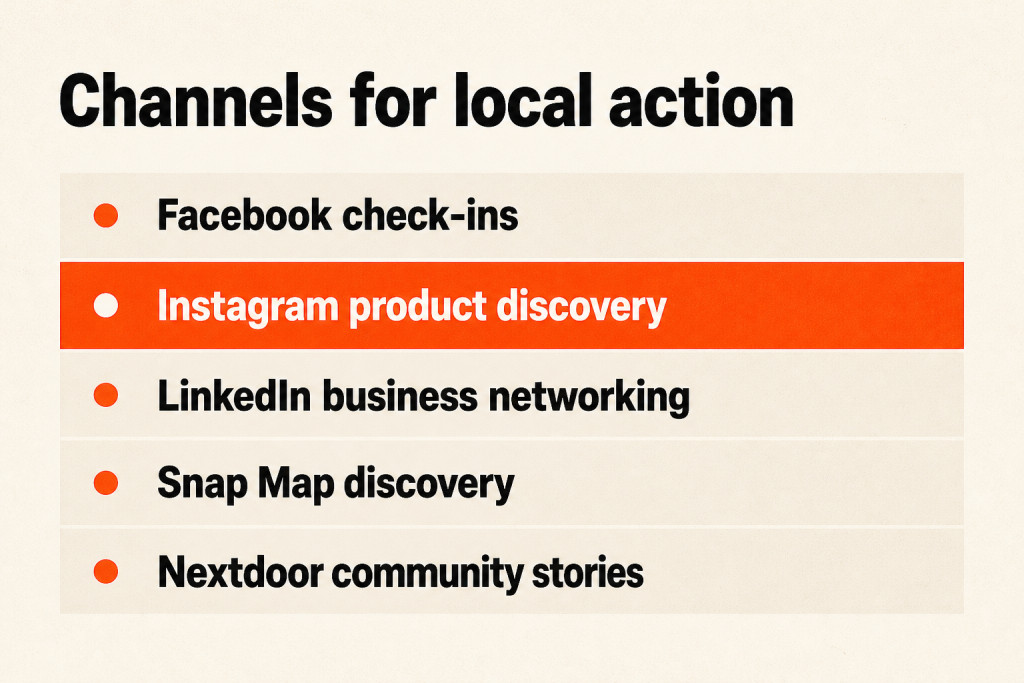
Facebook, Instagram, LinkedIn, TikTok, Snapchat, and Nextdoor are platforms local businesses can consider. Pick social channels by how local customers find and judge your business. Shops with visual products need places that help people discover and assess them, while booked professional services can focus on business networking and specific local audiences. For more channel selection strategies, see social media for small business marketing.
Since Facebook launched in 2004, more than 3 billion people use it each month worldwide, giving it the biggest user base among social media platforms. That’s 8.5 times the population of the US. Its users also span age groups more evenly than users on any other social platform.
Each week, 66% of Facebook users visit the page of a local business at least once.
Choose “local business or place” as the category for your Facebook Business Page so the page may appear in Facebook local results, display its listing details, and let Nearby Places indicate when a user’s friends are at the business:
- Display your hours and other listing information.
- Let customers check in at your business to endorse it and expand your visibility.
- Show users when their friends are at your business via Nearby Places.
Instagram arrived in 2010, eight years after LinkedIn and four years after X; it now has over 1 billion monthly active users. Its post formats give businesses different ways to promote products, and people use the app to shop. In the US, 44% of Instagram users turn to it for product reviews and recommendations.
Separately, when considering their next purchase, 70% of shoppers turn to Instagram.
Your industry shapes how often you post to the Instagram feed. Interior designers and home remodelers have more visual material to share than lawyers or appliance repairmen.
One social media management platform suggests posting 2-3 times per week, with a cap of once per day.
Launched in 2002, LinkedIn has over 310 million monthly users and leads all platforms in popularity for B2B social media marketing.
According to LinkedIn, companies that publish weekly get 2x the engagement on their posts. A social media publication suggests posting at least 2-3 times a week, but no more than once a day.
Since its 2016 launch, TikTok has grown quickly to 1.7 billion monthly active users. It ranks among the most downloaded apps and reaches nearly every demographic, so businesses can use it to connect with an engaged audience.
A local TikTok presence takes commitment: experts suggest posting at least 1-3 times per day. Posting consistently can help build followers, while trending sounds give your videos a starting point.
Snapchat’s largest age group is 18 to 26, and Snap Maps give the app a stronger local focus.
Experts suggest posting 4-7 times per week, though the right pace depends on your audience size and goals. Take these steps to show your Snaps in local discovery and keep your listing up to date:
- Tag your location in Snaps or use geofilters to increase the chance of appearing in an aggregated story highlight on Snapchat.
- Check whether your business is on the Snap Map and manage your listing.
In 2021-2022, a grilling company invited neighbors on Nextdoor to share stories about gathering over food. The campaign drew over 900 submissions, lifted searches on the platform by 199%, and raised brand mentions by 69%.
Three ways to build local engagement
Geo-tagging, user-generated content, and micro-influencer partnerships build local engagement. Local social engagement includes Likes, comments, check-ins, story mentions, and user tags from nearby people; those interactions build brand recognition and spark word-of-mouth, and some of that neighborly attention can bring people into the store.

Location tags
Location tags help nearby users find your content, especially when your business relies on foot traffic (restaurants, hospitality, and entertainment venues all do). A physical location tag can place a post in area-based searches and Stories, making it easier for potential customers to find and visit you.
Geo-tags work best when you want a local audience. If you’re targeting a broader region, consider whether a specific location tag could limit interest from users outside that area.
Add locations tied to local topics to your posts; they send local signals to Facebook and Google.
Customer-created content
Personal and authentic
A local River Walk restaurant earned strong engagement after sharing a straightforward post of staff naming the menu items they love most. The post felt personal and genuine, which helped it resonate with people.
Share and repost
Invite customers to share their experience with your brand or service, tag your business, and post photos or videos of their own. Then feature those posts on your channels or repost them, giving the customer credit.
Trust and buying decisions
Consumers are 2.4 times more likely to trust user-generated content (UGC) than polished ads. UGC campaigns can draw 28% higher engagement than standard posts, and UGC strongly influences the buying decisions of 79% of consumers.
Local micro-influencers
Micro-influencer partnerships can give a campaign neighborhood credibility, while their naturally limited reach makes audience scope an important trade-off. The table summarizes micro-influencers by audience scope, campaign budget, and returns.
| Campaign / Creator Type | Target Audience & Scope | Cost / Resource Input | Key Metric / Outcome |
|---|---|---|---|
| micro-influencers | local content creators with 1,000 to 10,000 followers | campaign budgets between $500 and $5,000 | returns ranging from 200% to 400% |
Rotate partners over time as their audiences shift. Larger influencers can still suit a strong strategy; choose between local and larger creators based on campaign goals, target audience, and desired reach.
Frequently asked questions
What counts as a “local” social media campaign?
A campaign counts as local when social media helps it reach people in a specific geographic area, using content and plans shaped for the community in that same place.
Which metrics best prove ROI for local campaigns?
Revenue growth linked directly to the campaign offers one of the clearest ways to judge ROI. Track impressions, shares, and comments, then connect those efforts to business results.
How can a small business run one on a tight budget?
With little to spend, a small business can lean on organic posts, local community ties, and free or affordable tools. User-generated content, hashtag campaigns, and location tags can boost visibility without a large budget.
Conclusion
Local social media marketing helps businesses reach people in a defined geographic area with content and plans that fit their community. To tie it to business results, watch campaign-linked revenue growth together with impressions, shares, and comments. Small businesses can keep spending down by using organic content, free or affordable tools, user-generated content, hashtag campaigns, and location tags.