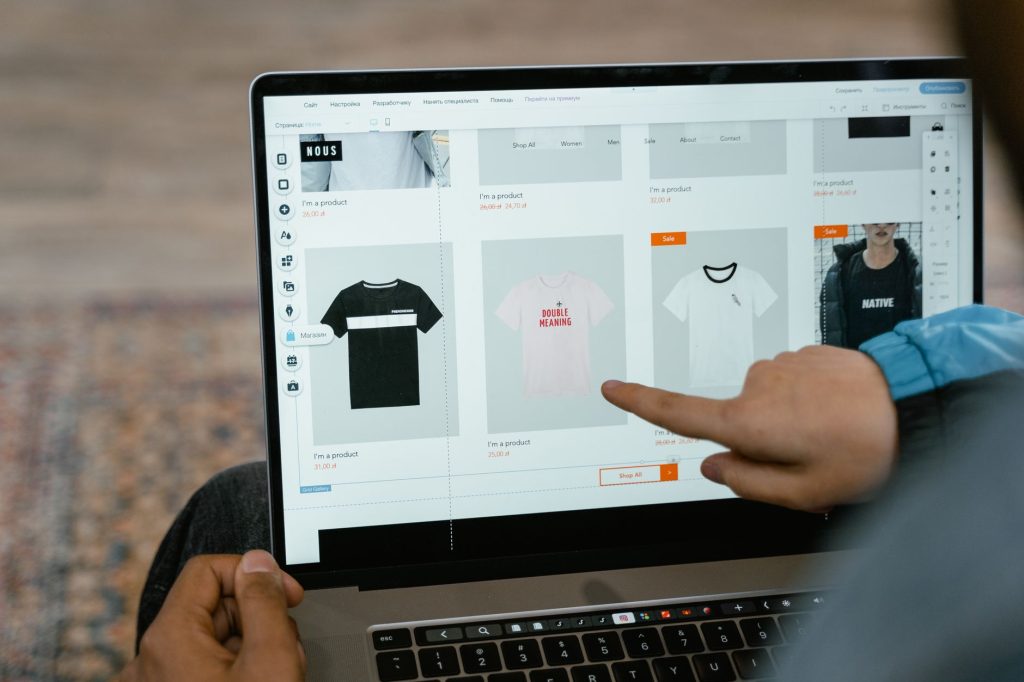
Social media marketing for retail brands has to connect each step, or a shopper can discover a product, ask a question, and go elsewhere without reaching checkout.
This guide will help you decide where agency support fits, which platforms and creators suit your brand, and how social storefronts and in-store content can support the path to purchase. You’ll also get a practical way to assess whether that journey is driving sales.
How to Choose an Agency for Social Media Marketing for Retail Brands
Retail brands should evaluate agencies on their ability to target likely customers and demonstrate measurable acquisition costs and return on ad spend. An agency can handle ongoing content creation (each month), paid media, audience targeting, and reporting, as the example below shows. Brands evaluating agency capabilities can also consult an external social media marketing consultant. When assessing fit, ask whether the agency has worked with retail brands like yours, can connect content and paid media to your buying journey, and will report against your sales goals.

Monthly content creation Each month, the agency handled content creation, paid media management, and reporting.
Custom audience targeting Custom audience targeting helped reach users very likely to become customers; paired with lead generation ads on Facebook, it produced a $1.50 cost per acquisition.
Return on ad spend In a social media retail case study, a mid-sized office supply retailer saw an overall $1.11 return on ad spend (ROAS). Partner products posted even higher numbers.
Which Core Capabilities Set Social-First Retail Brands Apart?
Community and useful content, paired with easy buying, help social-first brands stand apart.
In our recent research, brands that rate social media very or extremely important to their operations qualify as social-first and report average revenue 14.1% higher than peers.
More than half of consumers said they found a new brand through social media in the past year. Social-first brands give community management very high priority at two times the rate of brands with less-developed social media programs.
For nearly half of surveyed retail brands, customer communities rank among the most effective ways to grow customer relationships on social platforms, and that is true for brands at every level of social media maturity.
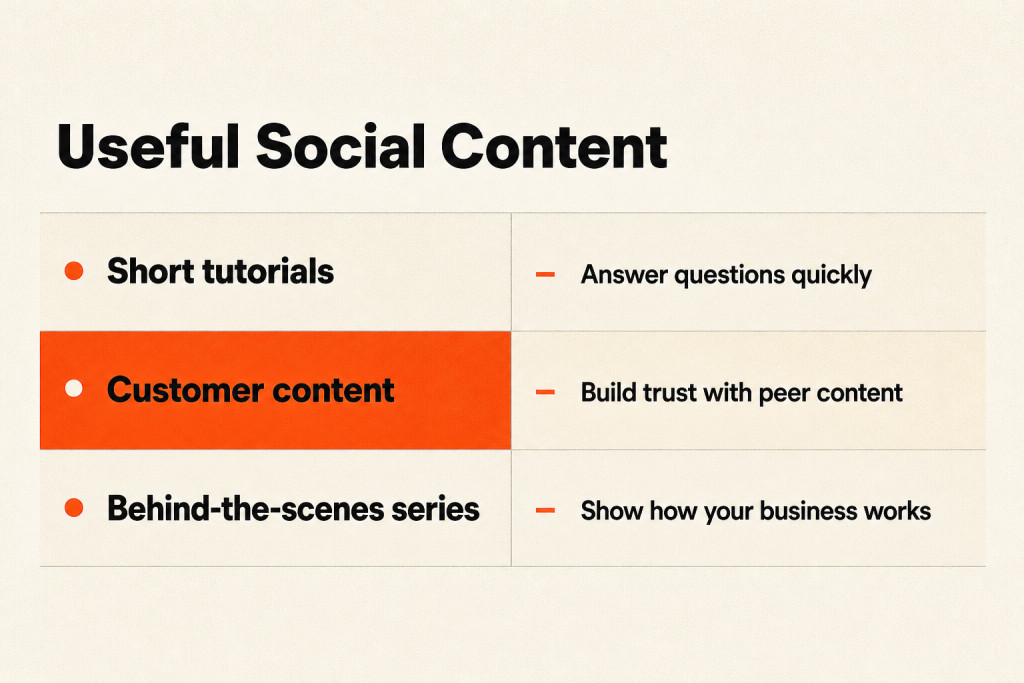
Use the 80/20 rule as a rough guide: about 80% of posts should entertain, inform, or inspire, leaving only 20% for direct product promotion. Of consumers engaging with sponsored social posts, 40% said entertaining content prompted them to interact, and another 39% cited content suited to their interests or needs.
Authentic communication matters to shoppers: 50% expect brands to speak authentically on social media nearly all the time or without exception.
Shoppers use social channels for questions and product recommendations, and to resolve concerns as they arise. A slow answer can hold up a purchase. Answer buying questions promptly and stay available after the sale; responsive customer care supports both trust and conversion. According to the 2025 report, 73% of consumers would turn to a competitor if their questions or concerns go unanswered on social.
In-App Social Storefronts
Native social storefronts let shoppers browse and buy on social channels with fewer steps from interest to checkout.
- Set up native storefronts where people can browse without leaving the app.
- Tag products in posts and videos to make content shoppable.
- Arrange products in collections to make browsing easier.
- Host live shopping events to demonstrate products and sell in real time.
- Link directly to key product or landing pages in your bio.
Launched in 2020, Facebook Shops gives small and medium-sized businesses a way to create shoppable storefronts and grow their social selling presence. It’s mobile-friendly and free, with full customization; businesses can bring in an existing product catalog or create one from scratch.
Survey respondents named four things that could make them more likely to buy a product straight from a social platform:
- Deals and discounts (62%)
- Customer reviews (46%)
- Appealing product videos and images (35%)
- Ease of payment process (34%)
An in-app checkout can make buying easier, but your brand gives up direct control of customer data and post-purchase email onboarding. Buying through social has become a one-click process, and direct purchases on social platforms have climbed 35% since 2023.
In-Store Experiences on Social
Live demos and similar formats connect online browsing with the in-store experience, helping shoppers inspect products and feel ready to buy.
- Use carousels to show different ways to use or style a product; customers can compare colors, angles, features, or use cases.
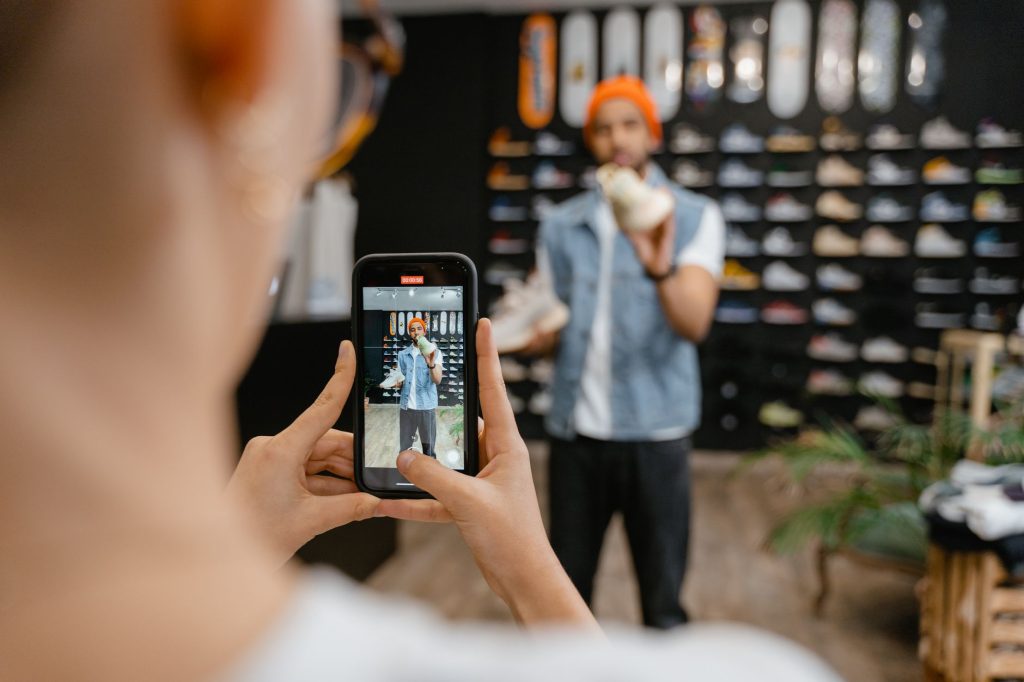
- Use live video to demonstrate products, promote new inventory, and answer questions in real time.
- Post behind-the-scenes content to show customers more about materials, production, or your brand story.
- Post customer reviews or testimonials in your content to build trust.
Live shopping event
The brand opened its live shopping event with a runway show featuring dogs available for adoption. Ads aimed at pet audiences ran across Facebook and Instagram.
Arielle Vandenberg served as host, while teaser posts helped build anticipation. As the livestream opened, she posted a behind-the-scenes clip to her Instagram Story and linked viewers to the shopping stream.
Once the event ended, the retailer reused its footage across paid and organic social posts. The results included ad spend returning 1.9x, and seven dogs were adopted.
Front-line employees
In the Q1 2026 pulse survey, more people wanted to hear from front-line employees (16%) than from executives (9%).
Employee posts can connect a brand with its community and may feel more credible to some shoppers than ads. Day-in-the-life videos and educational content suit people who’d rather hear from real voices than polished spokespeople.
Choosing Retail Platforms by Audience, Fit, and Shopping Features
Choose retail platforms by weighing audience size, product-category fit, shopping features, and the kind of buying each one encourages.

| Platform | Active User Base | Top Commercial Feature | Primary Buyer Intent |
|---|---|---|---|
| 3,000 million | shoppable posts | 30.4% of Gen Z using Instagram for product discovery | |
| TikTok | 1,990 million | “Shop Now” button | “TikTok made me buy it” |
| 578 million | shoppable pins | 80% of weekly Pinners have discovered a new brand or product |
Pinterest suits products people browse for ideas and planning, while TikTok fits spur-of-the-moment buys and live demonstrations for Gen Z.
Instagram Stickers and Reels
Product stickers
On Instagram, shoppers can buy through Product stickers placed in Stories, giving them a direct route from the post to checkout.
Reels
After people watch Reels, 79% have bought something on Instagram. One skincare brand saw purchases rise 43% after adding Reels to its usual ad mix.
TikTok Shopping Tools and Campaigns
TikTok Shop
TikTok Shop gives brands a storefront people can shop through the Shopping tab. Brands may also place a shop tab on business profiles, where a static product catalog can be synced. Since shoppers can buy without leaving the app, there are fewer steps between seeing a product and buying it.
Find Similar
When a viewer pauses a video, TikTok’s Find Similar feature comes up for them. AI scans the video, identifies similar products, and helps locate them, so people can buy what they see in just a few taps.
For Black Friday, one retailer launched #DealGuesser, a TikTok challenge pairing a branded effect with a hashtag and drawing on Heads Up. Users teamed up to guess products featured in the retailer’s deals. Six creators showed their audiences how to play and helped build momentum.
In just three days, the campaign drew 3.5 billion video views and 456 million engagements, while #DealGuesser was used 1.8 million times. Over Thanksgiving weekend, it ranked as the sixth-most viewed hashtag in the U.S.
Pinterest Discovery and Product Pins
80% of weekly Pinners have come across a new brand or product on Pinterest, which had over 570 million monthly active users in 2025. Millennials have also bought on the app, with upwards of 44% making a purchase there.
Product Pins, including shoppable pins, display current pricing and stock, and shoppers can save products to their boards. Ads Manager lets businesses assess campaign performance and increase the number of people they reach over time. Pinterest also offers advice on finding new audiences and retargeting existing customers.
How Should Retail Brands Work With Creators?
The key is letting creators tell authentic stories, replacing high-fi, brand-controlled briefs with creator-led narratives and building on the trust creators have earned with followers.
The Influencer Marketing Report says 59% of marketers plan to grow creator partnerships in 2026, emphasizing sustained, ongoing relationships over isolated sponsored posts.
Creator- and influencer-driven revenue climbed 20% from last year, with projected revenue reaching $184.9 billion in 2025. Nearly three out of four shoppers say they’ve bought something after an influencer recommended it.
Brands should match the networks their audiences already use to different points in the buying journey. Instagram, TikTok, and YouTube each fit a different stage, so one post doesn’t need to appear everywhere.

Micro-Influencer Partnerships
Micro-influencers and nano-influencers can get strong results with close-knit, engaged audiences. Micro-influencers currently see 2.8 times higher engagement than macro influencers. Look for influencers whose followers align with your target shoppers and whose content feels like a natural fit for your products.
Some influencer partnerships begin with a genuine moment that a retailer builds on. The resulting Instagram post racked up 1.32 million engagements, with a 45.5% engagement rate, far above the industry median of 0.16%. A few months later, the retailer gifted Rustyn a Bullseye mascot costume and partnered with the creator again to promote its Halloween costume collection. The TikTok earned a 52.3% engagement rate, making it the retailer’s most engaging post of the past year.
Customer-Created Content
79% of consumers say user-generated content significantly influences their purchase decisions. Customer-created reviews, unboxings, and tutorials add social proof, and consumers find this content 9.8 times more impactful than influencer content.
Brands can encourage user-generated content by resharing customer posts, running challenges, or making it easy for people to share product experiences.
Brands also need governance, moderation, and content rights management for customer-created content.
Polishing or scripting customer content until it looks like a studio commercial can take away the relatable proof that made the content work.
What Counts as Retail Social ROI?
Retail social ROI measures whether social activity brings shoppers in, turns interest into purchases, and keeps customers coming back.
- Click-through rate (CTR): Clicks signal relevance and show whether your social posts are connecting with people.
- Add-to-cart and checkout rates: These are the clearest signs of purchase intent from social touchpoints.
- Cost per acquisition (CPA): Use CPA to see whether your social media strategy for e-commerce is working efficiently.
- UGC velocity: The amount of customer content you generate helps measure brand love and influence.
- Social-attributed repeat purchases: This long-view KPI shows how social drives retention beyond first-time conversion.
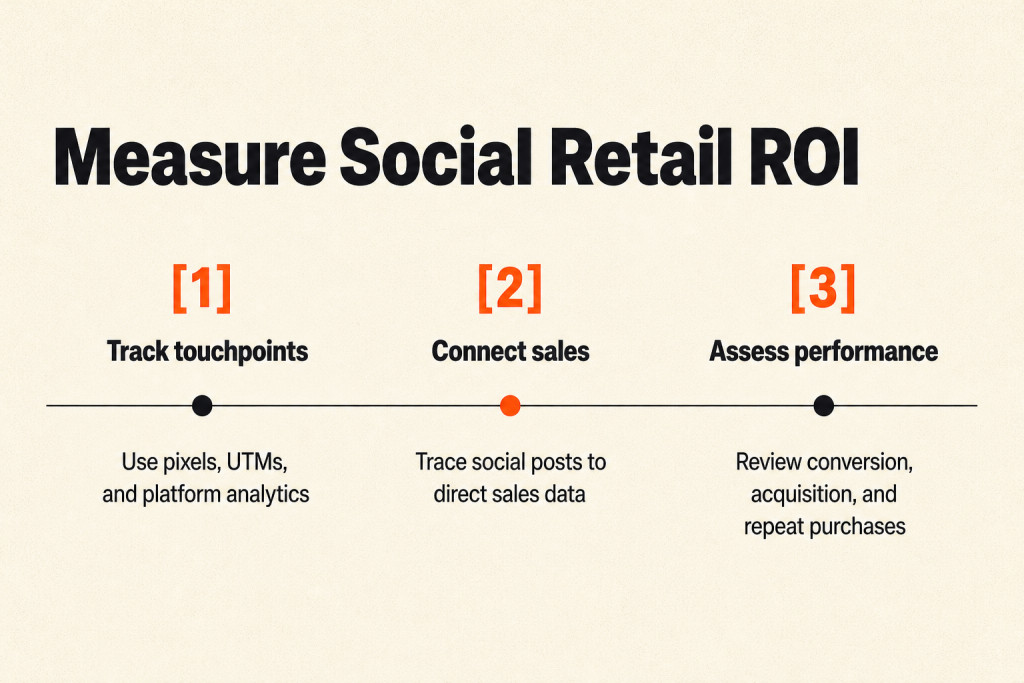
Tie conversion pixels and UTM parameters to direct sales data, so retail brands can trace which social posts led to a purchase. Track engagement rates and customer acquisition costs (CAC) to check whether social spend supports long-term brand equity and immediate revenue. Reach, engagement, click-through rates, and conversions are common KPIs, but your goals determine which ones belong in the mix. For creator sales, tag links with UTMs or use coupon codes; sentiment analysis shows how audiences perceive your brand.
A social platform can help a shopper discover a product, even when the sale happens at a physical cash register.
Frequently Asked Questions
How do retail brands measure ROI from social media marketing?
For retail brands, social campaigns’ performance is assessed through engagement, click-through rates, conversion rates, and the revenue they generate. Native platform analytics and third-party tools connect social activity to performance.
What social media platforms work best for retail marketing?
Retail marketing can benefit from Instagram, TikTok, and Facebook because of their visual nature and built-in shopping features.
How can retail stores increase sales through social media?
Use shoppable posts and an optimized link-in-bio to move customers from discovery to checkout in a few clicks. Limited-time social exclusives and retargeting ads can capture casual online visitors and encourage immediate purchases.
What strategies help retail brands increase conversions through social media?
Native shopping features, tagging products in content, and retargeting high-intent audiences with paid ads can increase conversions. Value-driven content and fewer steps between discovery and checkout also help.
Conclusion
Social media marketing for retail brands works as a connected buying journey: useful discovery should lead to an easy purchase, and sales should be measured. Choose platforms around your audience and how they shop; use shoppable posts, a link-in-bio, social exclusives, and retargeting ads to move customers toward checkout. Useful content and product tags can support conversions, while engagement, click-through rates, conversion rates, and revenue show what social campaigns delivered.