Roofing company local SEO puts your business where homeowners look first when they need a roofer, before they ask for referrals. More than 70% of customers go online before picking a local service, and nearly 80% of local searches lead to a call, visit, or inquiry within a day. BrightLocal’s 2024 Local Consumer Review Survey reported that 98% of consumers turned to the internet for local-business information in 2024, and 97% search online for local businesses before making contact.
Put your company on Google, because local visibility opens the door to nearly every roofing lead. Miss it, and prospects find competitors every day.
Why Local SEO Matters for Roofing Companies
A single roofing lead can be worth serious money when the average job runs $5,000 to $15,000 or more. PipelineOn puts Local SEO at approximately $13 for every $1 invested, one of the highest-return channels for local businesses. WebFX reports that less than 1% of searchers reach Google’s second results page. Miss page 1 or the Map Pack, and those leads go straight to competitors.
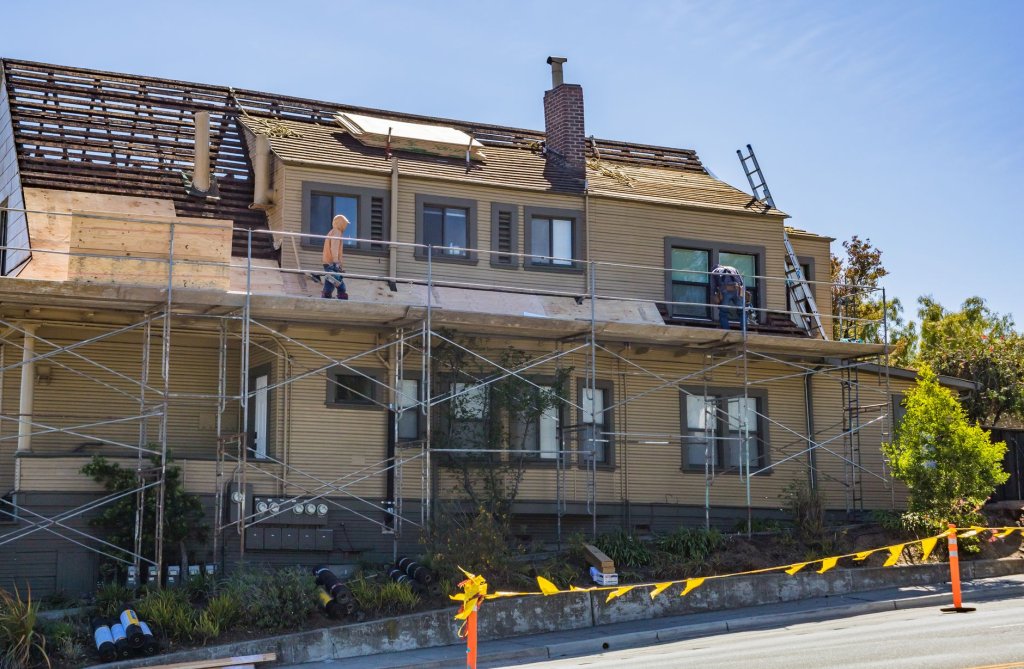
Once a roof issue shows up, homeowners grab their phones, type “roof repair near me” or “emergency roofing contractor,” and call the company they see first on Google.
How Search Engines Rank Local Roofing Contractors
Local rankings run on three signals: relevance, distance, and prominence. Relevance is how well your profile matches the search. Distance is how close your address sits to the searcher. Prominence is your review volume, citations, and engagement.
Google Maps and traditional organic search use different algorithms, even though both factor in location. Maps leans on your verified physical address and proximity, while organic search leans on on-page keyword use and content depth. Rank in one and you can still miss the other, so both need attention.
Why Roofers Struggle to Win Online Search Leads
The problem is rarely demand. It is visibility. Plenty of roofing businesses do good work yet fail to pull consistent leads because homeowners never see them.
Common issues include:
- Not appearing in local results: Your company stays off the Map Pack and page 1.
- Competitors dominating rankings: Rivals hold the top spots your leads click.
- Poorly optimized Google Business Profile: Missing categories, photos, or details.
- Website that does not convert: Visitors land, hesitate, and leave without calling.
- Conflicting addresses: Mismatched NAP data confuses local signals.
- Ignoring mobile speed: Most roof searches happen on a phone under a cracked ceiling.
NAP consistency across directories still supports how search engines validate a business, though its pull as a standalone ranking factor has slipped behind review signals and Google Business Profile completeness.
How Modern Property Owners Find Roofers
Homeowners search Google directly instead of asking around. They type “roof repair near me,” “best roofing company in [city],” or “emergency roof replacement nearby,” mostly on mobile, and usually pick from the top results.
Search habits split by age. Boomers are 14× more likely to include ZIP codes in searches than Gen Z, while younger homeowners rely on “near me” or assumed location. Google reports that the average AI Mode search runs triple the length of a traditional query.
Homeowners also vet before they call. BrightLocal found roughly half of consumers check more than one review platform before choosing a contractor, which is why spreading review requests across Google, Facebook, and directory sites beats leaning on a single platform.
What Makes Roofing SEO Unique Compared to Other Trades
Roofing SEO runs on two tracks at once: deep, educational content for homeowners planning a replacement months ahead, and fast visibility for frantic emergency searches during a midnight storm. This dual demand is why local SEO carries so much weight for service businesses like roofing, plumbing, HVAC, and general contracting.
Three traits shape the strategy. Demand is emergency-driven and seasonal, since storms spike searches for “roof leak repair” overnight. Jobs are high-value and local, since one new roof can hit five figures and the customer is almost always within 30 miles. Trust decides the sale, since homeowners check reviews and credentials before they call.
Business Growth from Organic Search Visibility
SEO improves your odds of landing on Google’s first page and in map results, which makes your business easier to find and contact. Unlike paid ads, it keeps working after the initial build. Once your site ranks, it brings traffic and leads without daily spend.
Organic SEO compounds like an asset. Once you rank for “roof repair near me” or “roofing contractor in [your city],” that visibility keeps generating leads month after month, not just while you pay for clicks. Contractors who rank in the Map Pack top 3 average 40% lower cost per sale than those relying on paid ads alone.
How Google Maps and Organic Results Differ
Google Maps and organic search use different algorithms, even though both factor in location. The table below shows where they diverge.
| Factor Type | Google Maps (3-Pack) | Organic Search |
|---|---|---|
| Primary drivers | Distance, relevance, prominence | Domain authority, on-page keyword use, content depth |
| Business address | Directly influences ranking (proximity to searcher) | Indirect; city/location references matter more |
| Reviews | Direct ranking factor for Maps prominence | Indirect; reviews build trust signals referenced by content |
| Result types shown | Three business listings plus a map | Directory lists, official websites, location pages |
Core Elements of Effective Roofing Company Local SEO
A complete campaign covers every place Google checks. Your profile, site, reviews, technical setup, and local proof need to back each other up, because phone-first homeowners call the company they see before anyone else.
Google Business Profile Setup and Optimization
Your Google Business Profile is where local visibility starts, putting your company into Google Maps, local results, and the Map 3-Pack when your other signals support it. Only a registered profile is eligible to appear in Maps or the 3-Pack.
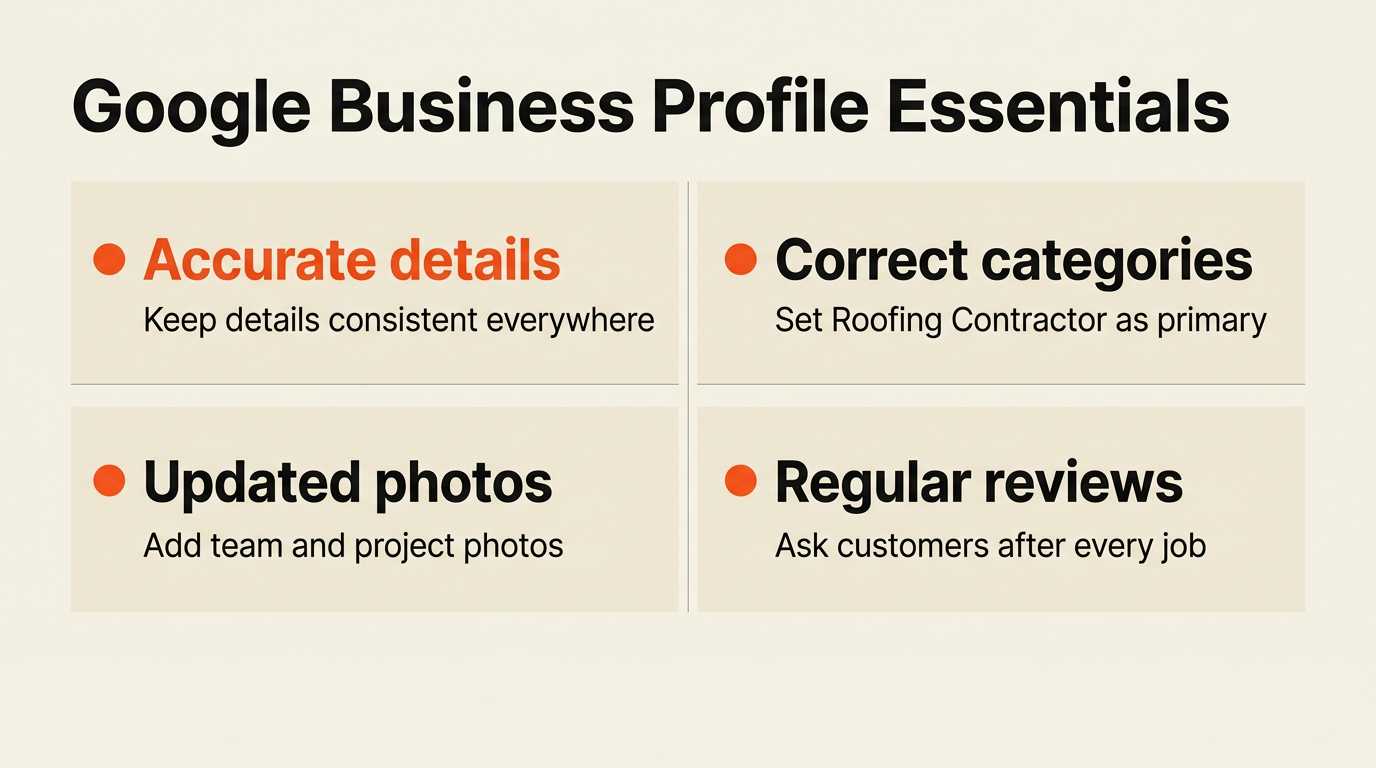
Keep these essentials current:
- Accurate business details: Company information correct and consistent everywhere it appears.
- Primary and secondary categories: Set “Roofing Contractor” as primary, then add relevant secondaries like “Roof Repair Service.”
- Updated services and photos: High-quality images of the business, team, and completed projects.
- Regular customer reviews: Review activity moving after each completed job.
Add 5+ fresh project photos each month, which correlates with higher Map Pack visibility, and post weekly Google Posts with updates, seasonal tips, or promotions. Skip padding your service areas: Whitespark reconfirmed in 2024 that listing service areas on GBP does NOT improve rankings.
Reviews now make up about 20% of the local algorithm, up from 16% in 2023. A complete profile pulls 7× the clicks of an incomplete one, and optimized roofing profiles can generate up to 63% more leads while converting 18% better.
Website Structure and On-Page Content Optimization
A fast, phone-friendly, easy-to-navigate site gives visitors fewer chances to bail before calling. Make calling easy.
Keyword research uncovers terms tied to your services, including “roof repair,” “roof replacement,” and “roofing inspections.” Weave those words into title tags, meta descriptions, headers, and page copy so each page clearly covers its subject. Tight copy lets search engines connect your services with real searches, and the site still has to turn those visits into leads.
Key Sections Every Roofing Service Page Needs
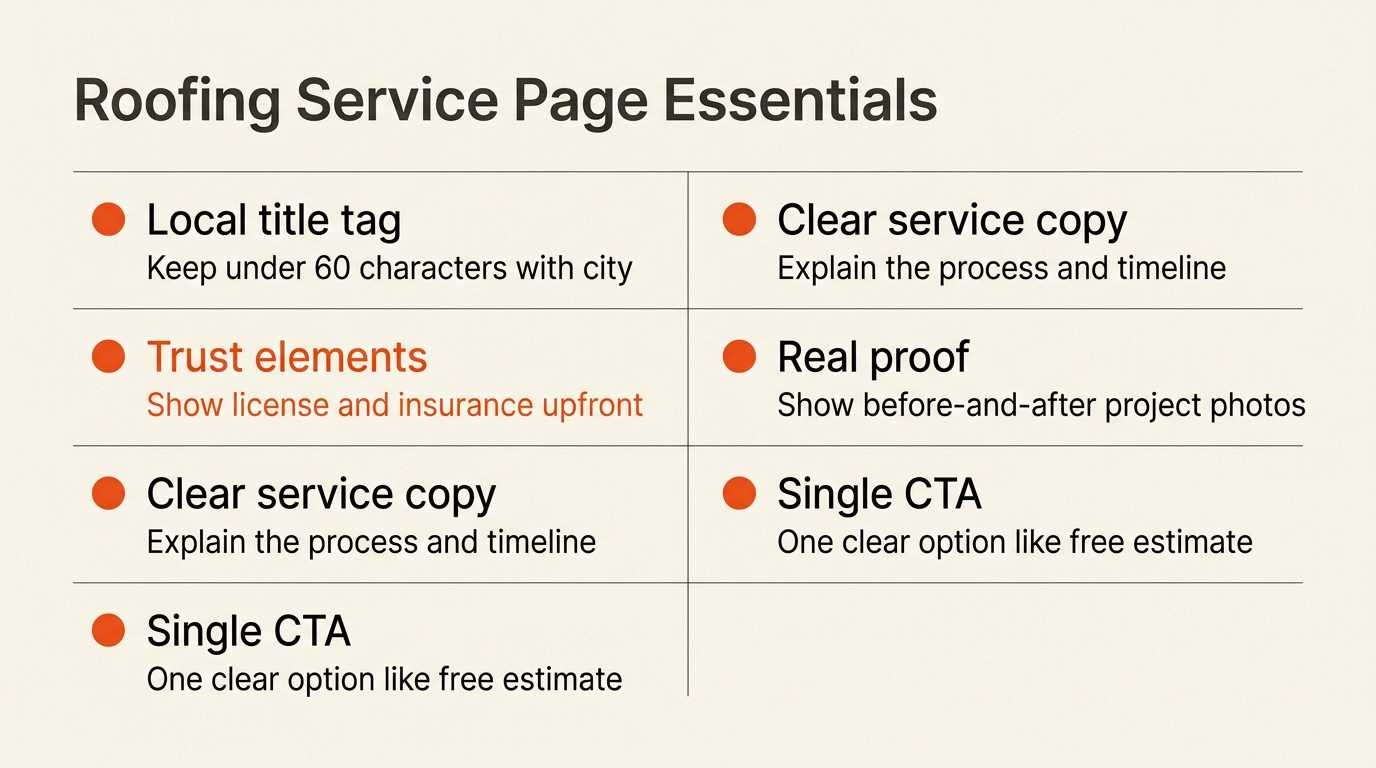
The page that ranks is rarely the homepage. It is a dedicated, intent-rich service page. A high-converting roof service page contains:
- City + service title tag: Under 60 characters, such as “Roof Repair in [City] | [Brand].”
- Above-the-fold trust: License number, insurance, years in business, and a tap-to-call button.
- Specific service copy: Written for the homeowner. Explain what the service is, why it may be needed, and how fast it can be done, without keyword stuffing.
- Proof: Real before-and-after photos, named technician reviews, and manufacturer certifications.
- One clear CTA: A free estimate, emergency line, or financing option instead of three competing buttons.
- FAQ microcontent: 3-5 questions pulled from actual customer asks, marked up for search.
- Internal links: Links to related services and service-area pages so equity flows through the site.
City and Neighborhood Service Area Pages
Location pages target searches like “roofing contractor Cedar Park,” “roof repair Round Rock,” and “roof replacement Georgetown.” Give each page its own copy. Swapping only the city inside one template creates thin pages, and Google catches duplicate content and may penalize it.
Show proof tied to each location through jobsite check-ins, mini-maps, schema markup, geo-coordinates, original photos, and taggable captions for finished jobs. Include the area’s roofing materials, weather challenges, building codes, and project photos. Those dated check-ins prove you served the area, support organic relevance, and can prompt reviews.
Helpful Guides That Turn Homeowners into Inquiries
Guides and articles handle homeowner questions before someone reaches out to a roofer, and Google favors pages that actually answer them. Start with the questions your office already receives:
- “How long will my new roof last?”
- “Should I repair or replace?”
- “Will my insurance cover storm damage?”
- “What’s the deal with metal roofs versus shingles?”
Build content for all three search types instead of betting everything on the familiar “roof repair” page.
Seasonal Content for Storm Prep and Weather Damage
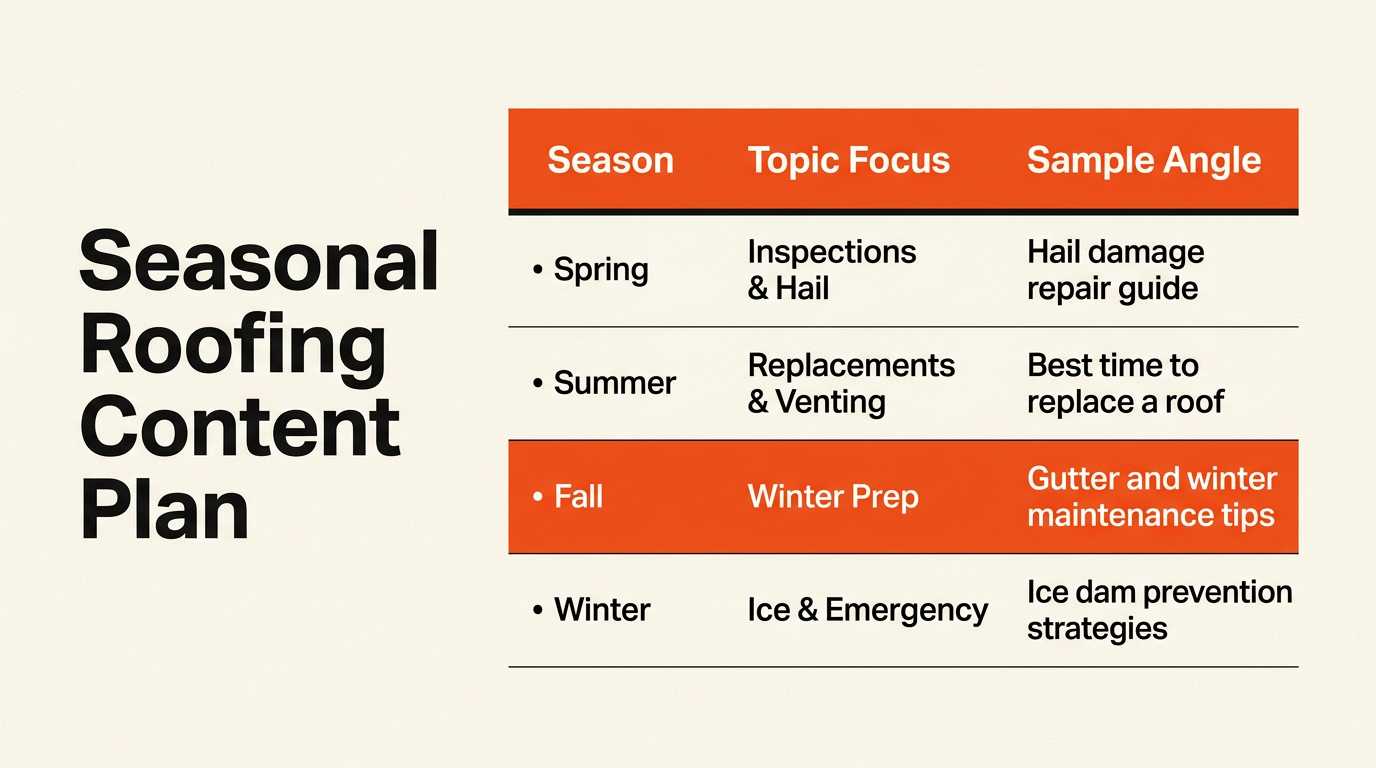
Get seasonal pages live before demand hits, not after weather has already lit up the phones. Publish 4 to 6 weeks before peak search volume, since pages need time to index and rank when demand spikes.
- Spring: “roof inspection after winter,” “hail damage roof repair”
- Summer: “best time to replace a roof,” “roof ventilation problems”
- Fall: “prepare your roof for winter,” “gutter cleaning and roof maintenance”
- Winter: “ice dam prevention,” “emergency roof leak repair”
Local Citations and Community Backlinks
Citations. Matching citations show search engines your business is real and local. Their standalone ranking pull has declined and now trails reviews and profile completeness, but your name, address, and phone must still match everywhere online. Roofers commonly show up on Yelp, Facebook, Better Business Bureau, and Angi.
Local links. Local relevance grows wherever your business name, address, and phone appear across the web. Youth sports sponsorships, charity events, and supplier partner pages pass both relevance and trust. One city “approved contractors” link can outweigh ten generic guest posts. Skip bulk directory submissions, since Google discounts low-quality citation spam and it can dilute the local signal you are building.
Customer Review Acquisition and Reputation Management
Reviews are a top local ranking factor and a primary trust cue for homeowners comparing contractors, and they move conversion rates directly. A systematic process should include:
- Project completion request: Ask every customer for a Google review when the job is done.
- Direct follow-up: Send a text or email with a direct review link.
- Review response: Respond to every review within 48 hours.
Aim for a steady stream over a sudden spike. Review velocity, the rate at which new reviews come in, signals to Google that your company stays active and trustworthy.
Technical Speed, Mobile Design, and Schema Markup
Schema markup hands Google structured details from your site, so services and service areas are easy to read without guessing. Most emergency searches happen by phone, and slow pages lose already-impatient visitors. Cover the technical basics:
- Page speed: Keep LCP under 3 seconds on 4G.
- Mobile design: Google prioritizes mobile-friendly sites in results.
- Business schema: Use LocalBusiness and HomeAndConstructionBusiness schema.
- Service schema: Use Service schema on every page.
- Contact forms: Make sure every form works correctly.
- Crawl health: Maintain zero critical crawl errors in Google Search Console.
- URLs and security: Use secure (HTTPS), clean, readable URLs.
Trust Signals and Industry Credentials
Google’s documentation states that E-E-A-T is not a specific ranking factor, but its automated systems use a mix of measurable factors to identify content that demonstrates it. There is no E-E-A-T score to optimize for, yet the underlying signals of displayed expertise, verifiable credentials, and customer-facing trust indicators still shape how content is evaluated.
An About Us page detailing the owner’s or team’s experience and credentials gives Google’s raters something concrete to check. Fewer than 2% of roofing contractors nationwide hold GAF’s Master Elite certification, so name the certifying body when you display it. An embedded display from a real review source, paired with documented jobsite history (photos, geo-tags, dates), gives users and Google’s systems a way to verify experience claims instead of taking them on faith.
Put credentials where homeowners decide whether to contact you:
- In your header or footer: Small, clickable logos for your license, insurance, and key certifications (like GAF Master Elite) on every page.
- On your About Us page: Explain what each certification means and why it benefits the customer.
- Near contact forms: Place a “Licensed & Insured” badge next to your “Get a Free Estimate” button to reassure hesitant visitors at the moment of conversion.
Budgeting, Timelines, and Expected Returns
At maturity, roofing SEO pushes the marginal cost per lead toward zero and becomes a long-term asset. It is not the right call if your crew needs jobs for next week’s payroll, which faster channels handle better.
Expected Timeline for Meaningful Lead Growth
Meaningful lead growth follows a predictable arc, from foundation work in the first quarter to stable, compounding visibility after nine months.
| Timeline | SEO Activities & Focus | Expected Results |
|---|---|---|
| Month 1-3 | Technical fixes, website optimization, keyword targeting, and Google Business Profile setup | Initial ranking and visibility gains. Focus on building a strong foundation |
| Month 3-6 | Content creation, local SEO strengthening, backlink building, and review growth | Noticeable traffic and local presence gains. Roofing businesses typically start receiving calls and inquiries |
| Month 6-9 | Authority building, content expansion, and continuous optimization | Strong rankings on key terms and steady traffic. Lead flow becomes more consistent |
| 9+ Months (Ongoing) | Ongoing improvements, performance tracking, and scaling | Stable rankings, long-term visibility, and consistent performance |
On a new or unoptimized site, competitive terms like “roof replacement [city]” usually take 4 to 9 months to reach meaningful rankings.

Ninety Day Action Plan for Quick Local Traction
Early work cleans up the digital foundation, strengthens local visibility, and expands coverage. The first 30 days are often digital cleanup: finding and correcting dozens of conflicting business addresses and phone numbers across the web, fixing critical site errors that keep the site invisible to Google, and rebuilding the Google Business Profile around real services and service area. It rarely generates leads on day one but makes future growth possible.
| Phase | Timeline | What gets done | Expected outcome |
|---|---|---|---|
| Foundation | Weeks 1-4 | Claim and optimize Google Business Profile, fix site speed, build core city/service pages, set up tracking. | Profile and site are crawlable and conversion-ready. |
| Build | Months 2-4 | Publish per-city and per-service pages, launch review campaign, earn local citations and links. | Long-tail rankings appear; map-pack presence strengthens. |
| Compound | Months 5-9 | Expand to neighboring cities, add seasonal content, refine conversion paths, grow review velocity. | Competitive city+service terms rank; organic leads rise. |
Organic SEO Compared with Paid Ads and LSAs
SEO and paid ads split on results speed, cost structure, lead generation, and long-term value. The table below lays out the trade-offs.
| Factor | SEO (Organic Growth) | Paid Ads (PPC) |
|---|---|---|
| Results Speed | Takes time but builds steady growth | Instant traffic and quick results |
| Cost Structure | No cost per click (long-term investment) | High cost per lead (pay per click) |
| Lead Generation | Consistent and sustainable leads | Stops when budget ends |
| Long-Term Value | Builds lasting online presence | No long-term value |
| Trust & Credibility | Higher trust from organic rankings | Lower trust compared to organic |
| ROI | Improves over time | Decreases if spending stops |
| Dependence | Less dependent on continuous spending | Fully dependent on ad budget |
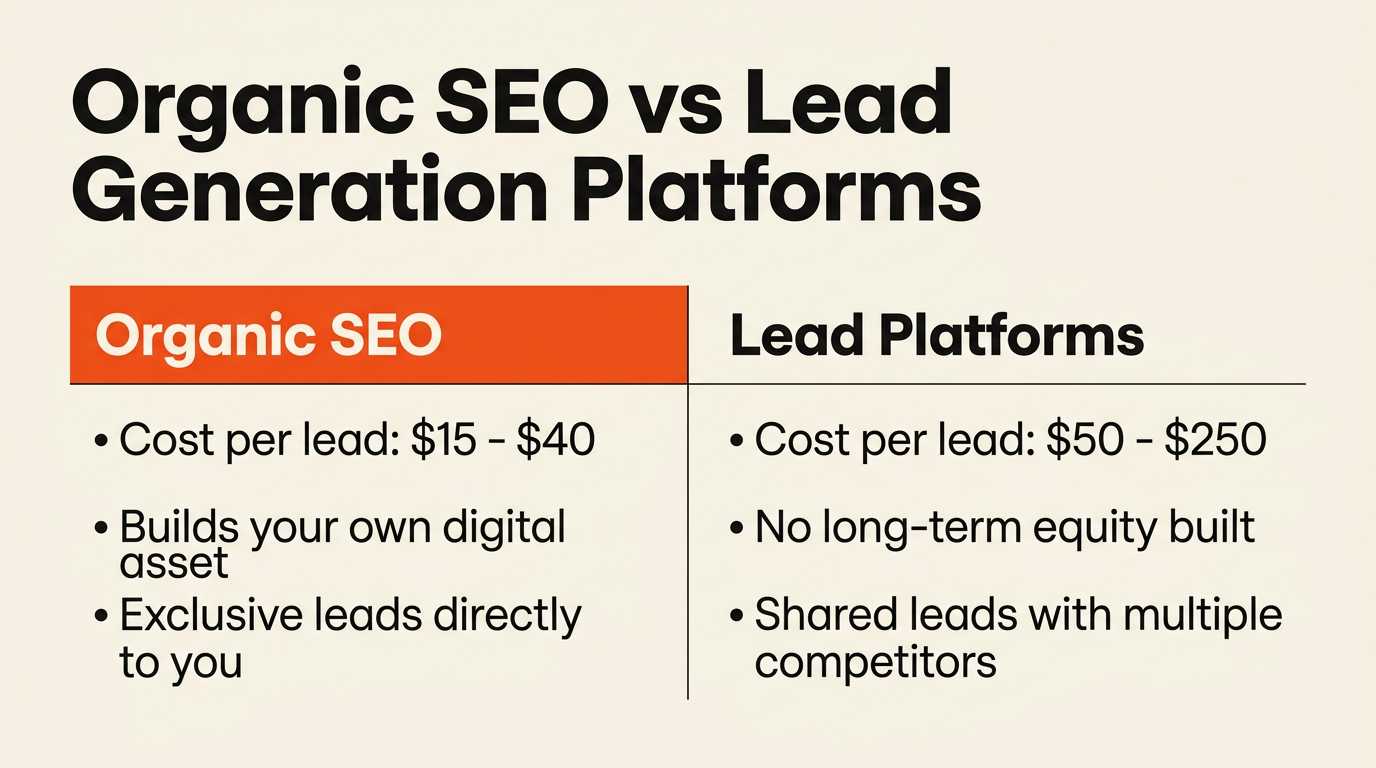
PipelineOn, citing SearchLight Digital, puts LSA leads at $53 each, 49% cheaper than standard Google Ads and 64% cheaper than non-branded search campaigns at $149. For home services, Google Ads CPL rose 10.51% year-over-year to a blended $104 for HVAC and plumbing in January 2026.
Contractors running both LSA and SEO generate 42% more total leads and 40% lower CPA than single-channel operators. Many profitable roofers put 60-70% of their marketing budget into ads early, then flip that ratio as organic matures. Paid ads are like renting an apartment where leads stop the moment you miss a payment. Organic SEO is like owning a house where the initial effort builds permanent equity.
Key Metrics That Prove Commercial SEO Return
Track the numbers that turn rankings into jobs, since rankings are a vanity metric unless they create work.
- Map-pack position: Track your top 10 city+service terms, because this is where calls come from.
- GBP actions: Count calls, direction requests, and website clicks from the profile.
- Organic conversions: Measure quote forms, call clicks, and plan signups attributed to organic.
- Booked jobs and revenue: Optimize toward these, the owner’s real numbers.
- Blended cost per lead: Combine organic and ads so SEO’s true savings show.

For roofing, target an organic cost per booked job 30-60% below the paid-only cost within 6-9 months of consistent work.
Typical Monthly Costs and Project Fees
Most roofing companies spend between $1,500 and $5,000 per month for ongoing local SEO, with one-time site builds running $3,000 to $10,000. Pricing tracks how many cities and services you need covered and how competitive your metro is.
At maturity, roofing local SEO produces leads at approximately $5 to $25 each, compared to $104 blended for Google Ads and $53 for Local Service Ads. SEO costs decrease over time, while paid search costs increase roughly 10.5% per year.
Common SEO Mistakes and Strategic Missteps
Avoidable mistakes keep roofing companies stuck even after they pay for local SEO.
Costly Setup Errors and Technical Traps
The traps below weaken local visibility and trust:
- National content: Chase local buyer-intent pages instead of national “how-to” content.
- Single service-area page: Build individual city and service pages; one “service area” page leaves too much uncovered.
- Fake reviews: Buying reviews, especially out-of-region ones, can trigger Google penalties, and Google actively removes them and may suspend your profile.
- Missing proof: Leave out photo and license proof, and trust drops at the decision moment.
- Slow websites: Slow or outdated sites make it harder to convert visitors into calls.
- Bulk links: Build links slowly and safely instead of buying low-quality ones.
Build links the safer way instead. Get listed in legitimate local directories, sponsor a Little League team and ask for a link from its website, and write a helpful guest post for a local home improvement blog. And do not lean on a single channel: the strongest roofing programs combine SEO, paid ads, social media, and referral networks.
Why Many Contractors Distrust SEO Promises
Roofing contractors often recount the same story: “I tried SEO once. Paid some companies a bunch of money, and nothing happened.” Suspicion sets in when firms collect payment, run automated software, and send reports that look impressive without booking jobs. The sales pitch usually gives away the warning signs.
- Past disappointment: Contractors paid companies well and saw no results.
- Automated reporting: Impressive reports that do not book more jobs.
- Realistic expectations: Good companies set them from the start.
- Ranking promises: They do not promise number one in a week.
- Quick-result claims: Anyone promising quick results probably is not being straight with you.
Avoid vendors promising “#1 in 30 days” or offering to “rent” you rankings on a domain they control.
Warning Signs Your Business Needs Immediate SEO Help
A few signals should move SEO onto your to-do list:
- Low traffic: Your website gets very little.
- Heavy dependence: You lean heavily on ads or referrals.
- Weak competition position: Competitors outrank you.
- Storm disruption: A storm floods results with new competitors buying ads, plus news and directory pages.
Recovery calls for stronger local signals and storm-damage content posted faster than rivals.
Evaluating SEO Agencies and In-House Tools
Choose an SEO agency that learns your business and leaves you owning the site, the Google Business Profile, and the reviews. If a firm only sends reports and invoices, keep looking.
Before you sign, ask every SEO partner these questions:
- Strategy: How will you choose which cities and services to target first?
- Ownership: If we part ways, do I keep 100% ownership of my website, Google Business Profile, and all content you’ve created?
- Reviews: What specific process will you use to help us generate more reviews?
- Reporting: Which metrics will you report monthly, and how do they tie to leads and booked jobs, not just traffic?
- Experience: Can you show a case study from a roofing company in a competitive market like mine?
What to Look for in a Reputable Marketing Partner
The better partners learn your business before pitching. They ask about the work you do best, study your service area and competition, set realistic expectations, and show progress along the way. Your local SEO partner should clear these standards:
- Local performance: Report map-pack rankings and booked jobs, not traffic charts alone.
- Reviews workflow: Use a system that keeps new reviews flowing, not a one-time request.
- Technical ownership: Handle schema, site speed, and crawl health without making you file tickets.
- Seasonal publishing: Get content ready before the demand peak, not after.
- Transparency: Show you the work, links, and rankings instead of hiding behind “we’ll handle it.”
Walk away from vendors promising “#1 in 30 days” or trying to “rent” rankings on a domain they own.
The background behind this guidance includes 10+ years in technical and content SEO, covering programmatic SEO at scale across 100K+ pages, semantic SEO and topical authority, internal linking architecture, log-file analysis and crawl budget optimization, tools like Ahrefs, Semrush, Screaming Frog, and YourText.Guru, plus team leadership across French and English markets.
Critical Questions to Ask Before Signing a Contract
Ask roofing SEO experts for an example of how they helped another contractor, then ask how their plan for your business would differ from everyone else’s. You want an asset you own: your site, your profile, your reviews.
Comparing Agency Models, Retainers, and Deliverables
A solid provider of roofing company local SEO brings more than reports and invoices. Roofing SEO sits within the broader category of local SEO for home service companies, but the agency model still counts, since a generalist may recycle the same moves it uses for a local restaurant.
That approach skips the real details. Roofing carries seasonality, emergency search spikes, and a sale built on trust. A specialist understands the roofing sales cycle, knows which credentials matter to homeowners, and builds content that suits both replacement research and storm damage inquiries.
Essential Software for Tracking Rankings and Citations
Free tools cover traffic, behavior, and search performance, while specialized options handle local visibility and listing management.
- Google Search Console: Monitor search performance, traffic, user behavior, and local rankings.
- Google Analytics: Track website traffic and user behavior.
- Google PageSpeed Insights: Measure performance and find areas to improve.
- Specialized local SEO tools: Monitor geogrid Map Pack rankings, citation health, and review requests.
- Moz Local and BrightLocal: Manage citations and reviews across directories, keep information consistent, and catch outdated listings.
Google Search Console and Google Analytics are free and, used together, give a clear picture of how your site performs in local search.
Emerging Search Trends and Future Preparation
Search engines keep getting smarter and users expect faster, more accurate results, so basic optimization no longer holds. Roofing companies that delay SEO find it harder to catch up as competition grows.
Hyperlocal Searches and Voice Queries
Local proof now reaches homeowners through images, voice, mobile screens, and assumed location.
- Images and voice: 1 in 6 U.S. searches now includes images or voice, giving roofers more chances to show project photos and before/after galleries.
- Spoken searches: Homeowners increasingly use spoken commands on mobile to find answers in a specific neighborhood.
- Location optimization: More users search through voice assistants and mobile devices, making location-based optimization more important.
- Younger homeowners: Younger homeowners rely on “near me” or assumed location instead.
Impact of AI Search and Chat Engines on Local Leads
Specific, detailed content now carries more weight because AI assistants read it before recommending anyone. A homeowner might tell their phone, “Find me the best roofer to fix a leak around my chimney,” and the AI goes beyond a list of names. It looks for a “chimney flashing repair” service, scans reviews for “leak” and “professional,” and checks GBP photos for matching jobs, then pulls service pages, reviews, and photos into one recommendation. For a request about the most reliable roofer in town, an AI assistant can review service pages and reviews, then build a trust summary explaining why the roofer looks dependable.
As search engines better grasp intent, your content should stay clear, useful, and tied to real homeowner needs. Google says the average AI Mode search runs triple the length of a traditional query. Homeowners now ask “why is my roof leaking around the chimney” rather than only “roofer near me.” Problem-specific queries are climbing: “why is my toilet running” rose 125% and “how much does it cost to replace a water heater” rose 140%, and their high CPC reflects users getting closer to a call.
How Social Media Engagement Supports Local Search
Social media does not directly move your position in search results, but visual posts and local interaction build awareness and support visibility indirectly.
- Project proof: Share completion photos, time-lapse installs, and storm damage education on visual platforms.
- Short videos: A 30-second roof transformation or drone flyover catches attention on TikTok, Instagram Reels, and YouTube Shorts.
- Content sharing: Regularly share blog posts, videos, and infographics.
- Community engagement: Join local Reddit and Facebook Groups to create brand mentions and drive direct traffic.
- Fast responses: Respond promptly to comments, messages, and reviews.
Advanced Technical Fixes for Higher Organic Traffic
Technical fixes speed up loading and help search engines read how pages connect.
- Code cleanup: Minify CSS and JavaScript so the site loads faster.
- Server distribution: Distribute content across multiple servers to improve speed.
- Page intent: Put similar phrases with the same intent on one page instead of multiple variations.
- Helpful Content alignment: Use an intentional page-intent strategy, since Google’s Helpful Content Update and later core updates deprioritize thin, narrowly scoped pages.
- Local schema: Use LocalBusiness + Service schema on every page so Google can connect the business to a place.
Frequently Asked Questions
What do SEO services for roofing companies include?
Professional roofing SEO handles page and listing work plus site fixes to lift rankings and bring in leads: keyword research, on-page optimization, technical SEO, Google Business Profile optimization, local citation building, content creation, link building, and ongoing performance monitoring.
Why is local SEO important for roofing companies?
More than 70% of customers search online before choosing a local service, and nearly 80% of local searches result in a call, visit, or inquiry within a day. That makes local visibility the gateway to nearly every roofing lead.
How long does it take for local SEO to work for roofers?
Local SEO typically brings consistent lead flow in 6-12 months. GBP and on-page updates often show the earliest results within 2-3 months, while link building and content development compound over 6-12 months.
What is the single most important local SEO step for a roofing contractor?
Your Google Business Profile. A full, accurate profile kept active with photos and posts delivers the best return for the least effort.
Can I do roofing SEO myself, or do I need to hire an expert?
You can manage GBP and reviews yourself and keep city pages consistent. A specialist usually handles the technical work, including schema and local link building.
How do online reviews affect my local search rankings?
Review signals account for about 20% of the local algorithm, up from 16% in 2023. Businesses that answer 80%+ of reviews rank measurably better than those that ignore them, and homeowners read those replies before reaching out.
Do I need a website or is a Google Business Profile enough?
A complete GBP is the foundation, but you still need a fast website with service pages to rank in organic results and to convert profile visitors with proof, pricing signals, and a quote form.
Why did my rankings drop after a storm?
A storm floods results with new competitors buying ads, plus news and directory pages. Recovery means reinforcing local signals and publishing timely storm-damage content faster than rivals.
How much does roofing local SEO cost per lead?
Approximately $13 return for every $1 invested at maturity, with marginal cost per lead approaching zero, compared to $228 per lead on Google Ads (PipelineOn).
Should I use Google LSA or local SEO for my roofing company?
Use ads for immediate cash flow and storm surges, and invest in SEO for the long-term, lower-cost pipeline. That order covers urgent demand while organic visibility keeps growing after the ad budget ends.
What is the most important factor for Map Pack rankings?
Google Business Profile signals account for 32% of Map Pack rankings, the single largest factor. Review signals (16-20%) and on-page signals (19%) round out the top three.
Key Takeaways for Long-Term Market Dominance
A roofing company’s local SEO strategy rests on three foundations that cannot substitute for one another: a fully claimed Google Business Profile for Map 3-Pack eligibility, review generation across platforms, and content grounded in genuine credentials and documented work rather than unverifiable claims.
Companies that bring these three together, instead of managing them as separate checklists, stay best positioned as Google’s local algorithms give greater weight to review signals and profile completeness each year. For roofing companies new to SEO, put on-page optimization and GBP improvements first, since they typically create the earliest measurable ranking lifts.
Once your site ranks for “roof repair near me” or “roofing contractor in [your city],” that visibility can generate leads month after month, not just while you pay for clicks.