Nearby clients’ first step is often a search, before phone calls or personal introductions, making local seo for accountants a practical way to get found.
Local SEO helps place your accounting firm in local searches when people in a specific area look for accounting services. The firm then appears in the local search those people are using. Claim your Google Business Profile, keep NAP (Name, Address, Phone number) information consistent, and collect positive customer reviews. This is local SEO.
Why Local SEO for Accountants Are Crucial for Your Firm
A local search reaches people who are already hunting for accounting help close by. BrightLocal’s latest Local Consumer Review Survey found that, over the past year, 99% of consumers went online to find nearby businesses, while 78% did so at least weekly. These prospects are already searching nearby.
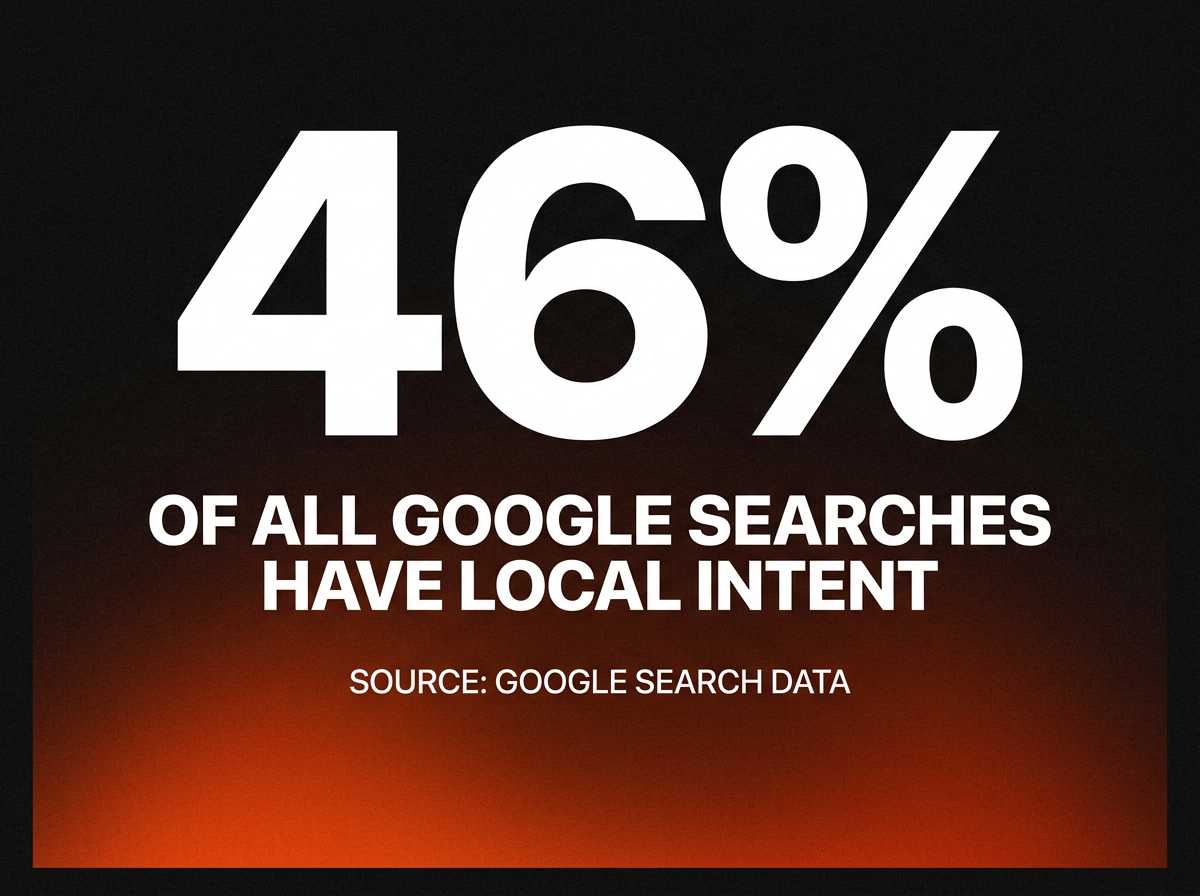
Local purpose shows up in 46 percent of all Google searches. On mobile, 88 percent of people making a local search contact or visit a business within a day.
If your accounting firm wants clients from the surrounding community, local SEO matters. It gets your online presence in shape, so nearby clients can find your services without much hunting.
Your placement affects how prospects judge the firm. Higher positions put you in front of people already searching and can build trust and credibility.
Google’s #1 result gets approximately 27.6% of all clicks. The top three listings account for 36% combined, leaving firms outside those spots at risk of losing prospects to another practice.
Almost 50% of Google searches involve local information. Being easy to find locally can bring in clients.
Referrals and word of mouth still bring business through the door. Sure, they can win clients, but they don’t give successful CPA firms and accountants the steady stream of qualified leads that local SEO can.
Even a strong referral gets checked online first. Prospects usually search the firm name after a recommendation, and a thin or stale presence makes that referral a coin toss against a competitor with stronger local visibility.
The Power of “Near Me” Searches
Local searches show immediate demand
People regularly search “accountant near me” and “tax help in [your city].” A Google Business Profile can show at the top of map results for “CPA near me” or “tax accountant in [city],” putting your firm in front of someone seeking help right now.
Broad informational searches differ sharply from searches tied to local hiring. Someone asking “what is corporate tax rate” wants an answer. In contrast, searches for “CA firm near me” or “tax consultant in Sector 62” show immediate commercial intent from someone ready to hire a firm.
That buying-ready purpose means local search visitors convert at significantly higher rates than national informational visitors.
The Local 3-Pack captures ready-to-hire clients
Google’s Local 3-Pack is a map box positioned above organic results that features three leading local company listings. When your accounting practice is missing or buried there, ready-to-hire local clients can call another firm instead.
A spot in the Google Map 3-Pack can bring calls and clicks. Call Now can connect prospects with a firm within seconds of a search, while Directions and Website buttons provide other ways in.
The monthly search numbers make the opening clear. “chartered accountants Ireland” gets approximately 12,100 searches each month. For “accountant near me,” monthly search volume is 3,500, while “accountant Dublin” gets up to 5,000 searches each month.
Google reports that “Near me” searches increased by more than 900% in recent years.
Building Local Trust and Community Connection
Visibility supports trust
Strong placements put your firm before active searchers and can build trust and credibility. That carries real weight in accounting, a high-trust field.
Economic uncertainty makes prospects dig deeper before picking an accountant. They want online evidence that the firm has expertise and is reliable enough to trust.

A stronger local presence, supported by Local SEO for accountants, can help accountants build community ties, supporting loyalty and long-term client relationships. It also helps them contend with a better-optimized competitor.
When clients trust an accountant’s expertise and can reach them easily, they are more likely to refer that accountant.
Personal access matters to accounting clients
Financial data and tax audits call for personal trust, and corporate advisory does too. Clients often favor firms where they can meet partners face to face.
Display CPA and AICPA certifications to show your qualifications and experience.
Why Basic SEO is No Longer Enough
A lot of firms stop too soon. They see local SEO as a one-time job after setting up a Google Business Profile, formerly Google My Business, and adding their services.
That approach holds up less as search habits change. According to Google, users leave without clicking through to a website in more than 60% of Google searches now, so your Google listing needs to carry more weight.
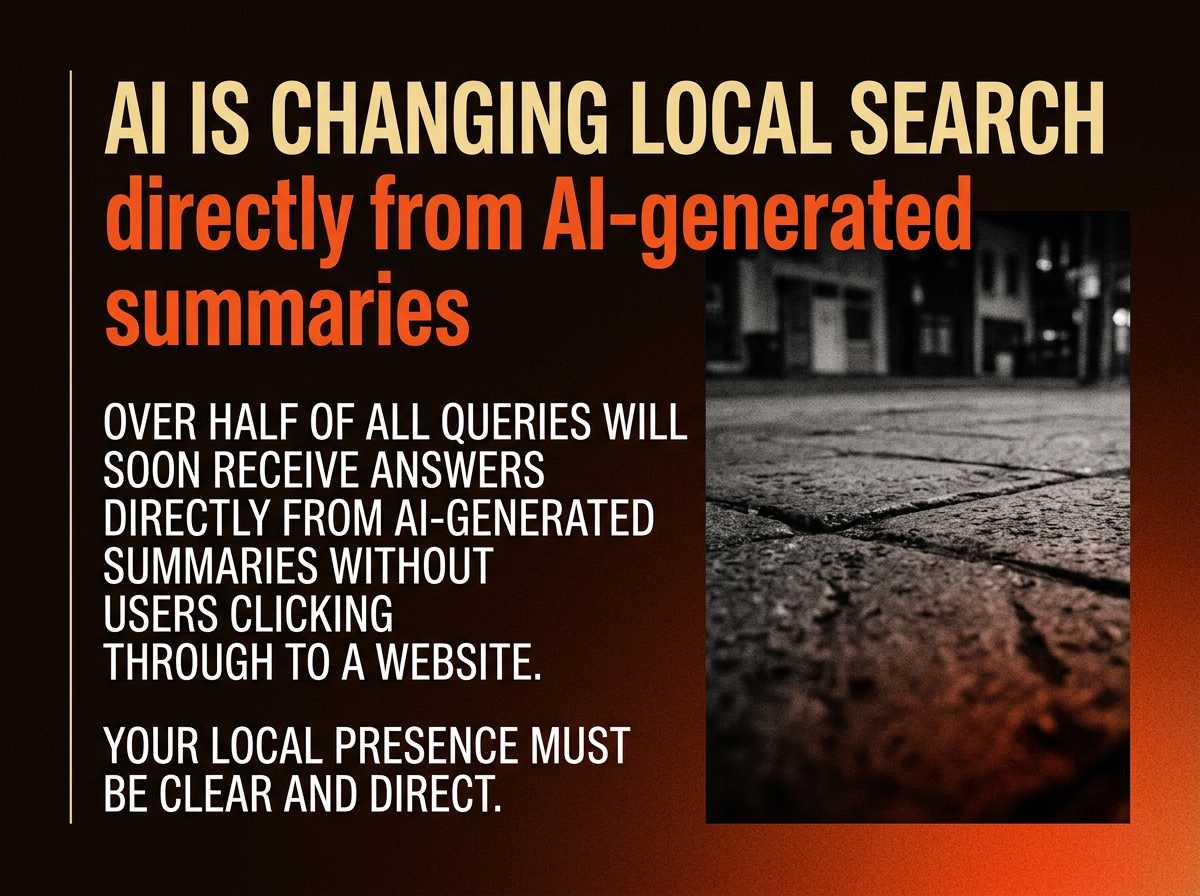
By 2025, over 50% of queries will get answers from AI-generated summaries rather than the usual blue links. Over half of searches already end without a click when an AI Overview or assistant response supplies the answer.
Your firm still has to be the clear, correctly answered source when searchers never click through. Searches are shifting toward hyper-local and AI-assisted results.
Content requirements for AI-first experiences
For AI-first experiences, your content should include:
- Clear answers to common questions, such as “How to file business taxes in Texas?”
- Proper use of headers, bullet points, and definitions
- Schema markup like FAQPage and HowTo
Google wants to answer questions quickly, often without sending people to a website. Give it the most trustworthy, direct local answer.
Your First Steps for Immediate Local Visibility
Accurate details, easy contact options, and proof that clients trust you still drive local visibility, even as AI-first results spread. Start with that foundation.
Fully Optimize Your Google Business Profile
For an accounting firm, Google Business Profile, formerly Google My Business, is the most vital foundation for local SEO visibility when marketing small business accounting for companies in [region]. Get it right first, and every other local effort has somewhere solid to land.
Nearby prospects treat it like the storefront where they first find you.
Fill out the profile with complete, accurate details.
- Complete the fields: Fill out every field. Google likes thorough people.
- Check the business details: Keep your business name, address, phone number (NAP), website, hours of operation, and service descriptions accurate and consistent across every online platform.
- List your services: Include credentials, certifications, and every service you offer: tax prep, bookkeeping, payroll, audit, and advisory.
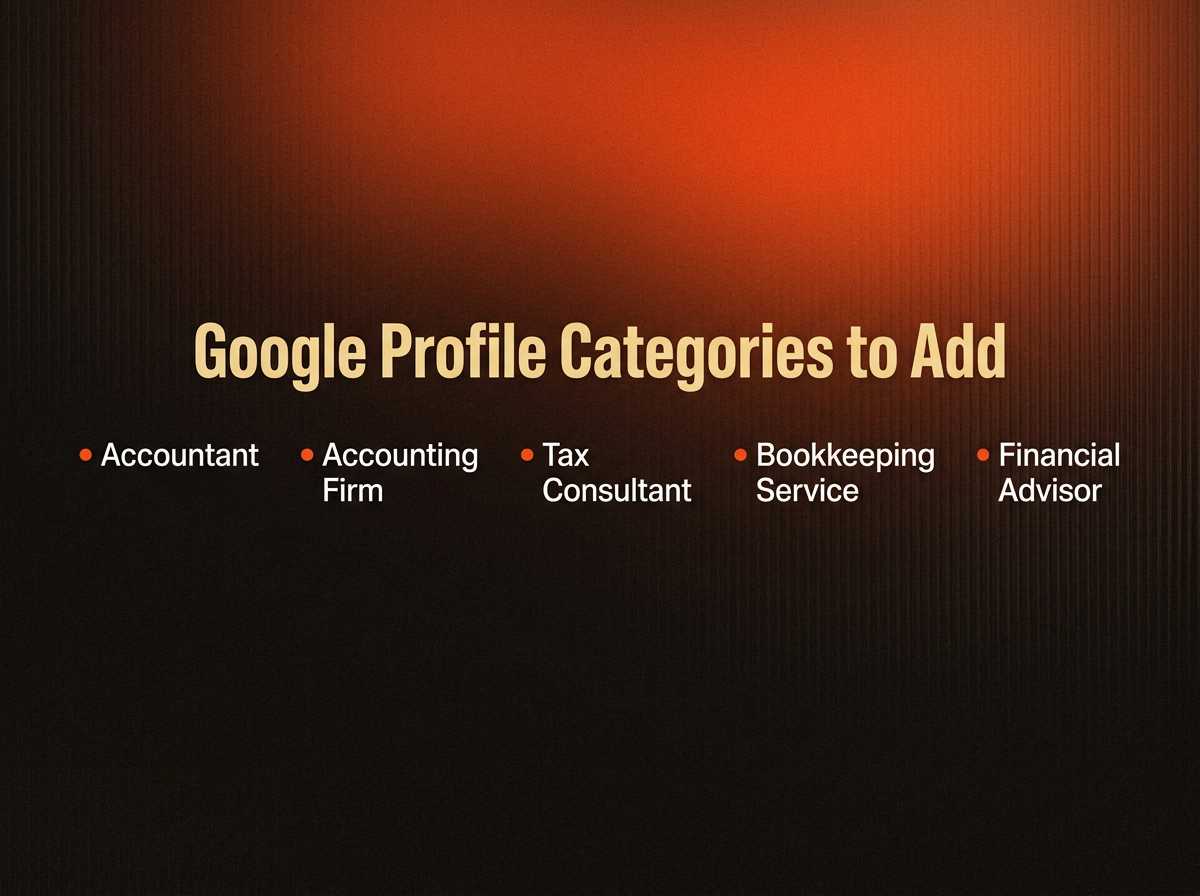
- Select a main category: Choose “Accountant” or “Accounting Firm” as your main category.
- Add secondary categories: Add “Tax Consultant,” “Bookkeeping Service,” or “Financial Advisor,” based on the work you do best.
- Use the category limit: Google allows up to ten categories, and each one can help you appear for a different search.
- Add photographs: Upload clear images of your office, team, and charts and graphs that explain your work.
- Go beyond the usual photo count: Businesses usually have at least 11 photos, so add more when you can.
- Use the description: Use the 750 characters to explain your business, your work, and where you do it.
- Include local keywords: Add phrases such as “tax preparation services in [city]” and “small business accounting for companies in [region].”
- Publish regular Posts: Publish at least one weekly reminder about tax deadlines, seasonal tax tips, blog updates, or news in your field.
- Answer questions: Address common questions about services, fees, specialties, or availability, so prospects see useful answers before they call.
Photos can drive action: studies show profiles with images receive 42% more direction requests and 35% more clicks to the company website.
Get More Client Reviews to Build Trust
Google factors reviews into its algorithm, and they give unfamiliar prospects a reason to trust your firm. Positive feedback can lift local SEO rankings while doing part of the selling for you. Prospects read it.
Use a simple review process.
- Ask after delivering value: Make asking for reviews a habit after you solve a hard problem, save a client money, or finish their taxes.
- Give a direct link: Send clients a direct link to your Google Business Profile review page.
- Use a short message: Send a quick email or text: “Thanks for trusting us with your taxes this year! “If you enjoyed our service, please leave a review on Google.”
- Begin with loyal clients: Start with your best customers; long-time clients who already trust you often leave the strongest reviews.
- Accept a natural range of ratings: A few bad reviews can look more trustworthy than only five-star reviews. A mix of ratings feels real.
- Reply to every review: Respond to every review, whether the feedback is good or bad.
- Thank positive reviewers: Thank people who leave positive feedback.
- Handle negative feedback professionally: Keep replies to bad reviews professional and focused on a solution.
- Move difficult conversations privately: Do not fight in public or get defensive. Acknowledge the concern, apologize when appropriate, and offer to talk privately about a solution.
- Avoid improper review practices: Never buy fake reviews or offer improper incentives. Google’s terms of service prohibit paying people or giving discounts for reviews.
People often decide before they ever contact you. Before choosing a company, 90% of customers read reviews, and 83% turn to Google for reviews of local businesses.
Regular, genuine reviews are a main local ranking signal. Firms that earn them generally place higher in the local map pack.
Details make reviews more useful. A smooth audit, a deduction someone caught, or responsive tax season support gives prospects more than a generic five-star rating.
Keep Your Name, Address, and Phone (NAP) Consistent Online
What citations contain
Citations are online mentions of your business name, address, and phone number, and those details should match across every site.
Tiny gaps can muddy the picture. “Street” on one listing and “St.” on another, or an omitted suite number, may make Google doubt the details and hurt rankings.
Why consistent NAP information matters
Search engines check NAP, meaning Name, Address, Phone number, across outside directories to confirm an accounting practice’s physical location. Accurate Citations confirm the firm as well.
Matching NAP details also help AI systems confirm a firm is legitimate.
Handle this information like official business registration records. Different addresses or phone numbers across listings resemble conflicting business cards, so search engines and clients may wonder which one is correct. Use one version throughout.
Directories to check first
Begin with major data aggregators and directories, since they send your details out to hundreds of other sites.
- Yelp
- Pages in yellow
- The Bureau of Better Business
- Chamber of Commerce
- Angi (formerly known as Angie’s List)
- Apple Maps

After that, review accounting and finance directories.
- A list of CPAs
- The National Association of Tax Professionals
- The American Institute of CPAs (AICPA), if you are a member
- CPA groups in every state
- Business groups in the area
Check Citations through Moz Local or BrightLocal, then promptly correct duplicate listings, stale details, and wrong information.
Strengthen Your Website’s SEO Foundation
Website quality directly shapes how clients find and trust your firm, and it carries the SEO load that keeps your whole strategy standing.
When content is clear and easy to follow, Search engines can rank your site accurately, while a smoother user experience builds credibility.
Build Authority with Long-Term Content Strategies
Relevant, high-quality content gives visitors useful answers to the questions they came to settle and gives them a reason to stay engaged. Given time, that consistency can make your firm a thought leader in accounting.
Keep putting out relevant, high-quality content. It helps SEO, while showing potential clients your firm is credible and worth trusting.
Integrating SEO with Other Marketing Channels
Siloed SEO planning won’t cut it because your other channels are already in play. Keep the message aligned across each channel, and an accounting firm stays consistent while getting the most from every dollar it invests.
Pair financial services seo with the other digital channels you use, and you can make campaigns more effective, bring in more qualified leads, and build stronger client relationships over time.
Analytics Integration
Pulling data together from every channel gives you a clear, complete view of overall performance.
Unified Reporting:
Track cross-channel interactions in Google Analytics and CRM systems, then gather all of those records in one report.
Data-Driven Decisions:
Reading the numbers helps sharpen plans and place resources effectively.
Common SEO Mistakes Accountants Should Avoid
It only helps when SEO receives ongoing upkeep beyond a one-time effort, with results monitored closely and your approach adjusted as they shift.
Monthly SEO retainers need a close look. Sure, some agencies and web developers deliver solid work, but plenty don’t, and the return for the firm can be thin.
Neglecting Your Google Business Profile
A Google Business Profile can be treated like paperwork, completed at setup and then never updated, with results unmonitored afterward.
For an accounting firm, that sends the wrong message. When a profile is stale or generic and provides thin detail, the GBP can make clients doubt a service category built on trust, where trust drives sales; many are ineffective.
Using Generic Content and Broad Keywords
Keyword Stuffing
Keywords that fit the page have a place, but cramming them in too often or in awkward, unnatural spots creates more trouble than value for readers and search platforms. That practice, Keyword Stuffing, makes copy hard to read and may lead to penalties from search engines.
Solution:
Write for people first, then place keywords naturally inside high-quality content that gives ranking systems context.
Thin or Duplicate Content
Pages offering little useful information or content copied from other sites can hurt SEO, since ranking systems favor informative content created to serve that page’s readers.
Solution:
Audit your content regularly so it remains useful and unique while meeting your audience’s needs over time.
Ignoring Your Website’s Technical Health
Overlooking Technical SEO
Technical problems can damage rankings without being immediately apparent to you, and search platforms will still catch site issues, from Broken links and slow load times to improper URL structures.
Solution:
Audit your website regularly, and fix Broken links or missing meta tags, along with slow page speeds whenever you find them during those technical reviews.
Neglecting Mobile Optimization
Solution:
Test your site across different devices, then make it fully responsive and mobile-friendly so every visitor gets a seamless experience.
Measuring Your SEO Success and What to Expect
With regular reporting, you tie SEO to measurable business results, which helps justify the marketing budget to partners and stakeholders while tracking SEO ROI, the return connected to client interest.
Key Metrics to Track Your Performance
These numbers tell you how visitors reach and use your site, and whether SEO is driving the actions you need.
- Organic Traffic: Count visitors who reach your site through unpaid search results.
- Keyword Rankings: Track where your targeted keywords appear in search engine results.
- Conversion Rate: Measure the percentage of visitors contacting you or downloading a resource.
- Contact Form Submissions: Track when people complete inquiry forms.
- Newsletter Sign-Ups: Watch your email list grow.
- Resource Downloads: Measure engagement with the content resources you offer.
- Bounce Rate: Record visitors who leave after viewing only one page.
- Average Session Duration: Review the average time people spend on your site for engagement clues.
To check SEO performance, open Google Analytics 4 (GA4).
For Keyword Rankings and indexing status, check Google Search Console, which also helps you spot technical issues.
A Realistic Timeline for Seeing Results
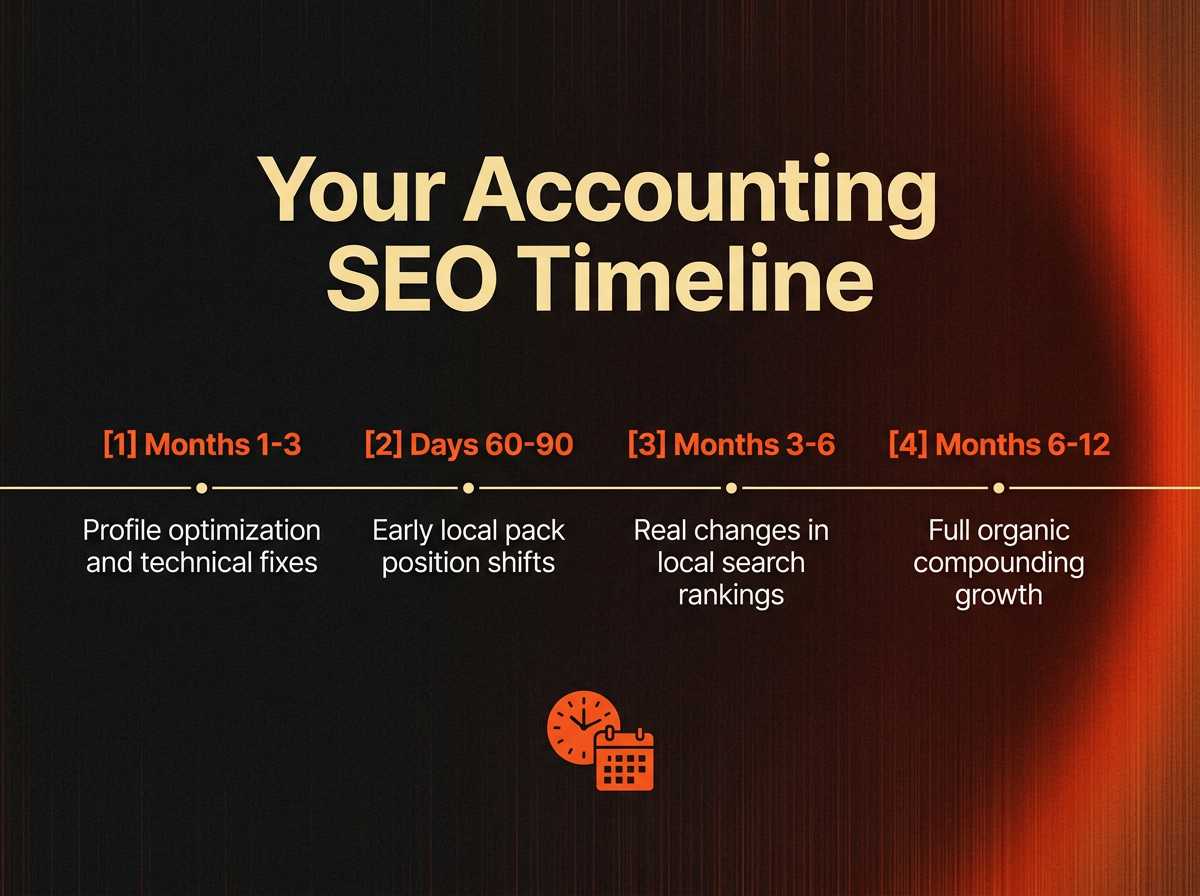
Over time, SEO results appear in stages, rather than showing up all at once. Firms may see the following as the work continues.
- First three months: Most of this period goes to Google Business Profile optimization, technical fixes, and initial review building. Visible movement may still be limited.
- 60- to 90-day range: Local pack shifts often show up here, especially outside the busiest filing season.
- 3-6 months: With steady Google Business Profile work, citations, and reviews, most accountants see a real change in local search rankings.
- 6 to 12 months: Broader guidance on accounting SEO timelines puts full organic growth in this range. Growth can take longer in dense metros like New York, Los Angeles, Houston, or Dallas, and the same pattern applies across competitive markets in the United States more broadly.
- Factors affecting the timeframe: Results depend on keyword competitiveness, website quality, and how consistently you apply SEO practices.
- Continuing the effort: Abandoning SEO around month four, just before the Local pack begins to move, is the single most common way firms decide this channel is “not worth it.”
Paid advertising can put you in front of people quickly, while SEO trades speed for stability. Once ad spend ends, so does that visibility; SEO needs longer to gain momentum, then can serve as a durable asset supporting your firm over time.
Essential SEO Tools for Accounting Firms
Free Google Search Console and Google Analytics give you a clear read on the searches sending people to your site, plus technical problems that may be holding back its visibility. Both tools are free.
Watch rises and drops in both tools, so changes don’t vanish before you see them. Google Analytics and Google Search Console give you room to react, while Ahrefs, or a comparable paid platform, shows what already ranks for nearby rival firms. Check that paid view before you spend your content resources on a search term another firm already owns.
Google Search Console
Check Google Search Console and Bing Webmaster Tools for indexing status and security or crawl issues. Google Search Console tracks search-query performance, flags site technical problems, and lets you respond to changes rather than overlook them.
Google Analytics
Unpaid search visits, conversion rates, and user behavior are measured in Google Analytics. In Google Analytics, you can monitor traffic sources and conversion paths, as well as user behaviour.
Google Keyword Planner
Google Keyword Planner, SEMrush, and Ubersuggest can surface terms prospective accounting-firm clients search when they’re ready to hire. Each also backs search-term research for accounting firms. It provides search volume and term difficulty, then suggests related terms.
Ahrefs and SEMrush
Dig into rival sites through SpyFu or Moz’s Keyword Explorer, then turn to Moz for backlink tracking; Ahrefs and SEMrush work as alternatives.
Run backlink audits regularly to find low-quality or spammy links that could hurt your search visibility, then identify the links you should disavow.
BrightLocal and Whitespark
BrightLocal and Whitespark can uncover citation opportunities you missed, and you can use either tool for citation building in the U.S.
FAQ
How much does local SEO cost for an accounting firm?
A typical monthly bill for agency-run SEO is USD $1,500 to USD $5,000 per month. DIY tools start near USD $0 to $200 per month, while freelancers and AI-assisted platforms fall between.
Do I need separate pages for tax prep, bookkeeping, and advisory services?
Give each distinct service its own page if you offer it. Tax prep and bookkeeping draw different searches from advisory. A single blended page may satisfy none of them well.
Should I run Google Ads or focus on SEO?
Google Ads suits individual tax-filing demand in the first quarter, when deadlines make demand rise quickly. Outside that period, Local SEO generally produces better ROI, bringing a steady, compounding flow of business and advisory clients rather than a seasonal spike.
Can an agency guarantee a #1 ranking on Google?
No reputable agency can guarantee a specific #1 Google Maps ranking: Google’s algorithm is closely guarded and changes constantly, making such a promise impossible.
Choose a trustworthy partner that commits to best practices and clear reporting, not a rank promise. Google’s local algorithm dynamically orders listings based on relevance and distance, along with prominent trust signals.
What’s the difference between local SEO and traditional SEO?
When people seek answers to questions, traditional SEO works best, with results aimed more at content than services.
Local SEO goes after nearby business searches, tuning your online presence for nearby results across Google, as well as other search engines. A common filter is proximity to the searcher, as in ‘Tax CPA near me’ or ‘Accountants near me’.
Results from SEO take time, expertise, and continuous monitoring. Hire an SEO professional or agency for SEO services, so you stay focused on your practice and your client’s finances.
You now know the practical split: what Local SEO for accountants cost, when Google Ads earns its keep, why separate service pages matter, and what an agency can honestly promise. Traditional SEO answers question-led searches, while Local SEO helps nearby searchers find an accounting firm. The effort still takes time, expertise, and steady monitoring, so many accountants hand it to an SEO professional or agency while they focus on their practice and clients’ finances. Google Maps changes over time, so ongoing attention matters.