It seems like every marketer is stuck in the ongoing debate over AI vs human-written SEO content. Marketers are told that either automated content is going to completely take over search, or that Google will systematically crush any site that isn’t 100% human-written.
The real way to win is a human-led workflow that uses AI to uniquely nail your E-E-A-T signals.
This article is going to walk you through that hybrid model. A crucial starting point is realizing there’s a world of difference between raw AI output and content that’s genuinely AI-assisted, and we need to get our definitions straight before we can build anything.
Defining AI vs Human-Written SEO Content
If you’re throwing all your “AI content” into the same bucket, you’re making a huge mistake. Your performance data becomes a mess, you can’t tell what’s actually working, and you end up wasting money on the wrong things. So let’s get the terms right. We’re really talking about three different things: raw machine output, pure human craft, and the hybrid model that sits in the middle.
What Is AI-Generated Content?
AI-generated content is any text a machine learning engine drafts from a simple prompt, with no human writing the words. Tools like ChatGPT, Claude, Gemini, or specialized platforms like Jasper and Copy.ai use natural language processing to turn a short instruction into a full blog post, product description, marketing email, or social update in minutes.
In the early days, I’ll admit I used these tools to just churn out articles. It feels like magic, and you can see the appeal, especially if you’re managing a huge site or have a crazy editorial calendar to fill. Nothing beats it for pure speed and volume, which is exactly why so many teams reach for it first.
But the hidden cost is that you have to be the expert who plans everything and then validates every single fact. The truthfulness and unique angle of the output depend entirely on your manual review. It’s not as “hands-off” as it looks.
What Is Human-Written Content?
Human-written content is text a real author writes themselves, drawing on their personal history, analytical mind, and creative choices. A person investigates the topic, breaks down complex data, and produces copy with the deep contextual understanding that automated software typically overlooks.
This kind of writing gets its strength from human ingenuity, real-world experience, empathy, and logic. It shows up in formats a machine can’t fake: investigative reports, individual stories, detailed case studies of actual client results, professional commentary, and original data collection.
A real writer weaves in their unique voice, feeling, and all the subtle shades of meaning that make a piece connect with someone. That’s what builds authentic credibility and practical authority.
What Is AI SEO Writing?
AI SEO writing is the practice of using machine learning tools to help build search-optimized pages, while a human strategist stays in control of the outcome. It covers targeted keywords, user intent, topic analysis, article structure, internal linking, and ranking performance, with the machine handling the preparatory work rather than authoring the piece.
Think of it this way. Relying purely on automation is like an algorithm writing an entire article from the first word to the last. Classic human writing is an author typing out every single line with no machine help. The hybrid approach sits in between: a skilled planner uses a high-performance tool to speed up the tedious parts like data gathering, structural layout, and a first draft, while the flesh-and-blood professional remains responsible for cracking the actual puzzle.
AI vs Human-Written SEO Content: A Direct Comparison
AI is great at the grunt work. It can help with brainstorming, topic expansion, keyword organization, and repetitive content tasks. The problem is that it can also produce copy that sounds polished but says nothing new. It tends to fall back on familiar ideas, repetitive sentence structures, and broad claims. Worse, it can get things wrong and sound completely confident while doing it.
That’s where human writers still have the edge. They can bring firsthand experience, original opinions, real examples, and a distinct brand voice to the page. They can also spot weak arguments, understand complicated search intent, and decide what the reader actually needs to know. A machine can imitate expertise. It cannot replace the person who has actually lived it.
| Attribute | AI-Generated Content | Human-Written Content |
| Speed | Extremely fast; can produce drafts in minutes. | Slower; research, writing, and editing take more time. |
| Cost | Generally inexpensive; often free or subscription-based. | Higher; depends on expertise and research depth. |
| Originality | Synthesizes existing information but struggles with genuinely new ideas or lived experience. | Brings original ideas, firsthand insights, and unique perspectives. |
| E-E-A-T Alignment | Limited; cannot demonstrate genuine firsthand experience and may introduce factual errors. | Stronger; naturally demonstrates experience, expertise, and credibility. |
| Strategic Value | Useful for research, brainstorming, outlines, and scaling production. | Strong for authority, brand voice, trust, and conversions. |
So which one is better?
That’s the wrong question. It is best to use both.
Let AI handle the tedious groundwork, then let a human expert do the thinking that actually matters — fact-checking, adding original insight, shaping the voice, and making the final call on what deserves to be published.
What Google Says About Using AI for Content
Google doesn’t care if a robot or a human wrote your article. They care if it’s helpful or if it’s spam. That’s it. This isn’t some new secret, but they’ve recently made it so clear that there’s no excuse for getting it wrong anymore.
Google’s Official Stance on AI Content
Google has been surprisingly upfront about this. Back in February 2023, they updated their guidelines to spell it out: they care about the quality of the content, not how you made it. To make sure everyone got the message and you learn the rules for AI content, Danny Sullivan from Google’s Search Liaison team came right out and said that using automation is fine, provided your main goal is to create something genuinely useful for people, not just to game the system.
Their ranking systems are built to reward things like credibility and a real focus on the reader. They’re trying to figure out if your page is valuable and useful, not whether it was typed out by a person or an algorithm. The caliber of the information is far more important than the method of its generation. The quality of the information is the only thing they’re trying to measure.
The Focus on Helpful, People-First Content
Now, I know what you’re thinking: “But what about their spam policies?” Sure, they have them. But those policies are designed to catch low-quality, unoriginal junk that’s only there to trick search engines. It doesn’t matter if a human or a machine made the junk. If it’s created just to get clicks without providing any real answers, irrespective of its origin, that’s what gets flagged.
The biggest mistake I see is this obsession with whether Google can “tell” it’s AI. Who cares? The real goal is to answer someone’s question so thoroughly that they don’t even think about hitting the back button. When you create that kind of experience, you’ve won. That’s the actual job.
What the Ranking Data Actually Shows
Should you use both human writers and AI? But that doesn’t mean a human and an AI are equal partners. The data gives a pretty clear verdict on where the real advantage is. When you look at what’s actually happening in the search results, not just on Twitter, you see that while AI is a standard part of the toolkit now, it’s not the one earning the spots that make you money. Those are still won by human-led work. And this isn’t a gut feeling. We’ve got the numbers to back it up.
Human-Led Workflows Are Still the Norm
The default way of working is still to have a person in charge. If you look at the surveys, you’ll find that a human is either writing the copy or calling the shots in 87% of all search optimization departments. That number comes from combining the 64% of pros who use a hybrid human-AI system with the 23% who don’t use any AI helpers at all.
Human-Written Pages Dominate Top Rankings
In a review of 42,000 different articles, the pages sitting at the very top were 8x more likely to have been written by a human. In fact, human-authored pages hold that premium spot 80% of the time. Content that was purely machine-made? It got there in a mere 9% of cases.
This gap is all about the fight for the top. An article in the first-place slot has an 80.5% chance of being human-made. But once you get past position 5 or so, the difference shrinks. If your team’s definition of success is just landing somewhere on the first page, then sure, AI-generated text can still get you in the game.
SEOs See AI Improving, But Quality Lags
The widespread use of these tools is driven by two main factors: speed and ideas. The biggest benefit of automation, according to 70 percent of search marketing departments, is simply getting content out the door faster. Another 62% say it’s most helpful for conceptualization support. Yet only 19% of professionals think these tools actually make the final copy any better.

That said, people are getting more comfortable with the hybrid approach. The number of search experts who say that human-AI collaborative text ranks as well as or better than purely manual work is up to 72%, a jump from 64% in a 2024 evaluation. Over that same time, the group of people who were uncertain or lacked comparison data shrank from 27% to just 15%, which means more teams are getting real-world data and forming an opinion.
The Prevalence of AI Content in Search Is Growing
For those using these tools, the sky is not falling. The total amount of AI-generated content in search results is definitely climbing. A 2024 investigation conducted for Originality.ai, which monitored 10,000 search outcomes, found that the share of automated pages in the top 20 positions grew from just 2.3% in January 2020 to 19.1% by November 2024.
And the marketers behind that content are mostly happy with what they’re seeing. A full 70% of marketers who employ automated content report that their ranking success has either increased or stayed the same. Another 25% state their visibility has remained flat. Only a small fraction, just 6%, have seen their results get worse.
A Note on Methodology
It’s important you know how these studies figure out what’s “AI content.” They aren’t having a person sit down and read thousands of articles. The research gauged the presence of automation by running each page through the classification algorithms of a tool, in this case Originality.ai.
You just have to remember that these detection tools aren’t perfect. They make mistakes, flagging human writing as AI and vice-versa, especially with heavily edited machine text or very structured human writing. Incorrect classifications in both directions occur. So think of these numbers as strong signals of a major trend, not as absolute, undeniable proof.
SEO Content Services vs AI Tools: The Pros and Cons
Choosing between traditional seo content services vs ai tools seems like a no-brainer; it’s faster and cheaper. However, treating it as a total replacement is a dangerous trade. The real cost appears later, when you lose the trust and brand loyalty that only human work can build.
Advantages and Disadvantages of AI Content
AI is undeniably fast. Research from Search Engine Journal shows at least 65% of specialists use AI for basic tasks like gathering info and cleaning up text. The problem is, the machine is a confident liar.
It invents quotes and gets facts wrong. Feeding a raw audio transcript to the software, for instance, often results in invented quotations. The machine also churns out bland, generic advice and makes up sources. This provides no real value and is a fast way to lose a reader’s trust.
Advantages and Disadvantages of AI Content
This is where a real person comes in. Human-led content builds brand equity that no one can copy. A machine cannot formulate novel concepts or share genuine personal histories. Real creative thought from a domain expert remains irreplaceable.
Automated systems make excellent assistants, perfect for helping with a first draft or organizing notes. But they are terrible strategists. To understand why the human-led approach wins long-term, look at what Google actually rewards when it scores for quality.
Scoring Content Performance with E-E-A-T
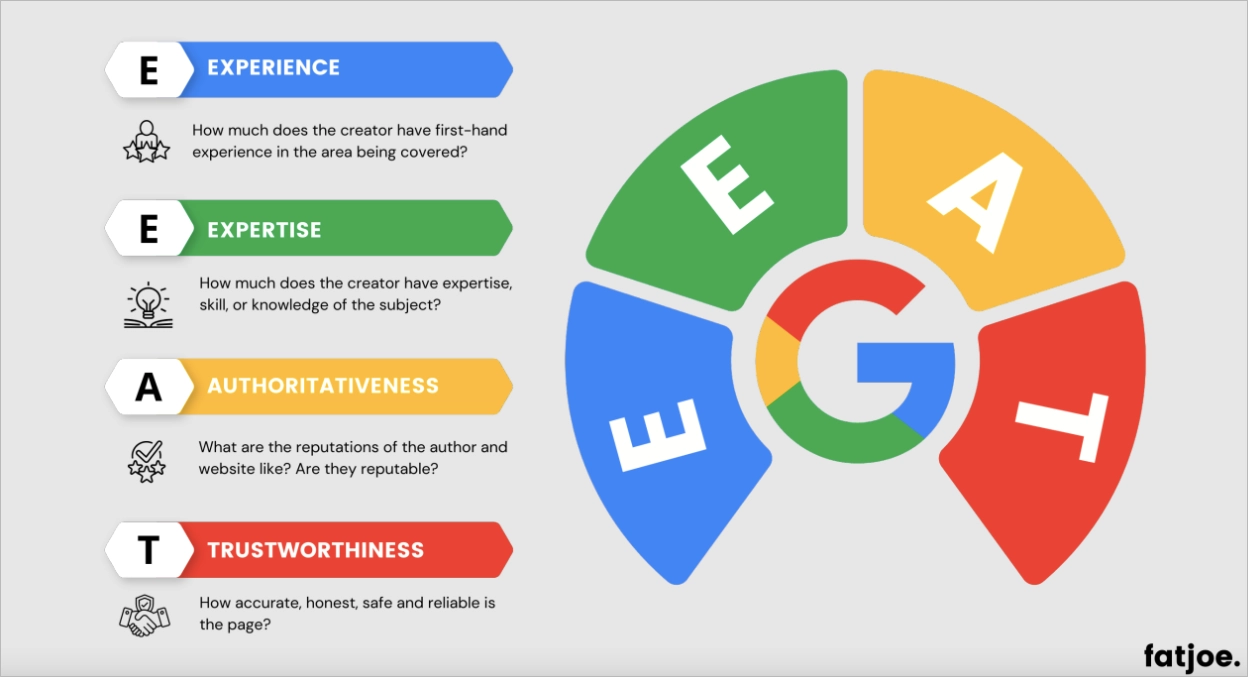
Google needs a way to tell the difference, so it published its scorecard: E-E-A-T, which stands for Experience, Expertise, Authoritativeness, and Trustworthiness. This is the literal framework their human reviewers use to judge your content.
Experience and First-Hand Accounts
The first ‘E’, for Experience, is where AI fails immediately. An AI has never lived a life. It cannot describe having a skin condition, only scrape what dermatologists have written. For travel, it cannot produce destination reports written by actual visitors.
It has not spent years on job sites. When a homeowner searches for instructions to repair a dripping water pipe, an AI will generate a generic, technically correct guide. But a plumber with 20 years of experience will write a guide that says, “Hey, if your house was built before 1980, you’re going to find this one weird part that the manual doesn’t mention. Here’s how you deal with it.” That’s real experience, and it’s what people are looking for.
Expertise, Accuracy, and Topic Depth
The second ‘E’, for Expertise, is tricky because AI is good at faking it. It sounds confident. When these tools first got good, I mistakenly thought I could use them for a first draft and do a quick proofread.
The tool behaves like an overly self-assured trainee. It will state something that sounds plausible but is wrong. It does not know it is lying; it is just pattern-matching. Fabricated assertions appear completely genuine to the casual observer. It can smoothly invent realistic points derived from mathematical data distributions, and a regular reader will not be able to tell the difference.
Authoritativeness and a Unique Brand Voice
Authoritativeness is about having a point of view. When I was starting out, I made the classic mistake of trying to sound “professional,” which meant sounding like everyone else. My content was invisible. Texts produced entirely by algorithms typically exhibit a predictable set of flaws.
AI makes the same mistake. It produces polished, grammatically correct sentences that say nothing new and is prone to using highly redundant grammatical structures. In contrast, human copywriters generally excel at establishing consumer belief, providing novel angles, and expressing a unique tone. An expert builds authority over time by having a unique voice, offering fresh takes, and building a relationship with their audience. That is how you build a brand, not by sounding like a robot.
Trust Signals and Content Credibility
Trust, the final component, is the easiest for AI to get wrong because it has no ethics. It does not know what plagiarism is. I have seen it produce an article that was a near-perfect copy of a competitor’s page, down to the headings. Publishing that is theft.
Publishing false or stolen content means other credible sites will never link to you, and any rankings you achieve will vanish.
The real damage is to your name. You are choosing between a short-term burst of content and the long-term trust of your audience. Flooding your site with unchecked AI content is a great way to burn that trust to the ground.
Creating Your Hybrid Content Workflow
The best content workflow isn’t AI or human, it’s a system where a human leads and the machine assists. Give the grunt work to the software, and reserve human effort for the unique perspective, factual verification, and original analysis that actually earns rankings.

How to Compare AI Content Generators for SEO
The right way to compare AI content generators is to judge them on the specific SEO tasks they handle well, not on raw writing quality. Before you pay for a tool, weigh it against a few concrete criteria:
- Keyword and SERP handling: can it cluster keyword lists, pull secondary questions, and map topical gaps, or does it only spit out prose?
- Structural output: does it draft usable outlines with a logical H2/H3 hierarchy, or a flat wall of text?
- Readability and grammar checks: how good is its first-pass cleanup on things like sentence structure and reading level?
- Research summarizing: can it condense transcripts, source files, and long references without inventing facts?
- Fact reliability: how often does it fabricate stats or sources? This is where the real cost hides.
A tool that scores well on the first four but poorly on the fifth is fine for grunt work and dangerous as an author, which is exactly why the strategic layer stays human.
A Step-by-Step Hybrid Content Process
An effective hybrid process starts with search intent and ends with a human sign-off:
- Analyze the target keywords and what searchers actually expect.
- Use software to surface unique angles and the secondary questions top results miss.
- Have a human specialist approve a detailed brief.
- Inject real company expertise, case studies, and proprietary insight.
- Draft or refine the copy to sound genuine and conversational.
- Run it through software to check readability and catch omitted points.
- Independently verify every statistic and claim.
- Add internal links, CTAs, FAQs, and metadata.
- Confirm the final draft sounds authentic, builds authority, and serves the reader.
- Revisit it later and adjust based on real search performance.
In practice, a Content Strategist owns steps 1–3 and the final E-E-A-T review, an AI or junior writer handles the first draft in the middle, and a senior writer or subject expert runs the critical second-round edit for fact-checking, proprietary perspective, and brand tone.
Best Practices for Using AI Tools Safely
The safest way to use AI is to treat it as an assistant, never an author. Let it handle data analysis, brainstorming, and raw drafts, but no AI-touched article should reach publication without a real person checking its logic, verifying its facts, improving its flow, and making sure it speaks to the audience.
Before you hit publish, run every piece through this final quality gate. If it fails any line, send it back for a human pass rather than publishing and fixing later.
- Is the primary search intent fully resolved by the text?
- Does the guide offer unique details that go beyond generic search results?
- Is the writing style natural and conversational to the reader?
- Are all claims supported by links to trustworthy references?
- Are search terms woven into the sentences without feeling forced?
- Are the structural headings logical and easy to follow?
- Is there an obvious and compelling CTA present?
- Have relevant internal connections to other pages been added?
- Will a real visitor feel their query was completely answered?
Common Mistakes When Using AI for Content
The most common mistake with AI is the simplest one: hitting “generate,” then “publish.” What you get is a wall of soulless, generic text that helps no one, and every other mistake tends to grow from that same root of letting the machine do the thinking.
I almost learned this the hard way. I was testing a new tool and had it draft an article for a client. On the final read-through, a few sentences felt a little too perfect. A quick search confirmed it: the AI had cloned entire chunks of a competitor’s top-ranking post, nearly word-for-word. Publishing that would have been theft with my name on it.
Beyond that, the mistakes I see most often are:
- Trusting the facts blindly. AI states wrong things with total confidence. Every stat and claim needs manual verification.
- Letting it flatten your brand voice. Raw output sounds like everyone else’s raw output. If you don’t reshape it, your content is invisible.
- Scaling the whole mess. Do this across hundreds of pages and you’ve built a thin, useless site. Google has a name for it, scaled content abuse, and its spam systems target exactly that.
FAQ
Is AI-generated content safe for SEO?
Yes, as long as you’re not producing spam. Google’s stance is unambiguous: text made by an algorithm is not inherently against their rules. It only becomes a problem when the content is unoriginal, plagiarized, full of errors, stuffed with keywords, or published in bulk with no unique value. Google cares about your intent, not your tool, so make sure your content genuinely helps a real person first.
Can AI content rank on Google?
Yes, but human work still wins the top spots. One study found copywriter-authored articles took the number one position 80% of the time, while purely machine-made content got there in only 9% of cases. AI can rank, but it rarely earns the positions that matter most.
Does AI content rank faster than human content?
No. Ranking speed has nothing to do with how the words were written. It comes down to your site’s technical foundation, its authority, and its historical credibility. Your reputation over time, crawl budget, and a properly configured sitemap are what decide how fast pages get indexed and surface in search.
How does using AI affect content ROI?
In the short term, you get a bump: AI boosts creation speed, so you publish more, faster. But those gains hit a wall if the content has no unique value or expert depth. Long-term returns come from pages that build trust and reader confidence, which is human work. Mix AI’s speed with a human expert’s judgment, and that’s when ROI really climbs.
What industries benefit most from AI in content creation?
Industries that need a lot of repetitive content see the biggest wins, like e-commerce sites with thousands of product descriptions or financial services publishing routine market updates. The risk rises sharply for YMYL topics (Your Money or Your Life) such as medicine, law, and finance. There, a bad piece of advice can cost someone their health or savings, so human review of every word is mandatory.
How can I start using AI in content creation safely?
Treat it as an assistant, not an author. Use it to brainstorm ideas and create rough first drafts, then let a human expert do the real analysis and tell the final story. A professional has to review every page to check facts, polish the writing, and make sure it speaks to your audience.
Can AI replace content writers completely?
No. AI isn’t a shortcut to firing your creative team, and treating it as a replacement misses the point entirely. These tools work best when they help skilled people work faster and better. The spark of imagination and lived experience a human brings is something software just can’t fake.
Conclusion
The debate over AI vs human-written SEO content is the wrong fight. The only way forward is to get them working together.
AI has turned basic, generic text into a commodity, so pumping out words no longer gives you an edge. It’s just the cost of entry. The one thing that still protects your business is your unique perspective, and that’s a moat no machine can cross.
Use software for the laborious research and drafting, but always let a human expert create the final piece and give it the green light. It’s the smartest way to build pages that earn authority and hold their rank, or you can hire an SEO agency to do it for you.