Many B2B SaaS teams are quietly burning 16–45% of their total budget on poor marketing strategies. Most of the time, it’s caused by the lack of a clear system that connects targeting, channels, and revenue goals.
A B2B SaaS Marketing Plan Template helps fix that. It turns scattered ideas into something you can actually execute, track, and improve over time.
I’ll be honest. I used to find writing a marketing plan overwhelming. I usually left blank docs and had unclear priorities. After a few messy launches though, I landed on a structure that actually works in practice.
This guide by Golden Owl Digital breaks down that structure, how to use it, and gives you a free template to download at the end.
What a B2B SaaS Marketing Plan Template Should Actually Do
A good template does three things:
- Forces clarity on who you’re targeting
- Connects channels to real business outcomes
- Helps your team execute without constant confusion
Without it, most teams fall into the same pattern:
| Without Template | With Template |
| Random campaigns | Clear priorities |
| Rising CAC | Controlled spend |
| Misaligned teams | Shared roadmap |
| Activity without results | Measurable progress |
Keep in mind that structure removes ambiguity.
Read more: The Role of B2B SaaS Marketing and How It Drives Success
How to Create a B2B SaaS Marketing Plan Template
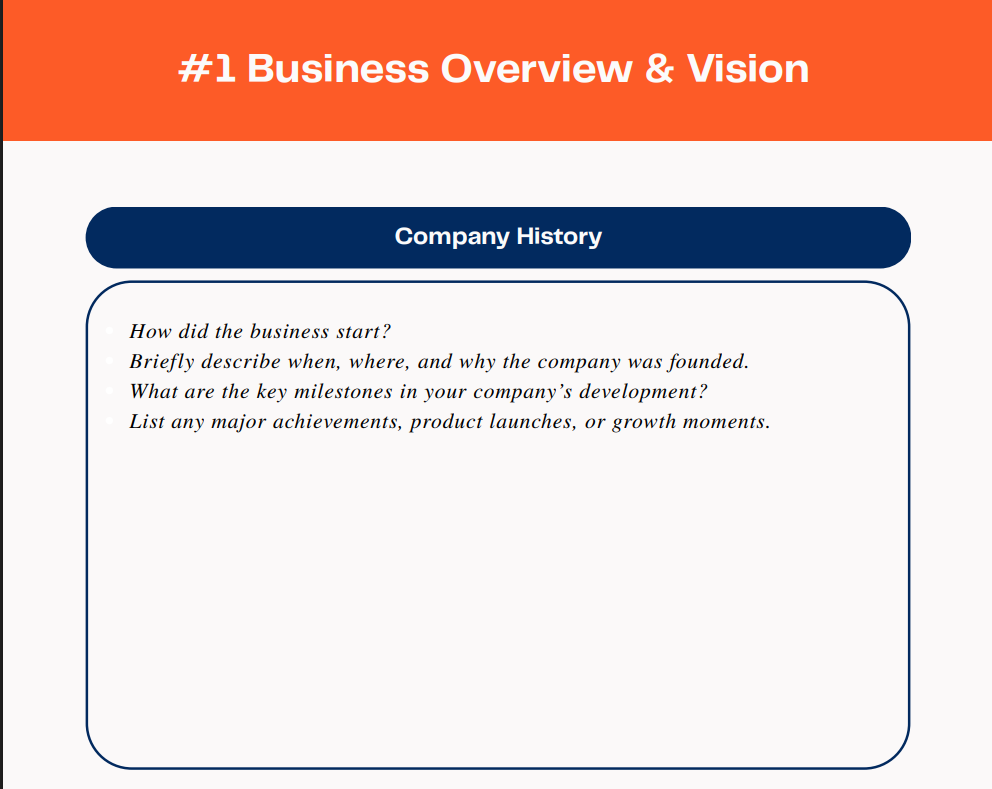
1. Business Overview & Vision
This should be your starting point every time.
Write down:
- Company background (keep it short)
- Mission, vision and long-term direction
- What success looks like in 12–24 months
In practice, this becomes your filter. When new ideas come in, you check if they actually move you toward that goal.
Teams that skip this end up chasing tactics that don’t connect to anything meaningful.
2. Objectives & KPIs
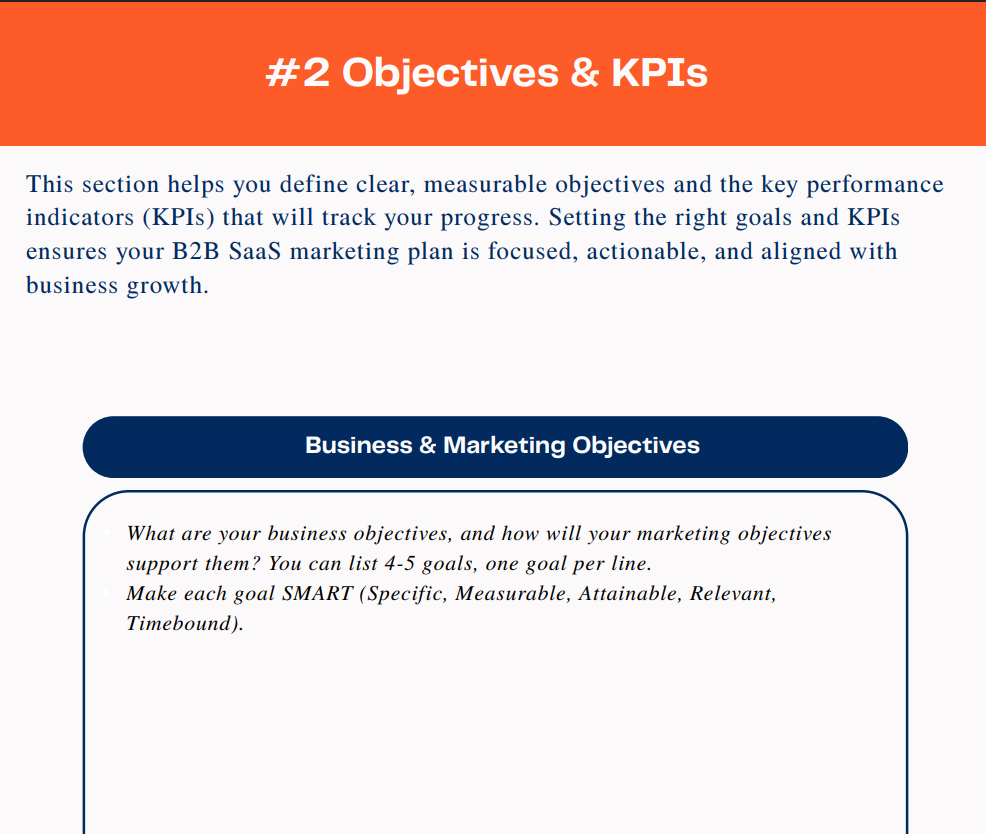
Set a small number of measurable goals:
- Revenue (ARR / MRR growth)
- Pipeline target
- Customer acquisition cost (CAC)
- Conversion rates (visitor → lead → demo → customer)
Example:
| KPI | Target | Why it matters |
| CAC | <$1,500 | Keeps acquisition sustainable |
| LTV | >3x CAC | Ensures long-term profitability |
| Demo conversion | 20%+ | Indicates sales efficiency |
If a goal isn’t measurable, it won’t survive past month two. We often see teams wrongly track activity instead of outcomes in our SEO audits.
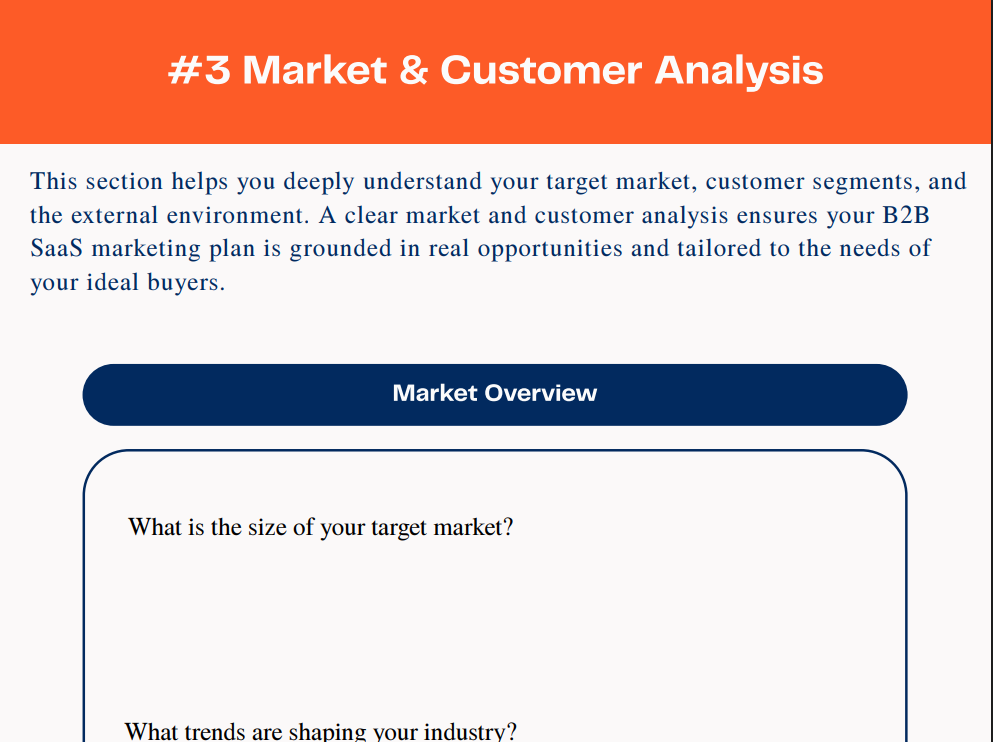
3. Market & Customer Analysis
The wake-up call: Marketing to everyone doesn’t work.
In this section, define clearly:
- ICP (industry, company size, budget range) and key competitors
- Decision-makers (CMO, Head of Growth, Founder)
- Pain points and buying triggers
- Market trends affecting your buyers
If your ICP isn’t clear, everything downstream gets expensive.
4. Product Overview & Market Positioning
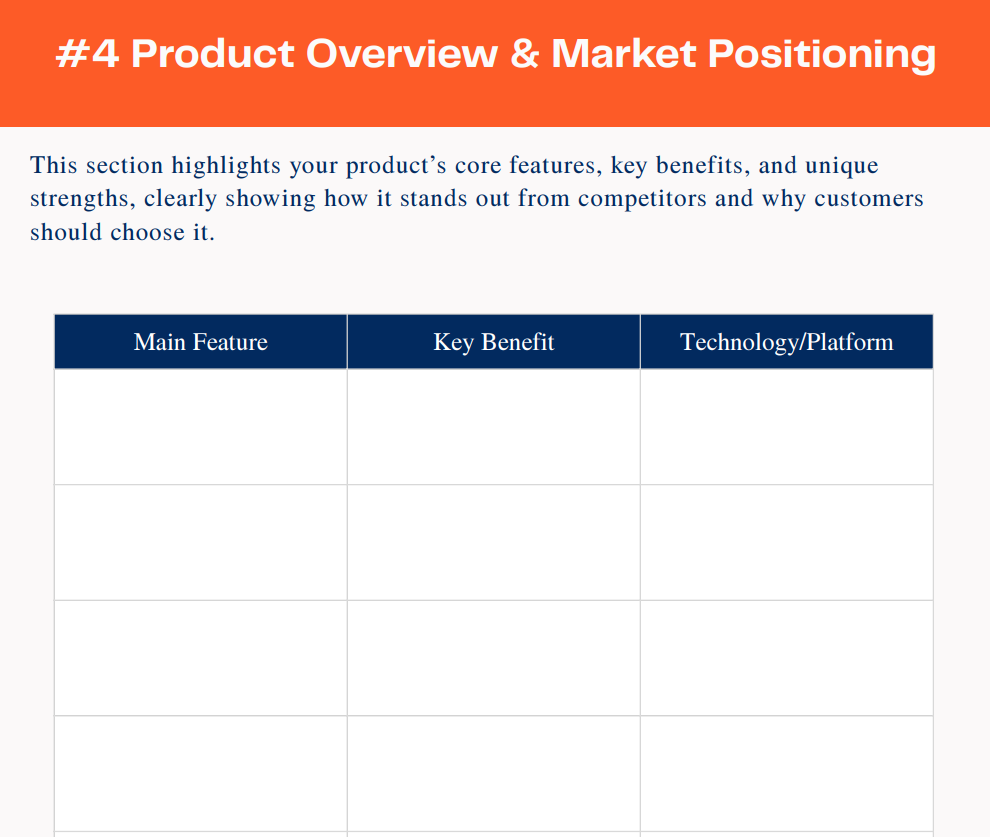
This is where your messaging either clicks or falls flat.
Break down:
- Core features → mapped to real use cases
- Key benefits (not just technical specs)
- Unique advantages vs competitors
A simple comparison table helps:
| Feature | You | Competitor A | Competitor B |
| Integration | Native | Limited | None |
| Setup time | <1 day | 1 week | 3 days |
This forces honesty. It shows where you win and where you still need work.
5. Brand Messaging & Content Strategy
Finding your voice takes trial and error. That’s what every company goes through, including us.
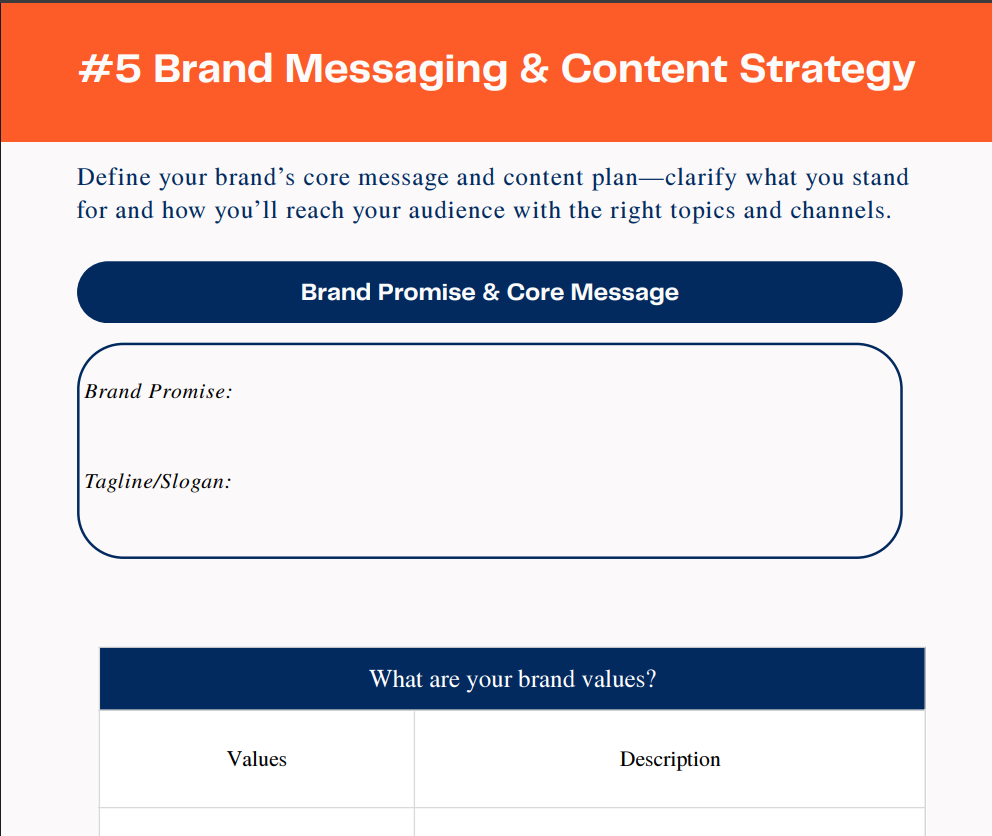
Define:
- Core message (what problem you solve)
- 3–5 content themes (based on real search demand)
- Content formats (blogs, case studies, landing pages)
- Ownership (who is responsible for what)
If your content isn’t aligned with how buyers search, it won’t bring in qualified traffic. This is why it is crucial to measure your SaaS content marketing.
This is also where a structured SEO campaign starts to make a difference. Many teams create content, but not around demand that actually converts.
6. Marketing Mix & Channels
Many teams ended up wasting their budgets quietly when they came to this stage.
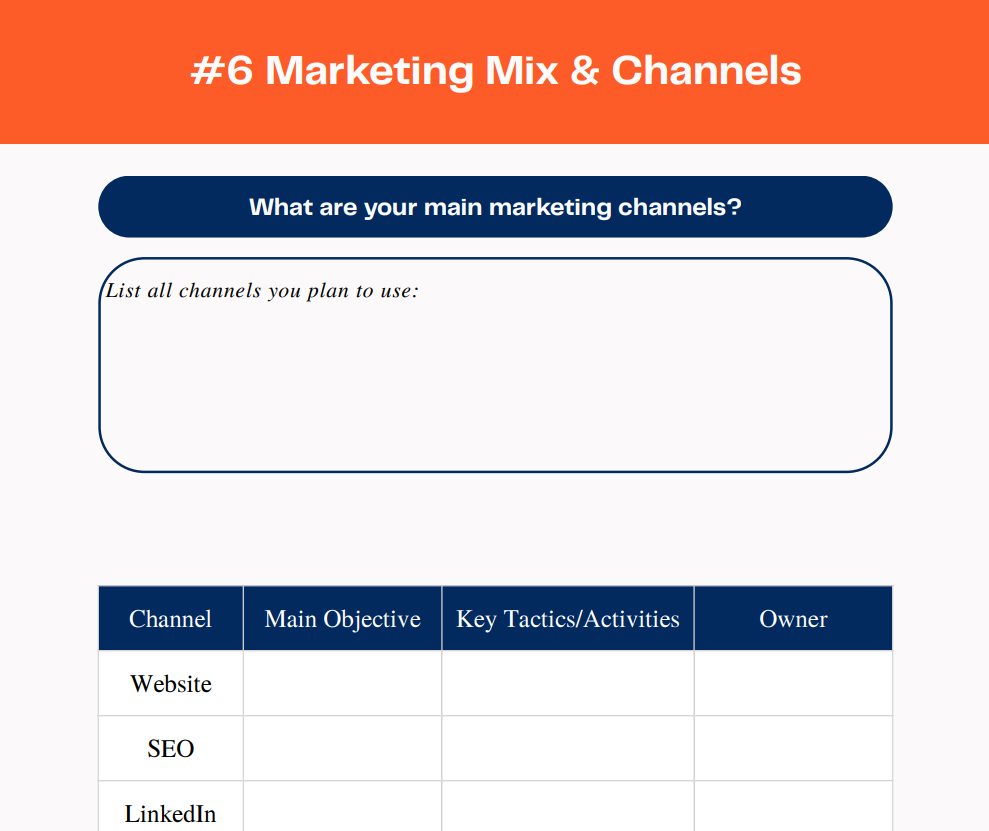
This worksheet forces you to pick the channels that really matter for your audience and business.
Choose channels based on your ICP and buying behavior:
- SEO → long-term demand capture
- Paid search → high-intent traffic
- LinkedIn → B2B targeting and retargeting
- Email → nurturing and retention
Define for each channel:
- Objective
- Key actions
- Budget allocation
In our experience, SaaS teams often spread too thin. Trying to be everywhere usually leads to underperformance everywhere (and a lot of wasted spend).
Read more: 9 Tight Budget Marketing Strategies for Small Businesses That Actually Work
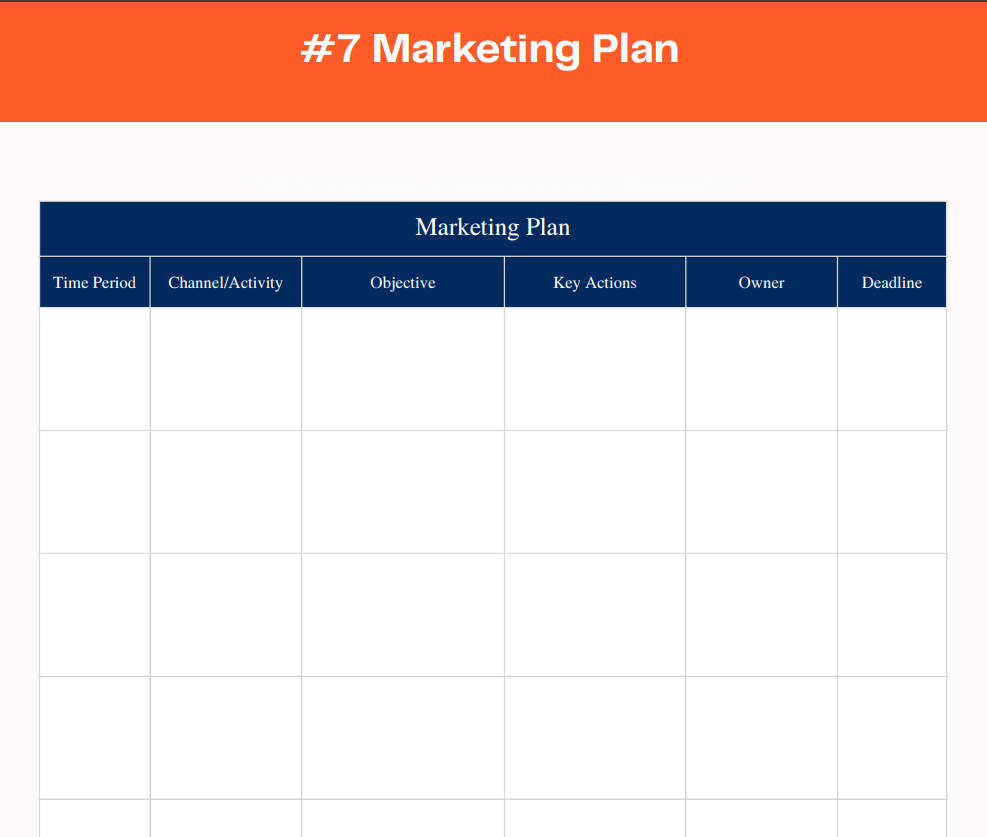
7. Marketing Plan Execution
Use a simple structure:
- Monthly / quarterly roadmap
- Key activities
- Owners
- Deadlines
Example:
| Month | Activity | Owner | Goal |
| Jan | SEO content launch | Marketing | +20% traffic |
| Feb | Paid campaign test | Growth | 50 demos |
Breaking things down this way helps you:
- Spot gaps early
- Align teams
- Avoid last-minute chaos
If you happen to be a small SaaS business that wants to start implementing content marketing for growth, you will like our article about Content Marketing for Small Businesses.
8. Results, ROI & Resource Planning
At this stage, you’re deciding how much to invest, what results you’re aiming for, and how you’ll measure if it worked.
Define:
- Expected outcomes
- Budget allocation
- Team resources
Track:
- CAC trends
- Channel performance
- ROI by campaign
Because if you don’t track this, your plan turns into wishful thinking (we’ve seen this more times than we can count).
How to Use This B2B SaaS Marketing Plan Template
To save you time and also (a lot of) budget, here’s how you can start using the B2B SaaS marketing plan template you’ve just created:
- Start with ICP, not channels
- Choose one primary acquisition channel first
- Build content around real demand
- Set 3–5 KPIs only
- Review performance every 30 days
Be careful: If you try to execute everything at once, the plan usually breaks within the first 60 days.
When This Template Works (and When It Doesn’t)
Works best for:
- SaaS with defined ICP
- Teams with at least one working channel
- Companies looking to scale predictably
Less effective for:
- Pre-product-market-fit startups
- Teams without clear sales process
- One-time purchase products
A lighter version works better in early stages. Keep it simple, validate fast.
Final Thoughts
A B2B SaaS Marketing Plan Template gives you something most teams lack, a system.
Without it, marketing becomes a series of disconnected experiments. With it, you start seeing patterns, improving performance, and scaling what works.
If you want a structured starting point, download the template below and adapt it to your current stage.
👉 Download the B2B SaaS Marketing Plan Template (includes KPI tracker, channel planning sheet, and execution roadmap)
If you need help turning this into a focused, executable plan, that’s where our structured digital marketing strategy engagement makes a difference.
FAQs about B2B SaaS Marketing Plan Template
What should a B2B SaaS marketing plan include?
It should include ICP, positioning, channels, content, KPIs, and execution roadmap.
How long does it take to see results?
Paid channels can show results in weeks. SEO typically takes 3–6 months.
Do early-stage SaaS companies need this?
Yes, but simplified. Focus on one ICP and one channel first.
What KPIs matter most?
CAC, LTV, conversion rate, and pipeline value.
Which channels work best?
SEO, paid search, and LinkedIn tend to perform well for most B2B SaaS.
How do you align marketing and sales?
By defining MQL/SQL criteria and tracking shared pipeline metrics.
Can I use a free template effectively?
Yes, if you customize it instead of copying it blindly.
How often should I update the plan?
Review monthly, adjust quarterly.

Jaden is an SEO Specialist at Golden Owl Digital. He helps brands rank higher with technical SEO and content that resonates