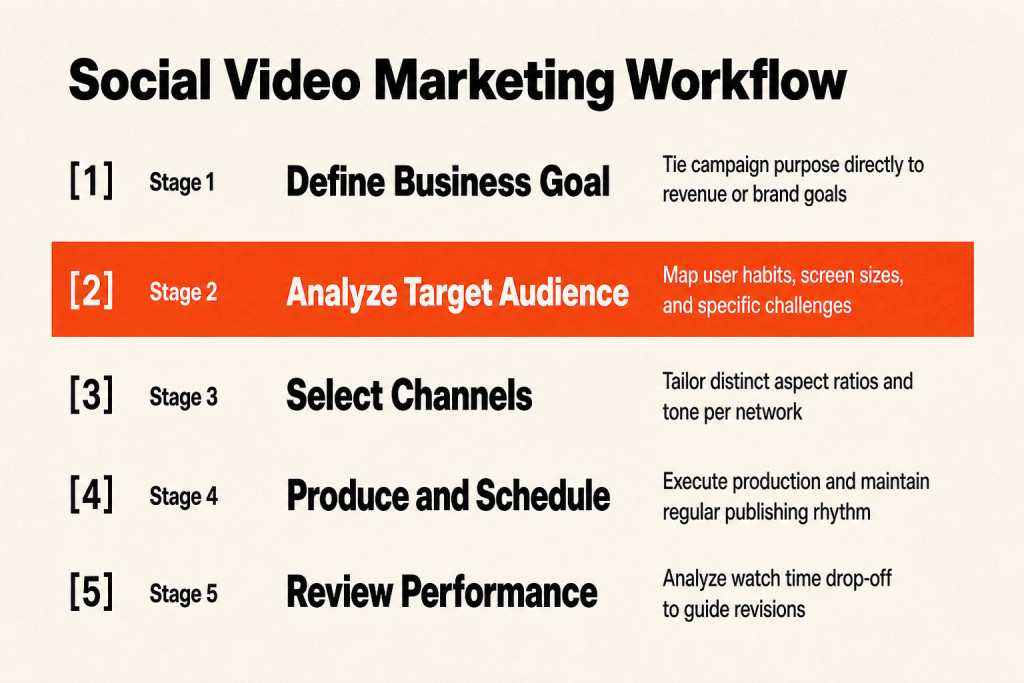
Social media adds another voice to a law firm.
Use social media marketing for law firms to share your knowledge, personality, and what you offer with people who may require legal help. Adjust how you communicate, since this channel is neither a client meeting nor a courtroom argument.
Communication still counts, yet the setting shapes its use. Here, social media reaches an audience that may be searching directly for legal help.
New settings call for different communication skills.
Build your law firm’s online outreach plan around useful content ideas and the rule of thirds. Pick platforms and formats that inform audiences and build trust.
Shape clear online content from your existing legal knowledge and organise it around people who may require legal assistance. Keep your platforms and formats aligned with that same work.
Paid Social Media Marketing for Law Firms
With organic content in place, give the firm a clear voice and see which messages land. When a post shows strong response, add a controlled paid budget to widen distribution and remain visible to potential clients.
- Start with organic content to establish the firm’s voice
- Targeting should focus on people most likely to need the
- Begin with a modest budget and increase it as results
- Refresh ad content regularly so campaigns remain engaging
Define the audience around the people most likely to need your services, using relevant demographics and interests, plus retargeting for website visitors and groups resembling existing clients. If you serve overseas or multicultural clients, run multilingual or region-specific outreach; LinkedIn can help you reach business and professional audiences.

Put in a modest budget first, and raise it as the results give you more confidence. Run tests across campaigns and ad versions to see which messages and creative styles perform best, then use conversion tracking to follow responses after ad interactions. Check conversions and ROI, move money toward strong campaigns, and keep tightening the audience and creative.
Keep ad content fresh so campaigns stay engaging and relevant. Compare copy and visuals across formats to see what connects with prospective clients, while keeping the tests controlled. When being on camera isn’t practical, use Carousel posts and voiceover videos with text overlays. As data builds, improve the strongest ads rather than letting one untested message consume the campaign budget.
Content Strategy and Ideation
Once your ads have proved themselves, settle on a posting rhythm of 2-3 posts each week, or another pace your law firm can actually maintain. Map every post on a content calendar, then pick the platform and timing that fit the firm’s goals. Posting every day won’t help when the material is uneven.
When ideas dry up, pull topics from these sources:
- Real client questions, with identifying details anonymized
- Google autocomplete or People Also Ask boxes
- Reddit threads or Quora discussions related to the firm’s practice area
- News stories connected to the firm’s specialty
Plan posts ahead of time with a content calendar, so the schedule stays steady. Trello and Google Calendar can manage that without much setup.
Buffer can schedule posts and show analytics while helping your team publish on several platforms. More advanced social media marketing tools add deeper tracking and audience insights to that same calendar.
The Rule of Thirds Framework
The rule of thirds keeps the mix balanced: 1/3 original content, 1/3 curated content, and 1/3 social engagement, rather than repeating one format each week.
| Content Category | Share of Content | Primary Objective | Example Formats |
|---|---|---|---|
| Original content | 1/3 | Updates about you and your firm | Insights, tips on legal processes, updates in your practice area, and behind-the-scenes looks |
| Curated content | 1/3 | Share valuable insights from others | Relevant legal news, articles, books, and online tools |
| Social engagement | 1/3 | Interactions that build your brand | Sharing team members’ posts and reposting insightful posts from clients or colleagues with your perspective |
Adding value through original content
Original content gives people a look at how your law firm thinks and operates, including legal insights and ordinary moments behind the scenes. Useful material gives them a reason to come back and makes the firm easier to understand.
Useful insights can include:
- Tips on legal processes
- Updates in your practice area
- Insights from your legal team
Use practical explanations to become a resource people can rely on. Correct common legal myths and share accurate information so readers can make informed decisions.
Your firm’s everyday work can supply original posts, too. Introduce the team and show the office culture, with relatable moments that help the audience feel connected to the people involved.
Posts about work anniversaries and personal accomplishments can do the same. They put the firm’s people and expertise in view while giving the audience a clear detail to remember and connect with.
Leveraging curated content
Curated content helps your firm share useful legal news and expert material while showing the range of its knowledge.
Useful resources to recommend include:
- Articles
- Books
- Online tools
Reputable sources build credibility.
Recommend resources that explain legal changes affecting followers, then add the firm’s perspective when it makes sense.
Building connections through engagement
A stream of published updates won’t make a law firm feel human by itself. Conversations with clients and colleagues, along with the wider audience, create a more connected online presence.
Repost team members’ updates to support collaboration and show how the firm works together. When a client or colleague shares something useful, add your own perspective during the repost so the firm remains part of that conversation.
Core Content Pillars
Content pillars give your online plan repeatable themes, which makes consistency easier. Four pillars can keep the mix varied while covering legal knowledge, community ties, social proof, and the people behind the practice.
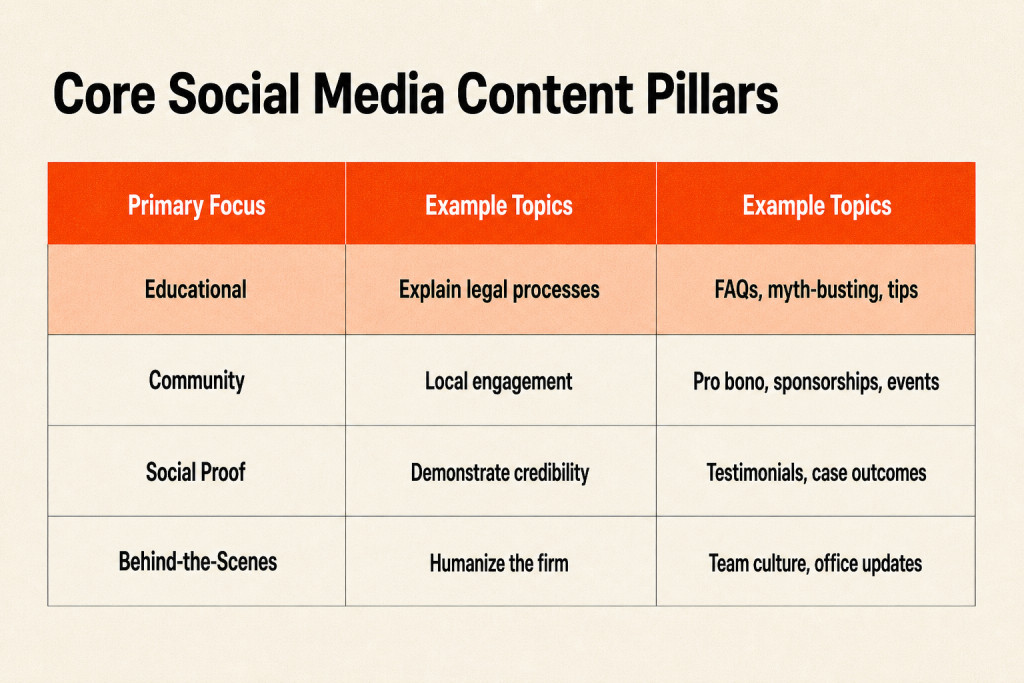
Use the four pillars below to plan posts and keep your social media marketing for law firms from becoming repetitive:
- Educational: Share legal tips, explain legal processes in simple terms, and clear up common misconceptions.
- Community: Highlight events you’ve participated in, pro bono work, and milestones connecting your firm to the local community.
- Social proof: Post client testimonials, case outcomes, and media features with proper permission and ethical guidelines.
- Behind-the-scenes: Introduce your team, share office updates, and publish moments that reflect your firm’s personality.
Blogs, podcasts, and industry insights can build legal thought leadership. When the team volunteers, sponsors an event, or supports a legal aid clinic, pair that involvement with a short caption and photo.
New hires, promotions, and awards put the firm’s talent on display. Share professional backgrounds, interests, client success stories, and transformations so people remember specific faces and outcomes.
Trust-Building Formats
Short-form videos, Reels, and Q&A-style posts can build trust when an attorney speaks to the camera clearly and calmly. These personal formats make the firm feel more credible to people who encounter its content.
Carousel posts
Instagram can put faces behind the law firm’s logo and show people how the firm helps. Carousel posts also break information into easier steps, giving you space to explain one point at a time.
Q&A-style posts
These subjects usually make strong posts:
- FAQs from consultations
- “Myth vs. fact” posts that clear up confusion
- High-level process explanations, such as “How does bail work?”
Return to questions that keep surfacing in consultations, recurring confusion, and broad legal processes.
Teach instead of giving advice. Use phrases such as “what the law says,” “what many people do,” or “common outcomes in cases like this,” rather than telling readers what they should do.
Steer clear of specific advice, particularly for ongoing cases, and add a disclaimer such as, “This is general information, not legal advice.”
Content Repurposing Workflows
Repurposing strong content saves time because one useful piece can serve several formats. Follow the workflow below to turn existing material into a steady stream of online posts:
- Turn blog posts into social media updates.
- Repost evergreen content.
- Update and reshare older posts with new insights.
- Use social media video marketing to turn longer weekly YouTube videos into valuable snippets for Shorts and other social platforms.
- Use infographics, carousels, videos, GIFs, and podcasts as different law firm content formats.
- Make each piece informative and credibility-building.
- Turn common client questions into blogs, carousels, or short video posts.
- Use infographics for timelines or legal checklists.
- Create content around seasonal legal topics such as taxes or wills.
- Share legal updates, perspectives, and educational explainers.
- Host live or recorded webinars and Q&As about common legal issues.
- Turn blog posts and podcasts into short-form social media content.
Many lawyers abandon social media once it starts consuming too much time. A Social Media Marketing Agency can support a steady presence with idea development, compliant writing, scheduling, and performance reports.
- Suggesting relevant post ideas tailored to your practice
- Generating compliant, on-brand copy
- Scheduling posts in advance across multiple platforms
- Providing performance reports to track what’s working
Automation keeps the schedule steady while the firm retains control of its voice.
Platform Selection by Practice Area
The right channel depends on the practice area, the people you want to reach, and the content you can keep producing. B2C practices such as family law or personal injury often belong on Facebook and Instagram, while B2B practices may get more from LinkedIn.
A family lawyer can need a different social media marketing platform than a criminal or immigration attorney, since each platform draws different people and supports different kinds of content.. Begin with your audience, then choose material you can share consistently.
Audience
Online networking pays off more when you show up deliberately, offer something useful, and stay consistent on the few platforms your audience actually uses. You don’t have to keep every profile alive.
Account focus
Launching several accounts at once feels productive, but running them all can spread your time and attention too thin. That leaves you with abandoned profiles and possible ethics violations.
Practice area
If your firm serves companies or executives, direct your resources toward LinkedIn thought leadership. If you represent everyday consumers in personal injury, criminal defense, or family law, put more attention into local channels such as Facebook and Instagram.
The American Bar Association’s 2024 Legal Technology Survey reports marketing use among 80% of law firms. The 2023 ABA TechReport says 84% have a social-network presence, while 16% report no digital presence.
LinkedIn is built for professional audiences. Lawyers can use it for networking, legal insights, company news, and referrals across the legal industry.
A strong LinkedIn page can sharpen a law firm’s online persona. Use it for:
- Short commentary on legal changes affecting businesses
- “Client question of the week” (with identifying details removed)
- Educational tips about compliance, contracts, or employment law
Present the profile professionally, beginning with a professional photo and details centered on the attorney’s current work.
Give the page a direct headline, a brief summary, and useful descriptions of relevant law firm experience.
Show career achievements that match the attorney’s present practice, focus, and goals, so visitors know who they’re dealing with today.
LinkedIn gives you room for longer posts and denser material, including some jargon, because its audience usually seeks expertise more than entertainment.
Treat LinkedIn as a place to build relationships, not just a storefront for services. B2B social media marketing also ties into B2B services and business development strategies.
For consumer-facing lawyers, Facebook still matters, especially in personal injury, family law, and criminal defense.
Organic and paid posts
Put both organic and paid posts in front of your target audience to attract prospects and hear their reactions in comments. Its broad reach gives local firms a dependable consumer channel.
Local visibility
Engage with the community and target nearby areas to keep consumer-focused practices familiar to people in those service areas. Boosted posts and ads can bring in leads at a manageable cost.
Recommendations
Over 70% of Americans use Facebook, and many visit every day. People also use it to ask for service recommendations and share them with others.
Use Facebook for:
- FAQs about common legal issues
- Firm milestones and reviews
- Articles or videos that answer real client concerns

Because the News Feed favors posts from friends and family, law firm content may have trouble earning attention.
Instagram works well for a firm with a modern identity or a visual story to tell. Short captions paired with graphics can send clients to another page.
Visual focus
Keep the colors, fonts, and graphic layout steady so people begin to recognize the firm without conscious effort.
Personality
Reels and Stories often beat static images, particularly when they reveal personality, firm culture, or community work.
- Day-in-the-life content from attorneys
- Reels with quick legal tips or myth-busting
- Firm culture highlights and behind-the-scenes
Instagram lets you show the people behind the logo and the way the firm helps clients. Add hashtags and location tags to posts, stories, and reels when they fit.
Professional image
Separate the firm’s Instagram account from personal accounts, even if you want the brand to feel approachable. Personal opinions still belong outside the firm’s professional image.
YouTube
YouTube is a strong home for long-form legal education, and its visibility in Google search gives it lasting SEO value and authority.
If consultations keep circling back to the same questions, turn those answers into videos people can reuse. Use it for:
- Explainer videos (“How to apply for a partner visa”)
- Case studies and firm Q&As
- Weekly legal tips, repurposed into Shorts
YouTube fits lawyers who like being on camera and teaching, with options that include livestreams, short-form videos, and long-form videos.
As of 2024, YouTube has 2.50 billion monthly active users and ranks immediately behind Facebook among social media platforms by usage. YouTube Shorts have a maximum length of 60 seconds.
You can begin with a quality camera, microphone, and editing software, or keep costs down with a smartphone that has advanced cameras.
Titles, tags, and closed captions can help people find your videos. Unsteady footage, poor audio, and old video technology can weaken the presentation.
TikTok
TikTok gives lawyers a casual way to make short, relatable clips that explain legal topics or answer common questions. It can connect with younger audiences when the firm has a modern brand or a visual storytelling angle.
Content ideas
Turn recurring legal questions and current news into short videos:
- “What to do if…” legal scenarios
- Breakdowns of viral legal news or headlines
- Common misconceptions in your practice area
Audience
Jefferson Fisher, who practices family and communication law, reached an audience of millions by mixing empathy, legal insight, and everyday communication advice in his videos. TikTok had 232 million downloads globally during the last quarter of 2023 and has some 1 billion monthly active users.
TikTok also lets people respond to copied content through participation tools, including a duet.
Use #lawtok alongside focused tags such as #familylaw and #employmentlaw. Read LawTok comments for unanswered questions and requests that can shape future content.
Authentic approach
Useful, genuine videos are enough on TikTok; lawyers don’t have to dance or act flashy.
Ethical standards
Handle trends and viral challenges with care, and don’t use misleading tactics to pull in clients. Follow state bar advertising guidelines whenever you post.
Measuring ROI in Law Firm Social Media Marketing
It takes more than likes and shares to measure ROI in law firm social media marketing. Ask whether social media helps bring in clients and educate the public, rather than whether an app makes money. The real targets are client growth and public education.
Start with metrics that show engagement and growth over time. Track engagement rate, Reach, impressions, Clicks, and Follower growth. Engagement rate measures the share of viewers who interacted with a post, Reach counts unique users, impressions count displays, and Clicks count visits to your website, intake forms, or blog posts. Follower growth can show whether your content is reaching the right audience.
Tracking pixels let you follow people from social media to your website and see whether they finish lead generation forms. Platform algorithms favor comments, shares, and direct messages, but viral views can distract you from the real question: did those interactions become phone consultations and signed retainer agreements?

Add “How did you hear about us?” to your intake forms and ask new clients to answer it. Then use Social mentions and direct messages to spot the content that made an impression. Social listening tools can track mentions of your firm’s name and lawyers, while listing profiles show reviews and ratings.
Small firms can usually review performance once a month. Track engagement and Reach beside website Clicks and leads, compare periods, spot trends, and adjust your strategy from the reports. Pick a platform, build a realistic content calendar, and send inquiries to one intake form or inbox. Expand only after posting and lead follow-up run smoothly. Move resources toward the campaigns and platforms with the best ROI, then set harder goals.
Ethics in Social Media Marketing for Lawyers
Treat social-media marketing for a law firm as legal work once posting and lead follow-up run smoothly, with the same rules covering advertising and confidentiality. Your firm remains responsible for each post, which must be labeled as advertising and contain only truthful, supportable claims under applicable state-bar and ABA guidance; do not make promises or guarantees. Check whether “expert” or “specialist” is allowed, since many states may prohibit those terms. Identify the jurisdiction in which the firm is licensed, refrain from offering legal advice or case-specific guidance, and ensure no post implies that an attorney-client relationship has begun.
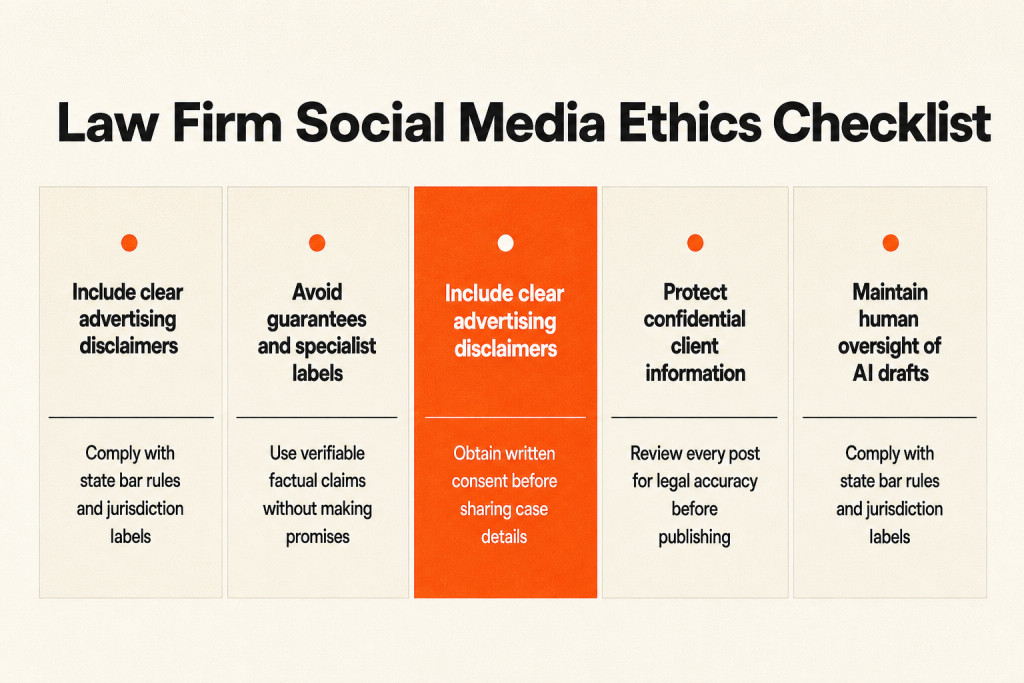
Get written consent before sharing case details, documents, or anything that identifies a client. When you use an example, remove identifying details and center it on the legal principle, not the person, because a well-meaning post can still disclose too much. The ABA Model Rules of Professional Conduct set the foundation for these standards and cover the firm’s digital presence.
AI-generated content still needs human oversight. Have a knowledgeable person review every post for accuracy and compliance with local bar rules before publication, whether AI drafts it or scheduling software publishes it. Written social-media guidelines and training should direct anyone posting for the firm.
Social Media Workflow Technology
Linking social activity to intake starts with Centralized Publishing Software, which handles cross-platform scheduling and publishing in one place, while analytics, team collaboration, and performance reporting guide decisions. Content calendars set timing and keep publishing consistent.
Creating branded graphics and short videos gets easier with Visual Design Suites and their customizable templates. Planning, repurposing, and delegation make the workflow repeatable, while analytics and steady human review keep the content effective.
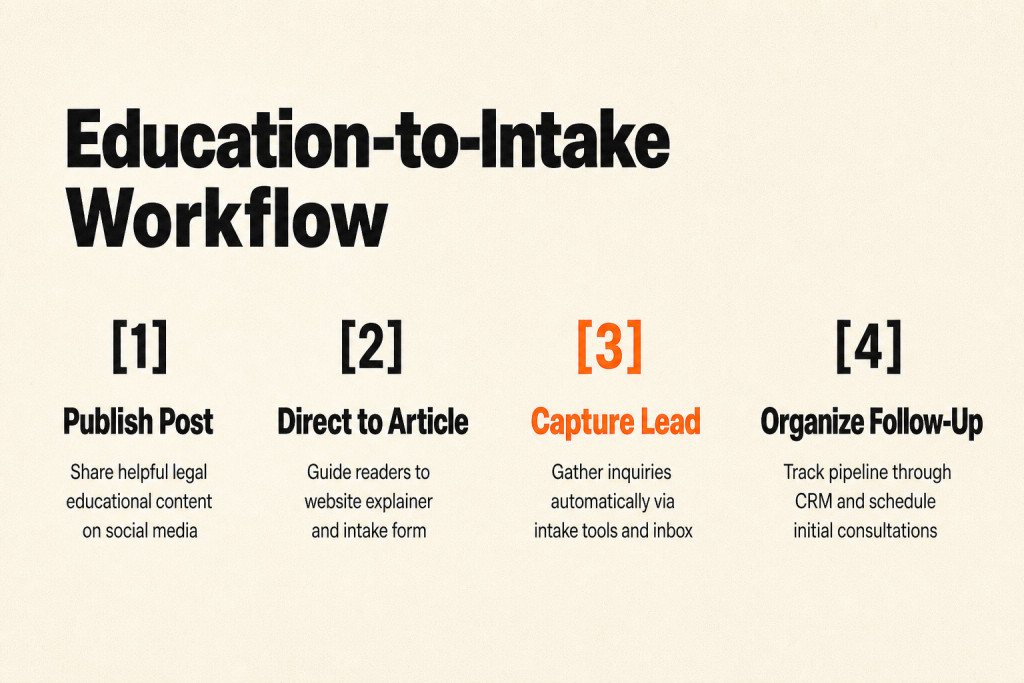
Practice Intake Integration moves attention into action: Facebook post → website article and intake form → email capture → lead inbox → follow-up/onboarding. Client intake tools gather inquiries and start intake automatically. CRM and lead-tracking tools keep communications and statuses organized through the pipeline. Use eSignatures and a client portal to finalize onboarding and maintain communication throughout the case; together, these tools simplify posting and engagement and make social-media interest easier to convert into clients.
Audience Engagement and Reputation Management
Use your social media profiles for meaningful interaction rather than popularity counts, and direct potential clients to your law firm’s website. Reply promptly in a courteous, professional tone, using internal guidelines to keep responses consistent so you educate instead of advising. Thank clients for positive reviews, and manage negative feedback calmly and confidentially. Don’t argue, and move serious matters offline.

Why Invest in Social Media Marketing Services for Law Firms
Professional handling in place, social media puts law firms in front of a large, growing audience. In the U.S., the average user holds 7.1 accounts and spends 2 hours and 20 minutes each day across different social apps. The country counted 308.27 million social media users in 2023, and that total is expected to reach 335.65 million by 2029.
That audience can turn into new clients. Of those surveyed who use social channels for professional purposes, 35% say they’ve gained clients through them, while 42% of small firms gain new clients through social media marketing. Consistent, useful posts make a firm seem active, approachable, and credible. Engagement then carries the message through digital word-of-mouth, helping bring in both clients and referrals.

Use LinkedIn to connect with companies seeking legal help and referral partners, while YouTube is better for building authority over time. When a new law firm blog post goes live, share its key points and link back to the full article. An optimized Google Business Profile is vital to appearing in local search results and maps.
Quality still beats volume. Posting too often can reduce quality, come across as spammy or too sales-focused, and push people away. Thoughtful posts that help readers beat aimless daily publishing.
You’ve now got a practical way to use social media as a focused education-to-intake system. Choose channels based on the clients and referrals you want, reuse useful legal expertise, answer people carefully, and tie each piece of content to search visibility. Judge progress in social media marketing for law firms through client inquiries and consultations, not popularity alone, while keeping the firm’s public communication consistent, useful, and professional.