There are dental clinics spending thousands of dollars per month on marketing and still struggling to fill chairs consistently. In competitive industries, Google Ads CPC cost for high-intent terms like “dental implants” can exceed $20–$30 per click in 2026. That adds up fast.
The real issue is that clinics invest in traffic without building a system that turns local search into booked treatments. That is where SEO for dentists becomes a long-term growth engine. In this article, we break down 8 strategies for dentist SEO that consistently work in 2026.
Why SEO for Dentists Is More Critical Than Ever in 2026
Search behavior has shifted. Patients rely heavily on Google Maps, reviews, and AI-generated overviews before making a decision. In many markets, more than 60 percent of healthcare-related clicks come from local intent searches.
At the same time, large dental chains are investing aggressively in digital. Independent clinics that rely only on referrals often see gradual decline in new patient flow.
Because if your clinic does not show up when someone searches “emergency dentist near me,” you are invisible at the exact moment intent is highest.
SEO for dentists today is about predictable patient acquisition.

8 SEO For Dentist Strategies That Work in 2026
1. Google Business Profile Optimization
For most dental clinics, Google Business Profile (GBP) drives more bookings than the website itself.
When someone searches “dentist near me,” Google Maps is where they are likely to make decisions. If your profile looks incomplete, outdated, or weaker than competitors, patients choose another clinic before visiting your website. Optimizing your profile directly increases calls, direction requests, and emergency bookings.
An optimized profile includes:
- Accurate primary and secondary categories such as “Dentist,” “Cosmetic Dentist,” and “Emergency Dental Service”
- Services listed using GBP Products, including Dental Implants, Invisalign, Veneers, Teeth Whitening
- Direct links from each listed service to its matching service page
- Real clinic photos, team photos, updated hours, and consistent NAP data
- Weekly posts and updated Q&A entries
Local SEO performs best within a realistic radius of three to five miles in dense urban areas. Many of our past clients tried to rank across an entire metro area, which spread signals too thin.
2. Local SEO and High-Intent Dental Keywords
The difference that turns traffic into patients is search intent. When your clinic ranks for the right type of searches, you attract people who are ready to book.
Focusing on high-intent keywords means aligning your visibility with treatments that drive real revenue, such as implants, Invisalign, or emergency care, instead of generic traffic that doesn’t really convert.
Patients rarely search using clinical terminology. They search based on pain, cost, or urgency.
Examples include:
- “tooth pain when chewing”
- “bleeding gums treatment”
- “emergency dentist near me”
- “Invisalign in [city]”
- “dental implant cost in [city]”
High-performing keywords fall into four categories:
| Keyword Type | Example | Business Impact |
| Emergency | emergency dentist near me | Immediate bookings |
| High-ticket | dental implant cost | High revenue per case |
| Cosmetic | veneers before and after | Brand positioning |
| Preventive | teeth cleaning near me | Recurring patients |
Intent typically follows this pattern:
- Symptom search = urgency stage
- Cost search = commercial evaluation stage
- “Near me” search = booking-ready stage
Each service page should target:
- 1 primary keyword
- 3–5 semantically related secondary phrases
- FAQ section covering long-tail conversational queries
This structure improves relevance for both traditional search and AI-generated summaries.
3. On-Page SEO for Dental Websites
Your website should help patients feel confident and make it easy to book. If pages are slow, confusing, or hard to use on mobile, patients leave, even if you rank well.
Good on-page SEO is simpler than you may think. It’s all about making sure every treatment page clearly explains what you do, builds trust, and guides patients toward calling or booking.
Strong dental websites include:
- Clear, benefit-driven title tags
- Meta descriptions aligned with booking intent
- Structured headings matching treatment queries
- Alt text such as “dental implants before after case 1”
- Dentist credentials to support E-E-A-T
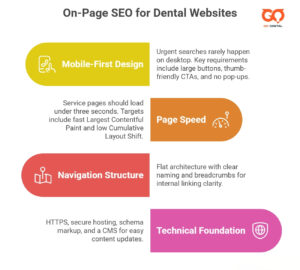
Mobile-First Design
Urgent searches rarely happen on desktop.
Key requirements:
- Call and Book buttons at least 44×44 pixels
- CTAs positioned within natural thumb zones
- No intrusive interstitial pop-ups
Page Speed and Core Web Vitals
Service pages should load under three seconds.
Targets:
- Largest Contentful Paint under 2.5 seconds
- Cumulative Layout Shift below 0.1
- Interaction to Next Paint within acceptable thresholds
To improve performance:
- Use WebP for all images
- Compress before-and-after galleries
- Apply lazy loading below the fold
Navigation Structure
- Flat architecture with service pages within three clicks
- Clear naming such as “Teeth Straightening” instead of overly clinical labels
- Breadcrumbs for internal linking clarity
Technical Foundation
- HTTPS and secure hosting
- Schema markup for Dentist, MedicalBusiness, FAQ, and Review
- CMS that allows content updates without developer dependency
If updating a treatment page requires submitting a ticket, SEO progress slows down quickly.
4. Treatment-Based Content Strategy
Most patients don’t think in terms of “SEO structure.” They think in terms of problems: pain, cost, fear, and results. Your website should follow how patients think rather than how dentists organize internal services.
When your content clearly explains problems and solutions, patients trust you faster. That trust directly affects consultation bookings, especially for high-ticket treatments like implants and Invisalign.
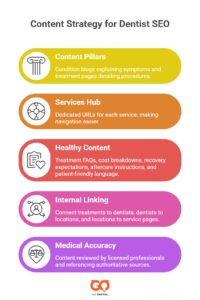
A patient-centric structure mirrors how people think about dental care.
Organize content into:
- Services, what the clinic offers
- Conditions, what patients experience
- Treatments, how problems are solved
Create a clear services hub with dedicated URLs:
- /services/dental-implants
- /services/invisalign
- /services/veneers
Content works best when divided into two pillars:
- Condition blogs explaining symptoms
- Treatment pages detailing procedure, cost, risks, recovery timeline, and aftercare
Healthy dental content should include:
- Treatment FAQs
- Cost breakdown guides
- Recovery expectations
- Aftercare instructions
- Patient-friendly language
Internal linking should connect:
- Treatments to dentists
- Dentists to locations
- Locations to service pages
Medical accuracy is essential. Content should be reviewed by licensed professionals and reference authoritative sources such as the American Dental Association when appropriate.
This structure improves topical authority and eligibility for AI-generated summaries.
5. Reputation Management and Review SOP
Reviews are often the final deciding factor before a patient calls. Two clinics may offer the same treatments, but the one with stronger reviews usually wins.
Besides improving visibility in Google Maps, good review management directly increases trust, consultation rates, and case acceptance.
Reviews influence both Map Pack visibility and conversion rates.

A safe review process includes:
- Neutral, non-incentivized review requests
- Centralized review management
- Formal SOP defining response boundaries
Operational standards:
- Aim for consistent monthly review flow, typically 5–10 new reviews per month in competitive cities
- Maintain rating stability above 4.5
- Respond within 24–48 hours
- Maintain response rate above 90 percent
- Avoid mentioning specific treatments publicly
- Invite offline follow-up for detailed issues
Early on, consolidate reviews on the primary clinic listing rather than spreading them across individual dentist profiles.
Consistency builds trust. Casual or defensive responses erode it quickly.
It is not uncommon for clinics to be unsure which local signals move bookings and which ones are simply just there. That is when we usually get involved.
6. Authority Building and Local Links
If Google is unsure how established or trusted your clinic is in your area, you won’t rank consistently, especially against larger dental groups.
Building local authority helps Google see your clinic as a real, active part of the community. That trust helps improve both rankings and patients’ trust.
Dental link building is local and relevance-driven.
Effective sources include:
- Local chamber of commerce listings
- Dental associations and professional directories
- Community sponsorships
- Local news features
- Partnerships with nearby businesses
Multi-location clinics should:
- Create separate, unique location pages
- Maintain distinct GBP listings per address
- Localize content per suburb or district
These signals reinforce geographic authority.
7. Conversion Optimization for Dental Clinics
Getting traffic is only half the job. If visitors don’t call or book, rankings don’t matter. Small friction points, such as hard-to-find phone numbers, long forms, unclear pricing, quietly cost clinics real revenue every month.
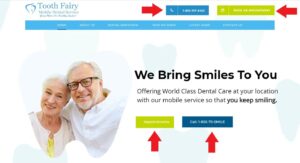
Conversion optimization includes:
- Prominent click-to-call buttons
- Online booking forms requiring minimal fields
- Clear consultation pathways for high-ticket services
- Before-and-after galleries with consent
- Insurance and financing transparency
Tracking setup should include:
- Call tracking per location
- Form submission tracking
- Booking confirmation tracking
- Revenue attribution per service category
Typical local service conversion rates range from 3 to 8 percent. Emergency searches often convert higher.
Many clinics focus on rankings and ignore booking friction. That usually costs more than low traffic.
8. Measuring SEO ROI for Dentists
SEO should not be judged by rankings or traffic alone. It should answer one simple question: is this bringing profitable patients into the clinic? If you can’t connect SEO to revenue, it becomes a marketing expense instead of a reliable growth system.
SEO performance must connect to revenue.
Track:
- Cost per booked patient
- Organic call volume
- Appointment-to-treatment conversion rate
- Revenue by treatment category
For example, one implant case can equal dozens of hygiene visits in revenue. Keyword strategy should reflect treatment value, not just search volume.
When clinics measure SEO through treatment revenue instead of pageviews, decision-making becomes clearer.
When Should Dentists Hire an SEO Agency?
Dentists should consider external support when:
- Growth has plateaued
- Paid ads are becoming too expensive
- Internal teams lack technical SEO expertise
- Multi-location expansion requires structured coordination
In our experience at Golden Owl Digital, we tend to get involved when clinics realize traffic and bookings are not aligned. Our role is usually to diagnose structural gaps, clarify keyword priorities, and build systems that compound over time.
SEO for dentists works best when it is integrated into a broader digital strategy, including landing page optimization and data-driven digital marketing decisions.
Final Thoughts
SEO for dentists is about building a structured, locally dominant presence that consistently converts searches into booked treatments. When strategy, content, technical structure, and conversion systems align, SEO for dentists becomes a leverage you can count on instead of a mere marketing experiment.
If you are evaluating how to turn organic visibility into predictable patient acquisition, that is usually the right time to take a deeper look at your structure through an SEO Audit. That is where an experienced operator such as Golden Owl Digital can make the difference.
FAQs About SEO for Dentists
How long does SEO for dentists take to show results?
Most clinics see measurable traction within four to six months, with stronger compounding effects after nine to twelve months.
How much does SEO for dentists cost?
Costs vary by competition and scope, but serious campaigns often range from $1,500 to $5,000 per month depending on market complexity.
Can small clinics compete with dental chains?
Yes, especially in local Map Pack and niche treatment categories, if strategy and structure are strong.
What keywords should dentists prioritize?
Focus on emergency, high-ticket, cosmetic, and preventive categories aligned with revenue goals.
Does content really matter for dental SEO?
Yes. Accurate, structured treatment content strengthens topical authority and patient trust.
How important are reviews?
Review quality, consistency, and response behavior significantly influence both rankings and conversion.
Can SEO help promote Invisalign and implants specifically?
Yes. Dedicated treatment pages and cost-related content often attract high-intent patients researching these procedures.

Jaden is an SEO Specialist at Golden Owl Digital. He helps brands rank higher with technical SEO and content that resonates