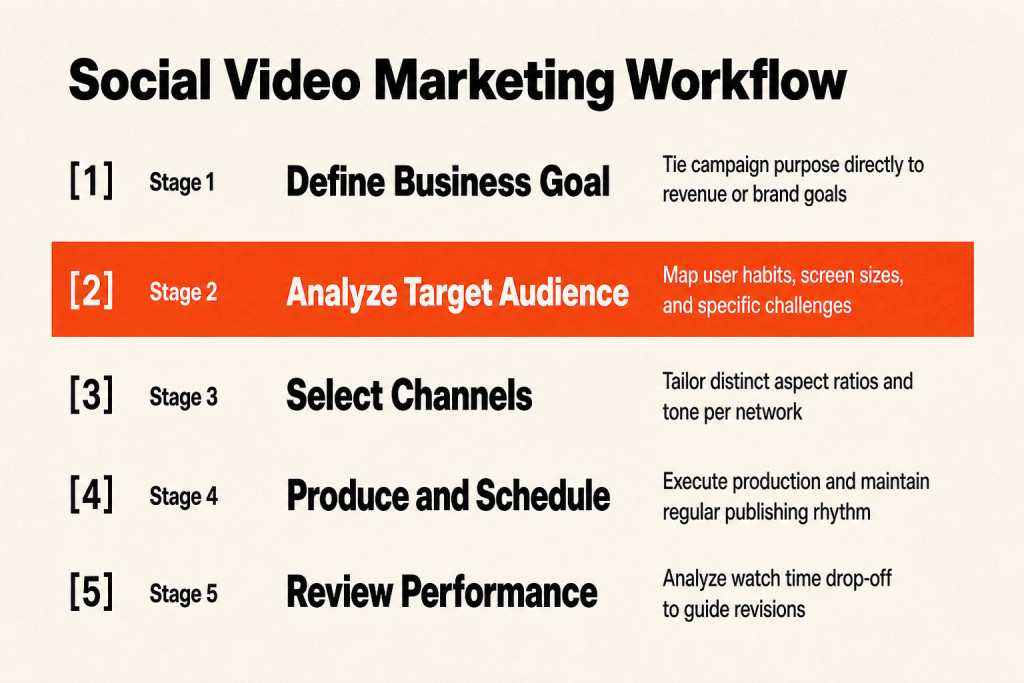
Use the social version to allocate content within your publishing plan: it supports a PACE framework social media marketing strategy. Choose the initiative version to rank competing work; the two tools answer different planning questions.
A good fit keeps each decision attached to the problem you’re solving, even when the work changes. Start with the constraint in front of you, then watch how the framework responds.
In practice, the right fit keeps decisions tied to the problem at hand (when the work changes). Begin with the constraint in front of you, then see how the framework handles it.
How the PACE Framework Social Media Marketing Strategy Works
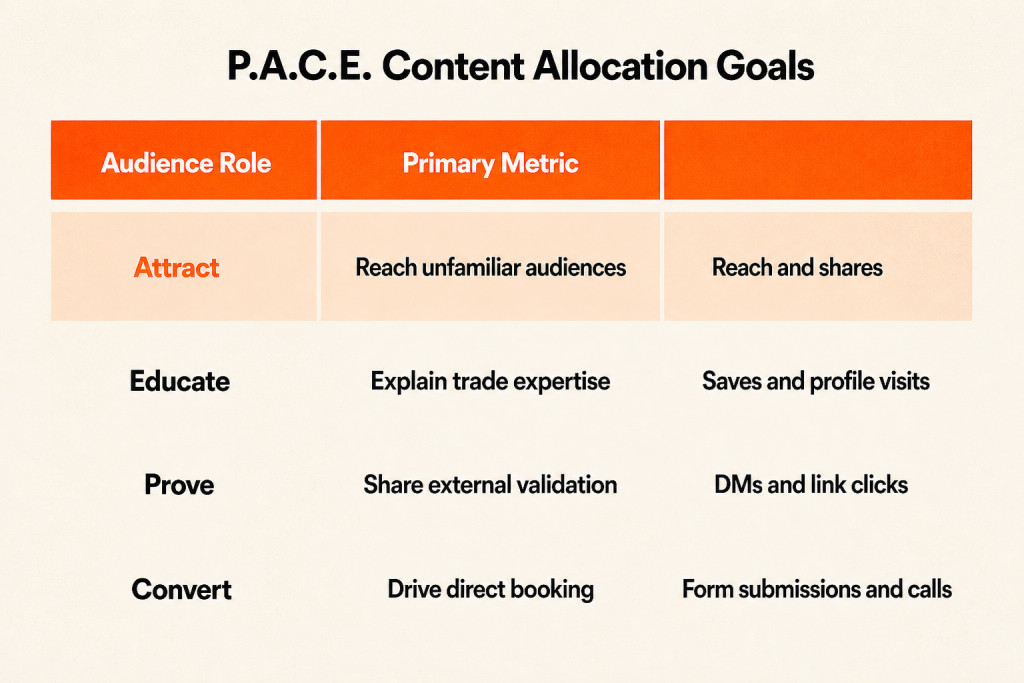
A social media calendar runs more smoothly when each post has a clear job. Posted Social gives every client post one of four goals: Attract, Educate, Prove, or Convert. Those goals make up the PACE Framework; its letters name the framework, not the sequence. Give each post the goal that fits. The journey starts with someone unfamiliar with the business and finishes with a booking.
Years of hands-on work at high-growth companies shaped the framework, which systematically ranks marketing initiatives by priority. It has been validated across various industries.
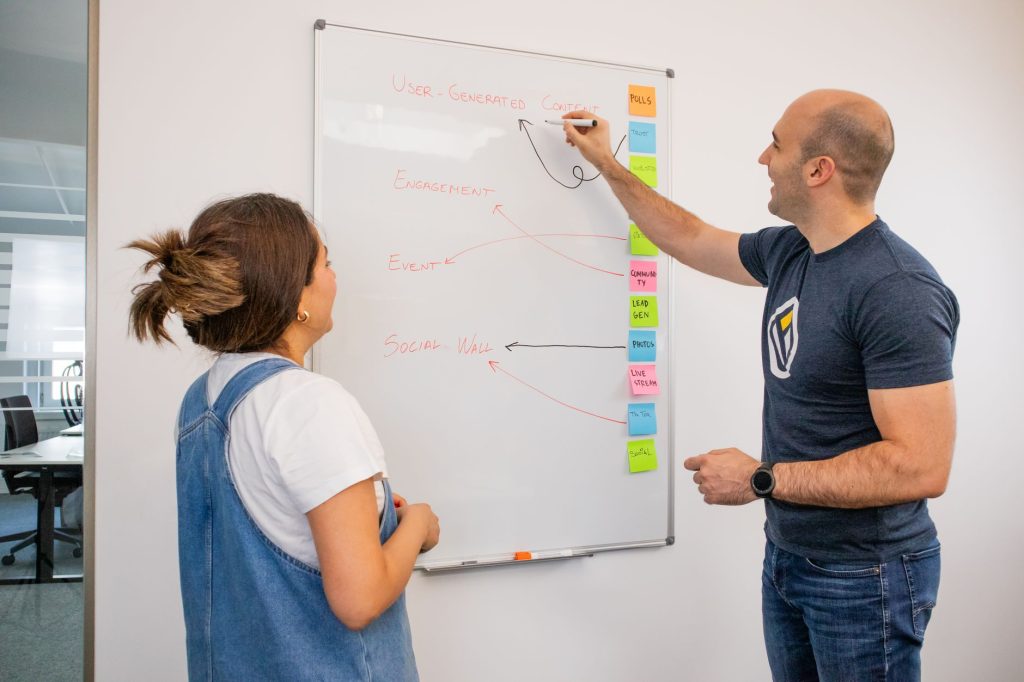
Every initiative gets a score on four key metrics.
- Potential: How significant could the impact be on your key metrics?
- Achievability: What’s the likelihood of successful execution?
- Cost: How resource-intensive is the initiative?
- Effect: How quickly will you see results?
Pick the model based on the problem you’re facing. Use the content allocation model to choose what to post this week. Use the social commerce model to establish an in-app storefront. If a team is overwhelmed by competing campaign ideas, turn to the prioritization matrix to choose what to pursue.
Content Allocation Model
Someone decides each week whether anything is worth posting. A job-site event gets turned into content when it looks worth showing; when the week is quiet, a random library image gets paired with a line about a free estimate. That pattern repeats, so hiring a social media marketing agency to audit historical publishing logs can reveal what worked and what did not.
Start with one plain question: what job should this post do? Without a brief, nobody asks it, and agencies often post the same way on their own feeds. The post ends up doing nothing.
Content allocation gives you a cleaner way to plan. Before the month begins, choose how many posts will support each goal.
Attract
New audiences
Attract content speaks to people who have never heard of you. Check who would understand the post; if it only makes sense to current followers, place it somewhere else. That audience has a different need.
What travels
Trending audio may seem like the natural choice here. But a trend only helps when the work gives people something worth watching. A pressure washing company could show a driveway halfway through its clean, filmed from a street a neighbor would recognize, without any audio. The image can really really carry the post. The driveway does enough.
Signals
Attract is working when Reach moves and when impressions from people who don’t follow the account or shares increase.
Educate
Your own voice
Educate posts let you show that you know your trade. Explain, in your own voice, how the work gets done. That separates Educate from Prove.
How the work gets done
When an owner explains on camera why a roof needs a soft wash rather than a pressure washer, that’s Educate content. A blog post can explain the same subject in more detail, and you can shift that material between formats, though blog posts cited by AI search follow a few rules. Repeat the lesson. The formats differ.
Audience response
You’ll know Educate is working through saves and profile visits, with questions arriving in comments or by DM as another sign.
Prove
Outside validation
With Prove posts, somebody else vouches for your work. Educate has you explaining the work, while Prove relies on a customer, a review, or a number to present the case. The speaker changes.
The distinction
People mix up Educate and Prove more than any other pair. That mistake can turn a business praising its own work into something labeled a testimonial. Show a review screenshot that names your crew, or place the homeowner’s own words beside the finished job. Keep those words with the job.
Evidence of results
Prove shows up through DMs and link clicks, along with comments asking about results.
Convert
Only Convert asks for something, whether that’s a call, a form, or a booking. Give each post one ask per post.
The remaining three goals establish trust first, so Convert should appear least often.
When a seasonal service announces that its booking window opens on a stated date, that’s a Convert post.
For Convert, track link clicks, form submissions, and calls.
Foundational Social Media Architecture
To develop your B2B social media marketing strategy, start by naming the audience that matters, then defining the action it should take. Fit the offer and commercial next step to your organisation’s capacity, and give attention, trust, and demand a clear route forward. Engagement belongs on that route, not at its end.
Give every channel one clear job: Discovery brings in relevant new audiences; Education makes problems and approaches easier to understand; Proof shows work and customer evidence; Community responds and learns; Conversion puts forward a relevant offer and route. Pick channels based on audience behaviour, and keep their business role plain. Popularity won’t guide you.

Build content around six pillars: customer questions, problem education, process and expertise, proof, point of view, and offer and action. Carry the same ideas into native formats, changing each platform’s hook and call to action instead of cross-posting blindly. Keep text readable and captions present, so the meaning works without sound.
Run the work through six stages, six in all: Research; Brief; Produce; Distribute; Respond; Learn. That sequence gives decisions and ownership clear homes, from insight through production and publishing, conversation handling, and the next brief.
Use the Signal Chain to read measurement: Delivery → Attention → Interest → Experience → Outcome → Learning. Read platform results alongside analytics and CRM data, incorporating customer responses, then follow the journey through to qualified leads and revenue.
Set a sustainable publishing rhythm around value and channel behaviour, within available capacity. Review the evidence, adjust pillars, formats, and decisions, and don’t force unsustainable volume.
Revenue Growth Funnel
For a PACE framework social media marketing strategy, estimate the time and money your chosen PACE tactics will need, along with the right expertise and social media marketing tools. Then assign the work across the financial quarters. Keep the numbers together. Track cumulative revenue through customer volume, average ticket size, and repeat orders per customer.
- Once you have selected your PACE tactics, estimate the
- Build acquisition through a diversified mix, direct or brand traffic; organic and paid search; social or promotional traffic; P.R. or referral
- As activity begins, analyze performance to measure ROI,
- Next, map the conversion funnel across the touchpoints in
- Finally, increase repeat revenue through email or automated
Diversify acquisition across several traffic sources: direct or brand traffic, organic and paid search, social or promotional traffic, P.R. or referral traffic, and offline traffic. This mix can bring in more qualified traffic, while social channels give you another place to watch prospects as they move through the funnel.
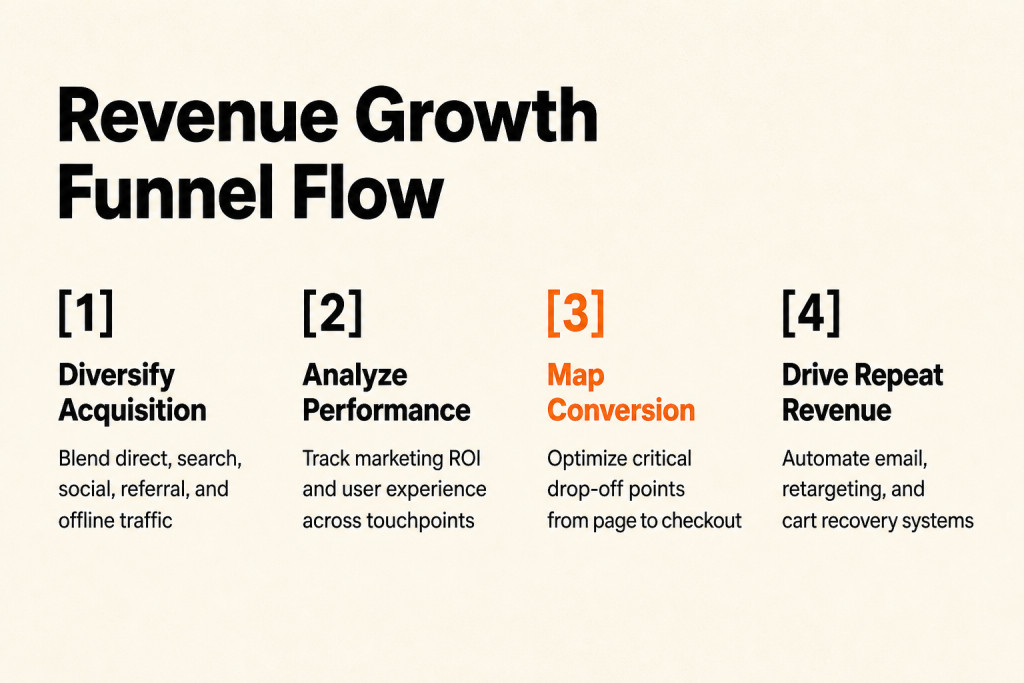
Once activity starts, measure ROI, choose relevant KPIs, and review traffic and user-experience data. Use what you learn to see which efforts are helping growth and where prospects need more support.
The customer journey includes many touchpoints, so chart the conversion funnel across each one. Follow the path from the landing page through payment, sign-up, or download. You’ll see where visitors leave. Test key pages and calls to action, including pages with high bounce rates, to improve conversion.
Finish by increasing repeat revenue with email, automated drip campaigns, social listening, retargeting, or abandoned-cart recovery. Social listening can shape conversations with your audience, while retargeting can help customers keep moving through the sales cycle. Together, these practices link acquisition, measurement, conversion, and retention in one revenue-growth process.
Real-World Case Studies
MizuMi Skincare
MizuMi, a renowned Thai skincare brand, shows those same links in practice, using the PACE Framework to build consumer engagement through promotions.
MizuMi draws consumers in with promotions.
- Festival discounts, product bundles, and “Buy 1, Get 1 Free” deals bring attention.
- Interactive activities such as giveaways, which strengthen consumer participation.
- Content created actively by MizuMi’s CEO, which enhances brand credibility and customer connection.
Shopify Merchant Education
Shopify’s Early Growth Phase
In 2015, Shopify was expanding its marketing while weighing dozens of possible growth initiatives.
Merchant education program
Shopify’s scoring process pushed its merchant education program to the top, since it rated high for potential impact and achievability.

That decision helped Shopify grow from 160,000 to over 240,000 merchants in one year.
Mailchimp Channel Expansion
Mailchimp applied a similar framework while weighing a move beyond email marketing.
The scoring ranked integrating with e-commerce platforms first, given its highest potential and reasonable achievability.
That move helped Mailchimp grow into a full marketing platform.
Buffer Resource Allocation
Limited resources pushed Buffer to use a similar scoring method to choose where its marketing efforts should go.
After evaluating each initiative, Buffer chose content marketing together with its affiliate program. Combined, the two offered the best balance of potential impact and achievability.
Frequently Asked Questions
How do you choose the right social media platforms?
Audience behaviour and business role
If you’re choosing a social media marketing platform, look at where your audience spends time, what formats your business can make, the offer, the journey, and measurement.
How often should a business post on social media?
There is no universal number that guarantees growth.
What are social media content pillars?
Content pillars give you repeatable subjects, each with a clear audience and business role. They keep education, proof, process, Point of view, community, and offers organized.
- Customer questions: Explain decisions people repeatedly ask about before buying.
- Problem education: Help the audience recognise symptoms, cost, and alternatives.
- Process and expertise: Show how the work is approached without inventing authority.
- Proof and demonstration: Use genuine examples, results with context, and visible product use.
- Point of view: State a useful position that the brand can defend.
- Offer and action: Make appropriate commercial invitations without turning every post into an advertisement.
How is social media ROI accurately measured?
Complete social signal chain
You’ll get a clearer view of social media ROI when platform evidence connects with analytics, CRM, and customer feedback where possible. The complete social signal chain follows.
Delivery
Delivery tracks reach, impressions, and frequency.
Attention
Attention covers retention, meaningful views, and saves.
Interest
Interest shows up in profile visits, outbound clicks, and direct questions.
Experience
Experience is judged through landing-page behaviour and form progression.
Outcome
Outcome covers qualified leads, sales, bookings, and revenue.
Learning
Learning comes from findings about the message, format, audience, and offer.
How does the PACE framework improve marketing efficiency?
The work takes time, but a PACE session takes two hours for idea generation, organization, scoring, and prioritization.
- Hour 1: Idea Generation and Organization (60 minutes): List all potential marketing initiatives (20 mins).
- Hour 1: Idea Generation and Organization (60 minutes): Group ideas by channel or type (20 mins).
- Hour 1: Idea Generation and Organization (60 minutes): Make a quick initial assessment of each idea (20 mins).
- Hour 2: Scoring and Prioritization (60 minutes): Score each idea using PACE criteria (30 mins).
- Hour 2: Scoring and Prioritization (60 minutes): Review and discuss the top scores (15 mins).
- Hour 2: Scoring and Prioritization (60 minutes): Select the initiatives to pursue (15 mins).
Each marketing initiative gets scores for Potential, Achievability, Cost, and Effect:
- Potential: How significant could the impact be on your key metrics?
- Achievability: What’s the likelihood of successful execution?
- Cost: How resource-intensive is the initiative?
- Effect: How quickly will you see results?
Conclusion
Long-term online success comes from adapting PACE to the situation, not forcing every business into one fixed formula. Treat it as a flexible guide shaped by your goals and target audience, along with your identity. Different needs call for different approaches, and the framework should fit the need in front of you.
Big budgets and large teams don’t guarantee success. The teams that do well put their resources behind the right initiatives at the right time.
PACE helps you pick the tool that matches the bottleneck you face today. Once you’ve made that choice, align your content, channels, measurement, and available capacity with it. It can support varied goals and audiences, along with different identities, without making every team follow the same plan. Choose what fits and work with the resources you have while keeping the effort aimed at the right initiative. That adjustment is how the PACE framework social media marketing works in practice.