In 2026, SEO is not only about ranking anymore, but also about whether your content is trusted enough to be cited by AI. Recent studies showed organic click-through rates (CTR) plummeted by around 61% when there were Google AI Overviews (AIO).
The key to surviving this “zero-click” era is Conversational Intent Mapping, a strategy focusing on designing content around the actual sequence of questions people ask, rather than optimizing isolated keywords.
In this guide, we break down how Conversational Intent Mapping works in practice, how it differs from traditional SEO, and how to implement it.
What Is Conversational Intent Mapping?

Conversational Intent Mapping is the practice of turning keywords into natural question paths, then mapping those questions into content structures that AI systems can easily interpret and cite.
Instead of optimizing for one query, you optimize for an entire conversation. That includes the first question, the follow-up questions, and the final decision-oriented questions that appear later in the journey.
In AI search, users rarely stop at one prompt. They ask things like:
- “How does AI SEO work?”
- “Is it different from traditional SEO?”
- “Does AI cite sources?”
- “How long does it take to see results?”
- “What should I do in the first 30 days?”
Conversational Intent Mapping groups these into logical clusters, orders them into a question ladder, and aligns each group with the right funnel stage. The outcome is content that feels natural to humans and extractable to AI.
Why AI Search Prioritizes Questions Over Keywords
Keywords were a workaround for limited search interfaces. AI search removes that limitation.

People now state their needs directly, with context, constraints, and follow-ups. AI systems are built to interpret intent. They look for answers that are:
- Direct and clearly scoped
- Explained in simple logic
- Supported with examples or evidence
- Connected to a broader topical context
This is why pages that “sound good” often fail in AI search. AI rarely cites elegant writing. It cites content that answers the right question, in the right place, with a structure it can confidently extract.
In practice, you are not optimizing words anymore. You are optimizing question sequences, so when AI assembles an answer, your site consistently has a usable passage.
Traditional SEO vs AI SEO: What Actually Changes
| Aspect | Traditional SEO | AI SEO (Conversational Intent Mapping) |
| Unit of optimization | Individual keywords or keyword groups | Question clusters and conversational context |
| Winning content type | Long-form pages, backlinks, on-page signals | Answer-first content, structure, entities, trust signals |
| Topic expansion | Based on search volume | Based on follow-up questions and constraints |
| Internal linking | Guides users | Guides users and signals topical coverage to AI |
| Citation advantage | High rankings help | Clear, trustworthy answer passages matter more |
| Measurement | Rankings, traffic | Traffic plus AI visibility, assisted conversions |
SEO and rankings still matter. But AI SEO determines whether your content is present before the click even exists.
Why SEO and AI SEO Need to Work Together
The simple answer is that SEO provides the foundation, while AI SEO builds on top of it.
Strong technical SEO, clear site architecture, and consistent topical coverage are often prerequisites for being cited. In a lot of audits we run, AI visibility issues are not caused by weak answers but by unclear structure, mixed intent, or inconsistent terminology across the site.
We usually see that teams that succeed decide which pages should drive traffic and which pages should primarily own answers..
How to Build Conversational Intent Mapping in 5 Practical Steps
Building Conversational Intent Mapping is mostly about sequencing decisions. Each step below exists to clarify intent and make your content easier for AI systems to interpret and reuse.
Step 1: Collect Real Questions From Data
Start with real language from real users. The best sources include:
- Google Search Console queries
- People Also Ask and related searches
- Competitor FAQ sections
- On-site search data
- Sales and support chat logs
- Pricing and inquiry emails
- Social media comments
You should aim to collect 30 to 100 spoken-style questions. Normalize duplicates, but keep variations that include constraints such as cost, timeline, suitability, or complexity. These constraints are what make answers extractable.
Step 2: Build a Question Ladder
Strong questions usually trigger several follow-ups.
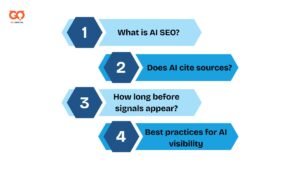
For example, “What is AI SEO?” often leads to:
- How is it different from traditional SEO?
- Does AI cite sources?
- What technical setup is required?
- How long before signals appear?
- Does this require a content hub?
Arrange questions in conversational order, from definition to evaluation to decision. This ladder tells you what belongs in one page, what becomes a section, and what deserves its own article in the cluster.
Step 3: Map Questions to the Funnel
Each question should have a clear intent stage.
- TOFU questions educate and define
- MOFU questions compare, evaluate, and narrow options
- BOFU questions focus on timelines, costs, deliverables, and fit
This step prevents intent confusion. When explanation and selling are mixed, both AI systems and readers struggle to understand the page’s purpose. Clear intent mapping also makes internal linking feel natural and not promotional.
Example Question Map by Funnel for AI SEO Services
| Funnel Stage | Question Cluster | Content Type |
| TOFU | What is AI SEO? Does AI cite sources? What is AEO? | Foundational guide with glossary and examples |
| MOFU | How does AI choose sources? Do I need schema? | Checklist, scoring framework, templates |
| MOFU | How do content hubs help AI understand expertise? | Playbook with internal linking diagrams |
| BOFU | How long does it take? What does implementation include? | Service page with 30/90-day roadmap and case studies |
When this map is complete, both users and AI understand where to go next.
Step 4: Choose the Right Page Type and Answer Placement
Not every question needs its own page.
Core questions often deserve dedicated guides. Supporting questions are better handled as H3 sections or FAQs. For each cluster, decide whether the right format is:
- An educational guide
- A checklist or framework
- A case study
- A service or solution page
Design internal links so TOFU pages lead to MOFU, and MOFU pages point toward BOFU pages with intent-appropriate anchors.
A small but valuable inside-tip for you: In one of our previous work, we saw a 22% increase in citations when we moved the ‘Answer’ to the first 50 words of the H2
Step 5: Write Answer-First Content That AI Can Extract
Every important H2 should begin with a short, direct answer. Two to four sentences is usually enough. You then follow with explanations, examples, tables, or checklists. Use consistent terminology and defined entities across the cluster.
Keep in mind that AI doesn’t just “read” the text. It also looks for JSON-LD data that confirms the “Question/Answer” relationship.
How AI Chooses Sources to Cite
AI citation decisions generally rely on four signal groups.
Relevance
The content must answer the exact question, in the right context, for the right audience. Answer-first structure and coverage of follow-up variants matter more than keyword density.
Trust
Clear authorship, consistent terminology, realistic claims, and real examples increase trust. AI favors sources that demonstrate practical experience rather than abstract theory.
Structure
Clean headings, short paragraphs, tables, checklists, and FAQs make content easier to extract. Structure reduces ambiguity.
Entities and Semantics
Consistent use of defined terms and relationships helps AI understand what your site represents. Internal links reinforce this entity map at scale.
Execution Plan for Conversational Intent Mapping
This execution plan reflects how we typically approach AI search readiness at Golden Owl Digital.
A 7-Day Starting Checklist
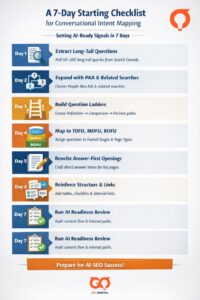
The first seven days are about creating visible AI-ready signals.
Day 1: Extract real long-tail questions from Search Console
Extract 50–200 queries that already have impressions, prioritizing long-tail, conversational questions ranking in positions 4–20.
Day 2: Expand with People Also Ask and related searches
For 5 core topics, collect People Also Ask and related searches, then cluster them into logical question groups. Prioritize constraints users care about most: cost, timeframe, complexity, risks, and suitability.
Day 3: Build question ladders for priority clusters
Create question ladders for the 10 most important clusters, with 5–10 questions per cluster. Each ladder should naturally progress from Definition → Comparison → Evaluation → Decision. Drop any cluster that doesn’t lead to a clear outcome or action.
Day 4: Map questions to TOFU, MOFU, BOFU and page types
Assign each question to TOFU, MOFU, or BOFU, then decide the right page type: guide, checklist, comparison, case study, or landing page.
Day 5: Rewrite answer-first openings on priority pages
Rewrite answer-first intros for 3 key pages, especially at important H2s. Add 2–4 sentence direct answers that can stand alone if lifted by AI or featured snippets.
Day 6: Reinforce structure and context
On priority pages, add at least 1 comparison table, 1 checklist, and 1 FAQ section aligned with the question ladders. Update internal links so they clearly reflect intent progression from TOFU → MOFU → BOFU.
Day 7: Run an AI readiness review
Review terminology consistency across pages, confirm internal links connect educational content to decision pages, and ensure there is at least one clear internal path leading to a service or solution page, supported by a soft CTA (e.g. requesting an AI-SEO quote).
A 30-Day and 90-Day Rollout Plan
Once the foundation is in place, the focus shifts from setup to reinforcement.
| Phase | Focus | Key Deliverables | What to Watch |
| 0–30 days | Structure and signal clarity | Completed question maps, 3–5 TOFU pages, 2 MOFU pages, updated internal linking | Long-tail impressions, visibility on multi-part queries |
| 31–90 days | Expansion and trust reinforcement | 8–12 clustered pages, refined FAQs, entity consistency, schema (preferably Speakable or FAQ Schema) where relevant | Topical coverage depth, assisted conversions, lead quality signals |
Keep in mind that Conversational Intent Mapping only works when technical SEO, internal linking, and page intent are aligned. Specialized SEO Services are often brought in at this stage to help teams turn question clarity into durable search visibility, without disrupting what is already working.
Five Common Mistakes That Make Websites Invisible to AI
- Writing for keywords without direct answers
- Mixing education and selling on the same page
- Poor structural clarity
- Inconsistent terminology and definitions
- Isolated pages without internal linking context
These issues are fixable, but only when identified early.
Final Thoughts
Conversational Intent Mapping is a way of designing search visibility around how people actually ask questions and how AI assembles answers.
When question paths are clear, answer placement is intentional, and internal links reinforce expertise, your content becomes easier to trust and more likely to be AI-cited.
For teams that want to implement this systematically, with clear templates and rollout timelines, this is typically where an AI-focused SEO foundation matters most.
FAQs
How is Conversational Intent Mapping different from keyword research?
Keyword research focuses on terms and volume. Conversational Intent Mapping focuses on question sequences and contextual intent, producing clusters designed for AI extraction.
How many questions should one cluster include?
Start with 20 to 40 high-quality questions. Expand based on Search Console and AI visibility data.
Do I need a separate page for every question?
No. Core questions deserve pages. Supporting questions work better as sections or FAQs.
Where can I quickly find real user questions?
Prioritize Search Console, People Also Ask, sales conversations, support logs, and pricing inquiries. Use AI only to expand, not to invent.
Is it safe to use AI to build question maps?
Yes, as an assistant. Always validate with real search data and funnel intent.
How do you measure success?
Track long-tail impressions, AI answer visibility, assisted conversions, and lead quality, not rankings alone.

Jaden is an SEO Specialist at Golden Owl Digital. He helps brands rank higher with technical SEO and content that resonates