Search works as a complete acquisition channel for traffic, free trials, demo requests, SQLs, and pipeline, not a basic awareness tactic. Effective B2B SaaS SEO reflects how software gets bought, accounting for multi-stakeholder committees, long sales cycles, and recurring revenue economics.
This guide covers the full-funnel approach to capture high-intent organic demand, expand ARR, and decide whether to execute with an in-house team or an agency partner.
Fundamentals of B2B SaaS SEO
B2B SaaS SEO is the systematic technical and content work software companies execute on public domains to capture high-intent searchers, educate qualified buyers, and convert visitors into product trials or paying accounts. The system connects discovery straight into product adoption.
You build search infrastructure to generate predictable recurring revenue while hedging against rising ad costs and unpredictable platform algorithms. Your team captures high-intent queries typed by active software buyers, turns those visits into booked demos, and wins citations across AI-generated answers. Generic search marketing stops at vanity traffic metrics. B2B SaaS SEO is measured strictly by qualified pipeline and closed revenue.

Balancing MQLs and SQLs sustains the commercial funnel. Early-stage researchers make up 90% of total site traffic as MQLs, while SQLs represent evaluators with immediate purchasing intent and active budget.
Differences from Traditional and B2C SEO
Enterprise software discovery operates across extended multi-month evaluation cycles where multi-stakeholder committees review complex tools, with contracts regularly carrying five-figure or six-figure Lifetime Values.
Navigating those timelines requires deep functional resources: software comparisons, alternatives pages, and integration directories. These commercial queries register lower search volume but yield higher contract value per visitor.
A standard B2B software buying committee divides evaluation across four roles:
- End users want to know if the software is easy to use
- Technical evaluators need security and integration details
- Financial decision-makers care about ROI
- Executives want strategic benefits
Data from Backlinko shows the top three unpaid positions secure 54.4% of total clicks for commercial queries. Architecture also differs: while consumer retail sites manage tens of thousands of SKU pages and broad taxonomies, B2B software sites maintain lean URL architectures that prioritize technical depth, integration guides, and high-intent topical authority over raw catalog scale.
Product-Led vs. Sales-Led SEO Dynamics
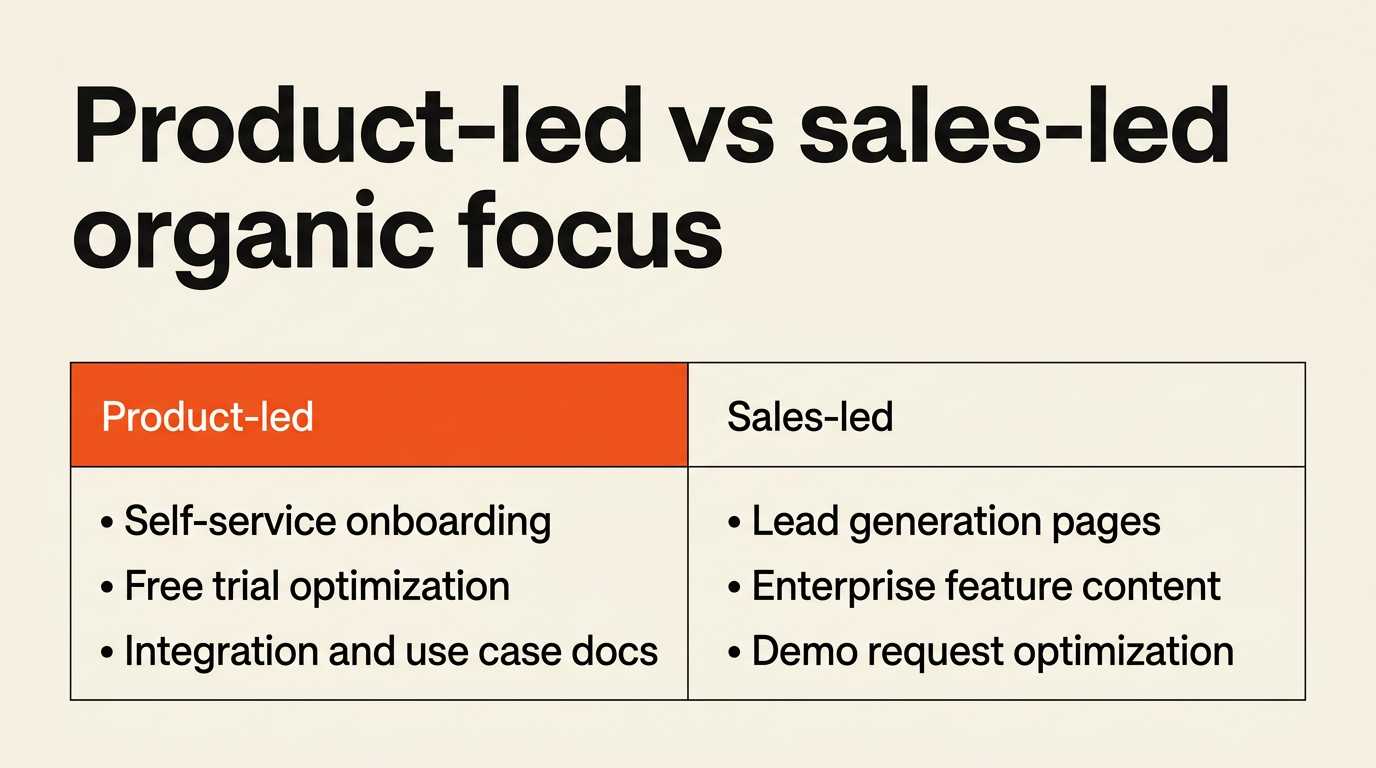
Your go-to-market motion dictates your technical architecture. Product-led teams engineer content around immediate software utility, whereas sales-led organizations design assets for multi-touch evaluation.
Product-led teams concentrate on:
- Self-service onboarding content
- Free trial conversion optimization
- Feature comparison pages
- Integration and use case documentation
Sales-led organizations prioritize conversion assets for high-touch procurement:
- Lead generation landing pages
- Enterprise feature content
- Case studies and social proof
- Demo request optimization
Product-led SEO reinforces the acquisition mechanism by capturing feature-specific intent so visitors can evaluate core functionality directly inside the product. Instead of producing generic guides like “How to manage a remote team,” you publish “How to use [Your Brand’s Specific Feature] to automate remote team check-ins.” This displays the actual interface and anchors the workflow to your software.
Findings from Navattic reveal that only 2% to 5% of web traffic opts for a live sales conversation, while 25% to 40% of users explore an interactive, self-serve product walk-through.
SEO and PPC Economics
Paid advertising costs continue climbing because of advertiser saturation, aggressive auction competition, and rising cost-per-click rates.
Casey Hill, Sr. Growth Marketing Manager at ActiveCampaign, tracked PPC campaigns across Google, Facebook, and LinkedIn and found cost per lead escalating 10% to 30% from 2023 to 2024 across multiple segments. A WordStream study of 17,000 ad campaigns showed 2024 CPL climbing across 19 of 23 industries on Google and Microsoft Ads, averaging an increase of roughly 25%.
Optimized content assets continue generating high-intent opportunities for years after publishing, while paid traffic disappears the moment you pause media spend. It functions like building a factory versus continually buying individual products off the shelf. HubSpot’s State of Marketing Report 2024 found that 29% of marketing executives ranked SEO as their highest channel for return on investment.
Audience Persona and Search Intent Architecture
Granular buyer personas form the foundation of every working B2B SaaS SEO strategy. When you dig past basic demographics into day-to-day workflow friction, user evaluations, and core motivations, your keyword architecture maps straight to real search behavior.
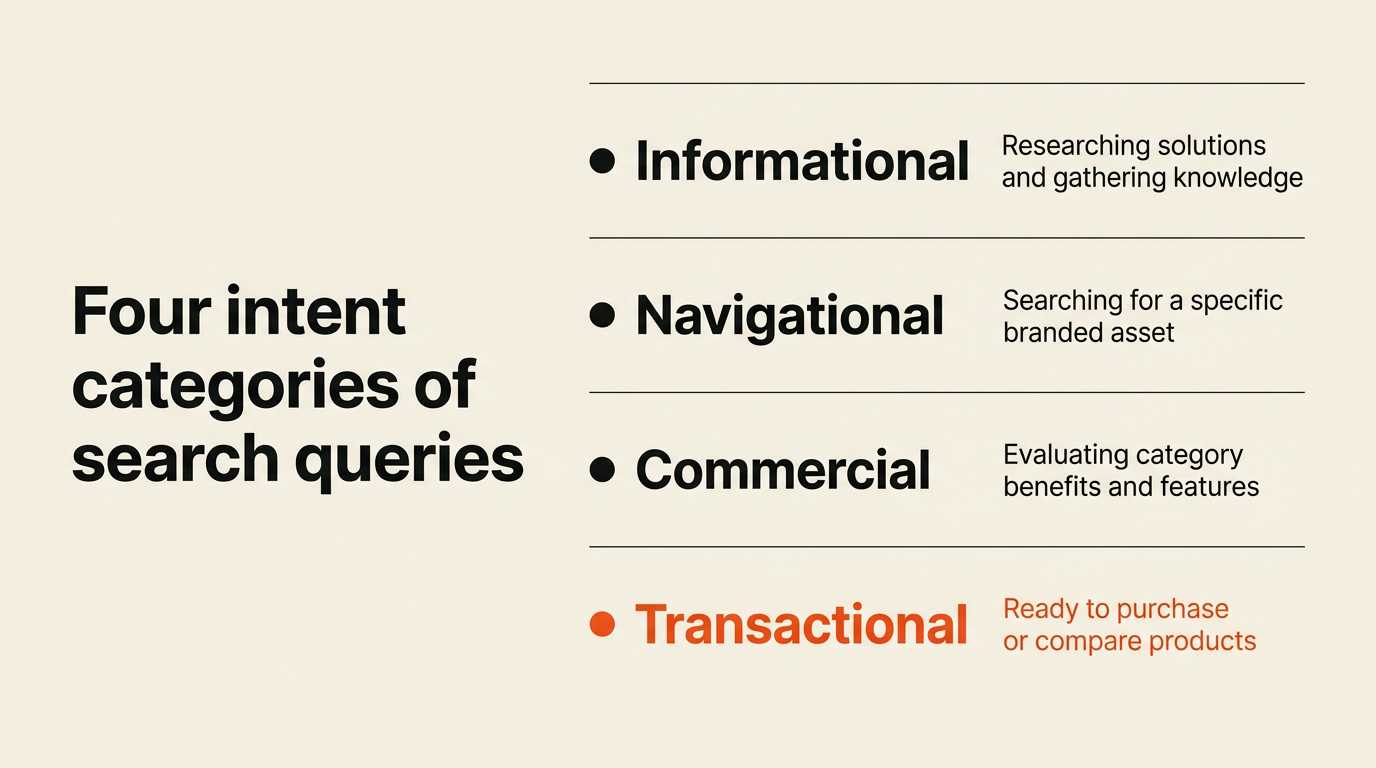
Search queries fall into four intent categories:
- Informational: Researching solutions, e.g. “how to improve customer service in SaaS”
- Navigational: Searching for a specific website or brand, e.g. “Salesforce pricing”
- Commercial: Evaluating product categories, e.g. “CRM benefits for SaaS businesses”
- Transactional: Ready to purchase, e.g. “HubSpot vs. Salesforce CRM comparison” or “best CRM software for small businesses”
ICP Persona Construction
Translate daily operational responsibilities into concrete search queries to build actionable personas:
- Job Titles and Responsibilities: Identify the decision-makers who manage the purchase process, then build content tailored to their operational responsibilities and business goals.
- Challenges and Pain Points: Focus on acute problems they need to solve immediately, whether fixing broken team communication, streamlining workflows, or upgrading support performance.
- Goals: Clarify what operators are trying to accomplish and what deliverables elevate their standing inside the organization.
- Search Behavior: Translate friction points into concrete queries like “best CRM for eCommerce” or “AI-powered project management tools.”
Naming specific workflow bottlenecks, JTBD frameworks, and documented frustrations gives you far more targeting precision than generic demographic profiles.
Direct customer discovery gives you your most valuable keyword inputs. Pull verbatim phrasing by auditing support tickets, reading CRM win-loss notes, talking to account executives, interviewing buyers, and reviewing call recordings in Gong, Chorus, or Salesloft.
Visitor tracking platforms like Lead Forensics, Leadfeeder, ZoomInfo, 6sense, and RB2B prove whether your organic pages actually attract your target ICP by logging user pathways, visiting accounts, and time on page. Most de-anonymization software matches traffic against accounts already in your CRM. RB2B identifies specific individuals outside your database.
The SaaS Search Funnel
Map your keyword targets across buyer awareness stages using the classic framework from Breakthrough Advertising. Search journeys rarely move in a neat line, so meet buyers at their exact stage of awareness. Nail down your target ICP first, lock in the core operational problems, and assign concrete search queries to every content theme.
Prospects evaluate software across three awareness stages:
- Problem aware (ToF)
- Solution aware (MoF)
- Product aware (BoF)
Top-of-Funnel Problem Identification
Problem-aware buyers feel obvious operational symptoms like falling retention or weak pipeline without understanding root causes or available software categories. Detailed how-to posts and educational guides give these operators the vocabulary to diagnose their internal problems.
Educational pieces like “How to Increase SaaS User Engagement” capture top-of-funnel traffic by answering practical questions. Long-tail problem terms like “how can AI automate customer support” and “how to reduce supply chain costs” attract motivated buyers despite smaller search volumes. Write exhaustive 2,000+ word cornerstone guides to address these competitive terms while establishing primary pillar resources.
Targeting search terms without strict ICP relevance wrecks domain focus. HubSpot provides a vivid example: an algorithmic update targeting non-strategic search volume wiped out approximately 77% of traffic to its organic blog after it published dedicated URLs targeting off-topic terms like “inspiring quotes by famous people” and “motivational quotes.” HubSpot kept page-one rankings for core software queries, but search engines penalized the off-topic volume plays.
A study of 25 B2B SaaS domains found Google generated an AI Overview across 36.1% of their search placements. Find target keywords that do not trigger an AIO so you can put editorial resources toward queries that protect organic click-through rates.
Middle-of-Funnel Solution Evaluation
Middle-of-funnel content reaches prospects who understand their core problem and want to compare software categories. Consideration queries like “Best CRM for small businesses” show buyers know the category and require functional differentiation.
Once buyers recognize they need a specific category, such as a CRM or a HIPAA-compliant video tool, in-depth comparison guides and feature breakdowns help them evaluate technical options. Write category-level pieces like “CRM benefits for SaaS businesses” to lay out core advantages before buyers build shortlists.

Bottom-of-Funnel Software Procurement
Product-aware buyers have narrowed their evaluation to two or three finalists. Decision queries like “[Your product] vs [competitor]” require head-to-head comparison tables, customer case studies, and concrete ROI figures to close deals. Competitor comparison terms produce the highest conversion rates in B2B SaaS, because prospects searching “Salesforce alternatives” or “Hubspot vs [Your Brand]” have already secured budget and entered final procurement.
High-converting procurement assets include:
- Feature Comparison Pages: Compare your feature set directly against incumbent vendors.
- Alternative Pages: Present curated alternatives for prominent legacy competitors, positioning your platform as the superior choice.
- Interactive Demos: Provide a product walkthrough prospects can test immediately without booking a call. While only 2% to 5% of visitors are ready to talk to sales, 25% to 40% will engage with an interactive demo.
- ROI Calculators and TCO Studies: Help finance and executive buyers justify replacement costs and calculate payback periods.
Specialized compliance terms like “Best HIPAA-compliant video software” and “Top GDPR-compliant lead management tools” attract complex enterprise requirements with minimal friction. Low search volume should never stop you from launching bottom-funnel pages, because even 50 monthly searches from high-intent buyers can generate massive subscription revenue. SPOTIO generated 1,700+ demos and $2.8M in ARR from organic search by focusing on high-intent terms.
SaaS Keyword Research and Opportunity Discovery
Treat keyword research as direct market research, because customer search queries stem straight from actual buyer demand. Take a hard look at your product capabilities, decide where you can win, and build direct alignment with your ideal customer profile instead of chasing broad search volume.
Multiple discovery channels give you the demand data to build your target list. Check search volume and difficulty inside Ahrefs and Semrush, keep Keywords Everywhere open as a fast supplemental tool, and isolate exact user questions in QuestionDB or AlsoAsked. Use case mapping separates your core features into point solutions, platform tiers, and discrete workflows, then assign each solution a business priority rank based on your revenue targets.
Search Volume vs. Pipeline Value
High-yield keyword research targets high-intent terms that reliably convert into qualified pipeline. Winning 100 monthly queries from purchase-ready prospects yields substantially more pipeline than 10,000 casual visitors. Rank every keyword target around commercial intent, customer lifetime value, ranking difficulty, and ICP alignment.
A case from the hospitality management SaaS vertical shows the danger of chasing raw volume. One company wiped every mention of hospitality from its public pages to sound like general business software, even though 99% of revenue came from hospitality businesses. Buyers in outside industries refused to evaluate the tool. Management restored the vertical focus, accepting lower search volumes because their software directly served hospitality buyers.
Long-Tail Pain-Point Targeting
Narrow long-tail queries carry lower keyword difficulty and pull in qualified visitors who already understand their operational problem. Target explicit troubleshooting phrases like “How to automate invoice tracking in SaaS” or “How to reduce lead qualification time.” Capture purchase-driven vertical terms like “Best HIPAA-compliant video software” to prove compliance fit. Enterprise buyers search exact parameters, typing “accounting software for small companies” instead of generic “accounting software.”
Competitor Keyword Gap Identification
Organic competitive research covers your direct rivals and search competitors who battle for identical SERP real estate, many of whom never appear in your sales pitches. Modern software categories create unusual overlap between broad platforms and specialized point solutions. HubSpot functions as an expansive marketing platform yet competes aggressively for “email marketing tools” because its software solves that workflow.
Run a keyword gap analysis to compare your domain against rival sites and highlight shared terms, ranking positions, and content deficits:
- Inspect domains with a strong footprint, auditing both organic rankings and the terms where they run Google Ads.
- Open the Semrush organic research tab to inspect their highest-performing URLs and outline pages that outperform existing results.
- Run the Ahrefs Link Intersect tool across domains ranking in the top 3 for your core product terms to produce a hit list of backlink opportunities where external sites reference two or three competitors simultaneously.
Getting listed on those shared resource pages closes the backlink deficit against established market leaders.
Integration and Ecosystem Queries
Enterprise evaluators focus on connected ecosystems, typing high-intent queries like “[Your Software] Jira integration” or “CRM with Slack webhook” during technical evaluations. Document your native connections across dedicated product pages to satisfy this intent while proving compatibility with tools like Jira, Slack, and QuickBooks. Listing your product across partner directories, participating in partner programs, and running co-marketing campaigns generates contextually relevant backlinks from high-authority software domains.
Programmatic Directory Opportunities
Systematic keyword patterns unlock programmatic directory expansion across repetitive search variations:
- “[Software category] for [industry]”
- “[Your product] [integration partner] integration”
- “[Use case] software for [company size]”
Structuring your database around these recurring patterns lets you deploy programmatic SEO systems that address hundreds of related terms at scale.
High-Impact B2B SaaS Content Strategy
Run content marketing and SEO as a single engine, matching your editorial calendar directly to your search roadmap. Google rewards deep topical authority across tight problem spaces, so cut top-of-funnel topics your ideal buyer never touches, confirm every outline serves actual customers, and rewrite posts that pull the wrong audience.
In software search, producing two exceptional articles every month beats publishing eight mediocre posts. Dedicated teams that invest two full days into a single breakdown consistently outrank giants like HubSpot and Zapier. Search algorithms reward concrete solutions to verified user problems, so avoid publishing pieces just because an idea sounds fun in an internal meeting.
Hub-and-Spoke Topic Clusters
The hub-and-spoke model builds domain authority across your core product categories by pairing an exhaustive pillar hub on a broad theme with targeted spoke pages tackling related long-tail questions. Rankings increase across both parent pillars and supporting cluster assets simultaneously.
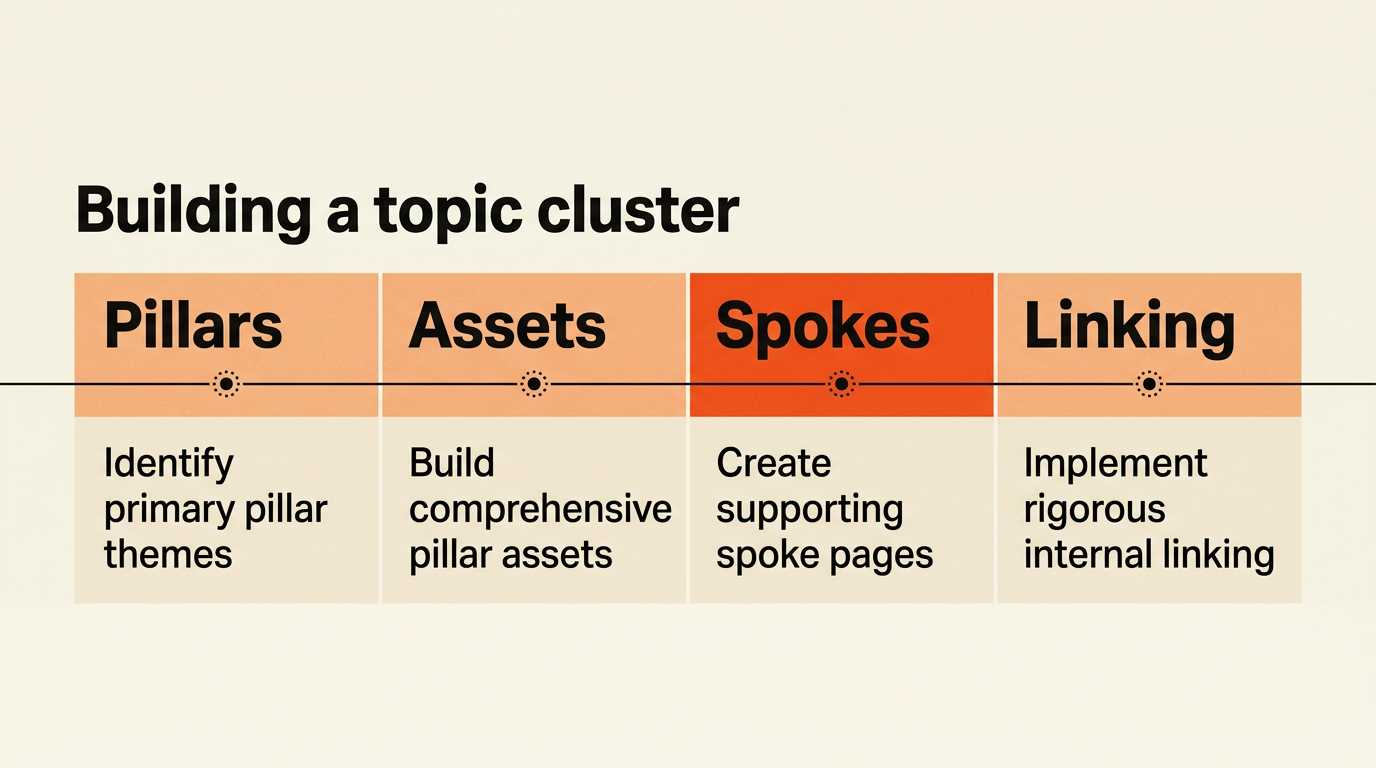
To build a reliable topic cluster framework:
- Identify Primary Pillar Themes: Start with the primary themes your product addresses. Example pillar: “Customer Support Software,” with cluster pages like “Best Practices for Customer Support Automation,” “How to Improve Customer Satisfaction on Support Calls,” “Integrating Chatbots into Customer Support,” and “How to Shorten Wait Times on Support Calls.”
- Build Comprehensive Pillar Assets: Ultimate guides (2,000+ words) target competitive keywords with evergreen content, establishing your domain footprint on core topics.
- Create Supporting Spokes: Build multiple pages exploring different angles of a subtopic with expert insights. A pillar on “Email Marketing” connects to clusters on email marketing automation, email marketing for ecommerce, best practices, and deliverability.
- Implement Rigorous Internal Linking: Ensure all cluster pages link back to the pillar and to each other. This signals topic relevance to search engines and improves rankings for both pillar and related pages.
- Link from Existing Content Assets: Interlink new articles with 3-5 relevant existing pages. On a brand-new site, give every new article at least 1 internal link to avoid orphan pages.
- Include Contextual Calls-to-Action: Guide readers toward natural product evaluation steps with relevant CTAs.
Competitor Comparison and Alternative Pages
Bottom-of-funnel comparison queries like “HubSpot vs Marketo” capture prospects who already understand the landscape and want to choose a vendor. Honest comparison pages let you shape the narrative and convert evaluators actively testing tools by laying out specific feature differences, transparent pricing, and product benefits side by side.
Product-Led Content Integration
Product-led SEO weaves your actual interface into educational guides instead of leaning on vague copy. When someone searches for invoice automation workflows, an interactive walkthrough or UI screenshots prove exactly how your software fixes the problem. Putting the product inside the tutorial builds trust, keeps visitors on the page longer, and drives conversions by letting prospects experience features without booking a demo. Navattic data shows that while only 2% of visitors agree to talk to sales, roughly 25% to 40% will click through an interactive demo.
Original Research and Benchmark Reports
Proprietary industry benchmarks and custom surveys pull in natural backlinks as reporters, analysts, and editors cite your findings. Competitors who would never link to your sales pages will regularly link to your original research.
High-authority formats that generate passive backlinks include:
- Original research and industry surveys
- Free tools and calculators
- Comprehensive industry reports
- Interactive assessments or ROI calculators
- Data visualizations and infographics
High-volume research queries like “sales statistics” create an automated link engine by giving industry writers quick stats. One data asset built for a B2B SaaS client landed 927 backlinks without a single cold outreach email.
To satisfy Google’s E-E-A-T guidelines, show real hands-on experience across every piece. Interview your internal product specialists, feature clear author bios with verified credentials, and publish unique survey takeaways alongside benchmark data.
Middle-Funnel Lead Nurture Assets
Middle-of-funnel assets help prospects figure out how specific software solutions solve their operational challenges. Use these core formats:
- Whitepapers and Ebooks: Offer in-depth resources that address specific challenges. Example: a whitepaper on “Optimizing Customer Support with AI Tools.”
- Use Cases and Case Studies: Demonstrate measurable results. Example: a case study showing a 30% boost in customer satisfaction via your CRM. Optimize these with relevant industry and use case keywords to rank for “[industry] case study” searches.
- Webinars and Demos: Engage prospects with live product demos. Example: a webinar on “Scaling SaaS with Integrated CRM Tools.”
When prospects download a whitepaper or attend a webinar, automated email sequences should send targeted follow-ups based on those touchpoints. A reader who downloads an enterprise case study gets follow-up stories tailored to their vertical, while webinar attendees get invites to custom walkthroughs.
Legacy Content Refreshes
Regular updates to older articles produce higher returns than drafting net-new posts. Well-targeted updates can generate 100%+ ROI within a single week, while brand-new articles usually take 3-9 months to gain traction.
Find quick wins by filtering Ahrefs or Semrush for keywords in positions 4-15, where small on-page tweaks can push you into the top three. Refresh these URLs with modern examples, current data points, sharpened CTAs, and fresh testimonials. Check top competitors in Semrush to see if they own the featured snippet, then restructure your headings to steal the placement. Tightening title tags and meta descriptions immediately improves click-through rates.
When you trim older URLs, like shortening yourwebsite.com/blog/the-top-10-remote-work-trends-of-2024 to yourwebsite.com/blog/remote-work-trends, always set up a 301 redirect to preserve backlink authority and internal link equity. Stay disciplined, since chaining too many redirects drags down page load speeds.
Technical SEO and Site Architecture
Technical architecture forms the operational bedrock of organic search, because crawlers cannot crawl, index, or rank your pages if the site structure is broken. Without dependable hosting, secure environments, a reliable CMS, editable canonical tags, schema markup, clean sitemaps, and reliable 301 redirects, content performance stalls out.
For 90% of operators managing a typical B2B SaaS website, technical SEO avoids the scale issues seen on massive e-commerce sites like Amazon, eBay, or Reddit. Complications usually stay limited to major platform changes, structural redesigns, or complex domain migrations. Since SaaS companies are tech entities, buyers expect marketing sites to mirror software quality through fast load speeds, tight security, and modern frameworks.
Conduct regular technical audits using these evaluation methods:
- Site Crawl Audits: Configure a crawler to scan your domain and prioritize recommendations by importance. Spend most of your time on errors, not warnings and notices.
- Search Console Monitoring: GSC provides feedback on indexing issues and performance errors. Create individual accounts for the main marketing website vs. other subdomains rather than one full-domain account, so it’s easier to understand marketing performance.
- Lighthouse Performance Reports: A Google Lighthouse Report takes 2 minutes to run, is free, and is built into Chrome. Results tie to Core Web Vitals with recommendations from decreasing image sizes to minifying CSS and deferring JavaScript.
- Blog Architecture Audits: Screaming Frog crawls indexable pages to export headings, titles, and meta descriptions, flagging errors like missing titles or ambiguous naming.

Site Hierarchy and Crawl Depth
Maintain a flat site hierarchy where important pages sit within three clicks from your homepage so crawlers index content efficiently. Systematically eliminate duplicate content, fix broken redirects, consolidate competing pages, and keep directories clean. URLs should stay short, descriptive, and keyword-rich, like /customer-support-software/best-practices, without long strings of random numbers.
Building an Integration Hub that functions like an app store directory lets you capture hundreds of high-intent long-tail integration keywords across your product ecosystem. Managing scalable directories requires a solid technical base to organize folders cleanly and prevent crawl depth bottlenecks.
XML Sitemaps and Indexing Controls
Place your key URLs inside your sitemap, typically at yourwebsite.com/sitemap.xml, to signal to Google that these paths represent your highest-priority content. Adding your target commercial URLs to your sitemap and submitting it to Google Search Console validates your setup.
Audit your XML sitemap to confirm canonical URLs get indexed properly, outdated URLs are removed, and crawl budget avoids waste from sitemaps containing 30,000 nearly-empty tag pages. Review robots.txt settings to prevent crawlers from accessing private folders and ensure your team never accidentally blocks key commercial sections.
Adding a canonical tag into a page’s code marks that URL as the original version for search engines:
- It helps you avoid duplicate content if others rip your blog posts.
- It helps Google understand which pages are the “source of truth” if you have overlapping content.
- If you have similar pages for different regions or use cases, it tells Google which version is primary.
In platforms like Webflow, you can set a global canonical tag that automatically applies to any page you create.
Core Web Vitals and Performance Optimization
Page speed ties directly to rankings and conversion rates. Data from Portent indicates a website loading in 1 second converts at 3 times the rate of one loading in 5 seconds. Google evaluates user experience through Core Web Vitals:
- Largest Contentful Paint (LCP): Measures loading performance.
- Interaction to Next Paint (INP): Measures interactivity.
- Cumulative Layout Shift (CLS): Measures visual stability.
Pinpoint performance bottlenecks with diagnostics tools like Google PageSpeed Insights, Pingdom, GTMetrix, Dareboost, and Uptrends. Decrease asset weight to improve site performance:
- Compress Images: Use JPG files ideally under 100 KB for images that don’t require a transparent background. If files are still too big, adjust width dimensions to 1280px or 1080px.
- Browser Caching and Scripts: Leverage browser caching and minimize large media files.
- Code Optimization: Minify CSS and defer JavaScript to prevent render-blocking resources.
Mobile-First Configuration
Google uses mobile-first indexing to evaluate and rank sites primarily on their mobile experience, making mobile optimization a requirement. Maintain a high-quality mobile presence with these standards:
- Responsive Web Design: Use responsive design so your site automatically adjusts layout across all screen sizes.
- Physical Device Validation: Test on actual mobile devices rather than desktop simulators to catch real usability issues.
- Mobile Readability and Navigation: Use legible fonts and appropriate sizes, ensure touch-friendly navigation, break up long paragraphs, use descriptive headers, and compress images.
Structured Data and Schema Markup
Adding schema markup into your site’s head tag helps search engines parse page context, produce rich snippets, improve click-through rates, and win featured snippets. Structured data also supplies clear entity context to LLMs, helping generative AI models understand product capabilities during queries.
Key schema formats for SaaS websites:
- Product Schema: Displays pricing, availability, and ratings directly in the SERP, useful for platforms with multiple pricing tiers.
- Review Schema: Displays user reviews to increase credibility, critical where decision-makers rely on peer validation.
- FAQ Schema: Occupies more real estate in search results while answering common questions directly.
- How-To Schema: Highlights step-by-step processes to capture featured snippets for complex solutions.
- Organization and Article Schema: Add Organization schema on your homepage and Article schema on blog posts to define page entities for search engines.
Conversion Rate Optimization and On-Page Execution
Teams that combine search acquisition with user session data can double organic leads without extra marketing budget. Every URL must map directly to clear buyer stages, or potential customers leave before generating pipeline value.
Product Page Conversion Optimization
SaaS conversions depend on product and feature pages, so build their layout so prospects grasp core value immediately. Structuring high-converting product and landing assets requires eight tactical elements:
- Conversion-Focused Content Structure: Guide prospects toward explicit conversion points like booking a demo or starting a free trial with clean headings, visible CTA buttons, and deliberate internal links.
- Landing Page Optimization: Build dedicated pages for high-intent terms like “free CRM trial.” Match search intent with a clear value proposition in your H1 and opening paragraph, prominent CTA buttons, and customer logos, testimonials, and security badges.
- Streamlining User Journeys: Examine drop-off data to eliminate friction. When visitors abandon landing URLs, simplify navigation and strip unnecessary intake fields. Merging product overview pages into signup forms cuts friction and increases completed trial signups.
- Keyword-Rich Descriptions: Write keyword-optimized copy explaining exact operational mechanics, aligned with target buyer personas and search queries.
- Highlight Use Cases and Integrations: Document specific use cases and tech stack integrations on core feature pages to capture high-intent volume while showing implementation viability.
- Add User Reviews and Social Proof: Place authentic reviews, testimonials, customer logos, and security badges across product pages to confirm authority to search engines and buyers.
- Incorporate Internal Linking: Point internal links from product pages toward technical documentation, case studies, and recorded webinars to reinforce topical clusters.
- Structured Headings and Product Schema: Organize feature hierarchies with descriptive H2 and H3 subheadings and implement product schema so search engines show pricing tiers, packages, and aggregate ratings in SERPs.
On-Page Metadata Structure
Clean on-page metadata allows crawlers to parse page intent accurately, raising visibility and click-through rates. Standardize your core metadata around five specifications:
- Title Tags: Place your target keyword near the front and keep total length under 60 characters, targeting 56-58 to avoid truncation. Example: “Best CRM Software for Small SaaS Businesses | [Your Company Name]”
- Meta Descriptions: Incorporate your primary keyword and prompt clicks. Keep the snippet under 155 to 160 characters to prevent truncation and lift click-through rates.
- Headings (H1, H2, H3): Place your primary keyword in the single H1, then divide subtopics with clear H2 and H3 tags. Maintain tight alignment across title, meta description, H1, subheadings, and body content.
- URL Slug Optimization: Configure your slug to reflect your exact target keyword. Edit the CMS default to remove stop words, random ID numbers, and irrelevant characters before publishing.
- Image Optimization: Apply descriptive file names and keyword-focused alt text to every visual. Save your main thumbnail as a JPG using the exact target keyword to assist image search indexing.
Behavioral Experience Analysis
Session recording tools like Mouseflow, Hotjar, and Fullstory highlight on-page friction rapidly, providing evidence to refine layouts, copy, and CTA buttons. Analytics tools like Amplitude or Mixpanel monitor how search visitors navigate your site. Filter an Amplitude view for Google referral traffic and exclude all UTM parameters to separate organic from paid, then deploy targeted CTAs to users who repeatedly explore integration pages.
Track four core interaction metrics to identify page drop-offs:
- Scroll Depth: Monitor vertical scroll percentages on conversion pages. If heatmaps show users abandon mid-page, move key buttons higher and break dense text with subheaders, diagrams, or widgets.
- Click-Through Rates (CTR): Evaluate click performance across buttons. When users pause before a “Sign Up for Free” button, adjust copy to “Start Your Free Trial Today – No Credit Card Required.”
- User Flow and Heatmaps: Heatmaps show where users click, scroll, and engage. When visitors ignore bottom-of-page prompts, place a mid-page CTA inside high-attention sections.
- Search Signals: Google evaluates bounce rate and time on page as quality signals. Weak on-page experience reduces rankings, lead generation, and conversions.
Authority Building and Digital PR
Real authority sits at the center of every serious B2B SaaS SEO playbook. You win category leadership by landing strong backlinks and putting out reliable thought leadership.
Backlinks still stand as one of Google’s most dependable ranking signals, but enterprise software demands a different playbook than a local retail shop. A steady influx of links speeds up page indexing, lifts visibility for fresh queries, pushes target URLs higher, and deepens topical authority. The industry frames this standard around EEAT: Experience, Expertise, Authoritativeness, and Trustworthiness. When world-class sites link to your pages, search engines recognize your product as a verified brand.
Budget between $200 and $1,000 per link when you hire an outside outreach agency. Spending less usually picks up junk links that hurt your standing. Stay away from cheap Fiverr packages and private blog networks, since Google core updates regularly wipe out organic traffic from teams trying to trick the algorithm. Focus on earning placements on legitimate SaaS sites and major industry publications, because toxic placements from spam domains tank your organic positions over time.
Passive Link Earning
Software brands earn their most sustainable acquisition route by shipping genuinely useful, original editorial content that attracts backlinks passively. Releasing proprietary research that other operators reference generates a compounding baseline of inbound citations. Once your pages hit top 3 positions for core transactional terms, industry researchers consistently find and cite your work.
Strategic Digital PR
Active media relations through platforms like Help A Reporter Out position your team as recognized experts while earning high-authority editorial quotes and backlinks. Send focused press announcements to trade reporters whenever you hit key milestones, ship major product rollouts, or close funding rounds. Publishing proprietary data studies and customer breakdowns gives journalists concrete reference points to cite.
Publishing targeted guest pieces on non-competing software blogs builds your starting baseline of domain rating. Reach out to a founder or CEO with a concrete pitch. Offering to rank their site for an important commercial keyword proves your execution chops, expands your portfolio, and often turns those teams into long-term clients. Secure inclusion in vetted “best software for” roundups, because these lists drive qualified referral trials and feed clean training data to LLMs.
Proven thought leadership formats that attract links:
- Webinars and Live Events: Attendees share your recordings and presentations with their networks.
- Whitepapers and eBooks: Long-form content on industry challenges establishes authority and provides linkable assets.
- Guest Posts and Speaking Engagements: Contribute articles to prominent publications or participate in speaking events.
Partnership and Ecosystem Link Building
Software teams increase backlink velocity by writing guest columns, pitching partner software brands for contextual link insertions, participating in private operator Slack groups, or retaining an experienced link building firm.
Modern search results are far more crowded than old-school pages with plain text ads above ten organic links. AI Overviews, People Also Ask modules, video carousels, and comparison aggregators like G2 dominate above-the-fold real estate, dragging down standard organic click-through rates. Take your strategy past standard organic rankings across every visible SERP feature to capture buyer touchpoints across multiple channels.
Third-Party Review and SERP Presence
A dominant presence across modern search pages requires actively managing several external properties:
- Audit all SERP touchpoints: Identify every touchpoint, including AI Overviews, Reddit, video carousels, G2, Capterra, and industry listicles for your most important keywords. In many cases, AI pulls from your content but names your competitors.
- Optimize third-party review sites: Sites like G2, Capterra, and Software Advice rank highly for “best software for” queries and are cited in LLM results. Optimize your profiles and sponsor placements to reach high-intent buyers.
- Engage in discussions: Reddit, Quora, and similar forums let you provide valuable, non-promotional insights, especially since sources like Reddit are included in LLM training data.
- Create video content: YouTube is the world’s second-largest search engine. Embed videos into relevant blog posts or product pages to rank in SERP video carousels or get referenced in AIO and LLM results.
External brand mentions feed generative search engines directly. Landing citations across trade news, roundups, Wikipedia, and review directories trains LLMs to surface your product. Prompt ChatGPT to see which sources shape its answers, then build coverage on those exact domains to secure AI visibility.
In-House SEO vs. Agency Partnership
Software leaders face an immediate tradeoff between rapid execution speed and permanent payroll overhead when choosing between building an internal department or hiring an external firm. Paid campaigns dry up the exact day you cut ad spend, whereas organic programs generate returns near 800% while capturing leads at 10% to 30% of standard PPC expenses.
The In-House SEO Model
An internal group of dedicated search specialists embedded within your product unit secures immediate control over technical messaging. Bringing in a Content Operations Lead, Content Editor, and SEO Strategist drives compounding trial signups, unbranded impressions, and paying subscriptions over time.
In-house teams coordinate straight with your web developers on technical site architecture, indexing rules, and canonical setup. Dig into your analytics dashboards each week to pull performance data on high-converting product pages, trial numbers, and demo conversion rates, then hand those figures to engineering as a clean roadmap.
Pros and Cons of In-House Teams
Building an internal search team offers distinct benefits:
- Deep Product Knowledge: Internal members build an intimate grasp of product workflows, technical features, and daily user pain points.
- Direct Cross-Functional Access: In-house strategists work directly with sales reps, review Gong or Chorus recordings, and extract pipeline signals from CRM win-loss data.
- Brand Authority Leverage: Companies with domain ratings of 80+ scale organic traffic efficiently by prioritizing internal architecture and editorial output over aggressive link acquisition.
Operating in-house also presents structural limitations:
- Resource Constraints and Burnout: Producing authoritative content requires two full days per long-form asset, putting internal teams at risk of burnout after two months without additional headcount.
- Ongoing Operational Overhead: Fixed expenses accumulate through full-time salaries, software subscriptions, and freelance fees, regardless of pipeline output.
- Algorithm Vulnerability: Algorithm updates frequently disrupt baseline rankings, requiring dedicated resources to monitor keyword movements and adjust configurations.
The SEO Agency Model
Software companies gain mature tactical playbooks, comprehensive site audits, and immediate access to established publisher distribution channels through specialized agencies. Dedicated search firms bring complete execution capabilities:
- Maintaining specialized datasets and tracking performance patterns across hundreds of B2B SaaS websites.
- Applying behavioral analytics and heuristic CRO recommendations to design and content for increased qualified leads.
- Deploying advanced audience insight techniques, including customer interviews, sales call recordings, and CRM win-loss analysis.
- Running generative engine optimization alongside traditional search on one unified roadmap.
- Assigning dedicated client-to-strategist ratios (such as 2-4 clients per strategist) to ensure deep strategic attention.
Specialized growth and marketing programs often start at $2k per month. Reputable link-building agencies charge between $200 and $1,000 per high-quality placement.
Pros and Cons of SEO Agencies
Working with an external agency delivers key advantages:
- Immediate Expertise and Time Savings: An outside specialist who understands enterprise technical search prevents your engineering team from wasting months on trial and error.
- Proven Tactical Playbooks: Agencies deploy tested frameworks for competitor keyword gaps, programmatic directory generation, and Generative Engine Optimization.
- Established Authority Networks: Agencies leverage existing editorial relationships and media channels to earn high-tier backlinks without months of manual outreach.
Selecting an outside agency introduces real risks:
- Low-Quality Vendor Risks: Paying less than $200 per link consistently damages your domain. Buying bulk backlink packages on Fiverr or relying on a private blog network (PBN) exposes your domain to severe penalties during core updates.
- Misalignment on Vanity Metrics: Generalist agencies frequently report on top-of-funnel impressions and vanity rankings instead of qualified demo volume and revenue. Raw traffic is useless if visitors never convert into paying accounts.
The Hybrid Execution Approach
Within a hybrid structure, your product team protects technical positioning accuracy while external specialists execute technical audits, authority link building, and generative search visibility. A balanced division of labor:
- Internal Marketing Teams: Define your Ideal Customer Profile, extract workflow objections from sales call recordings, lead technical demos, and ensure narrative accuracy across every asset.
- External Specialized Partners: Run technical site audits, resolve Core Web Vitals bottlenecks, execute competitor link intersect analyses, optimize for AI search (GEO), and secure high-authority digital PR placements.
Running a hybrid model requires unified reporting across core pipeline metrics:
- Configure Google Analytics 4 with custom conversion events and verify your primary domain properties inside Google Search Console.
- Integrate web analytics directly with the CRM (HubSpot or Salesforce) to establish closed-loop reporting connecting organic traffic to MRR, trial-to-paid conversion rates, and CAC.
- Create monthly dashboards for executives showing high-intent keyword rankings, organic-sourced sales meetings, and closed pipeline revenue.
How to Select a B2B SaaS SEO Agency
A thorough vendor review demands evaluating real operational workflows, delivery standards, and team capacity. A strong agency:
- Tells you exactly which net new logos are visiting your website, where they came from, when, and what they’re doing on your site.
- Applies neuroscience principles and heuristic CRO recommendations to your design and content for increased qualified leads.
- Uses advanced audience insight techniques (customer interviews, sales call recordings, CRM win-loss analysis).
- Maintains a database of B2B SaaS websites they continually analyze to understand what’s working in SaaS SEO.
- Assigns 2-4 clients per strategist (compared to 8+ at many agencies), so you get real attention.
Technical and Industry Expertise Criteria
Sustainable revenue expansion demands a disciplined strategy and clear execution roadmap, running precise plays at every phase from mapping topics to buyer personas to fixing server architecture and reverse-engineering generative engine optimization. Clean technical plumbing underpins every content win, because world-class articles won’t rank if the underlying site mechanics fail.
Generative engine optimization is now its own distinct practice. Consider TestRail, which pulls in 2,000+ referral visits and 25-30 qualified trial signups every month directly from LLM answers. When teams run into complex web engineering bottlenecks, bringing in a specialized SaaS SEO agency or consultant cuts out months of wasted trial and error.
Proven track records inside subscription software models give the cleanest benchmark for qualifying vendors:
- Stratabeat achieved a YoY increase of 544.4% in SEO-sourced sales meetings for the fintech SaaS company Masttro within six months.
- SPOTIO generated 1,700+ demos and $2.8M in new ARR from organic search.
- ForUsAll saw a 6x increase in qualified leads from organic search in under a year, enabling the company to scale back ad spend by 90%.
Essential Vetting Questions
Interview prospective partners across core operational competencies to isolate technical specialists from generalists.
Attribution and Pipeline Tracking:
- Do you implement multi-touch attribution models to credit organic touchpoints across long sales cycles and connect SEO to MRR?
- How do you integrate analytics with our CRM (HubSpot or Salesforce) for closed-loop reporting that shows which keywords and content actually generate customers, not just leads?
- Do you track trial-to-paid conversion rates, MRR impact, and CAC rather than relying exclusively on traffic numbers?
Content Research and Production Methodology:
- How do you translate buyer frustrations, pain points, JTBD, and goals into search queries rather than relying on high-volume generic keywords?
- What is your process for content briefs and writing for SEO to ensure human-led depth, and do you use tools like Clearscope or Surfer SEO?
- How do you adhere to Google’s E-E-A-T guidelines by incorporating expert quotes, author bios, and proprietary data rather than unvetted AI drafts?
- How do you structure content into hub-and-spoke topic clusters to signal topical authority?
Authority Building and Backlink Acquisition:
- What specific link-building tactics do you use, and do you avoid paid link packages, low-quality directories, and PBN schemes?
- If you charge for link building, does your pricing reflect high-quality placements ($200-$1,000 per link for reputable agency work)?
- How do you build linkable assets (data-driven reports, free tools, original research) to facilitate passive backlink acquisition?
Red Flags to Avoid
Stay away from keyword stuffing when drafting landing pages or articles. Forcing repetitive phrases unnaturally ruins the reading experience and triggers manual review flags from Google, which can drop organic rankings or remove pages from the index entirely. Run regular audits of published content to prevent penalties. Targeting identical terms across multiple URLs creates duplicate content conflicts, leaving crawlers unable to decide which page should rank.
Measuring SEO Performance and Business Impact
Tracking SEO KPIs connects search directly to revenue growth. Once you deploy new pages, track leading indicators like impressions alongside lagging revenue metrics to verify whether organic search creates qualified pipeline. Give your strategy adequate runway, since meaningful ranking improvements and downstream revenue typically appear in three to six months. Strong execution generates a nearly 800% return on investment, double that of PPC across comparable segments. Compare total organic expenses including salaries, tooling, and contractors against generated pipeline to calculate clear channel ROI, and mature programs produce the lowest CAC of any marketing channel.
Core SaaS SEO Metrics
Track these operational KPIs to ensure every organic asset drives qualified pipeline and revenue:
- Organic Traffic Growth: Measure traffic increase to key URLs and directories using Google Analytics and Google Search Console.
- Trial-to-Paid Conversion Rate: Track the percentage of trial users who convert to paying customers, confirming organic traffic translates into product adoption.
- Monthly Recurring Revenue (MRR) Impact: Measure how SEO-driven conversions contribute to MRR by connecting search visitors to ongoing subscription revenue.
- Customer Acquisition Cost (CAC): Track how SEO lowers acquisition cost to improve unit economics and scale efficiently.
- Keyword Rankings: Track priority keywords in SEMRush or Ahrefs as leading indicators. The top three organic results receive 54.4% of all clicks, per Backlinko.
- Click-Through Rates (CTR): Monitor CTRs in Google Search Console to identify queries where noisy SERPs limit traffic potential.
- Conversion Rates, MQLs, and SQLs: Track the percentage of organic visitors who turn into trials, demos, and customers. Isolate non-branded organic conversions across demo requests, free trials, and contact sales inquiries.
- Interactive Demo Engagement: Only 2% to 5% of visitors are ready to talk to sales at any time, whereas roughly 25% to 40% will engage with an interactive demo.
- LLM Referral Traffic and AIO Placements: LLM referral traffic accounts for 0.5% to 3% of total website traffic across client portfolios but is growing faster than most channels. Monitor performance in AI overviews and platforms powered by ChatGPT, Claude, and Gemini. TestRail earns 2,000+ referral visits and 25-30 qualified trial signups per month from LLMs.
- Revenue and Pipeline Won: Track new revenue and closed pipeline from organic search. SPOTIO generated 1,700+ demos and $2.8M in new ARR from organic search.
Closed-Loop Multi-Touch Attribution
Attribution models reveal how distinct search touchpoints contribute to conversions across complex journeys, assigning credit when a prospect reads an organic blog post before converting through paid media or email nurture. Connecting organic traffic to MRR and CAC through CRM integrations like HubSpot, Salesforce, or ActiveCampaign reveals which specific keywords and assets generate paying customers rather than non-buying visitors. Review win-loss reasons attached to organic touchpoints to verify your strategy attracts qualified target accounts. Research from Gartner shows 75% of B2B buyers prefer an entirely rep-free buying experience.
Executive Reporting Dashboards
Use these three primary tools to measure ongoing performance:
- Google Search Console (GSC): Measures leading indicators like impressions and clicks, and helps spot indexing or crawl errors.
- SEMRush or Ahrefs: Track site health, organic rankings, page performance, referring domain growth, and competitor keyword gaps.
- Google Analytics (GA4): Provides insights into organic traffic, user behavior, session duration, and goal completions over time.
An online dashboard gives leadership clear visibility, centered on a focused executive scorecard:
- Organic traffic growth
- Search engine rankings
- Impact of AIO and LLM referral traffic
- Traffic from your blog/articles to core pages
- Conversion rates
- MQLs
- SQLs (request a demo, free trial, contact sales)
- Sourced pipeline and ARR impact
Build a Looker Studio dashboard connected to Search Console data to isolate overall organic traffic, blog traffic, and non-branded queries. Share monthly dashboards and run quarterly deep dives to pinpoint emerging search trends. Tracking competitor ranking benchmarks and configuring a dedicated GA4 channel for AI referrals gives leadership complete visibility into brand reach and citation growth.
Software companies that tie organic search directly to closed pipeline turn search engines into compounding revenue channels. Aligning technical site foundations, customer pain-point targeting, and multi-touch CRM attribution converts commercial search intent into durable recurring revenue.
Frequently Asked Questions
What is B2B SaaS SEO?
B2B SaaS SEO is the systematic technical and content work software companies execute to capture high-intent searchers, educate qualified buyers, and convert visitors into product trials or paying accounts. It is measured by qualified pipeline and closed revenue, not vanity traffic.
How is SaaS SEO different from B2C or e-commerce SEO?
SaaS SEO targets extended multi-month evaluation cycles with multi-stakeholder committees and five- or six-figure contract values. It relies on comparison pages, alternatives pages, and integration directories that carry lower search volume but far higher contract value per visitor.
What is the ROI of SaaS SEO compared to PPC?
Organic search yields roughly 800% ROI for mature software businesses, about double standard PPC, while producing at least 50% of inbound prospects. Content assets keep generating pipeline for years, whereas paid traffic stops the moment you pause spend.
How long does SaaS SEO take to show results?
Meaningful ranking improvements and downstream revenue typically appear in three to six months. Legacy content refreshes can generate 100%+ ROI within a week, while brand-new articles usually take 3-9 months to gain traction.
Which keywords should B2B SaaS companies prioritize?
Prioritize high-intent commercial and transactional terms with strict ICP relevance over raw search volume. Competitor comparison and alternatives queries convert highest, and even 50 monthly searches from purchase-ready buyers can generate significant subscription revenue.
Should I build an in-house SEO team or hire an agency?
In-house teams offer deep product knowledge and direct cross-functional access but carry fixed overhead and burnout risk. Agencies bring proven playbooks and authority networks faster. A hybrid model keeps positioning accuracy internal while outsourcing technical audits, link building, and GEO.
How much should I budget for backlinks?
Budget $200 to $1,000 per high-quality placement from a reputable agency. Paying less consistently picks up junk links, and Fiverr packages or PBNs expose your domain to penalties during core updates.
Which metrics prove SEO drives revenue?
Track trial-to-paid conversion rate, MRR impact, CAC, and sourced pipeline through closed-loop CRM attribution, not just traffic. Connect organic touchpoints directly to HubSpot or Salesforce to show which keywords and content generate paying customers.