Social media teams, welcome to a workload that keeps moving: content planning spills into trend checks, comment replies, analytics reviews, and the next week is already underway.
Treat AI social media marketing as a powerful tool; it helps teams keep up with the pace (especially when the next week has already started). The pace is here already.
With AI handling social media tasks, teams can create content faster across channels, spot useful data points sooner, and make calls from real performance numbers. Routine tasks take less time, so teams have more room for worthwhile strategy.
Practical Uses of AI Social Media Marketing
AI for social media marketing now touches the whole workflow, from making content and running campaigns to reading performance and audience signals. That’s a broad setup.
Limited resources make every new format more demanding for social teams, while burnout affects 76% of marketers at least occasionally. That’s the pressure point.
People expect more from brands, too: brands should post multiple times per day, according to 32% of consumers. That creates plenty of posting.
The 2026 AI Report found that 95% of social media professionals use AI at work, and 37% use more than 4 different AI tools. More tools, naturally.
AI has improved productivity for 82% of marketers, yet only 35% report a significant impact. That gap still matters.
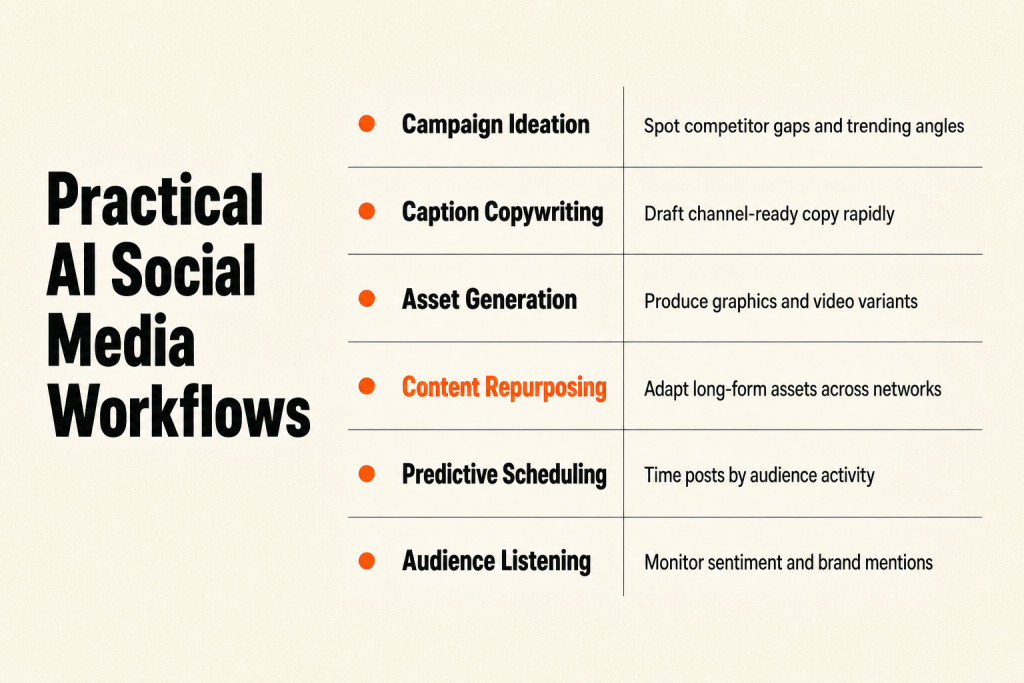
Campaign Ideation
Automated Content Creation and Ideation
Across multiple platforms, AI agents sift through trending topics, audience interests, and competitor activity to suggest content ideas. You get a starting list.
Looking at competitors can show where a brand has room to move, especially when customer pain points remain unanswered. An agent can flag those gaps as ways to stand apart.
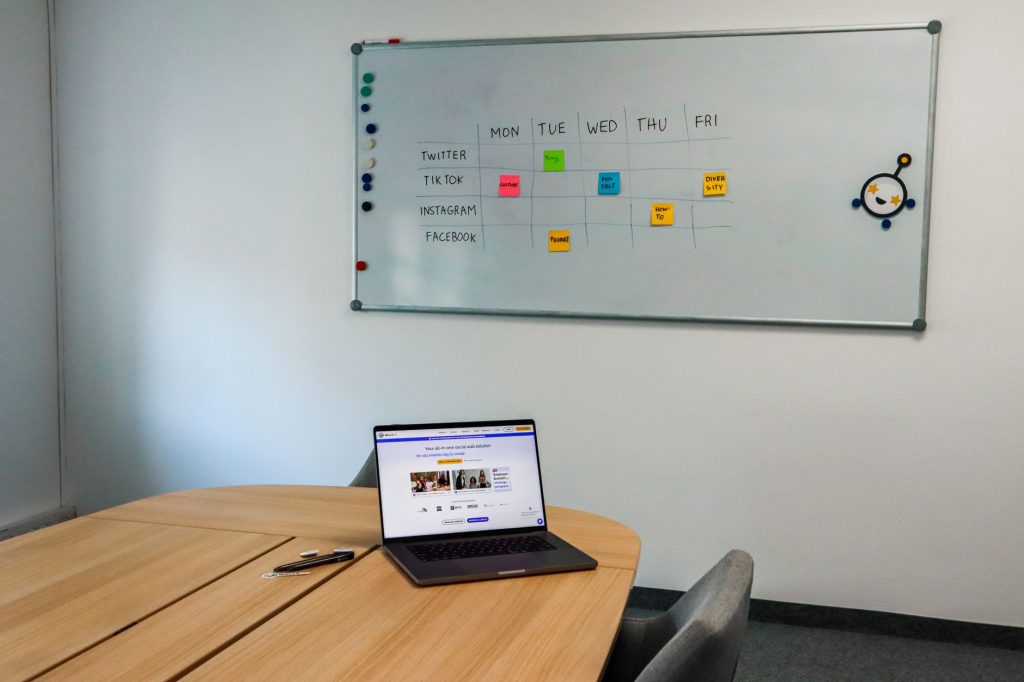
When writer’s block arrives, use AI as a creative partner. Open your preferred LLM tool and talk through the ideas you’re weighing.
AI can shape campaign concepts, map out complete content series, ease creative burnout, and test messaging angles before you choose one. Test first.
Caption Copywriting
More than 86% of Social Media pros use AI for text writing. Caption Copywriting has become routine.
These tools can produce platform-ready copy quickly, giving social media managers a goal-aligned draft they can personalize. Start with the draft.
For digital marketers, social-copy creation ranks among the most common AI uses. AI tools now let social media managers create that copy 10x faster.
Prompt engineering is the craft of shaping and refining the instruction or query you give a generative AI tool so the output gets better. Give the prompt the steering wheel.
For AI prompts used with social media assets in marketing material, keep these four points in mind:
- Define your goal or objective: Tell the AI what to produce, including the desired format, target audience, and tone of the content.
- Set the context: Give the AI model relevant background information so it understands your expectations and provides more accurate, pertinent responses.
- Offer examples and guidance: Examples give the AI a clear template, especially when the output must follow specific structures or guidelines.
- Continuously iterate and refine your prompts: Test variations, evaluate the results, and refine prompts as your objectives evolve, because prompt engineering is iterative.
Your prompt gives the AI several kinds of direction:
- The role it needs to play, such as copywriter
- Which creators to take inspiration from, such as Ann Handley and Seth Godin
- A clear framework to use, such as AIDA
- A series of examples to use for inspiration
Before reviewing individual software, explore the best ai tools for social media marketing. Copy.ai and Jasper can create captions and recommend hashtags. Examples can also provide inspiration.
Visual Graphic Generation
Midjourney turns text prompts into AI-generated images, alongside other image generators such as OpenAI’s DALL-E. Text goes in, an image comes out.
Text inside AI-generated images still misses the mark at times, a known limit of the technology’s current maturity. The overall image may still look good.

Canva’s Magic Studio and Adobe Firefly handle image edits, graphic creation, and post resizing across multiple channels. Routine edits covered.
The AI image creator offers similar help. Photo Studio can upscale resolution, erase an object, extend the image, or remove its background.
Video Asset Production
Generative AI now helps produce written content, designs, animation, edits, and even recorded video for social media video marketing. Video Asset Production covers a lot.
AI can repurpose blog content as social posts, turn newsletters into threads, and make podcasts into short-form content. Repurposing keeps the source alive.
Lil Miquela and Imma have demonstrated the ability of computer-generated influencers to attract massive followings and collaborate with global brands.
Multi-Platform Content Repurposing
You can reshape existing content for new channels and formats instead of rebuilding it every week. The source material keeps earning its keep.
For 66% of social media pros, AI helps adapt copy for different tones or channels, including these content changes:
- Turn blogs into social posts
- Convert newsletters into threads
- Transform podcasts into short-form content
- Extend the lifespan of your content
A single long-form piece can become LinkedIn posts, Twitter threads, Instagram captions, and TikTok scripts. Each version can fit its channel and audience.
Recent industry studies say businesses that use AI social media tools save 45% of content-creation time, gain 38% in engagement rates, and improve posting consistency by 52%. The average gains cover three different measures.
Teams that deploy AI agents for content creation, monitoring, and routine engagement report saving 10-15 hours per week. That’s a measurable chunk of time.
Reformatting for each network goes beyond simple cross-posting. Native audiences tune out posts that overlook channel-specific formats and conversational norms.
Predictive Publishing Schedules
AI agents read historical engagement data to pick posting times for each social media marketing platform and audience segment.
Audience receptiveness: AI agents find when a specific audience is most receptive, rather than leaning on generic “best times.” Let the audience decide.
Scheduling changes: Advanced AI scheduling can shift posting frequency with engagement trends, pause campaigns during negative sentiment spikes, and move posts when breaking news could drown out a message.
Predictive scheduling can improve engagement rates by 25-40% compared to static scheduling. Static schedules face competition.
Trndinn provides an agentic autopilot mode for scheduling. These tools also study audience behavior, sending posts at peak times for maximum reach and engagement.
Conversation Listening
AI agents keep watch over social media platforms for brand mentions, competitor activity, and industry trends. Conversation Listening runs quietly in the background.
Natural language processing lets them handle millions of conversations in real-time, read context, spot sentiment, and catch emerging issues before they grow. That’s a lot of conversation.
These agents can track conversations across 30+ channels, including Twitter, LinkedIn, Reddit, forums, blogs, and review sites.
With AI, teams can:
- Identify emerging conversations early
- Track audience sentiment in real time
- Monitor competitor positioning
Paid Audience Targeting
AI sorts through engagement data, breaks audiences into groups, and surfaces insights that would be hard to find manually. The sorting happens fast.
Likes, shares, and comments can reveal which content types are most likely to connect with the target audience.
By reading ad results, AI can forecast which ads are most likely to drive the highest click-through rates, conversions, and other types of engagement. The predictions stay tied to performance data.
Those forecasts can shape budget allocation recommendations, steering attention toward ads expected to deliver the best results. Keep the budget pointed at the data.
Implementation Strategy for Marketing Teams
AI social media marketing can turn social strategy into a repeatable, ongoing, data-led workflow rather than a process built around scheduled posts alone.
AI adoption is becoming standard, but plenty of teams still struggle to use it well. The technology is only part of the problem. Your setup and day-to-day processes must match existing workflows and the expertise already in-house.
Strategic Goal Definition
Choose the result you want before picking a tool, and identify content that resonates. Common goals include increasing engagement, growing followers, driving website traffic, or improving content quality.
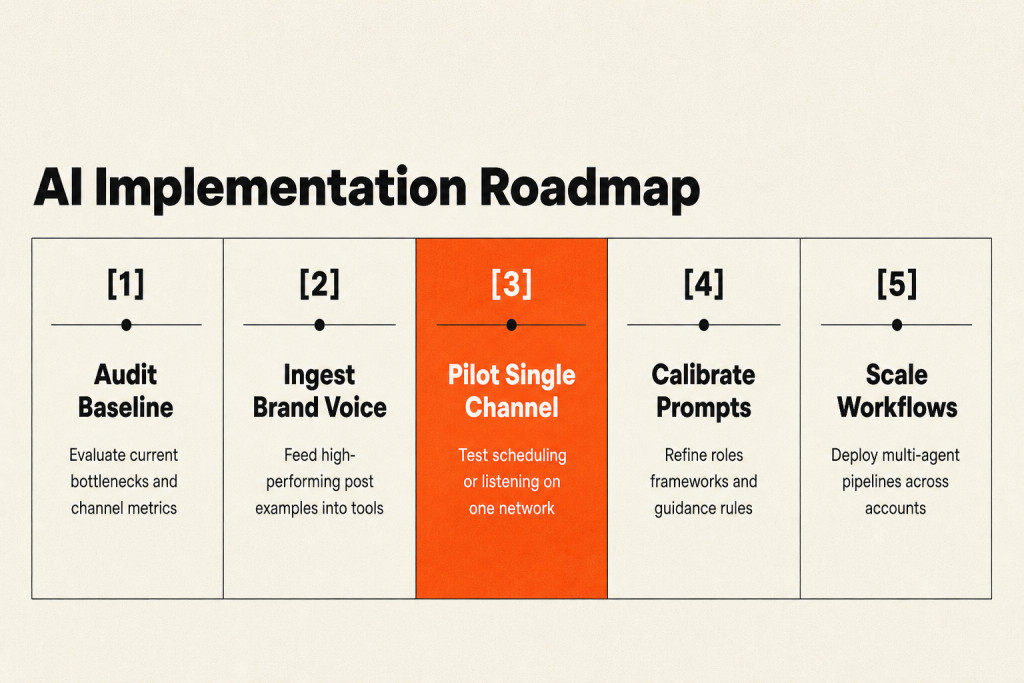
Baseline Performance Auditing
Establish a baseline by examining current social performance, identifying resonant content, seeing where each platform performs, and locating team bottlenecks.
Your baseline review should cover these areas:
- Analyze your existing social media performance. Which platforms are working? What content resonates? Where are the bottlenecks? This baseline helps measure AI impact.
- Before implementing agents, audit your social media data, brand guidelines, and content history.
- Data quality determines AI performance.
- While you may be excited about AI’s potential for your social media strategy, take a step back and assess your current social media plans.
Before you buy tools, get clear on:
- How much time you can actively invest on this channel
- Your potential budget for AI tools
- The tasks that stand out to you as the most worthwhile/relevant for utilizing generative AI
Brand Voice Ingestion
Give AI real examples and brand context so its output fits your company. Generic content is the default.
- Provide the AI with examples of your best-performing content.
- Without proper context, AI-generated content feels generic.
Single-Channel Pilot Testing
Begin with AI on one platform or one content type: generate a week’s worth of posts, review and edit them, then publish.
For a controlled pilot, create a week’s posts for one platform or content type, edit and publish them, then evaluate the use case with a small team before expanding.
Start with post scheduling or social listening. Each has a focused, clearly bounded purpose and an obvious success metric.
Scheduling agents need your posting history to learn timing. Listening agents only need a keyword list.
Prompt Engineering Calibration
Give prompts a clear role and a framework such as AIDA, using several examples so AI delivers consistent output.
- The role it needs to play, such as copywriter
- A clear framework to use, such as AIDA
- A series of examples to use for inspiration
Enterprise Workflow Scaling
Expansion: As confidence grows, extend AI usage to more platforms and content types. Partnering with a Social Media Marketing Agency can accelerate multi-brand scalability.
Use analytics to spot what works best, then keep tuning your AI prompts and settings.
Specialized agents: Multi-agent orchestration is emerging for complex workflows. Separate agents can create content and handle distribution, while another tracks engagement.
Specialized agentic networks will manage content production and community moderation while reallocating paid ads under centralized human guidance.
Broader objectives: These agent teams coordinate automatically to pursue broader marketing objectives.
Benefits of Social Media Marketing AI
In 2025, businesses chasing efficiency and better results are driving the AI social media market’s projected growth from $2.69 billion to an expected $11.37 billion by 2031.
Publishing Regularity
AI lets teams produce content more efficiently and keep their publishing schedule regular.
Creative Brainstorming
New perspectives: AI brings campaign ideas and creative prompts that give teams fresh angles and keep content engaging.
Fundamentals of AI in Social Media Marketing
Regular social output can now draw on fresh campaign ideas, with machine learning, natural language processing, and computer vision working together to grasp your brand, audience, and goals. That’s the foundation.
Core Underlying Technologies
AI social media marketing brings together content generation, conversation analysis, visual recognition, prediction, and live account data, giving you a crowded toolbox.
- By analyzing patterns, language, trends, and user behavior, AI generates marketing content faster than traditional manual workflows.
- For high-resource language pairs, modern translation AI reaches 85-95% accuracy when paired with human review in hybrid workflows.
- Using natural language processing, AI agents process millions of conversations in real-time, understand context, detect sentiment, and flag emerging issues before escalation.
- Manual design work can be reduced with AI-powered image and video generation tools that create visually appealing graphics and videos.
- Image and video recognition technologies make it possible to automatically tag, categorise, and analyse visual content shared on social media platforms.
- Audience sentiment and product placements can be evaluated through facial expression and image recognition.
- By combining multiple modeling approaches through ensemble architectures, predictive analytics reaches 85% accuracy.
- Model context protocol (MCP) serves as the connector framework that makes this possible.
- Through MCP, AI tools like ChatGPT can securely access external platforms and work with live account data, letting you manage workflows and insights without leaving the chat.
Native Social Platform Algorithms
Algorithms now steer daily media use across social platforms, and the same systems steer social marketing. The platforms have already taken that job.
- Because social media has become an integral component of everyday life, social media marketing has also become an integral component of any successful marketing campaign.
- The way we consume social media is being shaped by artificial intelligence, which is more than a buzzword on these platforms.
- Discovery has been redefined by TikTok’s For You Page (FYP).
- On TikTok, AI personalizes the FYP, recommends captions and hashtags, and enables AI influencers.
- On Instagram, AI optimizes the Explore page, detects fake accounts, and enhances filters and augmented reality effects.
- On Facebook, AI enhances content moderation, ad targeting, and chatbot-powered messaging.
- On X, AI powers tweet recommendations, bot detection, and AI-generated replies.
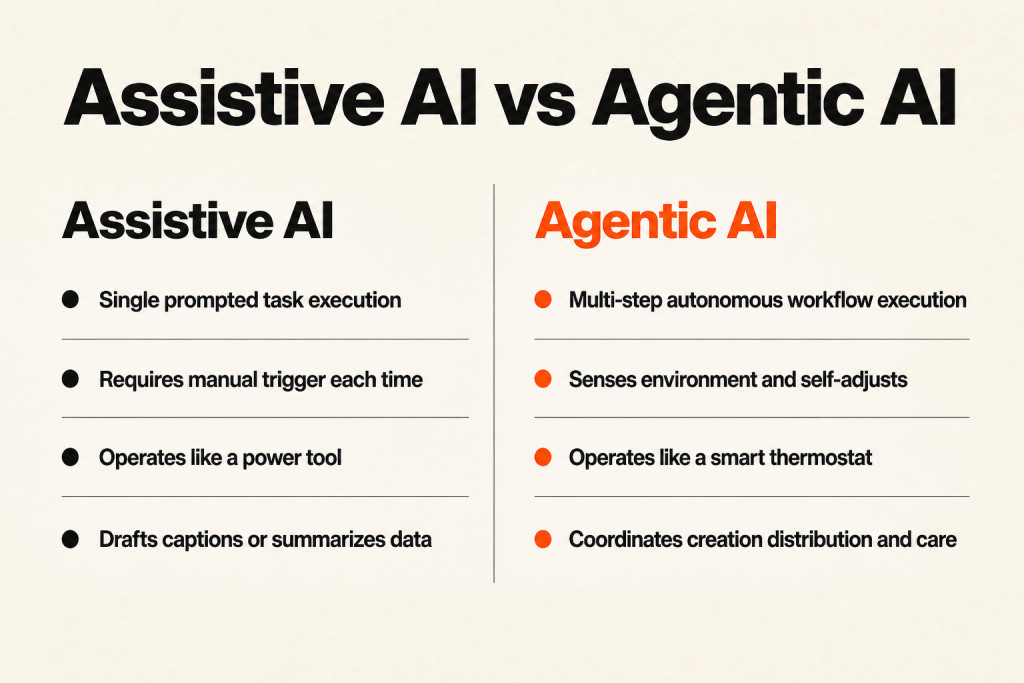
Assistive AI Systems
Assistive AI helps one user finish one defined task, whether that means drafting a caption, generating a report, or suggesting a response. It handles one task at a time.
When assistive tools run, a user prompt starts every action, so a person has to initiate each one.
Basic automation follows rigid if-then rules. AI agents, by contrast, draw on large language models and machine learning to read context, choose actions, and change course based on results. The prompt still starts the process.
Agentic AI Systems
Agentic AI executes multi-step workflows autonomously across content creation, publishing, listening, and care. The agents that succeed will augment human creativity and judgment rather than replace it. Assistive tools run only when you press the trigger, like a power drill. Agentic systems instead sense environmental shifts and adjust their settings on their own, like a programmable thermostat.
Operational Challenges
Barriers to full use:
Privacy, integration, accuracy, and authenticity can all get in the way as AI becomes standard across marketing teams, blocking full use.
Underused AI:
Ignore those roadblocks, and AI stays underused while the team sits still.
Audience Data Privacy
Agents must follow data privacy regulations, platform policies, and industry standards.
AI use should stay transparent, with proper access controls and audit trails set up for agent actions.
Personalisation and privacy remain a live tension, and balancing them will stay a key challenge in the future.
Technology Stack Integration
An AI-powered social marketing setup ties insight, execution, and performance together by bringing all those social media marketing tools into one place.
Generative Hallucinations
Before publishing, fact-check all AI-generated content because AI-generated responses can miss the point of the customer’s original social media posts.

Diminished Brand Authenticity
Human authenticity:
People still belong at the heart of social marketing teams.
Consumers may favor brands they see as more authentic when people vanish from the process or the brand keeps its AI use opaque.
AI brings clear benefits, yet consumers still expect openness about its use. The figure is blunt: 90% want brands to say if AI has been used in their marketing.
Virtual influencers scale easily and adapt instantly as campaigns change, with no missed posts. They still can’t fully reproduce human authenticity, which comes from lived experience and personal stories that let audiences trust and connect with real creators.
Use the test for authentic messaging: ask whether a direct rival could replace your logo on the post and nobody would notice.
Frequently Asked Questions
What is the difference between assistive AI and agentic AI in social media marketing?
Agentic AI is autonomous software that takes in data, works through complex situations, and chooses purposeful actions aimed at specific goals. That’s agentic AI.
Assistive AI
Agentic AI
What is AI social media marketing?
AI social media marketing uses artificial intelligence technologies to automate, sharpen, and improve how businesses manage their social media presence. That’s the working definition.
AI relies on machine learning, natural language processing, and computer vision to understand your brand, audience, and goals.
Can AI write social media posts?
It can produce social media posts by drafting captions, suggesting ideas, adding hashtags, and mapping out full content calendars.
That covers text posts, captions, hashtags, images, and video scripts, giving AI plenty of social media content to create.
Most businesses still check and tailor that output before anything goes live, so humans remain in the loop. Business review before publishing remains part of that process.
Can AI create images for social media?
Yes, plenty of AI tools can make original images, graphics, and creative concepts that support written content. The image still needs a brief.
How does AI improve social media marketing performance?
AI can test content variations, lift engagement rates, keep posting consistent, and make social media analytics more accurate.
- Businesses using AI social media tools report an average of 38% increase in engagement rates and 52% improvement in posting consistency.
- AI agents continuously test different variations of social media content to identify what performs best.
- Research shows AI improves social media analytics accuracy by 60% compared to traditional methods.
Those tasks tie content testing and measurement to the numbers marketers watch, including a 60% accuracy improvement.
Is AI good for small businesses?
Yes, AI can be especially useful for small businesses with tight resources because it supports marketing consistency and operational efficiency. Those limits are familiar.
When time and resources are scarce, small businesses often struggle with efficiency and consistency; AI can help with both constraints.
How much do AI social media tools cost?
Costs for AI social media tools vary widely, and the tool itself sets the price.
Can AI replace human creativity in social media marketing?
Human creativity still needs human insight and brand personality. AI can support creativity through ideas and repetitive tasks, but human insight and brand personality remain essential.
AI hasn’t lived a human life or built personal emotional stories, so it can’t bring everything human creativity adds to social media marketing.
It’s good at lighter jobs, such as short Q&A replies and brainstorming ideas. Keep those jobs in its lane.
Does AI replace social media managers?
Social media managers still have an essential role. AI can take repetitive work off social media managers’ plates, leaving more room for strategy, creativity, and engagement.
Treat AI as a productivity assistant for social media managers. Its job is to make their work easier, not replace them.
Can AI agents run social media without human oversight?
Full autonomy is inadvisable, so social media agents need explicit operational boundaries and human supervision.
Automation without monitoring can hurt an organization’s brand reputation and trigger algorithmic errors, so human supervision is mandatory.
Customers should know when they’re speaking with AI agents instead of people. Tell them who’s answering.
Do you need to write code to build a social media AI agent?
Code is not required. No-code platforms enable teams to create and launch agents without development resources, so code is optional here.
The real prerequisite is documentation, not technical skill: agents need clean social data, written brand guidelines, and content history they can draw on.
What goes wrong most often when teams adopt these agents?
Poor data puts a ceiling on agent quality because the agent only knows the brand guidelines and content history it reads. An unaudited data set can make weak output look like a model problem.
Too much scope too early causes another common failure: teams try full automation immediately instead of proving one use case. Start with one use case first.
Key Takeaways
But once you’ve proven one use case, the next question is how you run AI across content production and customer conversations, one use case at a time. Here’s what it can do.
- AI-powered social listening turns conversations into clear insights that brands can act on, helping them anticipate trends instead of reacting to them.
- When social media aligns with your audience’s priorities, it becomes an important part of decision-making rather than a purely reactive channel.
- UGC-based ads have been shown to drive a 4x higher CTR than traditional brand ads.
- Testimonials can increase CTR by 20%.
- Personalization, as these results show, goes beyond targeting the right audience; it means delivering credible, relevant content that builds trust and drives action.
- Create sentiment dashboards so agents show trends over time, segment sentiment by product or topic, and alert you when sentiment drops below defined thresholds.
The working rule is simple: automate the tasks that repeat and link the workflow from start to finish, with brand context plus human review at the moments that shape trust. Match automation to the job, and check the output before customers see it. AI social media marketing can surface insights and help produce content while tracking sentiment. People still supply the context and make the final call. That keeps the system useful while the brand-bearing decisions stay with people.