Are you spending more on ads but seeing little improvement in conversions? High impressions. Decent clicks. Rising CPC. But performance feels unstable. In many cases, the issue isn’t your product, your creative, or even your bidding strategy. It’s your ad group structure.
In today’s AI-driven advertising ecosystem, ad group targeting is no longer just about organizing keywords. It’s about structuring intent signals clearly so algorithms can learn faster and users can find exactly what they’re looking for.
This guide will explain what ad group targeting is, why it matters in 2026, and how to structure your campaigns for better performance.
What Is Ad Group Targeting?
Ad group targeting is the practice of organizing keywords or audience signals inside a campaign into tightly focused intent clusters. Each ad group should contain closely related keywords (or audience segments), ad copy that reflects that specific intent, and a landing page that directly fulfills it. Instead of placing dozens of loosely related keywords in one group, you separate them based on what the user actually wants.
Simple Example
Imagine you run a robotics and coding school.
| Poor structure | Proper ad group targeting |
One ad group contains:
One generic ad: One general landing page. Result:
|
Ad Group 1 – Coding Classes
Ad Group 2 – Holiday Camp
Same budget. Clearer intent. Better performance. |
Ad group targeting ultimately aligns search intent → ad message → landing page → conversion. That alignment is what drives efficiency.
Why Is Ad Group Targeting Important?
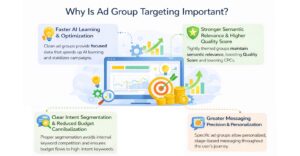
Ad group structure directly affects how much you pay, how fast algorithms learn, and whether your budget scales profitably. Here are four strategic reasons why it matters.
Faster AI Learning & Optimization
First, it improves AI learning efficiency. Platforms like Google Ads rely heavily on Smart Bidding and machine learning systems. Machine learning depends on clean data input. When ad groups mix different intents, they generate signal noise — conflicting behaviors, inconsistent conversion patterns, and fragmented audience data. By grouping keywords by consistent intent (signal consolidation), you provide focused data that improves algorithmic efficiency and stabilizes campaigns more quickly. Clean structure helps AI learn who converts and who doesn’t.
Stronger Semantic Relevance & Higher Quality Score
Second, ad group targeting increases semantic relevance and protects Quality Score. Advertising is no longer simple keyword matching; it is contextual matching. Platforms evaluate alignment between keyword, ad copy, and landing page. If this alignment breaks, Quality Score drops, CPC rises, and ad rank weakens. A tightly themed ad group maintains contextual alignment and improves semantic relevance, lowering cost through better structure rather than higher bids
Clear Intent Segmentation & Reduced Budget Cannibalization
Third, it prevents overlap in intent and budget cannibalization. Without clear segmentation, keywords within the same account may compete with each other. For example, “coding class Singapore” and “kids coding course Singapore” can overlap in auctions if not properly structured. This internal competition splits data and fragments the budget. Clear ad group segmentation isolates high-intent clusters and ensures spend flows toward keywords that generate conversions rather than just clicks.
Greater Messaging Precision & Personalization
Finally, ad group targeting enables hyper-personalized messaging. A research query like “what is robotics for kids” requires a different message than “robotics class Singapore price.” Proper ad group targeting allows you to map messaging according to funnel stages — TOFU (education), MOFU (consideration), and BOFU (decision). This improves not only CTR but also Conversion Rate Optimization (CRO), because the message matches the user’s exact stage in the journey.
Best Practices for Effective Ad Group Targeting
Having the right theory is not enough. Execution is where performance is won or lost. Below are the practical best practices we apply when structuring high-performing ad accounts — along with real-world examples to illustrate the difference.
1. Focus on Intent-Based Grouping
Always structure ad groups around one clear user intent. Do not group keywords just because they are related to a topic. Group them because they represent the same stage in the decision process.
For example, if you run a digital marketing agency:
Poor grouping:
- “what is Advertising”
- “how Advertising works
- “Advertising agency Singapore”
- “Advertising services pricing”
These represent different levels of intent.
Proper intent-based grouping:
| Keyword | Ad copy | Goal | |
| Ad Group 1 Informational (TOFU) |
|
“Learn How Advertising Works & Why It Matters for Your Business | Lead magnet / guide download |
| Ad Group 2 Commercial (BOFU) |
|
“Top Advertising Agency in Singapore | Get a Free Strategy Call” | Consultation booking |
When intent is clean, conversion logic becomes predictable.
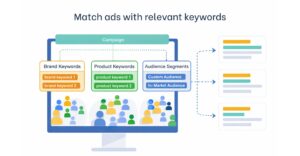
2. Match Ads With Relevant Keywords or Audience Signals
Every ad must clearly reflect the intent of its ad group. If someone searches “robotics class Singapore price,” an ad that highlights transparent pricing and trial availability will outperform a generic branding message. Specificity reduces cognitive friction and increases expected CTR. The same principle applies to audience targeting — if targeting parents of children aged 6–12, the ad should explicitly reference that age group and benefit.
3. Continuously Monitor & Adjust Based on Data
Ad group structure evolves with performance data. Regularly analyze conversion rates, CPC discrepancies, search term reports, and impression share overlap. If one group shows significantly lower conversion rates and higher CPA, it may indicate mixed intent within that group. Breaking it into smaller clusters and adding negative keywords often improves performance stability
Example:
| Ad Group A (High Intent) | Ad Group B (Mixed Intent) |
|
|
This signals structural dilution.
Action steps:
- Break Ad Group B into smaller intent clusters
- Add negative keywords to isolate overlap
- Adjust bids to prioritize high-converting groups
Optimization becomes surgical when the structure is clear.
4. Align Each Ad Group With a Dedicated Landing Page
Sending multiple intent clusters to one generic page weakens relevance. If a “Holiday Coding Camp” keyword directs users to a general “All Programs” page, conversion friction increases. A dedicated landing page with a clear schedule, pricing, testimonials, and CTA maintains intent integrity from query to conversion.
Practical Audit Checklist
To ensure your ad group targeting is built for performance, ask:
- Does each ad group represent one clear intent?
- Are ads explicitly reflecting that intent?
- Does each group send traffic to a matching landing page?
- Are high-intent keywords isolated from research keywords?
- Are CPCs inflated due to weak relevance?
This checklist is typically part of our structured SEO audits & Ads audits at Golden Owl Digital, where we ensure ad groups are engineered for actual business growth.
Common Mistakes in Ad Group Targeting
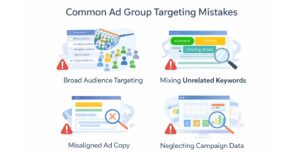
Even experienced advertisers can make structural mistakes when building ad groups. These errors don’t just affect relevance; they directly impact CPC, Quality Score, and overall ROI. Below are the most common pitfalls and how to avoid them.
1. Overly Broad Audience or Keyword Targeting
When one ad group targets keywords that reflect very different levels of intent, the algorithm receives mixed signals and struggles to optimize effectively.
For example, a coding academy placing “coding,” “programming,” “learn Python,” and “robotics class for kids” in the same ad group is combining generic research intent with high commercial intent. Someone searching “coding” could be a university student or hobbyist, while “robotics class for kids” signals a parent ready to enroll. Mixing them often leads to low conversion rates and higher CPC because the ad message cannot precisely match all intents.
The solution is simple: separate informational keywords from high-intent commercial ones, and use negative keywords to filter irrelevant audiences. Broad reach without segmentation almost always results in wasted spend.
2. Poor Keyword Strategy (No Negatives, Overuse of Broad Match)
Using broad match without a clear filtering strategy can inflate traffic without improving conversions.
For instance, targeting “robotics class” may trigger searches like “free robotics PDF,” “robotics jobs salary,” or “robotics university degree.” Without negative keywords, your ads pay for informational or job-seeking intent that has no enrollment potential. This leads to misleading CTR data and weak conversion performance.
Strong advertisers routinely review search term reports, add negative keywords proactively, and move high-performing queries into tightly themed ad groups. Effective targeting is about adding keywords and removing irrelevant ones.
3. Mixing Unrelated Themes in One Ad Group
One of the most damaging mistakes is grouping unrelated themes together, which dilutes semantic relevance and confuses machine learning signals.
Imagine an ad group containing “SEO agency UK,” “SEO audit tool,” “how to do SEO with a tight budget,” and “SEO course online.” These represent service intent, tool intent, learning intent, and training intent, which are completely different user goals. A single generic ad cannot speak clearly to all of them, resulting in a lower Quality Score and a higher CPC.
The fix is to split them into separate ad groups — such as SEO Services, SEO Tools, and SEO Training — each with tailored ad copy and landing pages. Clear thematic structure strengthens relevance and improves performance.
4. Not Aligning Ad Copy With Keyword Intent
Ad relevance is not just about keywords — it’s about message alignment. When ad copy ignores the specific wording or intent behind a search query, contextual relevance breaks down.
For example, if someone searches “robotics class Singapore price” and the ad simply says “Best Robotics Classes for Kids | Join Today,” the pricing and location intent are not directly addressed. The user is comparing costs, but the ad delivers generic branding. This mismatch often lowers CTR and conversion rates.
A better approach would mirror intent clearly, such as “Robotics Classes in Singapore | Affordable Pricing & Free Trial.” Specific alignment increases perceived relevance and drives stronger performance.
5. Ignoring Data & Letting Internal Competition Happen
Another overlooked issue is internal competition between ad groups targeting similar keywords. Without proper negative keyword exclusions, multiple ad groups can enter the same auction.
For example, one group targeting “coding class Singapore” and another targeting “coding classes for kids Singapore” may overlap if boundaries are unclear. This fragments budget, disrupts learning signals, and reduces overall efficiency.
To prevent this, define clear intent separation, apply cross-negative keywords where necessary, and monitor impression share overlap.
The Real Cost of These Mistakes
When ad group targeting is poorly structured:
- AI learns slower
- CPC increases
- Conversion rate drops
- Budget gets diluted
- Scaling becomes unstable
These issues compound. The longer the structure remains unclear, the harder it becomes for the algorithm to optimize efficiently. What seems like a small targeting problem can quietly erode profitability over time.
But when your ad group structure is intentional and strategically segmented, performance improves systematically. Machine learning becomes more accurate, costs stabilize, and scaling becomes predictable.
Ad group targeting mistakes are structural weaknesses in your advertising system, and structure is what ultimately determines whether campaigns plateau or scale.
Case Study: Optimizing Ad Group Targeting for The Lab Singapore
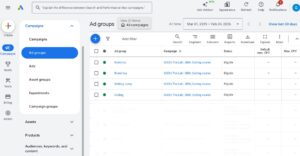
At Golden Owl Digital, we pay close attention to every small detail to maximize the effectiveness of advertising campaigns. For The Lab Singapore, instead of grouping all keywords into a single campaign, we separated them into distinct ad groups, each targeting a specific goal:
- Brand Keywords: Keywords related to the brand, such as “The Lab Singapore” and “The Lab Robotics,” were separated to create a campaign focused on lead generation for the brand.
- Classes Keywords: Keywords related to specific classes, such as “robotics class Singapore” and “coding class Singapore,” were grouped together and linked to the course information landing page.
- Holiday Program Keywords: Keywords for holiday programs, like “holiday robotics program,” were separated and directed to a landing page dedicated to holiday programs.
By doing this, each keyword group was optimized with a relevant landing page, helping to increase CTR by 67%, clicks by 75%, and improve conversion rates by 20%. We always focus on the small details to ensure the best results for our clients.
Q&A
What is ad group targeting in Google Ads?
Ad group targeting in Google Ads refers to setting specific keywords and audience criteria within an ad group so ads match a defined intent theme within a campaign.
How is ad group targeting different from campaign targeting?
Campaign targeting sets broader parameters such as location and budget, while ad group targeting refines keywords and audience signals for more precise control.
Why does ad group targeting matter for B2B advertising?
B2B buyers have longer sales cycles and niche intent signals. Structured ad groups improve message alignment and lead quality.
How many keywords should be in one ad group?
Typically, 5–20 tightly related keywords for search campaigns, depending on intent similarity and data volume.
Should I create single keyword ad groups (SKAGs) in 2026?
SKAGs are less common today due to smart bidding and close variant matching, but they may still work in high-value, low-volume B2B niches.
Can ad group targeting improve Quality Score?
Yes, tighter keyword grouping increases ad relevance and expected CTR, which can improve Quality Score over time.
Does ad group targeting affect conversion tracking?
Not directly, but clearer segmentation helps identify which intent clusters drive qualified conversions.
Is ad group targeting still relevant with AI-driven ads?
Yes. Even with automation, structured intent signals improve algorithm learning and reduce wasted spend.
Conclusion
Ad group targeting is a vital component of digital advertising that impacts both performance and budget efficiency across various platforms. By aligning ad groups with specific user intent, matching ads with relevant keywords or audience signals, and continuously optimizing based on performance data, you can ensure that your ads reach the right audience and drive valuable results. Regular audits and adjustments are necessary to keep campaigns effective and aligned with your goals.
By following these best practices and using the provided checklist, you can optimize your ad group structure to maximize the effectiveness of your campaigns across all digital advertising platforms, helping you achieve better results and improved ROI.
| 1 | https://goldenowl.digital/blog/15-top-seo-experts-in-the-world/ | 15+ Top SEO Experts in the World You Should Follow in 2025 – GO Digital |
| 2 | https://goldenowl.digital/blog/semrush-vs-ahrefs-vs-ubersuggest/ | SEMrush vs Ahrefs vs Ubersuggest: Feature-by-Feature Showdown |
| 3 | https://goldenowl.digital/blog/how-to-find-lsi-keywords/ | |
| 4 | https://goldenowl.digital/blog/how-to-optimise-for-search-intent/ | How to Optimise for Search Intent and Actually Reach Your Readers |
| 5 | https://goldenowl.digital/blog/why-local-seo-is-important-to-your-business/ | Why Local SEO Is Important to Your Business in 2025 and Beyond? |
| 6 | https://goldenowl.digital/blog/direct-traffic-vs-organic-search/ | Direct Traffic vs Organic Search : A Comparison Guide |

Jaden is an SEO Specialist at Golden Owl Digital. He helps brands rank higher with technical SEO and content that resonates