There are B2B teams losing revenue simply because they can’t see what’s happening inside AI search. In 2026, about 90% of B2B buyers use tools like ChatGPT or Perplexity during purchase research, yet most teams still rely on clicks and sessions to measure performance.
That gap creates confusion. You might be investing in content and GEO, but when leadership asks what it’s driving, the answer often feels unclear. To fix that, you need to understand how to measure the success of GEO campaigns without forcing it into outdated SEO models.
This guide breaks it down into a 6-step measurement framework, 3-layer KPI system, and 10+ practical metrics and tools you can start using immediately.
Why Measuring GEO Success Is So Difficult
The Shift to Zero-Click Search
A growing part of discovery now happens without users ever visiting your site. People ask AI tools, get structured answers, and move forward with a shortlist already forming in their mind.
Your brand can shape decisions before any measurable interaction takes place. This is why it often feels invisible in analytics even though it is already doing work.
If you only measure clicks, you are looking too late in the journey and missing the stage where decisions begin.
Dig deeper: Zero Click Search Seo Adaptation: How to Optimize and Adapt Your SEO Approach in 2025
GEO Can’t Be Measured Like SEO
Most SEO metrics were built around the idea that users click through search results to evaluate options. Rankings, impressions, and click-through rates all depend on that behavior.
AI-driven discovery does not follow that pattern. Instead of showing a list of links, AI systems select and summarize content directly into answers, often without sending traffic back to the source.
| Traditional SEO Metric | What Changes in GEO |
| Rankings | No fixed positions in AI answers |
| Traffic | Many interactions don’t generate visits |
| CTR | No results page to click from |
| Impressions | Visibility happens inside answers |
Because of this shift, many teams assume GEO is not working when in reality, they are simply measuring the wrong signals.
The ROI Question Behind GEO
At a leadership level, the question is straightforward. Does this contribute to pipeline and revenue?
The difficulty is that GEO does not follow a clean or immediate attribution path. A potential buyer might see your brand in an AI-generated answer, remember it, come back later through branded search, and convert through another channel days or even weeks later.
If you expect a direct line from AI exposure to conversion, GEO will always appear underwhelming. In practice, it behaves more like early-stage influence, and that influence tends to show up later in the funnel through signals such as branded search, direct traffic, and higher-quality leads.
Read more: AEO vs SEO: How Does AEO Differ from Traditional SEO?
What Does Generative Engine Optimization Success Actually Mean?
GEO success means your brand is consistently surfaced, trusted, and reused in AI-generated answers, and that influence translates into real business signals over time. Instead of focusing only on traffic or rankings, GEO success reflects how well your content shapes early-stage decisions and drives demand before users ever visit your site.
The 3 Layers of GEO Success
GEO performance becomes much easier to interpret when you separate it into three layers instead of trying to measure everything at once.
| Layer | What it means | What to track |
| Visibility | Appearing in AI answers | Mentions, citations |
| Influence | Shaping how your brand is seen | Context, sentiment |
| Conversion | Driving business outcomes | Branded search, pipeline |
Each layer builds on the previous one, because if your brand isn’t showing up in AI answers, it won’t shape perception, and that usually leads to inconsistent or hard-to-explain conversions.
From Ranking to Being Cited
Search used to favor higher positions, but AI systems now prioritize content that clearly answers the question and is easy to extract and reuse.
That shift changes what success looks like. Instead of focusing only on visibility in search results, the goal becomes getting your content selected, summarized, and consistently referenced in answers. Over time, this leads to stronger association between your brand and specific topics.
We have seen smaller companies outperform larger competitors in this area, simply because their content is more structured and easier for AI systems to interpret.
The New GEO Funnel
The buyer journey has not disappeared, but the starting point has moved earlier into AI-driven discovery.
In many cases, a user begins by asking an AI tool a question, sees your brand mentioned in the response, and forms an initial impression. That impression carries forward. And when they are ready to evaluate options more seriously, they search for your brand directly or revisit it through another channel.
If you’re also rethinking how to define success beyond traffic, it’s worth looking at How to Actually Set a Realistic SEO Goal: A Practical Guide in 2026, especially if your current targets still rely on outdated metrics.
What Should You Measure in a GEO Campaign?
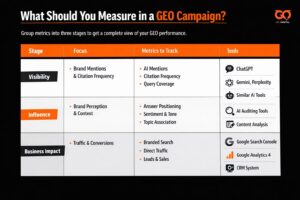
Once you move past theory, GEO measurement becomes digestible if you group metrics into three stages: visibility, influence, and business impact. Each stage answers a different question, so you’re not forcing everything into one number.
Visibility metrics
At this stage, you’re checking whether your brand appears in AI answers for relevant queries.
Focus on:
- Brand mentions across key prompts
- Citation frequency (how often your content is used)
- Query coverage across your category
- Presence across platforms like ChatGPT, Gemini, Perplexity
Example:
If you track 50 prompts like “best CRM for SaaS” or “how to scale B2B marketing,” and your brand appears in 12 of them this month vs 5 last month, that’s real GEO progress.
Influence metrics
Once you show up, the next step is understanding how your brand is positioned.
Look at:
- Whether you appear early or late in the answer
- How clearly your product or service is described
- Whether your brand is associated with the right topic
- Tone and context of the mention
Example:
Being listed as “one option among many” vs being described as “a strong choice for B2B SaaS SEO” leads to very different recall, even if both count as a mention.
Business impact metrics
This is where GEO connects to revenue, even without perfect attribution.
Track:
- Branded search growth (Google Search Console)
- Direct traffic trends (GA4)
- Assisted conversions (multi-touch paths in CRM)
- Lead quality (shorter sales cycles, more informed prospects)
Example:
Thanks to our GEO-integrated SEO Campaign, one of our clients saw branded search increase by ~30% over 3 months without increasing ad spend. The only major change was GEO-focused content, which started appearing in AI answers.
Read more: How Do You Predict SEO Results Effectively? Tools and Tricks Every Marketer Should Know
How to Measure the Success of Your GEO Campaign: Step-by-Step Guide
This is the exact workflow we use with clients. It’s practical, repeatable, and built around how AI discovery actually works.
Step 1: Build Your Conversational Prompt List
Everything starts here. If your inputs are weak, every metric after this becomes unreliable.
In GEO, keywords are no longer the core unit. Intent-based prompts are. You need a list of 30 to 100 prompts that reflect how your buyers actually talk to AI tools.
Start with a simple spreadsheet with three columns:
- Funnel stage
- Prompt
- Desired brand narrative
Then build it using real data. Go into Gong or Chorus recordings, support tickets, and sales conversations, and look for patterns in how people ask questions.
You’re specifically looking for phrases like “How do I…” or “What’s the difference between…”.
Once you have raw inputs, convert them into natural prompts. For example, “B2B lead gen software” becomes “I’m a Head of Growth at a Series B SaaS. What are the most cost-effective ways to scale lead gen in 2026?”
From there, structure your list:
- 20% problem-aware
- 50% solution-aware
- 30% comparison queries
This balance matters. Too many top-of-funnel prompts and you won’t see conversion signals. Too many bottom-of-funnel prompts and you’ll miss early influence.
A quick shortcut we often use is pulling queries from Google Search Console using a regex filter like:
^who | ^what | ^where | ^when | ^why | ^how
These are usually very close to how users phrase AI prompts.
Find out more: Conversational Intent Mapping: A Guide to AI SEO 2026
Step 2: Establish Your Baseline Visibility Score (Share of Model)
Once your prompt list is ready, you need to understand where you stand today. This is your baseline.
Run your prompts across:
- ChatGPT (4o or similar)
- Perplexity
- Gemini
For every prompt, track three things:
- Mention (Yes/No): Did the AI mention your brand?
- Citation (Yes/No): Did it link to your website?
- Sentiment score from 1 to 5, how favorable was the mention? (1 = neutral mention, 5 = strong recommendation)
From this, calculate your Share of Model (SoM).If you appear in 10 out of 100 prompts, your SoM is 10%.
This number becomes your core visibility metric. In our SEO audits, most brands start lower than expected, which is normal. The value here is not the number itself, but having a clear baseline to improve from.
Step 3: Benchmark Competitors and Run a Gap Analysis
Tracking yourself in isolation is a common mistake. You need to understand who is showing up instead of you, and why.
Add 2 to 3 competitors into the same tracking sheet and repeat the process across all prompts. Focus on prompts where competitors appear and you don’t.
Then go deeper by analyzing the sources AI is pulling from. They can be blog articles, product pages, LinkedIn posts, Reddit threads or third-party mentions.
You’re looking for the “authority source” behind those answers.
In many cases, patterns show up quickly. Competitors that appear consistently often have content that is easier for AI to extract, such as:
- Clear comparison tables
- Structured bullet points
- Direct, explicit positioning
For example, if a competitor dominates prompts like “Best [your category] software,” their page is usually highly structured and written in a way that AI can easily reuse.
This step turns GEO from guesswork into something actionable. You can see exactly what is being rewarded and where you need to close the gap.
Step 4: Connect GEO Visibility to Real Business Signals
This is where GEO starts to make sense to leadership.
Because AI platforms are essentially walled gardens, you won’t see clean referral data like “Source: ChatGPT” in most analytics tools. Instead, you need to track downstream signals that indicate growing demand.
Set up a simple “GEO impact” view in your analytics stack and focus on three metrics:
- Branded search lift: Is there an increase in people searching for “[Brand Name] + [Feature]”? This often happens after an AI recommends you.
- Direct traffic spikes, where users type your URL directly
- Lead source signals, using a free-text field like “How did you hear about us?”
Over time, you’ll start to see patterns. Users will mention things like “found you via ChatGPT” or “AI recommended your tool”.
Step 5: Build Your GEO Command Center
At this stage, your data is spread across tools. You need to consolidate it into one place so it’s usable.
A simple setup in Notion or Looker Studio is enough, as long as it includes three core views:
- A Share of Voice chart showing your mentions vs competitors across your prompt list
- A citation trend line showing how often AI links back to your site over time
- A message accuracy tracker that logs how your brand is being described
That last one matters more than most teams expect. If AI consistently mislabels your product, for example calling you an SMB tool when you sell to enterprise, that’s a positioning issue that will affect conversions later.
Step 6: Build the Optimize and Feed Loop
On a monthly cycle, review your weakest prompts and act based on what you see. Here are three practical scenarios that we usually see:
Scenario 1: If you’re mentioned but not cited, your content is likely too high-level. Add deeper insights, data, or original points that require attribution
Scenario 2: If you’re not mentioned at all, check structure and clarity. Your content should directly match the prompts you’re tracking, with clear headings and explicit explanations
Scenario 3: If a competitor is consistently the top recommendation, create structured comparison content that clearly positions your strengths
This becomes a continuous loop:
- Track prompts
- Identify gaps
- Improve content
- Re-track performance
Over time, this is where compounding happens.
It’s probably not as complex as you think it is, but it does require discipline. GEO rewards consistency more than one-time optimization.

What Tools Should You Use for Tracking GEO Performance?
There’s no single tool that does everything yet. Most teams combine 3–4 simple layers depending on maturity.
1. Prompt tracking
Start simple. Use a spreadsheet and track 30–100 prompts weekly.
Example setup:
- Column A: Prompt (“best SEO agency for SaaS”)
- Column B: ChatGPT result
- Column C: Whether your brand appears
- Column D: Position (early / mid / late)
It’s manual, but this is still the most reliable way to understand real visibility.
2. Dedicated GEO tools
These tools are built specifically to track AI visibility across platforms.
Examples:
- Goodie AI → tracks brand presence across ChatGPT, Gemini, Perplexity and gives optimization insights
- Otterly AI → simple dashboard showing when and how your brand appears in AI answers
- Peec AI → tracks citations, sentiment, and competitor share of voice
- GenRankEngine → provides “AI visibility score” and shows where competitors are being recommended instead of you
These tools help you scale tracking, but most still rely on sampled prompts, so treat them as directional, not absolute truth.
3. SEO tools (for content foundation)
Traditional tools still matter, just in a different role.
Examples:
- Semrush / Ahrefs → keyword research and topic discovery
- Clearscope / MarketMuse → structure and optimize content for better AI retrieval
They don’t track AI visibility directly, but they help you create content that gets picked up in the first place.
For more effective SEO tools, check out our guide for Best Programmatic SEO Tools to Scale Your SEO.
4. Analytics + CRM (for business impact)
This is where GEO connects to revenue.
Use:
- Google Search Console → branded search trends
- GA4 → direct traffic and returning users
- HubSpot / Salesforce → assisted conversions and lead quality
What you’re looking for is correlation. If GEO visibility increases and these signals move with it, that’s your business impact.
Read more: What Is the Best SEO Tool for Small Businesses? Top 11 tools of 2026
How to Report GEO Performance to Leadership and Prove ROI
Leadership doesn’t need every metric. They need a clear story that connects activity to business impact.
A simple way to report GEO is to structure it in three layers:
- Visibility: “We now appear in 35% of tracked AI prompts, up from 10% last quarter.”
- Influence: “Our brand is consistently positioned as a top solution in high-intent queries.”
- Business signals: “Branded search increased by 22% and direct traffic is trending up.”
That’s usually enough to show progress without overcomplicating things.
What works well in practice:
- Show trend over time, not snapshots
- Compare against competitors where possible
- Tie GEO signals to existing KPIs leadership already trusts
If you need a simple way to explain it in a room full of non-marketers:
“GEO helps us get discovered earlier. That shows up later as more people search for us and convert through familiar channels.”
How Long Will You See GEO Results? A Realistic Timeline
GEO is not immediate, and this is where expectations can make or break the initiative.
Most campaigns follow a pattern that looks like this:
- Month 1–2: Content gets indexed and starts appearing in a small number of AI answers
- Month 3–4: Visibility improves across more prompts, and mentions become more consistent
- Month 5–6: Early business signals appear, usually through branded search and direct traffic
This varies by industry and authority, but the sequence tends to hold.
Keep this in mind: GEO behaves more like SEO than paid ads. It builds gradually, but once it starts working, the gains tend to stack.
Common GEO Measurement Mistakes That Kill ROI
Most GEO campaigns don’t fail because of execution. They fail because of how performance is interpreted.
Here are the mistakes we see most often:
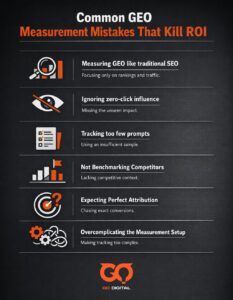
Measuring GEO like traditional SEO
Relying only on rankings and traffic gives you an incomplete picture. GEO influence often happens before any click, so those metrics alone will underreport impact.
Ignoring zero-click influence
If you only value what shows up in analytics, you miss the stage where buyers form opinions. That’s where GEO does most of its work.
Tracking too few prompts
A small sample leads to misleading conclusions. If you only track 5–10 queries, visibility will look inconsistent even if overall presence is improving.
Not benchmarking competitors
Without context, it’s hard to know if you’re actually gaining ground. Many teams assume they’re doing fine until they see how often competitors appear in the same prompts.
Expecting perfect attribution
GEO doesn’t produce clean, last-click conversions. Trying to force it into that model usually leads to undervaluing it and cutting investment too early.
Overcomplicating the measurement setup
We’ve seen teams spend weeks building dashboards before tracking anything meaningful. In most cases, a simple prompt tracker and a few core metrics are enough to get started.
Advanced Tips for Measuring GEO in 2026
Track cross-platform consistency
It’s not enough to show up in one AI tool. Strong GEO performance tends to show up consistently across ChatGPT, Gemini, and Perplexity.
If your brand appears across multiple platforms for the same queries, that’s a strong signal your content is being recognized as reliable. If it only appears in one place, there’s usually a gap in how your content is structured or distributed.
Measure share of voice, not just presence
Being mentioned is one thing. Being mentioned more often than competitors is what drives impact.
Instead of asking “Do we show up?”, shift to “How often do we show up compared to others?”
This is where competitive tracking becomes valuable. Over time, your goal is to increase your share of voice across your most important prompts.
Use GEO insights to guide content decisions
Your prompt tracking data is more than a reporting tool. It’s a content roadmap.
If you consistently don’t appear in certain queries, that usually points to a gap in your content. If you appear but aren’t positioned well, it often means your messaging isn’t clear enough.
Many of our clients see faster results once they start feeding these insights back into content creation instead of treating GEO as a separate activity.
Build a simple feedback loop
The teams that get the most out of GEO follow a simple cycle:
- Track visibility across prompts
- Identify gaps or weak positioning
- Update or create content
- Re-track and compare
It sounds basic, but it works. GEO improves through iteration, not one-time optimization.
Combine first-party data with GEO signals
Over time, your own data becomes more valuable than any tool.
Look at how GEO visibility aligns with:
- Branded search growth
- Sales conversations (“How did you hear about us?”)
- Lead quality and conversion rates
When these signals move together, you start to build a much clearer picture of GEO’s real impact.
Conclusion
If there’s one shift to make, it’s this: measuring GEO is about tracking influence before it shows up as traffic.
Once you stop forcing GEO into traditional SEO metrics, the picture becomes clearer. Visibility leads to perception, perception shapes demand, and that demand shows up later in branded search, direct traffic, and conversions.
That’s how to measure the success of generative engine optimization campaigns in a way that actually reflects how buyers behave in 2026.
Need Help Measuring Your GEO Performance?
Most teams don’t struggle with effort. They struggle with clarity.
That’s usually where we come in. At Golden Owl Digital (GODI), our role is often to help teams see what’s actually working, what’s being missed, and where GEO fits into the bigger growth strategy.
In many cases, it starts with a simple audit:
- Are you showing up in the right AI queries?
- How are you positioned compared to competitors?
- Which signals are already pointing to impact?
From there, it becomes much easier to decide what to scale and what to fix.
Contact us today for a free SEO Audit to grow your business.
FAQs
Can GEO performance be measured accurately today?
Not perfectly, but it can be measured directionally with enough confidence to guide decisions. The goal is clarity, not precision.
How is GEO different from SEO in measurement?
SEO focuses on rankings and traffic, while GEO focuses on visibility in AI answers and how that influences demand before users visit your site.
What is the most important KPI for GEO?
There isn’t a single KPI. Visibility, share of voice, and branded search together give a more complete picture.
How many prompts should I track?
Most teams start with 30 to 100 high-intent queries. Too few prompts can lead to misleading conclusions.
Do I need special tools to measure GEO?
Not necessarily. A spreadsheet, prompt tracking, and analytics tools like GA4 and Search Console are enough to get started.
How do I prove GEO ROI to leadership?
Focus on trends. Show how increased visibility aligns with branded search, direct traffic, and pipeline signals over time.
Is GEO only relevant for large companies?
No. In many cases, smaller brands can compete effectively by producing clearer, more structured content that AI systems can easily use.
Should GEO replace SEO?
No. GEO builds on top of SEO. Strong SEO foundations make it easier for your content to be picked up by AI systems.