Despite 84% of businesses investing in paid search, 65% report declining performance—rising costs and falling conversion rates make it harder than ever to prove ROI, even when campaigns continue to generate clicks.
From our experience working with paid search campaigns, this challenge rarely comes from budget alone. In most cases, gaps in strategy, structure, and execution prevent campaigns from converting effectively. When these key elements are misaligned, performance quickly plateaus.
In this guide, we break down how paid search works, why campaigns fail to convert, and what to fix to improve performance and ROI.
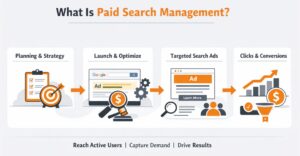
What Is Paid Search Management?
Paid search management is the process of planning, launching, and optimizing search advertising campaigns on search engines like Google Ads. The goal is to connect your business with users who are actively searching for a solution.
This channel focuses on capturing existing demand. Users already have a need and are ready to take action, which makes paid search one of the most conversion-driven marketing channels.
A strong strategy gives you control over budget, visibility, and performance while allowing continuous improvement based on real data.
How Paid Search Works (Keywords, Bidding, Auction)
Paid search operates through a real-time auction that happens every time a user enters a query. Advertisers compete to show their ads based on keyword targeting and overall campaign quality.
Three main factors determine ad placement:
- Bid amount
- Ad relevance
- Quality Score
Quality Score reflects the overall user experience, including expected click-through rate, ad relevance, and landing page quality. Improving Quality Score can reduce cost per click by up to 50% and improve ad position.
This system rewards relevance and strategy, not just higher spending.
Why Paid Search Management Drives High-Intent Leads
Paid search reaches users at the exact moment they are looking for a solution. This makes it one of the most effective channels for driving conversions.
The average conversion rate for search ads is around 6.11%, which is significantly higher than many other digital channels. Well-optimized campaigns often reach 8% or higher, especially in industries with strong purchase intent.
This ability to generate high-quality leads makes paid search a core component of performance marketing strategies.
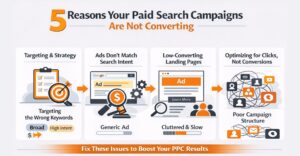
5 Reasons Your Paid Search Campaigns Are Not Converting
From our experience managing paid search campaigns across different industries, most conversion issues do not come from budget, but from misalignment between key components of the campaign.
Traffic may be coming in, but users do not take action due to mismatched intent, weak messaging, or poor user experience. Below are the most common issues we see when auditing underperforming campaigns—and how they impact results.
Targeting the Wrong Keywords
Keyword strategy defines the direction of your entire campaign, and it is often where we find the biggest inefficiencies. In many accounts we audit, teams allocate a large portion of the budget to broad, high-volume keywords that drive traffic but lack clear intent. At the same time, they underinvest in high-intent keywords that signal readiness to convert, such as “pricing”, “book”, or service-specific queries.
In one campaign, we restructured the keyword strategy based on funnel intent—separating discovery, consideration, and conversion-stage keywords. This change increased conversion rate by over 35% while reducing cost per lead. When you focus on intent-driven keywords, you attract users who are more likely to convert and use your budget more efficiently.
Focusing on intent-based keywords leads to stronger conversion performance and more efficient spend.
Ads That Don’t Match Search Intent
Ad copy directly influences how users respond to your campaign. When messaging does not match what users are searching for, performance drops quickly. We often see ads that stay too generic or overly brand-focused, while users look for specific solutions, offers, or outcomes. This gap lowers click-through rate and reduces conversion potential.
When we align ad messaging tightly with keyword intent—highlighting clear benefits, pain points, or offers—click-through rate often increases significantly, in some cases by more than 2x. Strong ads reflect exactly what users want and give them a clear reason to take action.
Low-Converting Landing Pages
A click does not guarantee a result. Landing pages drive conversion decisions, and even small friction points can cause users to drop off.
We often see issues such as unclear messaging, lack of focus, slow loading speed, or too many distractions. When load time increases from 1 to 3 seconds, bounce probability rises by 32%, which directly hurts performance.
In one campaign, we revamped the landing page to better match ad messaging by clarifying the value proposition, strengthening the call-to-action, and adding trust signals. As a result, conversion rates increased by more than 25%.
A high-performing landing page guides users smoothly from click to action and removes any hesitation along the way.
Optimizing for Clicks Instead of Conversions
Many campaigns focus on driving clicks rather than results. While traffic increases, business outcomes do not improve. Without proper conversion tracking and optimization, platforms cannot identify and prioritize high-quality users. As a result, campaigns attract more visitors but fewer qualified leads.
When we shift campaigns to conversion-focused bidding strategies, we usually see clear improvements in both lead quality and conversion volume—often by 15–25%. When you optimize for conversions, you align campaign performance with actual business goals instead of surface-level metrics.
Poor Campaign Structure & Budget Allocation
Campaign structure determines how effectively you can control performance and scale results. In many accounts, we see mixed keyword intent within the same ad groups. This setup makes it difficult to control messaging, analyze performance, or allocate budget efficiently.
When we restructure campaigns by intent and align keywords, ads, and landing pages more tightly, performance becomes easier to manage and optimize. In one project, this approach helped us shift budget toward high-performing segments and significantly improve overall ROI. A clear structure gives you better control, clearer insights, and a stronger foundation for scaling.
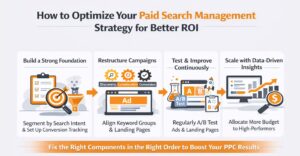
How to Optimize Your Paid Search Management Strategy for Better ROI
From our experience, improving paid search performance does not come from isolated tweaks. It comes from fixing the right components in the right order. Below is the exact approach we use when auditing and optimizing campaigns to improve conversion rate and ROI.
Build a Strong Foundation with Search Intent and Conversion Tracking
Start by defining search intent clearly. Do not group all keywords together. Instead, segment them based on intent:
- Discovery: informational queries (e.g., “what is…”, “how to…”)
- Consideration: comparison queries (e.g., “best”, “top”, “review”)
- Conversion: high-intent queries (e.g., “pricing”, “book”, “service near me”)
Then build campaigns around these intent groups so you can control messaging and budget more effectively.
At the same time, set up proper conversion tracking. Do not just track form submissions. Track the full funnel:
- Form submissions/leads
- Qualified leads (if available via CRM)
- Key actions (calls, bookings, downloads)
In one of our projects, simply fixing conversion tracking (from basic form tracking to qualified lead tracking) completely changed how the algorithm optimized—and improved lead quality significantly within weeks.
Restructure Campaigns and Align Ads with Landing Pages
Do not run campaigns with mixed intent in the same ad group. Structure them tightly:
- One intent = one campaign or ad group
- One keyword theme = one message
- One message = one aligned landing page
When someone clicks on an ad, they should see the same message again on the landing page—same offer, same angle, same expectation.
In practice, when we restructure campaigns this way, both Quality Score and conversion rate improve because the entire journey feels consistent and relevant.
Continuously Test and Improve Ads and Landing Pages
Do not assume your first version will work. Always test.
For ads:
- Test different headlines (pain point vs benefit vs offer)
- Test different angles (price, outcome, urgency)
For landing pages:
- Test headline clarity
- Test call-to-action placement
- Test content length and structure
Run structured A/B tests, not random changes. Change one variable at a time and let data guide decisions. In our experience, consistent testing often drives 10–30% improvement in conversion rate over time.
Use Data to Scale and Refresh Campaigns Effectively
Do not scale everything. Scale what is already working.
Identify:
- High-converting keywords
- High-performing ads
- Landing pages with strong conversion rates
Allocate more budget to these segments first.
At the same time, refresh underperforming areas:
- Rewrite ad copy when CTR drops
- Update landing pages when the conversion rate plateaus
In one campaign, we scaled only the top 20% performing keywords and paused the rest. This alone improved overall ROI while keeping spend stable.
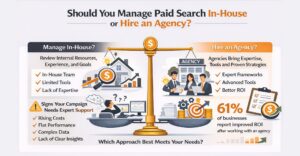
Should You Manage Paid Search In-House or Hire an Agency?
Choosing the right approach depends on your internal resources, experience, and growth goals. A clear understanding of your current performance helps you decide whether to manage campaigns internally or seek expert support.
Signs Your Campaign Needs Expert Support
Rising costs and stable performance indicate missed opportunities for optimization. Complex data and unclear insights make it difficult to improve results without a structured approach. Expert support helps bring clarity and direction.
What an Agency Can Help You Improve
Agencies provide proven frameworks, advanced tools, and hands-on experience. They focus on strategy, execution, and continuous optimization.
Around 61% of businesses report improved ROI after working with an agency, which shows the impact of expert support.
FAQs About Paid Search Management
What is paid search management?
Paid search management is the process of managing and optimizing search advertising campaigns to drive measurable business results.
Why is my paid search campaign not converting?
Common causes include misaligned keywords, unclear ad messaging, and landing pages that do not effectively guide users toward action.
How much budget do I need to start paid search?
Budget depends on your industry and competition. Businesses typically start with a sufficient budget to collect meaningful data and refine performance.
How long does it take to see results from paid search?
Paid search campaigns can generate early results within days. Most campaigns reach stable performance after 2 to 4 weeks of optimization.
What is a good conversion rate for paid search campaigns?
The average conversion rate is around 6%, while well-optimized campaigns often achieve 8% or higher, depending on the industry.
Conclusion:
Paid search management delivers strong results when built on a solid foundation. A strategy driven by search intent, structured campaigns, and accurate data creates consistent and scalable growth. When you focus on the right elements, you unlock the full potential of paid search and grow your campaigns with confidence
If you want to identify what’s limiting your performance and scale more efficiently, explore how Golden Owl Digital’s paid ads services approach campaign optimization.